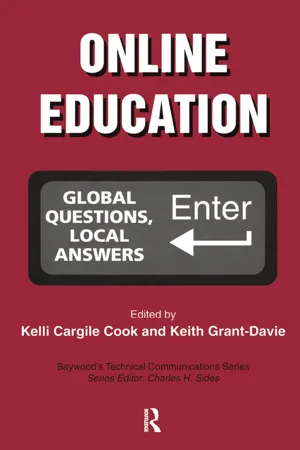
In "Online Education: Global Questions, Local Answers", 24 college educators focus on the most important questions to be addressed by all scholar-teachers and administrators committed to developing high-quality online education programs. We describe these questions as "global" because they transcend the particular situations of individual institutions. They are questions that everyone involved in online education needs to address: What are the issues to consider when first developing and then sustaining an online education program? How do we create interactive, pedagogically sound online courses and classroom communities? How should we monitor and assess the quality of online courses and programs? And how should recent developments and innovations in online education cause us to reexamine our roles and responsibilities as educators in technical communication?While these global questions affect all of us in one way or another, they demand different local answers, such as those presented by the contributors to this text. Readers will need to consider which of these local answers might apply to their own situations and how these answers might need to be adapted to reflect the particular needs of their own institutions.
- 264 pages
- English
- ePUB (mobile friendly)
- Available on iOS & Android
eBook - ePub
About this book
Information
SECTION 1
How Do We Create and Sustain Online Programs and Courses?
CHAPTER 1
Applying Technical Communication Theory to the Design of Online Education
Marjorie T. Davis
Whether you are talking about education in colleges or corporations, the trend toward online education is very strong and getting stronger. As technologies improve and become more affordable, schools and businesses are taking up the challenge to offer learning in electronic, nontraditional modes. The second study of distance education at postsecondary institutions conducted by the National Center for Education Statistics (data gathered 1997–98) reported that 78% of public four-year colleges offered at least some distance education courses, enrolling more than 1.6 million students [1]. The magazine Business Week predicted in the fall of 1999 that the number of people taking courses online would increase to 2.23 million by 2002 and would constitute about 15% of all higher education enrollments [2]. Businesses have long since surpassed colleges and universities in the amount of money spent on training and education. In a benchmarking study in 1999 by the American Society for Training and Development (ASTD), predictions were that about 27% of business training of all types would be delivered using learning technologies [3]. It’s clear that online education is a booming business.
OPPORTUNITIES FOR TECHNICAL COMMUNICATORS
This strong growth in online education provides new opportunities for technical communicators. Businesses need people with online education skills to develop and run their extensive training programs, and colleges and universities need people with both content knowledge and online education knowledge in order to develop programs. The opportunities are there for those who want to develop online education systems for industries and for those who want to lead in academic online education efforts. While this chapter applies to both industry and academe, the primary emphasis is on the role of technical communication faculty in colleges and universities offering two-year, four-year, and graduate courses or degree programs. Its thesis is that technical communicators should accept the challenge to apply what they know to the development of online education because they are uniquely positioned to provide leadership to schools and companies who are designing instruction for online delivery. They have mastered the important concepts of audience, purpose, persona, and usability; they have the knowledge of the technology for online delivery (or can acquire it easily); they have a strong collaborative work ethic and experience in project management; and they usually have the strength in instructional design to create effective online learning. Applying the theories of technical communication to the design and delivery of online education—especially within the field of technical communication—can be a significant service to the department, to the school or company, and most importantly to the students. As schools or industries venture into the online education environment, they can benefit from the significant expertise and knowledge of technical communicators.
To assist technical communication instructors in moving toward leadership in online education, this chapter presents the theories from technical communication that may be profitably applied to the design of online learning programs. This theoretical application demonstrates that technical communicators are not only qualified to develop online education within their own specialties, but, through this knowledge, are also capable of leading and assisting others as they develop online learning programs. In the sections that follow, I’ll discuss seven key knowledge domains of technical communicators that relate specifically to developing online education. From these knowledge domains arise both questions necessary for online program development and specific, local answers to these questions.
My own experience in developing online education comes from having helped start the first online degree program at Mercer University, the Master of Science in Technical Communication Management, offered entirely by online learning since 1996 [4]. For this reason, throughout this chapter, I emphasize program development, not course development. In most cases, providing a single course online is not a cost-effective endeavor in terms of time, effort, and technology. If students are to be attracted to online education, they must be able to derive substantial benefit from it—such as completing a degree or certificate. Further, the assumption is that these courses will be offered for credit from an accredited institution, and that they will be subject to evaluation by accreditation agencies. A further assumption is that the online learners will be truly adults—usually those with some work experience and enough maturity to be self-directed learners.
TECHNICAL COMMUNICATION KNOWLEDGE APPLIED TO ONLINE EDUCATION
The diversity of knowledge required to teach technical communication provides a strong foundation for planning and delivering education online. The process of teaching and learning is always demanding, but when the element of online education is introduced, the cognitive demands on the teacher increase exponentially. As teachers, we all have good skills in research, analysis, and creation of coherent knowledge. When we initially begin to plan education for online delivery, however, we may at first feel overwhelmed with so many new design tasks. Unlike teachers in many other disciplines, however, technical communicators have a strong knowledge base that will provide excellent strategies for designing online education. This knowledge includes the following areas and their related knowledge domains:
• The broad dimensions of rhetoric as applied to all aspects of communication but especially the analysis of audience and purpose;
• The understanding of an iterative design process that includes prototype development and testing for usability;
• Familiarity with a broad range of tool technologies, along with a willingness to experiment and learn more; and
• An understanding of business environments involving collaboration, marketing, and project management.
The rest of this section explores how technical communicators can apply these key knowledge domains to online education and explains how they can use these domains to overcome its challenges.
Analyzing Audiences
The importance of the audience in any communication has been recognized since Aristotle’s days. While modern rhetoricians have extended the theory and its applications, the basic principles are commonly known and used by technical communicators. Audience analysis is one of the strengths of skilled technical communicators, and this strength provides a solid foundation for planning education or training programs.
One of the first tasks that a program planner must do is to analyze the complex audiences involved in designing education for online delivery. This analysis is different from planning a course for in-house delivery in a number of ways, but especially because of the wider distribution of the materials. The audience will almost certainly be much larger and more diverse than students sitting in a physical classroom. Audiences who must be considered include the following:
• Local audiences—colleagues and administrators within one’s own department, school, or company who will need to approve the programs;
• Distance audiences—the target audience of students or customers who will want to take the online education programs;
• Employers of the graduates or employees who will authorize tuition reimbursements or accept the college credentials;
• The competitors for the target audience—all those schools and corporate entities who are offering learning online already;
• Accrediting agencies who will evaluate the educational product; and
• Peers in the technical communication community who will evaluate the quality of the content, the educational process, and its products.
One of the best tools for performing complex audience analyses, the egocentric audience analysis chart, was developed by Mathes and Stevenson1 and widely replicated in more recent technical communication texts [5]. Using the egocentric audience analysis chart will help technical communicators to identify the complex audience that their educational planning must address, whether for their own programs or for other programs they may be developing.
First, audiences must be identified in broad enough terms to include not only those to whom we are delivering our educational product but also those on the periphery. In writing to request approval of a new online education proposal in technical communication, for example, the audience must include not only the department chair and dean of the college but all those stakeholders who have opinions about online education and will have the opportunity to vote aye or nay. In a company setting, the audience analysis must identify not only the learners but also the many internal competitors and potential allies for the online education product. Using the egocentric audience analysis chart provides a visual representation to help keep all those audiences in mind.
Second, the planning must carefully and specifically describe the target audience. Is the program going to serve those with degrees in other fields who wish to enter the field of technical communication? Those who are already in the profession and need to acquire more advanced skills? Those who are seeking the PhD in order to teach or to lead corporate units? Are you targeting traditional-age students who wish to take asynchronous courses as a convenience, or nontraditional adults who do not wish to give up jobs and family life to complete a degree? Carefully and specifically describing the market niche will help to define and delineate the boundaries of the program proposal; additionally, it will help in writing the mission and purpose of the program.
Third, the audiences must include employers, parents, etc., who will evaluate the benefits of the knowledge gained in the online education program. In some cases the cost of tuition in online education may be less than the cost of travel, lodging, and lost productivity for students or employees who now attend educational programs onsite. The program must be prepared to address any concerns of these audiences about the credibility of the online educational offerings and the applicability of the learning objectives.
Fourth, the audiences include competitors—those who are already engaged in online education. With every year that passes, more and more technical communication programs are beginning to offer courses, certificates, or degrees online. This accessibility to a number of education providers means that competition is no longer limited to the 100-mile driving radius of your campus. A separate audience chart of competing programs should help further to determine the target audience and to focus on the benefits the program must provide in order to be competitive.
Finally, the audience analysis should include those external audiences who will judge the value of the program. Every college and university must answer to boards of trustees, state regulating bodies, and regional accrediting agencies; a few have professional accreditation boards who must be considered. If you are planning to submit your program for accreditation, keep that audience in mind as you begin to design the program. Additionally, colleagues beyond your own campus will evaluate the quality of programs as they advise students or employers about the value of the degree program.
No single program can accomplish all the goals that all these audiences might wish. A well-considered audience analysis, however, can help to determine exactly whom you are trying to reach as you plan the program. Eaton’s chapter, which follows this one, provides additional information about learners at a distance.
Analyzing Purposes
Once the complex audience analysis is completed, the statement of purpose or mission statement must be developed. Universities or industries may want to embark on online learning for a multitude of complex, often poorly defined, reasons. Many of these may be based on false assumptions. For example, a university chief academic officer may believe that online learning will be a cheap way to increase enrollments and revenues, seeing visions of the masses enrolling in courses unhindered by the pesky limitations of classroom size and concurrent time zones. In a recent survey of faculty from all disciplines who deliver instruction online, “forty-one percent of the respondents agreed with the statement that a primary motive behind online education was profit” [6, p. 6]. Perhaps companies are not as idealistic about financial returns as are universities; within the corporate setting, 44% of respondents recognized “the perception of high cost” as an obstacle to Web-based learning [7, p. 14]. (For additional discussions of the economics of online education, see Cargile Cook’s and Faber and Johnson-Eilola’s chapters later in this book.) From my experience and that of other colleagues, it should be abundantly clear that the profit motive is not a legitimate purpose for engaging in online education—it just won’t happen. Online delivery will likely cost more than you will predict in your planning in terms of time, effort, and money. It’s important to know exactly why you are committed to developing online education programs, and writing a clear purpose statement helps.
Another false assumption I have heard expressed is that a university or a corporation can “buy the best” world-renowned scholar, premiere in his or her field, who will be hired to develop the content, while lesser beings can do the daily work of grading quizzes and meeting with students who are having problems2 [8]. Again, building a reputation on a big-name scholar will not, in my opinion, provide the kind of content your audiences want and need, nor will it meet the ongoing demands of maintaining a program. The same kind of vision was predicted for educational television several decades ago. If the mass media/broadcast mode could have worked, the ubiquitous television technology would have accomplished it. The truth is that learners of all kinds want a more personalized, customized, interactive learning experienc...
Table of contents
- Cover
- Title Page
- Copyright Page
- Table of Contents
- Introduction
- Section 1: How do we Create and Sustain Online Programs and Courses?
- Section 2: How do we Create Interactive, Pedagogically Sound Online Courses And Classroom Communities?
- Section 3: How Should we Monitor and Assess the Quality of Online Courses And Programs?
- Section 4: How is Online Education Challenging Our Assumptions?
- Contributors
- Index
Trusted by 375,005 students
Access to over 1.5 million titles for a fair monthly price.
Study more efficiently using our study tools.
Frequently asked questions
Yes, you can cancel anytime from the Subscription tab in your account settings on the Perlego website. Your subscription will stay active until the end of your current billing period. Learn how to cancel your subscription
No, books cannot be downloaded as external files, such as PDFs, for use outside of Perlego. However, you can download books within the Perlego app for offline reading on mobile or tablet. Learn how to download books offline
Perlego offers two plans: Essential and Complete
- Essential is ideal for learners and professionals who enjoy exploring a wide range of subjects. Access the Essential Library with 800,000+ trusted titles and best-sellers across business, personal growth, and the humanities. Includes unlimited reading time and Standard Read Aloud voice.
- Complete: Perfect for advanced learners and researchers needing full, unrestricted access. Unlock 1.5M+ books across hundreds of subjects, including academic and specialized titles. The Complete Plan also includes advanced features like Premium Read Aloud and Research Assistant.
We are an online textbook subscription service, where you can get access to an entire online library for less than the price of a single book per month. With over 1.5 million books across 990+ topics, we’ve got you covered! Learn about our mission
Look out for the read-aloud symbol on your next book to see if you can listen to it. The read-aloud tool reads text aloud for you, highlighting the text as it is being read. You can pause it, speed it up and slow it down. Learn more about Read Aloud
Yes! You can use the Perlego app on both iOS and Android devices to read anytime, anywhere — even offline. Perfect for commutes or when you’re on the go.
Please note we cannot support devices running on iOS 13 and Android 7 or earlier. Learn more about using the app
Please note we cannot support devices running on iOS 13 and Android 7 or earlier. Learn more about using the app
Yes, you can access Online Education by Kelli Cargile Cook,Keith Grant-Davis in PDF and/or ePUB format, as well as other popular books in Education & Education Administration. We have over 1.5 million books available in our catalogue for you to explore.