eBook - ePub
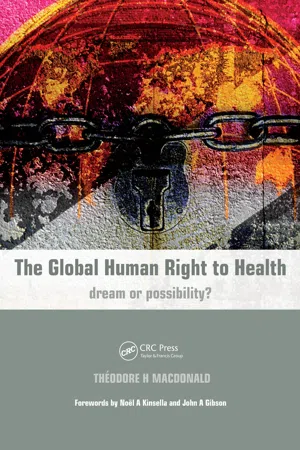
The Global Human Right to Health
Dream or Possibility?
- 248 pages
- English
- ePUB (mobile friendly)
- Available on iOS & Android
eBook - ePub
About this book
This work includes forewords by Senator Noel A Kinsella and John A Gibson, respectively Speaker, Canadian Senate; Barrister at Law and Principal, International Refugee Consulting. This is a book based on what the Charter of the UN states about health as a basic human right. General readers will find a refreshing, up-to-date account of why these issues are so crucial, while professionals will find the cogent epidemiological analyses needed to inform research efforts. The book argues that the major causes of ill-health are not bacteria and viruses, or even war and natural disasters, but poverty. If we could solve the immensely complex problems of global inequities in wealth, the health inequities would largely vanish. The issue is not a simple one. This book sets out, among other things, to break down the communication barriers between the 'professionals' (doctors, economists and international bankers) and the ordinary person who looks with dismay at international injustice but feels totally inadequate in the face of it. The book argues that neoliberal approaches to global finance and international trade, which are inextricably linked to the looming environmental crisis, are not the only way open to us, and suggests alternatives. Above all, it offers hope and a useful role for all of us in solving the problems. Theodore H MacDonald's previous books have won international acclaim. To this new title he brings to bear the fruits of years of experience as a medical doctor, teacher and researcher in some of the poorest countries in the world. This book is provocative and will inspire informed action on the part of all of us. "The passion, conviction and wealth of knowledge of this work's author are evident. His ability as a communicator in conjunction with a tempered expertise held by few enables him to identify, analyze and provide his reflection on the right to health and its relation to global economics. The content and style of the writing reflects MacDonald's impressive experiential background. Theodore Macdonald is known internationally as a leader in the promotion of the human right to health. Not only does this work have great heuristic value, it also serves as an example of how the efforts of one remarkable individual can address the concerns of millions." - Noel A Kinsella, in his Foreword. "Optimistic, clear and concise. [The book] greatly informs a lay reader like myself. Arguments are invariably backed up by hard empirical data drawn from a range of authoritative sources. [This book] significantly adds to the understanding of health as a fundamental human right, the content of that right and what must be done to ensure that it can become a reality for the millions who presently lack even an acceptable standard of primary health care. The reader is left with a clear message; unless we evaluate alternatives to existing structures to bring about qualitative change in health outcomes in the developing world, environmental disaster fuelled by war and international chaos is our probable destiny. I am honoured to have been asked to write this forward and enthusiastically recommend it to anyone with an interest in the future of mankind." - John A Gibson, in his Foreword.
Information
Chapter 1
Human rights: the UN’s mandate
The Millennium Development Goals
The expression ‘human rights’ only became widely used once it was enshrined in the United Nations (UN) Charter back in 1945. And in those first heady days, although the challenges facing human rights were recognised as great, at least the mechanisms seemed to have been put in place to promote and sustain human rights globally. All of this was cause for optimism indeed. But in the intervening years much of the hope, commitment and idealism drained away, as the UN seemed to lose power and influence and itself fall prey to infighting and the intrusion of influences designed to protect and further the interests of developed nations at increasing expense to less developed nations.
Much of the UN’s effectiveness in defending global human rights naturally depends on its Secretary General, and we are currently fortunate in having Kofi Annan as a leader who has been insistent on the primacy of human rights and equally vehement in declaring that a precursor to global human rights has to be the eradiation of poverty.
In September 2000, at the United Nations Millennium Summit in Geneva, a list of eight ‘Millennium Development Goals’ (MDGs) was finally agreed by 189 national heads of state (subsequently increased to 190). The Summit also agreed that the year 2015 should be the deadline for the fulfilment of these goals. The MDGs, which are intended to be ‘universal’ – that is, to apply globally and without exception – are as follows:
- 1 the eradication of extreme poverty
- 2 the achievement of universal primary education
- 3 the promotion of gender equality and the empowerment of women
- 4 the reduction of child mortality
- 5 the improvement of maternal health
- 6 the combating of HIV/AIDS, malaria, tuberculosis and other diseases
- 7 the establishment of environmental sustainability worldwide
- 8 the development of a global partnership for development.
At one of the subsequent meetings to consider progress towards the MDGs (in New York on 9 September 2005), Kofi Annan made the following statement:
We will have time to reach the Millennium Development Goals – worldwide and in most, or even all, individual countries – but only if we break with business as usual action across the entire decade between now and the deadline. It takes time to train the teachers, nurses and engineers, to build the roads, schools and hospitals, and to grow the small and large businesses able to create the jobs and income needed. So we must start now. And we must more than double global development assistance over the next few years. Nothing less will help to achieve the Goals.1
Why the MDGs are a minimal basis
It will be readily apparent to the reader that these goals are a minimum basis for creating a global context for equity in health and other human rights. If we achieve the MDGs, then the human rights defined in the UN Charter will be a possibility. If we do not, then the idea of global human rights must remain a dream. It is quite simple.
Already we can see plenty of room for manoeuvre, prevarication and delay by people anxious to avoid compliance. For instance, can we secure agreement on what is meant by ‘extreme poverty’ in MDG 1? How much ‘promotion’ should there be in MDG 3 and how will it be assessed? By how much would child mortality need to be reduced in order to satisfy MDG 4? And so on. However, if the relevant committees were satisfied by the target date that the goals had been met, we would be in a position to create transnational mechanisms for establishing and sustaining global equity in human rights.
Yet achievement of these goals is already threatened by two main factors:
- 1 unacceptable delays in implementation on the ground
- 2 resistance to the MDGs in the developed world.
Thus although some significant progress is being made towards meeting some of the targets in some of the affected countries, in many other parts of the world progress has been slow, patchy or even non-existent. This is due to a large number of often local factors which will be discussed in greater detail in subsequent chapters. To assist local implementation of the goals, a series of 18 targets was also drawn up so that the international community could recognise whether appropriate progress was being made in particular regions, and give appropriate advice if required. Factors that impede such delicate arrangements include wars, internal corruption and, above all, the vastly increasing impact of transnational corporate interests protecting their own investments in the developing world. For instance, in sub-Saharan Africa, the number of people living in extreme poverty is greater now (in 2006) than it was in 1990.
Much more worrying still is resistance to the MDGs by the developed nations at the highest levels. Much of the commentary in this book deals with this issue, as it is a very real threat. For now, suffice it to say that the USA has led the developed world in financial and military terms since the 1940s, and it was under its aegis that such organisations as the World Bank, the International Monetary Fund (IMF) and the World Trade Organization (WTO) came into being. Although they fulfil their global responsibilities as UN agencies, this book shows quite clearly that these and similar bodies are also assiduous in promoting and protecting US corporate interests. Likewise, US governmental representatives to the UN are serving two masters – their national interests and the global aims of the UN.
As the author points out throughout this book, this does not vitiate the role of the USA in the UN. The USA is a complex and energetic civilisation with much to offer in the realm of human rights. The less developed countries (LDCs) and progressive international thinking have valuable support in the USA. However, in 2005 President Bush appointed John Bolten as ‘acting’ US Ambassador to the UN while awaiting formal approval of the appointment some time after the US mid-term elections. However, it now appears that President Bush may not get his way on this due to those election results, and Mr Bolten will not be given the post. In the meantime though, John Bolten has seemed intent on representing US corporate interests in the LDCs which run counter to the MDGs in some respects. These issues are dealt with in greater detail in subsequent chapters, but Bolten has been hostile to both the present administration of the UN and its MDGs.
It is important to mention this here, because Bolten’s impact at the 2005 MDG summit in New York does not augur well for the prospects of either the UN itself or its MDGs. A month prior to that summit, in August 2005, John Bolten dropped his first bombshell when he submitted to the committee that was drawing up the 2005 UN Report a list of 750 alterations which he wanted made to the text – itself only 39 pages long! Outstanding among his many scathing criticisms was that he wanted all 14 references to the MDGs to be deleted. The goals that Bolten wanted removed included reducing by half the number of people living on less than US$ 1.00 per day by 2015. That number, by the way, was 1.3 billion people in 2005. It is true that, although the USA had not signed the agreement, people had been under the impression that the Bush administration would not actually oppose them – until John Bolten came on board to do the President’s will.
This does not bode well for the project as far as global human rights are concerned. In this author’s view, we must be both informed about the UN and ready to defend it as an institution. Only from such a position of security can it confidently deliver on its mandate to, for instance, order the recruitment of international peace-keeping forces in conflict zones, work effectively to prevent such evils as the trafficking of women and children for prostitution, organise international control of transnational corporations and their cartels, and so on.
As the reader makes their way through this book, they should keep in mind the unique aspects of the MDGs, and their cruciality in establishing global equity in human rights. Some of their unique features include, or strongly imply, the following.
- The MDGs constitute a compact between the world’s major economic players and those in less developed nations. While the latter are called upon to improve policies and governance, and to increase accountability to their own citizens, wealthy developed countries are pledged to provide resources when called upon by the UN to do so. Because commitment to achieving the goals comes from the highest political levels this means that, for the first time in history, governments are committed individually to the goals as part of their national policy programmes. And this must include the trade and finance ministers from the powerful nations. These individuals, both figuratively and literally, hold the world’s purse-strings. In the same way, such major international financial institutions as the World Bank, the IMF, regional development banks and the WTO have explicitly agreed to be accountable for achieving the goals.
- Never before has there been so much prosperity. For instance, the hundreds of billions of dollars that are being squandered on military adventures everywhere from the Republic of the Congo to Iraq have served to put things in perspective – and to remind us that we would need no more than US$ 50 billion each year to meet the goals. This could be mediated as aid. In 2003, about US$ 900 billion were invested in arms by governments. Consider also that the wealthy nations grant agricultural subsidies of about US$ 300 billion per year. At a purely financial level, then, we are not talking about much money, but about huge shifts in mindset.
- It is essential that progress in meeting the MDGs is monitored. That is, the goals cannot merely be idealistic statements. Precise monitoring mechanisms have been put in place by insisting that each government reports at specific time intervals on the millennium goals, and that the Secretary General of the UN reports once a year to the General Assembly of the UN, thus putting pressure on governments to maintain the highest standards. More than 60 such country reports (out of 190) have already been produced at the national level.
- There are no insurmountable obstacles to achieving these goals, only psychological ones. That does not make them easy to overcome, but any failure to meet the goals can never be blamed on lack of material resources. As this author argues in the Preface and throughout this book, the goals may be called ‘Millennium’ Development Goals, but they are more than that – they are ‘Minimum’ Development Goals. The bar cannot drop below this standard, and the MDGs constitute minimal bases required to finally achieve global equity in human rights.
To quote Millennium Campaign News:2
The Goals cover the range of key development issues and are rooted in a human rights framework. Freedom, equality, solidarity, tolerance, respect for nature and shared responsibility are at the heart of the Millennium Declaration. The eight Goals are by nature inter-linked. Success or failure on any one Goal will affect efforts to achieve all the others. And at their core, the Goals are about people’s lives. There is often a tendency to measure success in the aggregate – for example, how many more children are in school this year, and how many more women survived childbirth in 2003. This can give us a sense of how well or badly we are doing, but the most important question to bear in mind is this: how have people’s real lives been affected by our efforts to achieve the Goals? It is important to know how each individual, each region and each sub-region is affected as we strive to reach the Goals by 2015.
Given the level of prosperity in the First World now in 2006, we can easily pay for all the MDGs, and we also have at our disposal all of the technical expertise necessary to set up any infrastructure contingent upon them, such as water reticulation systems, etc. However, if we let things continue to slide as they are doing, the MDGs will not be realised and therefore neither will the UN Charter provisions for human rights.
As stated in the Preface, this author’s argument is that the real and overriding issue is to find an alternative method of global finance to that espoused by neoliberal economic theory. There are alternatives to consider, as discussed in the final chapter.
References
1 Annan K. Statement by UN Secretary General Kofi A Annan at the Millennium Development Goals Progress Meeting, UN, New York, 9 September 2005; www.un.org/millenniumgoals/index.asp (accessed 2 June 2006).
2 Millennium Campaign (2005) Voices Against Poverty; www.millenniumcampaign.org/site/pp.asp?c-grKVLZNLEs (accessed 2 June 2006).
Chapter 2
A bird’s-eye view of global finance and human rights
The players
The reader is about to enter into a discussion about issues that in some respects resemble a Russian novel in its complexity of plots, counterplots and characters. Of course, in this context not all of the ‘characters’ are individual people, but large institutions. Some are household words – the UN, UNESCO, UNICEF and WHO – and of these some are known by name but not widely understood. These and similar institutions operate through various procedures which tend to go under the sobriquet of esoteric acronyms (SAPs, TRIPS, GATT, etc.). Therefore, let us first introduce a few of these pivotal entities.
The United Nations (UN) and its Charter
During the early months of 1945, as World War Two was drawing to a close, representatives of 50 nations met in San Francisco to establish the UN. As the reader probably knows, the UN was established as an international organisation to promote international security, cooperation and peace. The impetus for its establishment was to prevent the horror of internecine strife, from which the world was just emerging, and to produce a global body that would be more effective than the pre-war League of Nations. Its headquarters is now in New York.
Fundamental to world peace is, of course, the concept of human rights, and this was the focus of the San Francisco meeting referred to above. At that conference the 50 nations adopted the UN Charter, a document which sets forth the UN’s goals, functions and responsibilities. Human rights have priority in the Charter right from the start. Article 1 of the Charter sta...
Table of contents
- Cover
- Title Page
- Copyright Page
- Contents
- Dedication Page
- Foreword
- Foreword
- Preface
- Acknowledgments
- 1 Human rights: the UN’s mandate
- 2 A bird’s-eye view of global finance and human rights
- 3 The global impact on human rights of UN agencies
- 4 Worsening global equity of access to safe water
- 5 Inequalities in global wealth distribution
- 6 Poverty and primary healthcare
- 7 Transnational corporations: instruments for global control
- 8 Gender equality as a basic right to health
- 9 In defence of children and their rights
- 10 Literacy and education
- 11 Impact of the globalisation of HIV/AIDS
- 12 Malaria, tuberculosis and other infectious diseases
- 13 The worldwide exclusion of minorities
- 14 Saving the human race: environmental sustainability
- 15 Global right to health: dream or possibility?
- Index
Trusted by 375,005 students
Access to over 1.5 million titles for a fair monthly price.
Study more efficiently using our study tools.
Frequently asked questions
Yes, you can cancel anytime from the Subscription tab in your account settings on the Perlego website. Your subscription will stay active until the end of your current billing period. Learn how to cancel your subscription
No, books cannot be downloaded as external files, such as PDFs, for use outside of Perlego. However, you can download books within the Perlego app for offline reading on mobile or tablet. Learn how to download books offline
Perlego offers two plans: Essential and Complete
- Essential is ideal for learners and professionals who enjoy exploring a wide range of subjects. Access the Essential Library with 800,000+ trusted titles and best-sellers across business, personal growth, and the humanities. Includes unlimited reading time and Standard Read Aloud voice.
- Complete: Perfect for advanced learners and researchers needing full, unrestricted access. Unlock 1.5M+ books across hundreds of subjects, including academic and specialized titles. The Complete Plan also includes advanced features like Premium Read Aloud and Research Assistant.
We are an online textbook subscription service, where you can get access to an entire online library for less than the price of a single book per month. With over 1.5 million books across 990+ topics, we’ve got you covered! Learn about our mission
Look out for the read-aloud symbol on your next book to see if you can listen to it. The read-aloud tool reads text aloud for you, highlighting the text as it is being read. You can pause it, speed it up and slow it down. Learn more about Read Aloud
Yes! You can use the Perlego app on both iOS and Android devices to read anytime, anywhere — even offline. Perfect for commutes or when you’re on the go.
Please note we cannot support devices running on iOS 13 and Android 7 or earlier. Learn more about using the app
Please note we cannot support devices running on iOS 13 and Android 7 or earlier. Learn more about using the app
Yes, you can access The Global Human Right to Health by Theodore Macdonald,Richard Mayon-White in PDF and/or ePUB format, as well as other popular books in Politics & International Relations & Health Policy. We have over 1.5 million books available in our catalogue for you to explore.