Politics pervades every link in the food chain from the farm to the fork. It influences what foods we eat, how much they cost, what we know about them, and how safe they are. This book brings the point home by focusing on the vexing issue of dietary fat content - known to be a health menace but also an ingredient in many or most of our best-loved foods. Through this prism, Dr. Sims explores the politics of food assistance programmes (with a case study of the National School Lunch programme); agricultural policy (for example, the price premium paid to farmers for milk with high butterfat content); food content (with case studies of food labelling and the approval process for fat substitutes); and dietary change (with a case study of nutrition education programmes). The book concludes with consideration of the costs and benefits of government intervention and nonintervention in food policy from the supply side to the demand side and its consequences for human health (and happiness). "The Politics of Fat" shows how government policy affects not only breakfast, lunch and dinner, but also our between-meal snacks; explores the nexus of health policy and agricultural policy from price supports to trade policy; and is written in an accessible style enlivened by discussion-provoking case studies.
What’s political about food? my friends often ask.
Listen up. Almost everything about food is political.
—M. Burros*
This book describes the connection between federal policies and the foods we eat. Government-sponsored reports repeatedly warn us of the dangers of consuming foods high in fat. Yet for more than half a century, food and agricultural policies have been in place that favor the production and pricing of those foods that our health policies now recommend restricting. This imbalance of policies is further compounded by the fact that most people really like and prefer high-fat foods to low-fat fruits, vegetables, legumes, and grains.
Despite growing public awareness of the health dangers of high-fat diets, the amount of dietary fat consumed by Americans has only slightly decreased in recent years. Many believe that long-standing government policies have favored the production of high-fat foods, thus creating a situation where these less healthful foods are more plentiful and cheaper for consumers than their lower-fat counterparts. Others maintain, however, that it is our history and culture that are mainly responsible for our food choices, and that, government policies aside, we’ll continue to eat as we like. Indeed, research has demonstrated the physiological connection between dietary fat’s contribution to the flavor of foods and our “addiction” to fatty foods.
American consumers are increasingly confronted with a plethora of food choices. It is estimated that most modern supermarkets offer more than 20,000 different food items. Even though we face an almost overwhelming array of foods from which to choose, the assortment of different foods that we consume is often constrained by powerful influences on the food system—marketing orders, commodity price supports, regulations, laws, educational programs, even tax incentives—which act in concert to circumscribe the number and type of foods that are available to us at prices we can afford.
The Politics of Fat tells a fascinating story, based on the power of economics and the findings of science, all compounded by the pleasures associated with eating. Consumers have gotten the message: “Eat low-fat!” And the food industry is scrambling to meet market demand by creating new foods and novel ingredients, all subject to government’s regulatory approval. Yet current federal policies are often either working against consumer concerns and the potential marketplace response, lagging behind these influences, or ignoring them altogether.
The main purpose of this book is to examine whether current food policies have failed to keep pace either with the marketplace or with consumer concerns about diet and health, with the potential result the undermining of the health of Americans. A major question addressed by the book is whether federal policies have created an environment whereby health-promoting food choices are easier, or more difficult, to make. In fulfilling this purpose, we will also explain how government policies are operative at virtually every stage of the food system and show the interaction between the government and market forces in influencing consumers’ food choices.
Why Dietary Fat?
This book tells the fascinating tale of fat—the kind in food and the kind we eat, not the kind on our bodies. This is not a book about obesity or losing body fat, albeit dietary fat is certainly a major contributor to that condition. Dietary fat is, in fact, a symbolic representation of public policy in the arenas of science, health, economics, and consumer behavior. Dietary fat serves as a symbol of the “schizophrenia” within federal public health agencies and the dominance of agribusiness interests at the U.S. Department of Agriculture that promote production of high-fat foods on the one hand and dispense information that admonishes consumers not to eat “too much” dietary fat on the other. Further, the issues concerning dietary fat demonstrate the viability of the Advocacy Coalition Framework,1 a public policy analytical tool that describes the role of entrenched interests; the role of government bureaucrats as members of advocacy coalitions; and the role of scientific evidence, policy analysis, elections, and the media—all of which act in concert to alter the climate for reforming the status quo.
This chapter will discuss fat as a chemical component of our bodies and as a food ingredient. Further, we will show how dietary fat consumption has been implicated as a serious health risk. Because of dietary fat’s role in contributing to the risk of chronic disease, it has an underestimated impact on national economic costs and thus becomes a public policy issue.
Fat as Chemical—An Essential Physiological and Culinary Component
Lipids—or by their more familiar name, fats—are chemically a family of compounds that are soluble in organic solvents (like alcohol or ether) but are not soluble in water. (Think of an oil and vinegar salad dressing. The oil is not soluble in the water-based vinegar; upon standing, the two separate into distinct layers, with oil on top and vinegar on the bottom.) Technically, lipids include triglycerides (which most people think of as fats and oils), phospholipids (of which the emulsifier lecithin is one), and sterols (of which cholesterol is the best known). Further, fats are lipids that are solid at room temperature, while oils are liquid at room temperature.
Fats serve a variety of functions, both in our bodies and as a food ingredient.2 For the purposes of our discussion in this book, these functions have been divided into two main categories: (1) in our bodies, where the roles of fat are physiological or nutritional, and (2) as a food ingredient, where fat has a culinary role.
Physiological (Nutritional) Functions of Lipids
Triglycerides are the major form of fat in the body. Triglycerides in the body are used to store and supply energy, to protect and insulate body organs, and to aid in the absorption of fat-soluble vitamins. We require only a minute amount of fat, but our bodies cannot function properly without it.
Dietary fats supply more calories (the measure of energy value) per unit weight than any other nutrient. Lipids provide 9 calories per gram of weight, while carbohydrates and proteins supply 4 calories per gram, and alcohol provides 7. Another way to think of it—a tablespoon of oil supplies 124 calories, a tablespoon of sugar only 50. While one tablespoon of butter contains 11 grams of fat and has 100 calories, whole-wheat bread contains little fat, and one slice supplies 80 calories.
Fat is the body’s chief storage form for the energy from food when consumed in quantities not needed for immediate use. In addition, body fat is concentrated in certain places in the body primarily as “fat pads” to protect vital organs, such as the liver and kidneys. Some fatty acids from foods may be incorporated into cell membranes, where they may affect what enters the cell as well as control what is transported between and within cells.
Among all the different fats in our food supply, two have been labeled “essential” because they cannot be manufactured from other substances by the human body itself. These substances must be supplied and consumed “preformed” in the food fats we eat. These fatty acids are linoleic acid and alpha-linolenic acid, found mainly in plant seed oils and “fatty” fish, such as salmon, tuna, and sardines.
Dietary fats also serve to transport the fat-soluble vitamins—vitamins A, D, E, and K—throughout the body, thus making them available for various physiological purposes. Eating a small amount of visible fat or foods that contain fat is absolutely essential so that the body can use these vitamins efficiently. This premise applies regardless of whether these four vitamins are taken in the form of supplements or in foods.
Culinary Functions: Fat as Food Ingredient
Many foods naturally contain fats, with familiar fare like meats, dairy products, poultry, fish, nuts, and vegetable oils supplying most of the fats Americans eat. Whole grains and vegetables contain only small amounts of fats when not swimming in salad dressing or cooked in fat. Further, most fruits—with the exception of avocados, coconut, and olives—do not contain fat. Many food favorites hide their fat; fat is a necessary ingredient to make baked goods flaky and tender, and fat is used to give fried foods their crispy texture and familiar flavor. Grocery staples such as butter, margarine, shortening, and oil are almost all fat.
The properties fats impart to foods—their flavor, texture, and aroma—are what cause certain foods to be preferred and enjoyed. Many of the aromatic compounds that give foods their distinctive flavors are fat-soluble, and fat is the vehicle that carries these dissolved substances to the sensory cells in the mouth that discriminate taste and smell. Oil-based flavorings are often used in baking or in making candy. Heating spices in oil intensifies the flavors of an Indian curry or Mexican dish far more than simply adding them at the table. Thus, many highly flavorful foods are associated with a high fat content.
Fats in foods provide a wide variety of oral sensations. Food scientists use the term mouthfeel to describe the rich, smooth, creamy sensation that fat gives to many foods such as ice cream or custard. Dairy fat in ice cream contributes to the smoothness of the product by preventing the formation of large ice crystals.
Triglycerides and other lipid components in foods are responsible for the textures we associate with our food favorites. The most tender cuts of meat are usually also high in fat. The marbling of meat—where fat is interspersed within the muscle—contributes to its tenderness because the fat melts during the cooking process. In contrast, low-fat meats, such as flank steak or brisket, require special preparation techniques—such as marinating or slow, moist cooking—to ensure tenderness.
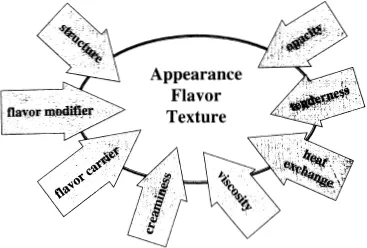
Figure 1.1Functions of Fats in Foods
Source: American Journal of Clinical Nutrition: 62, 1176S, November 1995.
Fats have specific functions in baked goods, such as pie crusts, cakes, cookies, and pastries, without which these products would not exist. Certain properties of fats in bakery goods are responsible for the sensation of freshness and moisture. In products such as cakes, fats help to produce a high, fine texture. When fats and sugar are “creamed” or mixed together (the first step in mixing many cake batters), fats trap tiny air bubbles that help the batter to rise. Fats also help keep doughs and batters from separating and falling, and fats coat the proteins in flour to make a tender or flaky product. Figure 1.1 illustrates the different functions of fats in foods.
Edible fats and oils are excellent cooking media. They can be heated to above 100°C to provide rapid cooking (without the steam associated with boiling water) and simultaneously impart surface texture (crispness) and flavor to fried food. This fact may explain, in part, why some foods offered in various “fast-food” franchises in the United States—such as “french fries”—are so popular with consumers.
Consumption of Dietary Fat
The relationship between human beings and the food they consume goes far beyond the animal instinct to eat. For people, appetite is not simply a physiological drive toward food but, rather, a complex set of physical, emotional, and cognitive stimuli that direct the response to food. Early species of Homo sapiens learned what foods were edible or poisonous, which tastes each food conveyed, which foods had to be “cooked” or treated in certain ways to make them palatable and chewable, and how to store foods so that nourishment would be available when no food was readily obtainable by hunting or crop cultivation.
Obesity researchers tell us that the human preference for dietary fat was probably inherited originally from our ancestors who survived as hunter–gatherers. When plant foods were unavailable, our ancestors relied on their internal fat stores or adipose tissue to get them through long periods of food deprivation. Thus, they naturally began to seek foods that contained greater amounts of dietary fat in their drive for basic survival because fats provide more than twice the amount of calories as an equal amount of carbohydrates.
Factors Influencing Food Choices
Those factors that influence how much and what kinds of food people choose to eat are displayed in Figure 1.2. In general, these two sets of factors can be further categorized as those external to the individual (and thus applicable to groups of people) and those that are idiosyncratic and specific to the individual. The outermost of the concentric circles is ringed by the terms food, agricultural, and trade policies, which, when abetted by technology, contribute most directly to what foods are available for consumption. These policies, in turn, are directly affected by consumer demand, in terms of both the quantity and quality of certain food products. It is here that the government exerts its most direct influence on food choices—that is, by influencing what foods are available for purchase and choice.
Most of us eat foods from a core group of about 100 basic food items, which account for 75 percent of our total food intake. We may think we buy—and report that we buy—foods for their sensory appearance, freshness, safety, nutritional quality, healthfulness, convenience, or price. Those factors undoubtedly affect our food purchases, but we are still constrained in our choices by the routines, habits, and associations that have surrounded our interactions with food throughout our lifetimes.
Group Influences
Early humans learned the joy of social interaction and the sharing of food as one of the experiences in which such interaction could take place. Certain foods began to be associated with certain desirable characteristics—for example, meat with strength. Equally, certain foods began to be associated with certain tribes or groups of human beings, usually based on those consumable items that were available and edible. This is also how certain religious beliefs came to be expressed through ceremonial rites involving the preparation and consumption of f...
Table of contents
Cover
Half Title
Title Page
Copyright Page
Dedication
Table of Contents
List of Tables and Figures
Preface
Acknowledgments
Part I. Overview and Approach
Part II. Public Policy in the Food System
Part III. Implementing Public Policy in the Food System
Part IV. Summary and Conclusions
Notes
Selected Bibliography
Index
About The Author
Trusted by 375,005 students
Access to over 1.5 million titles for a fair monthly price.
Study more efficiently using our study tools.
Frequently asked questions
Yes, you can cancel anytime from the Subscription tab in your account settings on the Perlego website. Your subscription will stay active until the end of your current billing period. Learn how to cancel your subscription
No, books cannot be downloaded as external files, such as PDFs, for use outside of Perlego. However, you can download books within the Perlego app for offline reading on mobile or tablet. Learn how to download books offline
Perlego offers two plans: Essential and Complete
Essential is ideal for learners and professionals who enjoy exploring a wide range of subjects. Access the Essential Library with 800,000+ trusted titles and best-sellers across business, personal growth, and the humanities. Includes unlimited reading time and Standard Read Aloud voice.
Complete: Perfect for advanced learners and researchers needing full, unrestricted access. Unlock 1.5M+ books across hundreds of subjects, including academic and specialized titles. The Complete Plan also includes advanced features like Premium Read Aloud and Research Assistant.
Both plans are available with monthly, semester, or annual billing cycles.
We are an online textbook subscription service, where you can get access to an entire online library for less than the price of a single book per month. With over 1.5 million books across 990+ topics, we’ve got you covered! Learn about our mission
Look out for the read-aloud symbol on your next book to see if you can listen to it. The read-aloud tool reads text aloud for you, highlighting the text as it is being read. You can pause it, speed it up and slow it down. Learn more about Read Aloud
Yes! You can use the Perlego app on both iOS and Android devices to read anytime, anywhere — even offline. Perfect for commutes or when you’re on the go. Please note we cannot support devices running on iOS 13 and Android 7 or earlier. Learn more about using the app
Yes, you can access The Politics of Fat by Laura S. Sims in PDF and/or ePUB format, as well as other popular books in Politics & International Relations & Literary Criticism. We have over 1.5 million books available in our catalogue for you to explore.