- 464 pages
- English
- ePUB (mobile friendly)
- Available on iOS & Android
eBook - ePub
Microelectronics
About this book
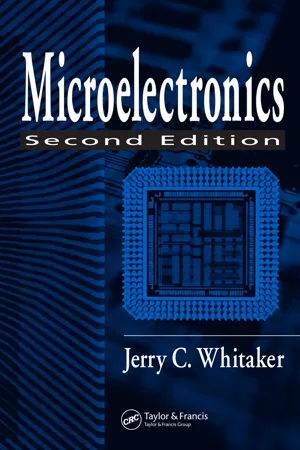
When it comes to electronics, demand grows as technology shrinks. From consumer and industrial markets to military and aerospace applications, the call is for more functionality in smaller and smaller devices. Culled from the second edition of the best-selling Electronics Handbook, Microelectronics, Second Edition presents a summary of the current state of microelectronics and its innovative directions.
This book focuses on the materials, devices, and applications of microelectronics technology. It details the IC design process and VLSI circuits, including gate arrays, programmable logic devices and arrays, parasitic capacitance, and transmission line delays. Coverage ranges from thermal properties and semiconductor materials to MOSFETs, digital logic families, memory devices, microprocessors, digital-to-analog and analog-to-digital converters, digital filters, and multichip module technology. Expert contributors discuss applications in machine vision, ad hoc networks, printing technologies, and data and optical storage systems. The book also includes defining terms, references, and suggestions for further reading. This edition features two new sections on fundamental properties and semiconductor devices.
With updated material and references in every chapter, Microelectronics, Second Edition is an essential reference for work with microelectronics, electronics, circuits, systems, semiconductors, logic design, and microprocessors.
Information
1
Semiconductor Materials
1.1 Introduction
1.2 Crystalline Structures
Basic Semiconductor Materials Groups • Three-Dimensional Crystal Lattice • Crystal Directions and Planes
1.3 Energy Bands and Related Semiconductor Parameters
Conduction and Valence Band • Direct Gap and Indirect Gap Semiconductors • Effective Masses of Carriers • Intrinsic Carrier Densities • Substitutional Dopants
1.4 Carrier Transport
Low Field Mobilities • Saturated Carrier Velocities
1.5 Crystalline Defects
Point Defects • Line Defects • Stacking Faults and Grain Boundaries • Unintentional Impurities • Surface Defects: The Reconstructed Surface
1.6 Summary
1.1 Introduction
A semiconductor material has a resistivity lying between that of a conductor and that of an insulator. In contrast to the granular materials used for resistors, however, a semiconductor establishes its conduction properties through a complex quantum mechanical behavior within a periodic array of semiconductor atoms, that is, within a crystalline structure. For appropriate atomic elements, the crystalline structure leads to a disallowed energy band between the energy level of electrons bound to the crystal’s atoms and the energy level of electrons free to move within the crystalline structure (i.e., not bound to an atom). This energy gap fundamentally impacts the mechanisms through which electrons associated with the crystal’s atoms can become free and serve as conduction electrons. The resistivity of a semiconductor is proportional to the free carrier density, and that density can be changed over a wide range by replacing a very small portion (about 1 in 106) of the base crystal’s atoms with different atomic species (doping atoms). The majority carrier density is largely pinned to the net dopant impurity density. By selectively changing the crystalline atoms within small regions of the crystal, a vast number of small regions of the crystal can be given different conductivities. In addition, some dopants establish the electron carrier density (free electron density), whereas others establish the hole carrier density (holes are the dual of electrons within semiconductors). In this manner, different types of semiconductor (n type with much higher electron carrier density than the hole density and p type with much higher hole carrier density than the electron carrier density) can be located in small but contacting regions within the crystal.
By applying electric fields appropriately, small regions of the semiconductor can be placed in a state in which all of the carriers (electron and hole) have been expelled by the electric field and that electric field sustained by the exposed dopant ions. This allows electric switching between a conducting state (with a settable resistivity) and a nonconducting state (with conductance vanishing as the carriers vanish).
This combination of localized regions with precisely controlled resistivity (dominated by electron conduction or by hole conduction) combined with the ability to electronically control the flow of the carriers (electrons and holes) leads to the semiconductors being the foundation for contemporary electronics. This foundation is particularly strong because a wide variety of atomic elements (and mixtures of atomic elements) can be used to tailor the semiconductor material to specific needs. The dominance of silicon semiconductor material in the electronics area (e.g., the very large-scale integrated (VLSI) digital electronics area) contrasts with the rich variety of semiconductor materials widely used in optoelectronics. In the latter case, the ability to adjust the bandgap to desired wavelengths of light has stimulated a vast number of optoelectronic components, based on a variety of technologies. Electronic components also provide a role for nonsilicon semiconductor technologies, particularly for very high bandwidth circuits that can take advantage of the higher speed capabilities of semiconductors using atomic elements similar to those used in optoelectronics. This rich interest in nonsilicon technologies will undoubtedly continue to grow, due to the rapidly advancing applications of optoelectronics, for the simple reason that silicon is not suitable for producing an efficient optical source.
1.2 Crystalline Structures
Basic Semiconductor Materials Groups
Most semiconductor materials are crystals created by atomic bonds through which the valence band of the atoms are filled with eight electrons through sharing of an electron from each of four nearest neighbor atoms. These materials include semiconductors composed of a single atomic species, with the basic atom having four electrons in its valence band (supplemented by covalent bonds to four neighboring atoms to complete the valence band). These elemental semiconductors, therefore, use atoms from group IV of the atomic chart. Other semiconductor materials are composed of two atoms, one from group N (N < 4) and the other from group M (M > 4) with N + M = 8, filling the valence bands with eight electrons. The major categories of semiconductor material are summarized in the following sections.
Elemental (IV–IV) Semiconductors
Elemental semiconductors consist of crystals composed of only a single atomic element from group IV of the periodic chart, that is...
Table of contents
- Cover
- Half Title
- Title Page
- Copyright Page
- Table of Contents
- 1 Semiconductor Materials
- 2 Thermal Properties
- 3 Semiconductors
- 4 Metal-Oxide-Semiconductor Field-Effect Transistor
- 5 Integrated Circuits
- 6 Integrated Circuit Design
- 7 Digital Logic Families
- 8 Memory Devices
- 9 Microprocessors
- 10 D/A and A/D Converters
- 11 Application-Specific Integrated Circuits
- 12 Digital Filters
- 13 Multichip Module Technology
- 14 Testing of Integrated Circuits
- 15 Semiconductor Failure Modes
- 16 Fundamental Computer Architecture
- 17 Software Design and Development
- 18 Neural Networks and Fuzzy Systems
- 19 Machine Vision
- 20 A Brief Survey of Speech Enhancement
- 21 Ad Hoc Networks
- 22 Network Communication
- 23 Printing Technologies and Systems
- 24 Data Storage Systems
- 25 Optical Storage Systems
- 26 Error Correction
Trusted by 375,005 students
Access to over 1.5 million titles for a fair monthly price.
Study more efficiently using our study tools.
Frequently asked questions
Yes, you can cancel anytime from the Subscription tab in your account settings on the Perlego website. Your subscription will stay active until the end of your current billing period. Learn how to cancel your subscription
No, books cannot be downloaded as external files, such as PDFs, for use outside of Perlego. However, you can download books within the Perlego app for offline reading on mobile or tablet. Learn how to download books offline
Perlego offers two plans: Essential and Complete
- Essential is ideal for learners and professionals who enjoy exploring a wide range of subjects. Access the Essential Library with 800,000+ trusted titles and best-sellers across business, personal growth, and the humanities. Includes unlimited reading time and Standard Read Aloud voice.
- Complete: Perfect for advanced learners and researchers needing full, unrestricted access. Unlock 1.5M+ books across hundreds of subjects, including academic and specialized titles. The Complete Plan also includes advanced features like Premium Read Aloud and Research Assistant.
We are an online textbook subscription service, where you can get access to an entire online library for less than the price of a single book per month. With over 1.5 million books across 990+ topics, we’ve got you covered! Learn about our mission
Look out for the read-aloud symbol on your next book to see if you can listen to it. The read-aloud tool reads text aloud for you, highlighting the text as it is being read. You can pause it, speed it up and slow it down. Learn more about Read Aloud
Yes! You can use the Perlego app on both iOS and Android devices to read anytime, anywhere — even offline. Perfect for commutes or when you’re on the go.
Please note we cannot support devices running on iOS 13 and Android 7 or earlier. Learn more about using the app
Please note we cannot support devices running on iOS 13 and Android 7 or earlier. Learn more about using the app
Yes, you can access Microelectronics by Jerry C. Whitaker in PDF and/or ePUB format, as well as other popular books in Technology & Engineering & Hardware. We have over 1.5 million books available in our catalogue for you to explore.