Who we feel ourselves to be, and how we articulate this – what has commonly been called identity – has been the focus of much psychological and social research. In this section I begin by reviewing some of the problems with the concept of ‘identity’ and how theorists have reworked or redefined this term so as to make it analytically productive (Brubaker & Cooper, 2000). Central to such an attenuated understanding of identity is articulating the relationship between language, identity and affective dimensions of belonging. Often, within poststructural theory, the ‘turn to language’ and the ‘turn to affect’ are seen as at epistemological odds with each other. Yet, meaning-making (including meanings of emotions) is articulated through language, which indicates that there is ‘little point in trying to decompose affective activity into its bodily and discursive constituents’ (Wetherell, 2012, p. 53). As Wetherell suggests, we should rather take affective-discursive practices as ‘interwoven phenomena’ (2012, p. 53) in the process of identification/subjectification.
Building on such a view, I engage with the idea of identity as an articulation of momentary fixedness in a sea of change, that is, contextual and intersectional, as opposed to ‘authentic’. What one claims as an ‘identity’ becomes tied up with ethical questions about what rights and responsibilities accompany claiming a category of belonging. I argue this is especially so in the postcolonial context, where ethical and affective responses to questions of identity are indelibly bound up with one’s subject position. As such, in the final sections of this chapter I elaborate on Yuval-Davis’s (2006a) theorisation of belonging as productive in separating out the issues of 1) subject position in the social world, 2) affective attachment to an identity category, and 3) the ethical dimensions of identity politics. These three aspects of belonging (Yuval-Davis, 2006a) provide a helpful framework for understanding the relationship between language, identity and identification in the ‘post’-colony.
Identity
In recent times the concept of identity has been deployed so variously, across epistemological orientations, so as to have dramatically weakened its analytical capacity. As Brubaker and Cooper (2000) note, ‘conceptualizing all affinities and affiliations, all forms of belonging, all experiences of commonality, connectedness and cohesion, all self-understandings and self-identifications in the idiom of ‘identity’ saddles us with a blunt, flat, undifferentiated vocabulary’ (p. 2). While identity issues are pertinent to understanding how participants articulate their language experiences, analytically my focus is on subjectivity and subject positioning, a concept that is not inevitably captured by the broad term ‘identity’.
A helpful distinction that Brubaker and Cooper (2000) make in their formative paper on the conceptual messiness of ‘identity’ is that certain terms used in the interpretive social sciences can refer to ‘categories of social and political practice and categories of social and political analysis’ (p. 4, emphasis in the original). ‘Identity’ is just such a term. They go on to point out that just because a practice is salient to one’s area of study, it does not follow that the practice has to be used as a ‘category of analysis’ (p. 5). To use ‘identity’ in this way would be to reify identity itself as something fixed and stable, an assumption that has long been done away with in poststructural theory (Weedon, 1997, 2004; Hall, 2000; Hall, 1996). Paradoxically, ‘identity’ has been used as an analytical category in studies where the epistemological assumptions at play seem to undo the concept itself, i.e. the notion of a fluid identity. As Brubaker and Cooper argue, ‘It does not contribute to precision of analysis to use the same words for the extremes of reification and fluidity, and everything in between’ (2000, p. 36).
‘Subjectivity’ is a much more accurate concept for articulating how flows of power constitute different subject positions in the postcolonial context. It is important for me to highlight this because, inasmuch as I am interested in experience of language, which would seem to presume an ‘individual self’ who speaks (Parker, 2002, p. 135), my theoretical concern is in understanding how this ‘sense of selfhood’ is produced ‘in relation to others’ (Parker, 2002, p. 135). For this reason I use the word subjectivity, not ‘identity’ or ‘self’, which are often used interchangeably. In doing so, I aim to ‘account’ for the ‘process of reification’ in relation to identity and language (Brubaker & Cooper, 2000, p. 5), and ask how it is that symbolic categories come to shape material realities. Focusing on subjectivity and subject positioning allows me to attend to the ‘processes and mechanisms’ that produce a particular reality, without reinscribing this reality in normative and essentialist terms (Brubaker & Cooper, 2000, p. 5).
Hall’s (1996) seminal paper, ‘Who Needs ‘‘Identity’’?’ traces the epistemological and ontological underpinnings of various ways in which identity has been theorised in the post-Cartesian era. Hall (1996) notes that mind/body dualism is no longer a stable assumption of the subject. He traces discursive theories that argue for an understanding of the constitution of the subject through language thereby influencing our experience of our bodies. He notes how psychoanalytic theory has at times seen the internal world of the ‘drives’ as the ultimate determinant of who we are, while comparing this to Althusser’s theory of interpellation, which has been accused of economic determinism. It is much more likely that all three of these components (discursive, psychoanalytic and materialist) play a role in constituting who we feel ourselves to be and how we come to experience ourselves in the world in relation to others. As I will argue in the proceeding chapters, reading Bourdieu, Butler and Althusser together allows us to do just that.
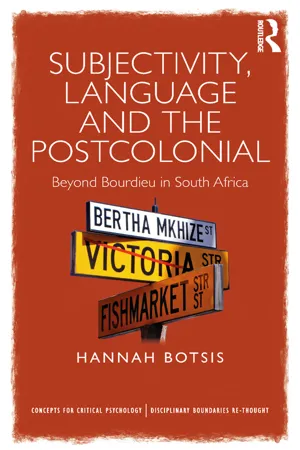
However, without resolving these tensions here, I argue that in order to engage with the concept of identity it is useful to approach it as a concept ‘under erasure’ (Hall, 1996, p. 1). Following Derrida, Hall explains that terms used under erasure means that, ‘they are no longer serviceable – ‘‘good to think with’’ – in their originary and unreconstructed form. But since they have not been superseded dialectically, and there are no other, entirely different concepts with which to replace them, there is nothing to do but to continue to think with them’ (Hall, 1996, p. 1). Thus, Derrida uses the term erasure to emphasise our dependence on terms that are ‘useful, necessary and wrong’ (Sampson, 1989, p. 7, my emphasis). A term under erasure is written down and then crossed out to indicate that we need the term for the point being made to be intelligible, while simultaneously emphasising that this is the incorrect term, or does not capture the fullness of what might be meant.
Identity then, is not used to index a fixed position in the world, or a stable sense of belonging, or even an authentic sense of self, but rather is the ‘thing’ that feels contested whenever we speak about our social location, our feeling of belonging and a set of parameters being set on who we ‘really’ are. Thus, in line with Bauman’s (1996) suggestion to see identity as a verb, it might be more appropriate to speak of the identification of the subject with social categories of difference and feelings of attachment. In Hall’s words, identification is ‘a process of articulation, a suturing, an over-determination not a subsumption’ (2000, p. 3). Hall’s metaphor of the suture is particularly effective in describing something that feels natural, but bears the scars of being held together. The suture leaves a scar on the body, so one always knows that area of the skin was sewn together, but once the tissue has healed, the scar becomes a part of our bodies in a way that makes us unique and feels natural. The suture has also been referred to as an ‘intersection’ (Heath, 1981, p. 106), a term now ubiquitous in social sciences and humanities research, introduced in Crenshaw’s legal scholarship (1993). Intersectionality refers to that particular set of c...