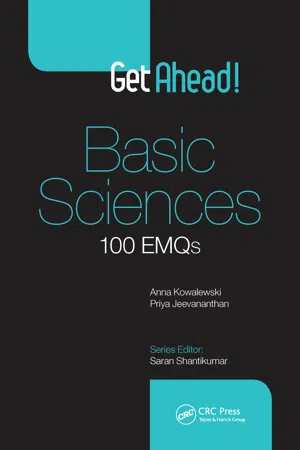
Ideal for medical students studying basic sciences, Get ahead! Basic Sciences: 100 EMQs covers anatomy, physiology, pharmacology and biochemistry, including clinical-based themes. Questions are accompanied by explanations to guide further review, making this, along with the companion SBA volume, an essential resource for your basic sciences exams.
- 136 pages
- English
- ePUB (mobile friendly)
- Available on iOS & Android
eBook - ePub
EMQs Paper 1
1. CARDIOLOGY
- Aortic regurgitation
- Aortic stenosis
- Mitral regurgitation
- Mitral stenosis
- Pulmonary regurgitation
- Pulmonary stenosis
- Tricuspid regurgitation
- Tricuspid stenosis
For each of the following scenarios, select the most appropriate condition. Each option may be used once, more than once or not at all.
- A 58-year-old male patient presents with a history of exertional chest pain and dizziness. He notices he becomes short of breath on climbing stairs.
- A 70-year-old female patient has a ‘bobbing uvula’ and an early diastolic murmur best heard at the left sternal edge, 4th intercostal space on examination.
- A 44-year-old female patient presents to her GP with palpitations and is found to be in atrial fibrillation. Further questioning reveals a history of ‘a jerking movement disorder’ as a child. She is found to have a murmur and facial flushing on examination.
- A 76-year-old male patient has a loud pansystolic murmur and lateral displacement of his apex beat. The murmur is heard best with the breath held in full expiration.
- A 24-year-old male patient of no fixed abode presents to accident and emergency with a high temperature and looks unwell. He has a pansystolic murmur heard best on inspiration. Multiple scars are observed over his arms, and it is especially difficult to find a vein to cannulate.
2. PHARMACOLOGY
- Angiotensin-converting enzyme inhibitors
- Beta-blockers
- Calcium channel blockers
- Loop diuretics
- Methyldopa
- Minoxidil
- Potassium sparing diuretics
- Thiazide diuretics
For each of the following scenarios, select the most appropriate medication. Each option may be used once, more than once or not at all.
- A male patient has started on a drug by his GP and now reports problems sustaining erections.
- A female patient has developed a swollen, tender first metatarsophalangeal joint in her left foot since starting this new medication.
- A male patient has started on a new medication as an inpatient for severe hypertension by a specialist. He notices that his male-pattern balding seems to be improving with the growth of new hair.
- A female patient has developed a dry irritating cough after starting a new medication.
- A male patient has developed constipation and ankle swelling after starting this drug.
3. CARDIOLOGY
- Collapsing pulse
- Electrical alternans
- Jerky pulse
- Pulsus alternans
- Pulsus bisferiens
- Pulsus paradoxus
- Radial femoral delay
- Slow rising pulse
For each of the following scenarios, select the most appropriate examination finding. Each option may be used once, more than once or not at all.
- A 66-year-old female patient reveals a wide pulse pressure and an early diastolic murmur.
- An 82-year-old male patient is found to have a loud ejection systolic murmur radiating to the carotids. What else would you expect to find?
- A 24-year-old male student with a family history of sudden unexplained death at a young age presents with dizzy spells and occasional palpitations. Examination reveals a double apical impulse. What else might be found on examination?
- A 21-year-old female patient has a wide carrying angle and an abnormal chest X-ray. The X-ray shows a normal heart size but some rib notching. Which sign may you expect to find on examination?
- A 76-year-old male patient is known to have severe left ventricular failure. On palpation of the carotid pulse you notice the volume does not feel the same each time.
4. CARDIOLOGY
- Atrial flutter with 2:1 block
- Atrial flutter with 3:1 block
- Bifascicular block
- Complete heart block
- First-degree heart block
- Mobitz type I heart block
- Mobitz type II heart block
- Trifascicular block
For each of the following descriptions, select the most appropriate ECG pattern. Each option may be used once, more than once or not at all.
- A ventricular rate of 100 beats per minute with a saw-tooth appearance between the R–R intervals.
- Sinus rhythm with normal axis, a QRS duration of 96 ms and a PR interval of 238 ms.
- Sinus rhythm, left axis deviation, a QRS duration of 110 ms with a right bundle branch block pattern and a PR interval of 230 ms.
- Ventricular rate of 40 beats per minute, and P-waves at a rate of 90 beats per minute which seem to ‘march through’ the trace.
- A prolonged PR interval followed by a ‘dropped beat’. The PR t...
Table of contents
- Cover
- Title Page
- Copyright Page
- Contents
- Preface
- Contributors
- EMQs Paper 1
- Answers Paper 1
- EMQs Paper 2
- Answers Paper 2
- EMQs Paper 3
- Answers Paper 3
- EMQs Paper 4
- Answers Paper 4
- EMQs Paper 5
- Answers Paper 5
- Index
Trusted by 375,005 students
Access to over 1.5 million titles for a fair monthly price.
Study more efficiently using our study tools.
Frequently asked questions
Yes, you can cancel anytime from the Subscription tab in your account settings on the Perlego website. Your subscription will stay active until the end of your current billing period. Learn how to cancel your subscription
No, books cannot be downloaded as external files, such as PDFs, for use outside of Perlego. However, you can download books within the Perlego app for offline reading on mobile or tablet. Learn how to download books offline
Perlego offers two plans: Essential and Complete
- Essential is ideal for learners and professionals who enjoy exploring a wide range of subjects. Access the Essential Library with 800,000+ trusted titles and best-sellers across business, personal growth, and the humanities. Includes unlimited reading time and Standard Read Aloud voice.
- Complete: Perfect for advanced learners and researchers needing full, unrestricted access. Unlock 1.5M+ books across hundreds of subjects, including academic and specialized titles. The Complete Plan also includes advanced features like Premium Read Aloud and Research Assistant.
We are an online textbook subscription service, where you can get access to an entire online library for less than the price of a single book per month. With over 1.5 million books across 990+ topics, we’ve got you covered! Learn about our mission
Look out for the read-aloud symbol on your next book to see if you can listen to it. The read-aloud tool reads text aloud for you, highlighting the text as it is being read. You can pause it, speed it up and slow it down. Learn more about Read Aloud
Yes! You can use the Perlego app on both iOS and Android devices to read anytime, anywhere — even offline. Perfect for commutes or when you’re on the go.
Please note we cannot support devices running on iOS 13 and Android 7 or earlier. Learn more about using the app
Please note we cannot support devices running on iOS 13 and Android 7 or earlier. Learn more about using the app
Yes, you can access Get Ahead! Basic Sciences by Anna Kowalewski,Priya Jeevananthan in PDF and/or ePUB format, as well as other popular books in Medicine & Anatomy. We have over 1.5 million books available in our catalogue for you to explore.