- 234 pages
- English
- ePUB (mobile friendly)
- Available on iOS & Android
eBook - ePub
About this book
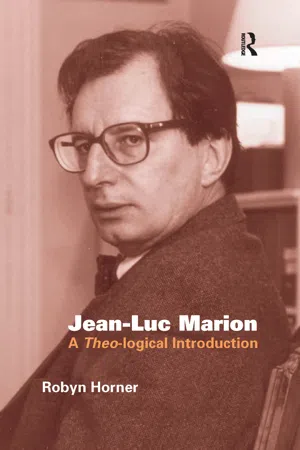
Jean-Luc Marion is one of the leading Catholic thinkers of our time: a formidable authority on Descartes and a major scholar in the philosophy of religion. This book presents a concise, accessible, and engaging introduction to the theology of Jean-Luc Marion. Described as one of the leading thinkers of his generation, Marion's take on the postmodern is richly enhanced by his expertise in patristic and mystical theology, phenomenology, and modern philosophy. In this first introduction to Marion's thought, Robyn Horner provides the essential background to Marion's work, as well as analysing the most significant themes for contemporary theology. This book serves as an ideal starting point for students of theology and philosophy, as well as for those seeking to further their knowledge of cutting-edge thinking in contemporary theology.
Information
PART I
SITUATING MARION
Chapter 1
Contexts
Jean-Luc Marion was born in Meudon, on the outskirts of Paris, in 1946. The son of an engineer and a teacher, Marion initially pursued undergraduate studies in the humanities at what was then the University of Nanterre, and subsequently at the Sorbonne, before deciding to become a professional philosopher. This choice eventually led to his being accepted at the highly exclusive École Normale Supérieure in the Rue d’Ulm in Paris, where entry is based on competitive examination, and where he was taught by several of the intellectual giants of the day, including Louis Althusser, Gilles Deleuze, and a young Jacques Derrida. At the same time, Marion’s deep interest in theology was privately cultivated under the personal influence of theologians such as Louis Bouyer, Jean Daniélou, Henri de Lubac and Hans Urs von Balthasar, and he read widely in this area. Marion’s life as a student coincided with a vigorous political climate in France. In 1968, he, like so many others, was caught up in the student riots, and continues to mark those years as some of the most important and formative in his life.1
In 1970, Marion married a school-teacher, Corinne Nicolas, and their two sons were born in 1973 and 1975 respectively. From 1972 until 1980, he prepared his Agrégé de Philosophie, Doctorat d’État on the early thought of Descartes, while working as an assistant lecturer at the Sorbonne, and contributing as a member of L’équipe Descartes.2 During that time, Marion published what he describes as a first triptych on Descartes: Sur l’ontologie grise de Descartes (1975); the Index des ‘Regulae ad Directionem Ingenii’ de René Descartes, with Jean-Robert Armogathe (1976); and an annotated translation: René Descartes. Règles utiles et claires pour la direction de l’esprit en la recherche de la vérité (1977).3 At the same time, however, Marion was also developing a name for himself as a theologian, having published his first articles in Résurrection in 1968. Résurrection was later to be incorporated into the Révue catholique internationale Communio, the French edition of which Marion was to be one of the founding editors, at the behest of none other than the prominent Swiss theologian, Balthasar. This association is not without significance, since it has been argued that Communio epitomises neo-conservative Catholicism, and that Marion represents a conservative push within the Church. Jean-Louis Schlegel, for example, observes of the journal:
Despite the denials of Communio, the review has no doubt been founded as a counterpoint to another, more critical, international theological review, Concilium. Communio is dedicated to making an intellectual (and unconditional) defence of “roman” or “official” catholicism in its diverse aspects (dogmatics, moral theology, ecclesiology, discipline …).4
Schlegel’s comment is made in the context of an examination of Marion’s later work, Dieu sans l’être [God Without Being], and some years after, David Tracy responds to accusations of theological conservatism by Marion in the Foreword to the English edition of the same:
In this book, Marion has moved the discussion of the proper model for contemporary theology and philosophy beyond the usual conservative-liberal impasse (for example, in Catholic terms in France and elsewhere, the Concilium-Communio differences). On some ecclesial issues (witness Marion’s intriguing reflections here on bishops as theologians), his sympathies are clearly with the Catholic journal Communio and not (as are mine) with Concilium. What is stunning and heartening in this text, however, is the absence of any inner-ecclesial polemics…5
With the contributions both to Résurrection and to a number of other journals through the 1970s, Marion indicates the breadth of his theological and philosophical interests. There are articles on revelation, incarnation, and eucharist; examinations of aspects of Augustine, Maximus the Confessor, and Denys the Areopagite (hereafter Denys); studies of hermeneutics, iconography, the “death of God,” and, of course, Descartes. Analyses of patristic texts reflect Marion’s involvement with the renewal in France during the twentieth century of interest in this area, and his acknowledged indebtedness not only to de Lubac and Daniélou, but also to Jacques Maritain and Étienne Gilson. Serving to bring many of Marion’s diverse interests together is his first full-scale theological work, L’idole et la distance: cinq études [The Idol and Distance: Five Studies], published by Grasset in 1977.6 It remains a groundbreaking book; ambitious in scope, it represents a serious attempt to think theologically in the wake of Friedrich Nietzsche and Martin Heidegger, with an eye to contemporary directions in the works of Derrida and Emmanuel Lévinas, but with reference to theological classics, including the works of Denys and Gregory of Nyssa. Such a genuine engagement of theology with the full spectrum of European philosophy is rare. This marks a particular contribution of Marion to the development of theology: his extraordinary knowledge of the history of philosophy, including, in particular, its twentieth-century manifestations, means that his dialogue with Christian tradition is extraordinarily rich. Of The Idol and Distance, Stanislas Breton comments: “I see here for my part the highest ‘figure’ of a certain medium of thought, where what one calls ‘philosophy’ and ‘theology’ exchange their ‘idioms’ with neither confusion nor separation …”.7
Having received his doctorate in 1980, Marion’s first subsequent posting was at the University of Poitiers, some distance to the south-west of Paris, to which he commuted weekly. One of Europe’s older universities (it was founded in 1431), Poitiers has the distinction of being the alma mater of Descartes himself.8 But there is a further connection with Poitiers that deepens the significance of Marion’s appointment: Lévinas taught there between 1963 and 1967, and remarkably, from this point on Marion has followed in Lévinas’ footsteps, at least in an institutional sense. It was in this context that Marion completed his next volume on Descartes, this time with a theological focus: Sur la théologie blanche de Descartes.9 Shortly after the appearance of this work, the French edition of God Without Being also hit the shelves, and Marion’s controversial place in the history of theology was assured.10
By that time Marion already had something of an international reputation, having been invited to speak in several European countries as well as in South America. In Europe he was a recognised Cartesian scholar, and his work on Heidegger had been tested in a forum that involved dialogue with those beyond the French-speaking world.11 But it was in the early to middle 1980s that Marion’s career really began to flourish in every respect, that is to say, not only because of God Without Being, but in terms of a number of his intellectual interests: in this case, Descartes, the history of philosophy, and the intersections of philosophy with theology. It was at this point that he began to break into the consciousness of North American scholars. As might be expected, Marion had a role to play in Francophone Canada, but more significantly for English speakers, he began giving academic papers in the United States at this time, initially in his role as a Cartesian specialist. It was in 1983 that Marion first addressed a seminar at Columbia University in New York City. This marked the beginning of Marion’s relationship with Daniel Garber, now Professor of Philosophy at the University of Chicago. Garber’s unrestrained enthusiasm for Marion’s work is readily apparent from the opening lines of his Foreword to the English edition of the first volume of Cartesian Questions: “Jean-Luc Marion is one of the most important of the younger generation of philosophers working in France today, and one of the three or four most important living historians of modern philosophy.”12 Clearly, many others have either shared this opinion or have been keen to test its validity. Marion’s speaking engagements multiplied extraordinarily in the mid-1980s, and since that time have taken him not only to major academic centres in France and in Europe more generally, but also to Canada, to Tunisia, Israel, and Japan, and repeatedly to prestigious institutions in the United States.
The mid-1980s was not only a time when Marion began to travel extensively, but it continued to be a fruitful period for writing. In 1983 and 1984 two collaborative ventures were realised: first, a volume dedicated to Marion’s teacher, Ferdinand Alquié, and second, a collection of essays on phenomenology and metaphysics.13 This latter volume marked the beginning for Marion, in print at least, of the development of a new research focus on Husserlian phenomenology, a focus that has proven to be a highly significant part of his work and a useful tool in his readings of Heidegger. In 1986, the final part of Marion’s double triptych on Descartes was published, Sur le prisme métaphysique de Descartes. Constitution et limites de l’onto-théo-logie dans la pensée cartésienne [On Descartes’ Metaphysical Prism: The Constitution and the Limits of Onto-theo-logy in Cartesian Thought], having been completed at Poitiers.14 The theological work, Prolégomènes à la charité [Prolegomena to Charity] appeared in the same year, along with a tribute to Jean-François Lacalmontie.15 Meanwhile, responses to God Without Being were emerging with increased momentum. Illustrating the most extreme end theologically is the pamphlet by Roger Verneaux: in the Étude critique du livre “Dieu sans l’être” he accuses Marion of ignoring the doctrine of the Trinity and the teaching of Christ, charging Thomas Aquinas with blasphemy, and asserting that the Church is simply wrong.16 This, and some of the other responses, has had something of the effect of pushing Marion out of theological conservatism and into the realm of the radical.
In 1989 an important new volume appeared with Presses Universitaires de France: Réduction et donation: recherches sur Husserl, Heidegger et la phénoménologie [Reduction and Givenness: Investigations of Husserl, Heidegger and Phenomenology].17 Picking up his earlier studies of ...
Table of contents
- Cover Page
- Jean-Luc Marion
- Copyright Page
- Contents
- Acknowledgements
- Introduction
- Part I Situating Marion
- Part II The Theological Destitution of Metaphysics
- Part III Exceeding Excess
- Postscript
- 1. Primary Bibliography of Jean-Luc Marion
- 2. Secondary Bibliography of Jean-Luc Marion
- 3. Excerpts from Selected Texts
- Index
Trusted by 375,005 students
Access to over 1.5 million titles for a fair monthly price.
Study more efficiently using our study tools.
Frequently asked questions
Yes, you can cancel anytime from the Subscription tab in your account settings on the Perlego website. Your subscription will stay active until the end of your current billing period. Learn how to cancel your subscription
No, books cannot be downloaded as external files, such as PDFs, for use outside of Perlego. However, you can download books within the Perlego app for offline reading on mobile or tablet. Learn how to download books offline
Perlego offers two plans: Essential and Complete
- Essential is ideal for learners and professionals who enjoy exploring a wide range of subjects. Access the Essential Library with 800,000+ trusted titles and best-sellers across business, personal growth, and the humanities. Includes unlimited reading time and Standard Read Aloud voice.
- Complete: Perfect for advanced learners and researchers needing full, unrestricted access. Unlock 1.5M+ books across hundreds of subjects, including academic and specialized titles. The Complete Plan also includes advanced features like Premium Read Aloud and Research Assistant.
We are an online textbook subscription service, where you can get access to an entire online library for less than the price of a single book per month. With over 1.5 million books across 990+ topics, we’ve got you covered! Learn about our mission
Look out for the read-aloud symbol on your next book to see if you can listen to it. The read-aloud tool reads text aloud for you, highlighting the text as it is being read. You can pause it, speed it up and slow it down. Learn more about Read Aloud
Yes! You can use the Perlego app on both iOS and Android devices to read anytime, anywhere — even offline. Perfect for commutes or when you’re on the go.
Please note we cannot support devices running on iOS 13 and Android 7 or earlier. Learn more about using the app
Please note we cannot support devices running on iOS 13 and Android 7 or earlier. Learn more about using the app
Yes, you can access Jean-Luc Marion by Robyn Horner in PDF and/or ePUB format, as well as other popular books in Theology & Religion & Christian Theology. We have over 1.5 million books available in our catalogue for you to explore.