No organization is impervious to change. Rather, the survival and growth of an organization is dependent on how well it copes with change. Successful change initiatives consist of the integrated eco-system of its portfolio, programs, and projects. These change initiatives become the delivery mechanisms for implementing the strategy of an organization. Improving Business Performance: A Project Portfolio Management Approach clarifies how the proper application of portfolio, program, and project management concepts can help commercial and non-profit organizations achieve their strategic objectives. Most organizations have been good at devising strategy, but falter during its implementation. Executing strategy well to deliver superior business performance remains a key challenge, which is addressed as the core theme of this book.
The book portrays a top-down orientation as well as a bottom-up integration of change initiatives to facilitate alignment to strategy and accommodate mid-course changes. It takes into account existing global best management practices to bring forth an approach that is customizable and useful to organizations in any industry.
Describing why portfolio management lies at the apex of change initiative management, the book explains how to design and fine-tune portfolios so they are in alignment with your organization's overall strategy and business needs. After reading this book, you will understand:
How to design the project portfolio structure for your organization
How to integrate programs and projects within the portfolio more effectively
How to better manage interactions across diverse change initiatives
How to maintain focus while managing change to realize benefits
The book presents a case study that illustrates the application of project portfolio concepts in practical scenarios. It includes chapters dedicated to transition management, change management, benefits management, and the Enterprise Project Management Office. It also includes templates you can immediately put to use in your own portfolios, programs, and projects.
No organization is impervious to change. Rather, the survival and growth of an organization is dependent on how it can cope with change. Adapting to change is a critical success factor, which differentiates robust organizations with those that “go under.” And this postulate works for commercial organizations as well as for non-profit organizations.*
The triggers for change can come from multifarious factors. The organizational context becomes a significant factor in determining which factors bear more importance. To illustrate, governmental organizations are more prone to changes because of political factors, as compared to commercial organizations (which are for-profit entities). Breakthroughs in technology are more likely to impact commercial organizations, as compared to non-profit organizations. The changing competitive landscape can become the most critical factor for transformation in commercial organizations, which may not be as pertinent for non-profit organizations.
But the bottom line is that all organizations need to manage change, which is facilitated by change initiative management. “Change initiative management” collectively encompasses what needs to be done within portfolio, program, and project perspectives to address change.*
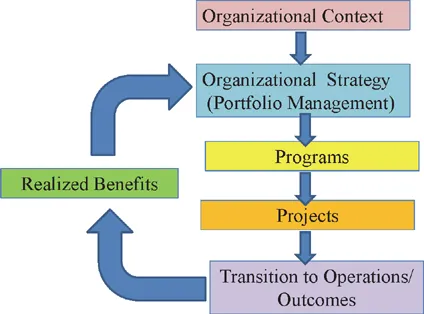
Figure 1.1
Change Initiative Management across Multiple Perspectives.
As we will see later in this book, all the above three perspectives are interrelated. Portfolio management decides which change initiatives need to be implemented as programs and projects (for the projects directly linked to the portfolio). Program management, in turn, spawns the projects that need to be executed.
Once the outputs from the projects are transitioned into operations (which are controlled by the functional departments), the outcomes and benefits are monitored, which can give a reverse feedback to strategy. This provides a way to determine if the programs and the projects taken up were indeed successful in achieving the strategic objectives of the organization.
A pictorial representation of how different perspectives of change initiative management are linked together is depicted in Figure 1.1.
As noted in this figure, the organizational strategy is impacted by the context in which it is positioned. For instance, not-for-profit organizations will have a different value chain, as compared to a for-profit organization.
1.2 Triggers for Change
The triggers for change can emanate through “political,” economic, social, technology-driven, legislative, and environmental factors (usually known by the acronym PESTLE). The following illustrations indicate how change can be triggered by these six factors:
1.Changes that are due to political factors. For instance, change in the ruling party at the national level as a result of elections or change in the organizational structure can have ripple effects. When two companies merge or when a new Chief Executive Officer (CEO) joins, the expectations set off changes, which can be ascribed as ones that are due to “political” factors. In many countries, which party comes into power can influence the overall direction of business for many companies.
2.Changes that are due to economic factors. The economic downturn during 2008–2009 “wiped” out the fortunes of many financial institutions. Banks in particular had to be restructured and had to undergo “stress tests” to prove their viability. This led to a redesign of their portfolio and the business lines they operate.
3.Changes that are due to social factors. These can be triggered because of migrations, increase in literacy levels, restructuring of social hierarchies, etc.
4.Changes that are due to technology factors. These changes are among the easiest to discern. Technology has played a critical role in facilitating social networks. Advances in mobile and cloud computing, data analytics, etc., could be quoted as examples, giving rise to new change initiatives for organizational survival, and on how they deal with customers.
5.Changes that are due to legislative factors. These changes, more often than not, have been seen in industries that are regulated, such as financial institutions, healthcare organizations, etc.
6.Changes that are due to environmental factors. These changes could be attributed to the concern for protecting natural assets and increasing the quality of life.
Market transparency, labor mobility, global investments, and instantaneous tools for communication have intensified global competition. For most of the global companies, moving forward has become embedded as a part of the work culture, as these companies appreciate that improvements and churns are brought about only by change. At the strategic level, organizations would be monitoring the triggers for change, along with customer feedback. In addition, successful organizations also involve critical stakeholders as a part of the change process.
Change initiative management enables managing complex change, which involves process, organization, and technology dimensions. However, most of the change initiatives fail because of inadequate involvement on the part of the concerned stakeholders. It is human nature to resist change and not to come out of one’s comfort zone. This aspect will be discussed in a subsequent chapter (see Chapter 6: Change Management).
One critical aspect of change initiative management is that the rate of change itself is increasing, and the organizations of tomorrow will need to cope with more rapid changes. In this context, it would be useful to consider the concept of “velocity of change” of various industries. By their very nature, change in some of the industries is relatively slow moving, such as in the lumber industry. Change in other industries, however, is relatively fast moving, such as in information technology (IT) and telecommunications.
In a nutshell, whenever the strategic objectives of an organization change, a review of its collection of change initiatives is required. Successful organizations do not shy away from change but, rather, welcome it as an opportunity to “reinvent” themselves, discarding irrelevant practices and structures in the context of new settings.
1.3 the Impact of Change
The impact of change itself can vary across the perspectives. Portfolio Managers need to be open to changes coming from external factors, whereas Project Managers typically need to control changes within defined dimensions of scope, schedule, quality, and budget. Program Managers need to consider the top-down changes coming in from portfolio management as well as changes coming from the execution of projects and the resultant outcomes in operations.
In subsequent chapters, we expand on how the successful management of portfolios, programs, and projects facilitate coping with change.
_______________
*In his blog (http://www.aei.org/publication/fortune-500-firms-in-1955-vs-2014-89-are-gone-and-were-all-better-off-because-of-that-dynamic-creative-destruction), Mark J. Perry states the point that only about 12% of the companies survived the 60 years, from 1955, in the Fortune 500 list. Others went out of existence, merged with others, or dropped out of the Fortune 500 list. And many of the companies who did not survive had failed to adapt to change. Similar studies by Deloitte’s Center for the Edge (www.forbes.com/sites/stevedenning/2012/01/25/shift-index-2011-the-most-important-business-study-ever/) show that the average life expectancy of a Fortune 500 company has declined from around 75 years half a century ago to less than 15 years today, and it is heading toward 5 years, if nothing else is done. The pressure to adapt to change is ever more increasing.
*“Change initiative management” is known by different terminologies as per varying organizations. The Project Management Institute (PMI) calls the change initiative management, “Organizational Project Management.” As per the PMI, organizational project management is defined as the “Systematic management of portfolios, programs, projects in alignment with the organization’s strategic business goals.” (Quoted from the PMI standard: “Managing Change in Organizations: A Practice Guide”; http://www.pmi.org/~/media/Files/Home/ManagingChangeInOrganizations_A_ Practice_Guide.ashx.). Many of the AXELOS frameworks refer to change initiative management as P3M (called “Portfolio, Programme and Project Management”), which is a crisp definition encompassing all three perspectives. This acronym is used in this book to connote change initiative management.
Chapter 2 It All Commences with Strategy! Project Portfolio Management
2.1 Starting Point for Portfolio Definition
In Chapter 1, we saw that all organizations need to address change. Change could be entropic or could lead to a better order of things. Organizations respond to change by redefining their strategy.
A rational first step to take while redefining strategy is to assess what the context of change is and where the organization currently stands. This “as-is” assessment is easier for an ongoing business, as it has past records and plans (such as sales data, personnel productivity information, etc.) to use. For a start-up organization, further market analysis needs to be undertaken to ascertain where the organization currently stands, with reference to the industry and the competitive landscape.
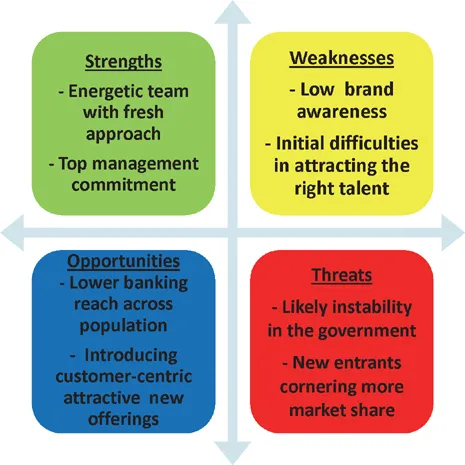
One simple tool that can be used to commence this analysis is the SWOT matrix formulation. SWOT is an acronym that stands for “Strengths, Weaknesses, Opportunities, and Threats” and is widely used in management.
To give a simple illustration for SWOT, consider a scenario in which the new government of a country (which is dependent on the continued support of its coalition partners) has reformulated the regulations for setting up new banks, to have a wider banking reach to its under privileged population. For a prospective bank considering entry, the following SWOT matrix (see Figure 2.1) is applicable.
In this matrix, two entries have been noted for each grid (in reality, there would be more entries, arising out of brainstorming discussions, etc.). It can be noted that whereas strengths and weaknesses are internal to the organization, threats and opportunities are external.
It is also quite likely that competitors perceive similar threats and opportunities, but the differentiation occurs during the recognition of the strengths and weaknesses unique to the particular organization and acting on this information.
Figure 2.1 Illustrative Swot Matrix.
2.2 Strategic Positioning of Organizations
As a part of strategy formulation, the organization needs to decide where it needs to position itself during, say, the next five years. This time horizon can be dependent on the “velocity” of the industry referred to in Chapter 1 and the context and expected dynamic nature of changes. Many companies maintain a longer time horizon of, for example, five years, together with a mid-term perspective of three years, and they keep refining the operational plans for a ye...
Table of contents
Cover
Dedication
Table of Contents
Preface
Acknowledgments
About the Author
Chapter 1 Context for Change
Chapter 2 It All Commences with Strategy! Project Portfolio Management
Chapter 3 The Core of Program Management—Benefits Management
Chapter 4 Project Management—Delivery Enabler for Change
Chapter 5 Change Initiative Integration into Operations—Transition Management
Chapter 6 Change Management and Stakeholder Engagement
Chapter 7 Benefits Management—Link between Portfolio and Program Management
Chapter 8 Setting Up and Running an Enterprise Project Management Office (EPMO)
Chapter 9 An Integrated Case Study—Application of Project Portfolio Management
Appendix: Structure of Major Portfolio, Program, and Project Artifacts
Glossary
Suggested Reading
Index
Trusted by 375,005 students
Access to over 1.5 million titles for a fair monthly price.
Study more efficiently using our study tools.
Frequently asked questions
Yes, you can cancel anytime from the Subscription tab in your account settings on the Perlego website. Your subscription will stay active until the end of your current billing period. Learn how to cancel your subscription
No, books cannot be downloaded as external files, such as PDFs, for use outside of Perlego. However, you can download books within the Perlego app for offline reading on mobile or tablet. Learn how to download books offline
Perlego offers two plans: Essential and Complete
Essential is ideal for learners and professionals who enjoy exploring a wide range of subjects. Access the Essential Library with 800,000+ trusted titles and best-sellers across business, personal growth, and the humanities. Includes unlimited reading time and Standard Read Aloud voice.
Complete: Perfect for advanced learners and researchers needing full, unrestricted access. Unlock 1.5M+ books across hundreds of subjects, including academic and specialized titles. The Complete Plan also includes advanced features like Premium Read Aloud and Research Assistant.
Both plans are available with monthly, semester, or annual billing cycles.
We are an online textbook subscription service, where you can get access to an entire online library for less than the price of a single book per month. With over 1.5 million books across 990+ topics, we’ve got you covered! Learn about our mission
Look out for the read-aloud symbol on your next book to see if you can listen to it. The read-aloud tool reads text aloud for you, highlighting the text as it is being read. You can pause it, speed it up and slow it down. Learn more about Read Aloud
Yes! You can use the Perlego app on both iOS and Android devices to read anytime, anywhere — even offline. Perfect for commutes or when you’re on the go. Please note we cannot support devices running on iOS 13 and Android 7 or earlier. Learn more about using the app
Yes, you can access Improving Business Performance by Ramani S in PDF and/or ePUB format, as well as other popular books in Business & Business General. We have over 1.5 million books available in our catalogue for you to explore.