In this book, twelve eminent Latina Psychologists illustrate how they practice gender- and culture-sensitive psychotherapy, counseling, research, pedagogy, social justice, and mentoring. They share how they create their own path in the midst of oppression – by becoming aware of the connection between their lives and their gendered, cultural, social, and political circumstances – and how they liberate themselves and those who seek their psychological services. Based on lived experiences, they reveal how they integrate a borderlands theory, a testimonio method, and an embodiment analysis into a Latina Feminist Psychology. More importantly, these Latina Psychologists offer easy-to-follow advice to help readers thrive while living in the cultural borderlands.
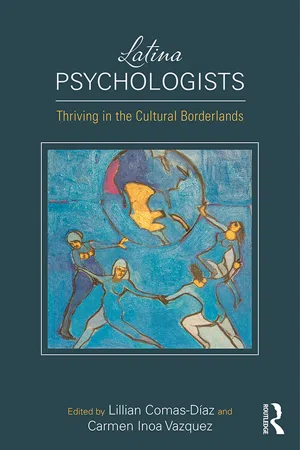
eBook - ePub
Latina Psychologists
Thriving in the Cultural Borderlands
- 246 pages
- English
- ePUB (mobile friendly)
- Available on iOS & Android
eBook - ePub
Latina Psychologists
Thriving in the Cultural Borderlands
About this book
Information
PART I
Introduction
Latina Feminist Psychology
Testimonio, Borderlands Theory, and Embodied Psychology
Lillian Comas-Díaz and Carmen Inoa Vazquez
We as women should shine light on our accomplishments and not feel egotistical when we do. It’s a way to let the world know that we as women can accomplish great things.Dolores Huerta
An Invitation
We hope that this anthology touches your heart. This collection of narratives may evoke both tears and smiles in your spirit. But more than anything, we hope that it inspires you. The rich tapestry of stories in this volume introduces us, a group of twelve Latina Psychologists representing psychotherapists, scholars, researchers, educators, mentors, leaders, and activists. We reflect on how our gendered ethnicity impacts our life and work. We share our ways of coping with intersectional oppression, adversity, and cultural conflicts. More importantly, we narrate how we became psychologists while struggling against sexism, racism, heterosexism, homophobia, xenophobia, and ethnocentrism. As a result of our lived experiences, we embark on a liberating journey to transform our work into a psychology that is relevant in gender and cultural terms.
Whether you are a Latina or not, a woman or not, a psychologist or not, we believe that you can potentially relate to the stories in this anthology. Maybe you will identify or empathize with, and/or connect to, some of our narratives. However, regardless of how these stories make you feel, we extend you an invitation: Allow yourself to develop a relationship with us, one that will encourage you to flourish.
As a group, we embody a variety of female experiences including identities reflective of the intersection of ethnicity, gender, culture, race, sexual orientation, socioeconomic class, age, (dis)ability, immigration status, nationality, language, religion/spirituality, place, and other diversity variables. Much like the Latinx community, we mirror the mosaic of our people. We use the term Latinx to designate the Latino/a community because this term is a gender-neutral concept that moves beyond binaries (McAlister, 2016). Moreover, the term Latinx includes lesbian, gay, bisexual, transgender, and queer (LGBTQ) (Sharrón-del Rio & Aja, 2015). In this volume we introduce a multiplicity of ancestry represented by women who are Mexican American, Puerto Rican, Cuban, Dominican, Colombian, Argentinian, and multiethnic. While several of us are immigrants and/or refugees, others are native-born and several are transnationals. Some of us are married, with or without children; while others are single, widowed, and/or divorced. Our sexual orientation includes heterosexual, lesbian, and queer. Since most Latinx people are of mixed race and heritage, we reflect a racial rainbow ranging from mestizas, creoles, indigenous, LatiNegras (AfroLatinas) to multiracial women.
Latinx spirituality functions independently from religion (Campesino & Swartz, 2006). As a consequence, numerous Latinas endorse spirituality as an important cultural value (Hunter-Hernandez, Costas-Muñiz, & Gany, 2015). Similarly, our spirituality and religions span from Christianity to Judaism to spiritual mestizaje. Originally coined by Gloria Anzaldúa (1987), the term spiritual mestizaje entails a transformative process of unearthing bodily memory to develop a continuous critical analysis of oppression and activism through a renewed relationship with the sacred (Delgadillo, 2011). As such, spiritual mestizaje is a method of transformation (Medina, 2014), one that involves an amalgamation of Western, indigenous, and African beliefs/rituals (Comas-Díaz, 2014).
The narrative tapestry in this volume illustrates how we, as a group of Latina Psychologists, compose our lives in the midst of oppression. Our approach is similar to autoethnography, a qualitative research method that goes beyond personal essays to connect lives with cultural, social, and political contexts (Chang, 2008, 2016). Here you will read about our challenges, disappointments, and failures as well as our strengths, passions, and successes. We describe what wounds us in addition to what motivates us. You will witness how each of us became empowered to alchemize pain into healing. Sharing our reflections from a Latina psychological point of view illustrates life lessons on coping with hardship, discrimination, cultural domination, and trauma. Out of our life stories you will witness how we develop and practice a feminist psychology in the cultural borderlands. More importantly, we hope that our testimonios offer you a roadmap to help you thrive.
Testimonio: In Our Own Voices
It is the responsibility of those who survive the struggle for freedom to give testimony.Julia Alvarez (2004)
We use a testimonial voice to share our life reflections with you. A Spanish word meaning “witness account,” testimonio entails a woman’s description of her experiences with oppression, marginalization, victimization, and trauma (Aron, 1992). As a powerful healing tool used in psychotherapy with Latinx (Vazquez & Rosa, 2011), testimonio fosters empowerment, agency, and self-healing (Comas-Díaz, 2006). It reduces anxiety, depression, sleeplessness, and post-traumatic stress disorder (PTSD) (Agger, Igreja, Kiehle, & Polatin, 2012). Moreover, it facilitates the development of post-traumatic meaning-making (Akinyela, 2005). As a personal narrative, testimonio promotes strategies against patriarchy and oppression. Along these lines, it helps the development of an antiracist consciousness (Adleman & Enguidanos, 1995).
Born in a Latin American context, testimonio is a liberation method for the promotion of resistance, struggle, and social transformation (Cienfuegos & Monelli, 1983). As a form of life history, testimonio facilitates cultural survival, agency, and resilience (Smith, 2012). Just as important, testimonio is a gendered cultural script for understanding the relationship between self and other. As such, it allows the voices of the oppressed to move from the margins to the center (Brabeck, 2003). Therefore, when Latinas give testimonio, they reclaim their indigenous beliefs and practices, keeping alive their ancestral legacy. The structure of testimonio is consistent with the experiences of most people of color. Therefore, as a storytelling method, testimonio is congruent with the Latinx culture. For example, many Latinas use testimonio to offer powerful narratives and intersectional analyses of their struggle and resistance (Ortega, 2016). Likewise, as Latina Psychologists, we give testimonio to challenge oppression by rewriting gendered, ethnic, racial, sociopolitical, and psychological stories.
The definition of testimonio is fluid, including an individual strategy as well as a collective method. A single voice in testimonio goes beyond an individual occurrence, echoing the experience of many oppressed individuals. As an illustration, the sense of I explicitly stands for the sense of We of those who are oppressed (Brabeck, 2003). This way of sharing experiences informs individuals of their position within socially oppressive systems. As a result, testimonio generates knowledge based on individuals’ lived experiences, rather than on the dominant culture’s discourse. Since testimonio conveys the notion that truth is being revealed “under oath” (Smith, 2012), it grants cultural validity to the narrator, and encourages individuals to be experts of their communities (Ortega, 2016). At the same time testimonio also offers opportunities to individuals to critique their social contexts, fostering and thus empowering them to demand changes to transform the social structures that oppress them (Watkins & Shulman, 2008).
As a form of narrative inquiry, testimonio nurtures individuals’ development of critical consciousness in order to acquire a thirst for justice and social equality. In this process, testimonio facilitates collective resistance and enhances the emergence of solidarity and coalition among the oppressed (Brabeck, 2003). It is important to note that testimonio differs from narrative research, where the psychologist shapes the unfolding of the narrator’s story. Instead, testimonio presents an individual perspective, one that echoes a collective story that happened, and may continue to happen, in the Latinx community. Through this process, testimonio contributes to the growing scholarship on critical race methodologies, which aims to disrupt the apartheid of knowledge in academia (Pérez Huber, 2009). As such, testimonio advances the development of inquiry and research informed by gendered, racial, and social justice (Pérez Huber, 2009).
The practice of testimonio has been found to be empowering and emancipatory. Aside from revealing the effects of oppression on Latinas, testimonio elucidates women’s strength to resist and overcome oppression. In this anthology, we share our experiences with cultural domination and describe how we challenged and transformed psychology. As women of color negotiating multiple cultures, we live at the edge of different and, at times, conflicting societies. Situated at such crossroads, we reconstruct our identity as we struggle against oppression to transform our lives and work. Most importantly, we document how we thrive while living in the cultural borderlands.
Surviving in the Borderlands
To survive in the borderlands you must live sin fronteras, be a crossroads.Gloria Anzaldúa (1987, pp. 194–195)
A borderlands perspective is at the center of this anthology. Gloria Anzaldúa (1987) developed a borderlands theory to describe Chicanas’ experiences living betwixt and between cultures. We have found that this theoretical perspective resonates with most Latinas regardless of national background. The concept of borderlands transcends geographical location to include cultural, conceptual, spiritual, and psychological spheres. Living and surviving in the cultural borderlands nurtures the emergence of a borderlands consciousness; in other words, the new mestiza (a mixed-race Latina) and the new mulatta (a multiracial Latina). While we celebrate the diversity among Latinas, we also identify Latinas’ commonality of living in the borderlands. Therefore, we use the term new Latina to designate Anzaldúa’s new mestiza. The new Latina’s reconstructed identity affirms an intersectional self, one that embodies gender, ethnic, linguistic, psychological, spiritual, and geopolitical aspects of Latinas’ realities.
Anzaldúa (1987) described the borderlands perspective as an interdisciplinary approach consisting of cultural studies, women’s issues, indigenous mythology, spirituality, art, and Jungian psychology. Accordingly, Latinas become inner exiles as they straddle two or more cultures. In other words, Latinas are designated as the Other in the dominant culture. Notwithstanding these circumstances, surviving in the cultural borderlands generates border thinking (Anzaldúa, 1987). A fractured language born out of a subaltern perspective, border thinking is a reaction to the dominant cultural discourse (Mignolo, 2000). At the same time, border thinking empowers Latinas to transform obstacles into strengths or, in Anzaldúa’s (1987, p. 247) words, “to dream the story into a virtual reality.” Specifically, living at the cultural border imparts Latinas with a shift in perception, one that allows them to see accurately through people, events, systems, and dynamics. Instead of being divided by borders, Latinas are empowered by them, while they develop a specific way of perceiving power differences. This shift in perception is called la facultad, a keen spiritual intuition that emerges from the soul to deepen the way Latinas see themselves and the world (Anzaldúa, 2002).
Within the borderlands perspective, nepantla (a Nahuatl word for land in-between) is a liminal space of transforming possibilities. Latinas inhabiting nepantla feel the pain of oppression, an experience that fragments their sense of self. Paradoxically, this pain opens up multiple and alternative views of reality. That is, out of suffering emerges an awakening consciousness. The Aztec mythology serves as a vivid guide to understand inhabiting the borderlands. As an illustration, Anzaldúa (1987) reclaimed Meso-American goddesses as icons of feminist development and empowerment. She coined the term “Coatlicue state” to designate a female self-transformation process. An Aztec Earth goddess who embodies both creation and destruction, Coatlicue is a symbol of non-duality. In the borderlands context, the Coatlicue state refers to the negative feelings that Latinas experience as the Other in the dominant culture. To initiate the process of self-integration, Latinas can embrace the Coatlicue energy as a gestational state to give birth to themselves (Anzaldúa & Keating, 2002). During the Coatlicue state, Latinas descent to el cenote – a deep well where they come in contact with their cultural collective unconsciousness (Anzaldúa quoted in Román-Odio, 2013). Immersed in el cenote, Latinas use la facultad to access unconscious modes of knowledge in order to challenge the traditional ways of viewing the world. This new conocimiento (ancestral knowledge) emerges as an ancestral knowledge that is understood through a spiritual knowing-within.
The next Anzaldúan developmental step involves crossing over nepantla. To access this stage, Latinas can invoke the feminine energy of Coyolxauhqui, the Aztec moon goddess daughter of Coatlicue. According to Aztec mythology, Huitzilopochtli, Coyolxauhqui’s brother, butchered her in an act of revenge. As a result, Coyolxauhqui became the Milky Way goddess. Out of Coyolxauhqui’s dismembering, her head became the moon and the stars emerged out of her body. For this reason, Anzaldúa chose the Milky Way goddess to represent the inte...
Table of contents
- Cover
- Half Title
- Title Page
- Copyright Page
- Dedication
- Table of Contents
- Acknowledgments
- Contributors
- PART I: Introduction
- PART II: Psychotherapy
- PART III: Scholarship/Research
- PART IV: Social Justice
- 8. Weaving Identities and Theoretical Perspectives of Cultural Competency in Nepantla
- 9. Transforming Development through Just Communities: A Lifelong Journey of Inquiry
- PART V: Mentorship and Leadership
- PART VI: Conclusion
- Index
- back
Trusted by 375,005 students
Access to over 1.5 million titles for a fair monthly price.
Study more efficiently using our study tools.
Frequently asked questions
Yes, you can cancel anytime from the Subscription tab in your account settings on the Perlego website. Your subscription will stay active until the end of your current billing period. Learn how to cancel your subscription
No, books cannot be downloaded as external files, such as PDFs, for use outside of Perlego. However, you can download books within the Perlego app for offline reading on mobile or tablet. Learn how to download books offline
Perlego offers two plans: Essential and Complete
- Essential is ideal for learners and professionals who enjoy exploring a wide range of subjects. Access the Essential Library with 800,000+ trusted titles and best-sellers across business, personal growth, and the humanities. Includes unlimited reading time and Standard Read Aloud voice.
- Complete: Perfect for advanced learners and researchers needing full, unrestricted access. Unlock 1.5M+ books across hundreds of subjects, including academic and specialized titles. The Complete Plan also includes advanced features like Premium Read Aloud and Research Assistant.
We are an online textbook subscription service, where you can get access to an entire online library for less than the price of a single book per month. With over 1.5 million books across 990+ topics, we’ve got you covered! Learn about our mission
Look out for the read-aloud symbol on your next book to see if you can listen to it. The read-aloud tool reads text aloud for you, highlighting the text as it is being read. You can pause it, speed it up and slow it down. Learn more about Read Aloud
Yes! You can use the Perlego app on both iOS and Android devices to read anytime, anywhere — even offline. Perfect for commutes or when you’re on the go.
Please note we cannot support devices running on iOS 13 and Android 7 or earlier. Learn more about using the app
Please note we cannot support devices running on iOS 13 and Android 7 or earlier. Learn more about using the app
Yes, you can access Latina Psychologists by Lillian Comas-Diaz, Carmen Inoa Vazquez, Lillian Comas-Diaz,Carmen Inoa Vazquez in PDF and/or ePUB format, as well as other popular books in Psychology & History & Theory in Psychology. We have over 1.5 million books available in our catalogue for you to explore.