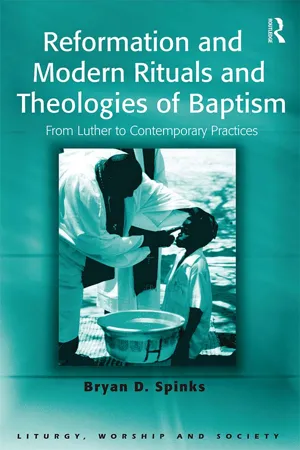
eBook - ePub
Reformation and Modern Rituals and Theologies of Baptism
From Luther to Contemporary Practices
- 266 pages
- English
- ePUB (mobile friendly)
- Available on iOS & Android
eBook - ePub
Reformation and Modern Rituals and Theologies of Baptism
From Luther to Contemporary Practices
About this book
Presenting a comprehensive survey of the historical underpinnings of baptismal liturgies and theologies, Bryan Spinks presents an ecumenically and geographically wide-ranging survey and discussion of contemporary baptismal rites, practice and reflection, and sacramental theology. Writing within a clear chronological framework, Bryan Spinks presents two simultaneous volumes on Baptismal Liturgy and Theology. Early and Medieval Rituals and Theologies of Baptism summarizes the understandings of baptism in the New Testament and the development of baptismal reflection and liturgical rites throughout Syrian, Egyptian, Roman and African regions. In this second volume, Reformation and Modern Rituals and Theologies of Baptism, Spinks traces developments through the Reformation, liturgies in the eighteenth and nineteenth centuries, and explores important new ecumenical perspectives on developments of twentieth-century sacramental discussion. Present practices of Baptist, Amish, as well as Methodist, Roman Catholic, Lutheran, Reformed and Anglican denominations are also examined.
Information
PART I
DIVERGENT RIVERS
CHAPTER 1
Luther and the Lutheran Tradition
Martin Luther’s Theology and Rites of Baptism
The more or less universal baptismal rite with local variants throughout the West, together with the scholastic methods of theology, were brought to an abrupt end in the sixteenth century with the Reformation. The Reformers challenged much in the inherited ritual, and some of the prevailing theology on baptism, though of course the Reformers differed amongst themselves as to the nature and extent of change needed in both. In Germany the Reformation was sparked by the Wittenberg professor, Martin Luther. Many of the more recent Luther studies have been concerned with a developmental approach, and have tended to trace the growth and change in his theology from his early works through to his more mature writings. Three phases are helpful in considering his baptismal theology: the Young (pre-1519) Luther, the Reformation or anti-Roman Luther, and the Mature or anti-Enthusiasts Luther.
The Young Luther
Among Luther’s early writings, those most relevant to baptism are the lectures on the Psalms, Romans, Galatians and Hebrews. What is remarkable is the paucity of references and discussions on baptism in these works, given Luther’s later emphasis on baptism as the central event in the Christian life. For example, in the Dictata Super Psalterium (1513–15), there are occasional references to the Jordan as mystically denoting baptism, but otherwise very little. Similarly the Lectures on Romans have references to baptism, but no detailed discussion. Commenting on 6:3, the Reformer noted in the Glosses:
3. Do you not know, brethren, as if to say, you ought not to be ignorant, that all of us who have been baptized, because the threefold dipping of Baptism signifies the three-day death period and the burial of Christ, into Christ Jesus, that is, by faith in Christ Jesus, were baptized into his death, that is, through the merit and power of his death? Hence ‘Baptism’ (baptismus), ‘dipping (mersio), ‘to baptize’ (baptiso), and ‘to dip’ (mergo) all mean that 4. We were buried therefore together …1
In the corresponding Scholium the discussion is about sin, not baptism. Werner Jetter has attempted to examine the various background influences on the young Luther which would explain this neglect, though without any convincing conclusion.2 However, we can discern one important shift that was crucial, although it does not immediately deal with baptism. In the Lectures on the Psalms, Luther was still using and thinking in scholastic categories, and he examined Scripture under the headings of historical, allegorical, tropological and anagogical. In this work he also still drew on the medieval via moderna and its pactum (covenant) theology and the humilitasfidei.3 Humanity was understood to be active in the process of justification.
However, in the Lectures on Romans, Luther had moved towards a new understanding of justification. In justification it is God who turns humanity to himself. Justification is propter Christum, not propter fidem, and even less propter pactum or our cooperation with God. Thus in 1520 Luther could write, ‘Baptism, then, signifies two things – death and resurrection, that is, full and complete justification.’4 The bond between justification and baptism will imply that the latter too must become from start to finish the gracious work of God to humankind. Ideas of cooperative grace will have no place.
The ‘Reformation’ Luther
With the ‘Reformation’ Luther we turn to two important writings which were directed against the prevailing Roman interpretation of baptism: The Holy and Blessed Sacrament of Baptism (1519), and The Babylonian Captivity of the Church (1520). Both writings were polemical.
In the 1519 work we find a concern for generous use of water in baptism:
Baptism [Die Taufe] is baptismos in Greek, and mersio in Latin, and means to plunge something completely into the water, so that the water covers it. Although in many places it is no longer customary to thrust and dip infants into the font, but only with the hand to pour the baptismal water upon them out of the font, nevertheless the former is what should be done. It would be proper, according to the meaning of the word Taufe, that the infant, or whoever is to be baptized, should be put in and sunk completely into the water and then drawn out again. For even in the German tongue the word Taufe comes undoubtedly from the word tief [deep] and means that what is baptized is sunk deeply into the water. This usage is also demanded by the significance of baptism itself. For baptism, as we shall hear, signifies that the old man and the sinful birth of flesh and blood are to be wholly drowned by the grace of God. We should do justice to its meaning and make baptism a true and complete sign of the thing it signifies.5
We also find the idea of death/resurrection and regeneration linked together:
The significance of baptism is a blessed dying unto sin and a resurrection in the grace of God, so that the old man, conceived and born in sin, is there drowned, and a new man, born in grace, comes forth and rises … Through this spiritual birth he is a child of grace and a justified person. Therefore sins are drowned in baptism, and in place of sin, righteousness comes forth.6
Luther also introduces an eschatological element; because man is simul iustus et peccator, baptism’s significance is not fulfilled completely in this life. It is something which is ongoing. More important still is the emphasis in 1519 and in 1520 on the importance of the Word, as God’s promise, and of faith. Reacting against the extreme forms of ex opere operato scholastic teaching on sacraments, Luther first insisted that the most important thing is the divine promise (divina promissio) which says he who believes and is baptized will be saved. Luther wrote:
A great majority has supposed that there is some hidden spiritual power in the word and water, which works the grace of God in the soul of the recipient. Others deny this and hold that there is no power in the sacraments, but that grace is given by God alone, who according to his covenant (ex pacto) is present in the sacraments which he has instituted.7
However, he argues, both of these views, which drive a wedge between the signs of the old covenant and those of the new, are to be shunned; signs have attached to them a word of promise, requiring faith (verbum promissionis, quod fidem exigat):8 ‘The sign, the assurance of my salvation, will not lie to me or deceive me. God has said this: God cannot lie.’9 What is important is not the blessing of the water, but the fact that God has instituted baptism. Word and water go together, not a priestly blessing of water. Thus it is not man’s baptism, but Christ’s and God’s baptism which is received:
Hence we ought to receive baptism at human hands just as if Christ himself, indeed, God himself, were baptizing us with his own hands[10] … The Doer and the minister are different persons, but the work of both is the same work, or rather, it is the work of the Doer alone, through my ministry. For I hold that ‘in the name of’ refers to the person of the Doer …11
However, in these two works Luther is also at pains to stress the importance of faith in what he calls the signs or sacraments of justification: ‘Thus it is not baptism that justifies or benefits anyone, but it is faith in that word of promise to which baptism is added. This faith justifies, and fulfils that which baptism signifies.’12
The importance of faith in the sacraments was stressed in Luther’s Lectures on Hebrews, where he asserted that it is not the sacrament which justifies but faith in the sacrament; the sacrament justifies not because it is performed but because it is believed.13 In The Babylonian Captivity he could say:
For unless faith is present and is conferred in baptism, baptism will profit us nothing; indeed, it will become a hindrance to us, not only at the moment that it is received, but throughout the rest of our lives. That kind of unbelief accuses God’s promises of being a lie, and this is the greatest of all sins.14
Faith is such a necessary part of the sacrament, said Luther, that it can save even without the sacrament.15 However, it seems that Luther meant by ‘faith’ simply accepting that in the sacrament God will do what he promises. Thus he wrote:
We must humbly admit, ‘I know full well that I cannot do a single thing that is pure. But I am baptized, and through my baptism God, who cannot lie, has bound himself in a covenant (sich vorpunden hatt) with me. He will not count my sin against me, but will slay it and blot it out.’16
And again,
For no sin can condemn him save unbelief alone. All other sins, so long as the faith in God’s promise made in Baptism returns or remains, are immediately blotted out through that same faith, or rather through the truth of God, because he cannot deny himself if you confess him and faithfully cling to him in his promise.17
It would seem that by ‘faith’ Luther here means acceptance that God will grant justification and salvation through this strange ritual with water which is performed in his name.
Luther also used the word ‘covenant’ (bund; vorpindung). In the 1519 work on baptism Luther notes that you must give yourself up to what baptism is and what it signifies, that is, that God accepts your desire for baptism and what it signifies. You must pledge yourself (vorpindest du dich) to continue in this desire and to slay sin until your dying day. So long as you keep your pledge to God (Die weyl nu solch deyn vorpinden mit got steet) he in turn gives his grace, and pledges not to impute to you the sins which remain in your nature after baptism.18 Admittedly this sounds like the pactum theology, but in fact the pledge is to be understood within the concept of the faithfulness of God, and the eschatological nature of continually returning to baptism. In the early commentary on Galatians, Luther argued that pactum, testamentum and promissiones were all the same in meaning, and refer to the death of Christ and its benefits.19 In Treatise on New Testament he made it quite clear that a testament is a gift:
For a testament is not beneficium acceptum, sed datum; it does not take benefit from us, but brings benefit to us … Just as in baptism, in which there is also a divine testament and sacrament, no one...
Table of contents
- Cover
- Half Title
- Title Page
- Copyright Page
- Table of Contents
- List of Figures
- Acknowledgements
- Introduction
- Part I Divergent Rivers
- Part II Converging Streams
- Appendices
- Bibliography
- Index
Trusted by 375,005 students
Access to over 1.5 million titles for a fair monthly price.
Study more efficiently using our study tools.
Frequently asked questions
Yes, you can cancel anytime from the Subscription tab in your account settings on the Perlego website. Your subscription will stay active until the end of your current billing period. Learn how to cancel your subscription
No, books cannot be downloaded as external files, such as PDFs, for use outside of Perlego. However, you can download books within the Perlego app for offline reading on mobile or tablet. Learn how to download books offline
Perlego offers two plans: Essential and Complete
- Essential is ideal for learners and professionals who enjoy exploring a wide range of subjects. Access the Essential Library with 800,000+ trusted titles and best-sellers across business, personal growth, and the humanities. Includes unlimited reading time and Standard Read Aloud voice.
- Complete: Perfect for advanced learners and researchers needing full, unrestricted access. Unlock 1.5M+ books across hundreds of subjects, including academic and specialized titles. The Complete Plan also includes advanced features like Premium Read Aloud and Research Assistant.
We are an online textbook subscription service, where you can get access to an entire online library for less than the price of a single book per month. With over 1.5 million books across 990+ topics, we’ve got you covered! Learn about our mission
Look out for the read-aloud symbol on your next book to see if you can listen to it. The read-aloud tool reads text aloud for you, highlighting the text as it is being read. You can pause it, speed it up and slow it down. Learn more about Read Aloud
Yes! You can use the Perlego app on both iOS and Android devices to read anytime, anywhere — even offline. Perfect for commutes or when you’re on the go.
Please note we cannot support devices running on iOS 13 and Android 7 or earlier. Learn more about using the app
Please note we cannot support devices running on iOS 13 and Android 7 or earlier. Learn more about using the app
Yes, you can access Reformation and Modern Rituals and Theologies of Baptism by Bryan D. Spinks in PDF and/or ePUB format, as well as other popular books in Theology & Religion & Christian Rituals & Practice. We have over 1.5 million books available in our catalogue for you to explore.