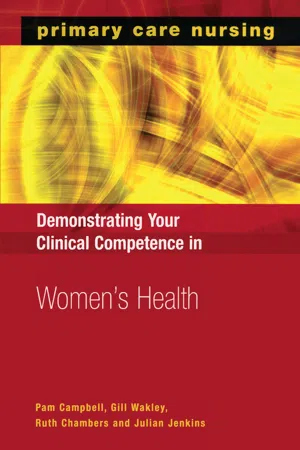
eBook - ePub
Demonstrating Your Clinical Competence in Women's Health
- 224 pages
- English
- ePUB (mobile friendly)
- Available on iOS & Android
eBook - ePub
Demonstrating Your Clinical Competence in Women's Health
About this book
Primary Care Nursing Series. All registered nurses are required to keep portfolios which demonstrate their competence in clinical practice in order to receive re-registration with the Nursing and Midwifery Council. In addition, they are encouraged to seek individual annual appraisals which highlight their progress and areas the require development. This book provides examples and ideas on how to document learning, competence, performance or standards of service delivery. Presented in an easy-to-read style, with practical suggestions to improve clinical care, it enables readers to expand their clinical knowledge as well as enabling them to demonstrate their level of expertise through portfolio work, focusing on the area of women's health. It highlights the most appropriate evidence to prove competency and expertise, and provides the information to identify areas of strength and weakness, suggesting ways in which clinical care can be improved and explains how to gather evidence for clinical interactions and other aspects of daily work. All nurses working in primary care with an interest in women's health, including practice nurses, health visitors, community midwives, school nurses, district nurses, occupational health nurses and sexual health nurses will find this book essential reading. For more information on other titles in this series please click here
Information
1
Making the link: personal development plans, post-registration education and practice (PREP) and portfolios
The process of lifelong learning
The professional regulatory body for nursing, the Nursing and Midwifery Council (NMC), has stated within the Professional Code of Conduct (2002) that all registered nurses must maintain their professional knowledge and competence.1 The code states ‘you should take part regularly in learning activities that develop your competence and performance’. This means that learning should be lifelong and encompass continuing professional development (CPD). The formal requirements for nurses to re-register state that nurses must meet the post-registration education and practice standards (PREP). This includes completion of 750 hours in practice during the five years before renewal of registration, together with evidence that the nurse has met the professional standards for CPD. This standard comprises a minimum of five days’ (or 35 hours’) learning activity relevant to the nurse’s clinical practice in the three years prior to renewal of professional registration.2 This requirement is seen as minimal by many nurses who would profess to undertake much more CPD than this in order to keep themselves abreast of current changes in practice. However, many nurses pay little attention to the recording of their CPD activity. This chapter will help you to identify a suitable format for recording learning that occurs in both clinical and educational settings.
Learning involves many steps. It includes the acquisition of information, its retention, the ability to retrieve the information when needed and how to use that information for best practice. Demonstrating your learning involves being able to show the steps you have taken. CPD takes time. It makes sense to utilise the time spent by overlapping learning undertaken to meet your personal and professional needs with that required for the performance of your role in the health service.
All nurses are required to maintain a personal professional portfolio of their learning activity. This is essential to maintain registration with the NMC.2 Many nurses have drawn up a personal development plan (PDP) that is agreed with their line manager. Some nurses have constructed their PDP in a systematic way and identified the priorities within it, or gathered evidence to demonstrate that what they learnt about was subsequently applied in practice. The NMC does not have a uniform approach to the style of a PDP. Some nurse tutors or managers are content to see that a plan has been drawn up, while others encourage the nurse to develop a systematic approach to identifying and addressing their learning and service needs, in order of importance or urgency.2
The new emphasis on lifelong learning for nurses has given the PDP a higher profile. Nurse educationalists view a PDP as a tool to encourage nurses to plan their own learning activities. Managers may view it as a tool that allows quality assurance of the nurse’s performance. Nurses, striving to improve the quality of the care that they deliver to patients, may want to use a PDP to guide them on their way, perhaps towards post-registration awards or towards gaining promotion opportunities.
Your personal development plan
Your PDP will be an integral part of your annual appraisal (sometimes referred to as an individual performance review) and your portfolio that is required by the NMC to demonstrate your fitness to practise as a nurse.
Your initial plan should:
- identify your gaps or weaknesses in knowledge, skills or attitudes
- specify topics for learning as a result of changes: in your role, responsibilities, the organisation in which you work
- link into the learning needs of others in your workplace or team of colleagues
- tie in with the service development priorities of your practice, the primary care organisation (PCO), hospital trust or the NHS as a whole
- describe how you identified your learning needs
- set your learning needs and associated goals in order of importance and urgency
- justify your selection of learning goals
- describe how you will achieve your goals and over what time period
- describe how you will evaluate learning outcomes.3
Each year you will continue or revise your PDP. It should demonstrate how you carried out your learning and evaluation plans, show that you have learnt what you set out to do (or why it was modified) and how you applied your new learning in practice. In addition, you will find that you have new priorities and fresh learning needs as circumstances change.
The main task is to capture what you have learnt, in a way that suits you. Then you can look back at what you have done and:
- reflect on it later, to decide to learn more, or to make changes as a result, and identify further needs
- demonstrate to others that you are fit to practise or work through:
- – what you have done
- – what you have learnt
- – what changes you have made as a result
- – the standards of work you have achieved and are maintaining
- – how you monitor your performance at work
- use it to show how your personal learning fits in with the requirements of your practice or the NHS, and other people’s personal and professional development plans.
Incorporate all the evidence of your learning into your personal professional profile (PPP). Evidence from this document will be needed if you are asked to take part in the NMC audit, which is designed to ensure that all nurses are complying with the PREP standard. It is up to you how you keep this record of your learning. Examples are:
- an ongoing learning journal in which you draw up and describe your plan, record how you determined your needs and prioritised them, report why you attended particular educational meetings or courses and what you got out of them, as well as the continuing cycle of review, making changes and evaluating them
- an A4 file with lots of plastic sleeves into which you build up a systematic record of your educational activities in line with your plan
- a box: chuck in everything to do with your learning plan as you do it and sort it out into a sensible order every few months with a good review once a year.
Using portfolios for appraisal/individual performance review and PREP
Appraisal is widely accepted in the NHS as a formative process that should be concerned with the professional development and personal fulfilment of the individual, leading to an improvement in their performance at work. It is a formal structured opportunity whereby the person being appraised has the opportunity to reflect on their work and to consider how their effectiveness might be improved. This positive interpretation of the appraisal process supports the delivery of high-quality patient care and drive to improve clinical standards. Appraisal has been in place in industry, commerce and public sectors for decades. In the NHS, nurses and other health professionals, managers and administrative staff are now all expected to undergo annual appraisals.
Nurses working in the health service should receive an appraisal or individual performance review at least once a year. This appraisal should include two main functions. Firstly, there should be an assessment of fitness to practise in the current role, and secondly there should be a review of the CPD that has taken place and that is needed for the future. This should focus on the needs of the individual together with the needs of the organisation for which the nurse works.
Details of how annual appraisals are structured will vary from one organisation to another, but the educational principles remain the same. The aims are to give nurses an opportunity to discuss and receive regular feedback on their previous and continuing performance, and identify education and development needs.
The United Kingdom Central Council (UKCC) first introduced in 1995 the need to demonstrate that you have undertaken meaningful learning activities, directly related to your nursing role. As the superseding professional body, the NMC has maintained this PREP requirement. When you apply to renew your registration as a nurse every three years, you are required to sign a notification of practice form that includes a declaration that you have met the PREP requirements. This means that your employer may be at liberty to ask to see your PPP that will show the learning activities undertaken and how these have influenced your work. The term portfolio and profile tend to be used synonymously in nursing. A helpful view on distinguishing between the two terms has been given by Rosslyn Brown who views the portfolio as encompassing the development of the individual as a whole (including both personal and professional perspectives) whereas the profile provides a more focused approach to the professional development and may be produced for a more clearly defined audience.4
The English National Board (ENB) stipulated that portfolios should be incorporated into pre-registration nursing programmes in 1997.5 This demonstrates that portfolios are designated as part of the culture of nursing. They should not be viewed simply as a tool for assessing outcomes of courses, but as meaningful documents that provide firm evidence of an individual’s journey and progression within nursing. You do not need to set out your portfolio in any specific format. In fact, one of the benefits of using a portfolio is that it allows you to be creative and to produce evidence about your practice in a way that reflects your individual style. However, there are certain elements that should be included. Quinn suggests six main areas:6
- factual information: e.g. qualifications, job description, etc
- self-evaluation of professional performance
- action plans/PDP
- documentation of any formal learning undertaken, such as courses attended, etc
- documentation of informal learning, such as reading journal articles that have altered your practice by providing a firm evidence base to follow
- documentation of hours worked between registration periods. This may be particularly important if you do not have a regular contract of employment.
A portfolio will provide evidence that you have complied with the NMC Code of Professional Conduct (2002). This clearly states that your professional knowledge must be maintained in the ways given in Box 1.1:1
Box 1.1: Nursing and Midwifery Council requirements for maintaining professional knowledge
- You must keep your knowledge and skills up to date...
Table of contents
- Cover
- Title Page
- Copyright Page
- Table of Contents
- Preface
- About the authors
- Chapter 1 Making the link: personal development plans, post-registration education and practice (PREP) and portfolios
- Chapter 2 Practical ways to identify your learning and service needs as part of your portfolio
- Chapter 3 Demonstrating common components of good quality healthcare
- Chapter 4 Women’s health and lifestyle
- Chapter 5 Contraception
- Chapter 6 Sexually transmitted infections
- Chapter 7 Managing infertility in primary care
- Chapter 8 Vaginal bleeding problems in primary care
- Chapter 9 The menopause
- Chapter 10 Teenager-friendly healthcare
- And finally
- Index
Trusted by 375,005 students
Access to over 1.5 million titles for a fair monthly price.
Study more efficiently using our study tools.
Frequently asked questions
Yes, you can cancel anytime from the Subscription tab in your account settings on the Perlego website. Your subscription will stay active until the end of your current billing period. Learn how to cancel your subscription
No, books cannot be downloaded as external files, such as PDFs, for use outside of Perlego. However, you can download books within the Perlego app for offline reading on mobile or tablet. Learn how to download books offline
Perlego offers two plans: Essential and Complete
- Essential is ideal for learners and professionals who enjoy exploring a wide range of subjects. Access the Essential Library with 800,000+ trusted titles and best-sellers across business, personal growth, and the humanities. Includes unlimited reading time and Standard Read Aloud voice.
- Complete: Perfect for advanced learners and researchers needing full, unrestricted access. Unlock 1.5M+ books across hundreds of subjects, including academic and specialized titles. The Complete Plan also includes advanced features like Premium Read Aloud and Research Assistant.
We are an online textbook subscription service, where you can get access to an entire online library for less than the price of a single book per month. With over 1.5 million books across 990+ topics, we’ve got you covered! Learn about our mission
Look out for the read-aloud symbol on your next book to see if you can listen to it. The read-aloud tool reads text aloud for you, highlighting the text as it is being read. You can pause it, speed it up and slow it down. Learn more about Read Aloud
Yes! You can use the Perlego app on both iOS and Android devices to read anytime, anywhere — even offline. Perfect for commutes or when you’re on the go.
Please note we cannot support devices running on iOS 13 and Android 7 or earlier. Learn more about using the app
Please note we cannot support devices running on iOS 13 and Android 7 or earlier. Learn more about using the app
Yes, you can access Demonstrating Your Clinical Competence in Women's Health by Pam Campbell,Gill Wakley,Ruth Chambers,Julian Jenkins in PDF and/or ePUB format, as well as other popular books in Medicine & Gynecology, Obstetrics & Midwifery. We have over 1.5 million books available in our catalogue for you to explore.