- 246 pages
- English
- ePUB (mobile friendly)
- Available on iOS & Android
eBook - ePub
About this book
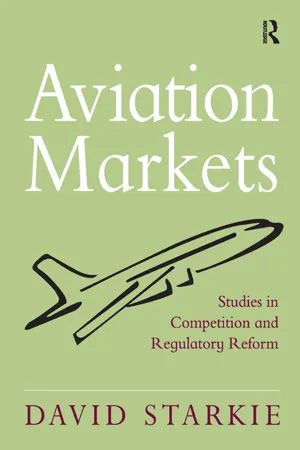
Aviation Markets: Studies in Competition and Regulatory Reform is a collection of 17 papers selected from David Starkie's extensive writings over the last 25 years. Previously published material has been extensively edited and adapted, and combined with new material, published here for the first time. The book is divided into five sections, each featuring an original overview chapter, to better establish the background and also explain the papers' wider significance including, wherever appropriate, their relevance to current policy issues. These papers have been selected to illustrate a significant theme that has been relatively neglected thus far in both aviation and industrial economics: the role of the market and its interplay with the development of economic policy in the context of a dynamic but partly price regulated industry. The result provides a strong flavour of how market mechanisms, and particularly competition, can operate to successfully resolve policy issues. The book will be of interest to academics and those engaged in the formulation of aviation policy, such as public administrators and consultants, as well as those working in the aviation industry. It is also relevant to economic studies in a more general context, particularly to students and practitioners in industrial organisation economics, including those studying and researching the public utility industries.
Information
PART I
Airline Competition
Overview
In 1949, the Australian federal government introduced what became known as the ‘Two Airline Policy’, initially by agreement but later endorsed by statute. This policy allowed only two airlines to operate trunk routes between the major cities and, for a time, it required the airline duopoly to operate identical equipment and to offer identical fares. In spite of some subsequent relaxation of constraints, by the 1980s the policy was much criticised for stifling competition and in 1987 the federal government announced its firm intention to remove restrictions on entry into inter-state aviation; it put the industry on three year’s notice. This changing policy was encouraged by a number of factors including an agenda of general de-regulation in Australia during the 1980s (see Starkie 1989). But, de-regulation of the US domestic aviation industry in 1979 was a potent factor and was used as an example by those Commonwealth states pressing for a change in federal policy. South Australia was one such state and it had taken steps some years before to lead by example: it had de-regulated intrastate aviation.
Chapter 1 is based on a detailed examination of this de-regulated air service market within South Australia undertaken by myself and Margaret Starrs, then of the South Australian Department of Transport, and the results formed part of the South Australian government’s case made in submissions to the federal authorities prior to the 1987 decision to de-regulate inter-state aviation. The chapter analyses what happened following de-regulation in South Australian with particular reference to the theory of contestable markets which was receiving much attention at that time. Many of the routes served sparsely populated remote areas with eight-seat Cessna 402s being the most common aircraft type. The analysis showed that new firms had entered the market, services had increased significantly, new routes had developed and, importantly, there was no apparent difference in the structure of fares on multi-firm and single firm (monopoly) routes. In the light of these findings we speculated that contestability theory might have been more robust than its critics had thus far acknowledged. Nevertheless, it remains an unusual if not unique study of competition in an air services market much of which was at the subregional (or ‘third’) level.
Chapter 2 turns attention to Europe and to the period immediately following the introduction, in 1993, of the ‘Third Package’ of measures liberalising European aviation. At that time, there was speculation on whether and how the liberalising measures would impact on the European scene and easy assumptions were being made based on events that had unfolded in the US in the (1980s) decade following de-regulation of the US domestic industry. The chapter takes a more considered view. It is a much abbreviated version of my 1993 contribution to the lecture series established at the beginning of the 1990s under the auspices of the Institute of Economic Affairs and London Business School by Professors Michael Beesley and Colin Robinson, and later known as the Beesley Lectures in honour of Michael Beesley, a former tutor of mine who greatly influenced my thinking. This 1993 contribution (not published until 1994) is one of three that I made to the series and another will be found at Chapter 5.
The focus of the piece is the hypothesis that the bilateral air service agreements that governed services within Europe prior to liberalisation in 1993, had embedded parts of the European market with a potentially competitive structure. This difference was evident in statistics that had been compiled for mid-1989 comparing European aviation (prior to the ‘Third Package’) with the situation in the United States at that time, (which was about a decade after de-regulation of the US industry). The statistics showed that the proportion of ‘thin’ or less dense markets in Europe served by more than one carrier was greater than the corresponding proportion in the US, probably as a result of the bilateral system that required services by at least one airline established at each end of an international route. In the chapter it is argued that this structural difference, existing at the outset of European liberalisation, could lead to a more competitive structure in Europe and thus help to offset those differences between Europe and the US (such as shorter and fewer dense routes in the former) that had the effect of increasing average costs per kilometre in European aviation. The chapter concludes by criticising the residual controls on airfares, specifically those applying to on-demand fares unencumbered by restrictions on use. In particular, it points out that the cost benchmarks, used by the European Commission when appraising such fares, are inappropriate in an environment where airport capacity is constrained and demand for its use is often subject to quantity rationing.
The final chapter in Part I, Chapter 3, switches attention to the United States and the issue of predatory conduct in the US airline industry. In April 1998 the US Department of Transportation published proposed guidelines on predatory conduct in the domestic aviation industry. The Department had come to the conclusion that unfair exclusionary practices had been a key reason why new low fare carriers had not been able to gain significant entry into concentrated hubs to compete with incumbents in the US market. It was of the view that a not untypical response by the incumbent to entry was to flood the market with additional low fare capacity. To counter such behaviour by incumbent airline(s), the DoT proposed to examine conduct on a case-by-case basis and to institute proceedings when it considered conduct to have been unreasonable. The DoT invited comments on its proposal and the chapter is based on my response, which was published subsequently in the European Competition Law Review.
The DoT’s regulatory proposal I thought intrusive and considered that the problem could be addressed in a more benign way. The essence of my counterproposal was that, in the event of an entrant subsequently exiting the market, the post-entry capacity (but not the price(s)) of the incumbent’s services was to be temporarily frozen or locked-in. The basic feature of the proposal was that it penalised only those incumbent airlines responding to entry by offering excessive capacity in relation to market demand; it continued to permit during the entry phase an unconstrained competitive response by the incumbent. Post exit, the incumbent would be free to fine-tune prices (fares) but the core price(s) would be driven by the extent of the capacity supplied to the market and it was this quantum that it was proposed should be temporarily frozen on exit of the entrant. This approach regulates with a very light touch because the competition authorities need only monitor post-exit capacity (aircraft seats) supplied to the market and this is a much easier task than monitoring prices (yields). This latter problem of information asymmetries was the Achilles heel of an earlier and superficially similar approach, unknown to me at the time, the essential idea of which was to commit the incumbent to a post-entry price (Baumol 1979). (A further weakness of the Baumol approach is that it does not prevent the incumbent reducing capacity to achieve a profitable outturn at the committed low level of fare(s) although, by doing so, the incumbent increases the scope for re-entry.)
In addition to the DoT, I also sent my submission to Professor Alfred Kahn, (the former Chairman of the US Civil Aeronautics Board) because of his particular interest in this subject and because I had previously worked with him in New Zealand on an aviation case. This led to extensive correspondence between us, wherein Professor Kahn tested my arguments at length. I was eventually able to convince him of the veracity of the approach proposed. This correspondence can be read in Chapter 15 of Forsyth et al. (2005).
Chapter 1
Contestability and Sustainability in Regional Airline Markets1,2
Introduction
The Australian airline market is closely regulated. The ‘two-airline’ policy affecting trunk routes is well known, but less appreciated are state controls imposed on regional and local aviation. These controls exist in four of the six states; Victoria and South Australia are the exceptions. This distinction between the states was of little consequence prior to 1979. Until then the Commonwealth government also controlled regional air transport using powers under the Air Navigation Act of 1920. But in 1979, as a result of the Domestic Air Transport Policy Reviews, the Commonwealth decided not to hinder the development of competition in regional air transport (BTE 1981, p. 113). The result has been a much more competitive environment in both Victoria and South Australia.3
This chapter focuses on South Australia and considers what has happened since 1979 by reference to recent developments in the theory of market structures. These developments stress ease of market entry and exit and have particular relevance to industries with mobile assets such as aircraft. The South Australian regional airline market provides a good basis for testing theory. The overall size of the market is limited, there is a number of low demand or ‘thin’ routes and there is a considerable range of stage lengths. The thrust of the chapter is empirical and descriptive but [first] we set out the theory of contestable markets [and then] we analyze in broad terms the current South Australian position, before […] focusing upon developments during the last four years. Finally, […] we consider the general performance of the South Australian industry with reference to the theory of contestable markets.
Contestability: A Brief Review of Theory
The major contribution of the ‘new’ theory of contestability has been to show that the structure of an industry – the number of competing firms – may have no bearing on the degree to which production will be efficient and welfare maximised. Traditional theory has assumed otherwise. As Baumol (1982) points out, the received theory of market structures tends to view efficiency as a monotonically increasing function of the number of firms in an industry, with unregulated monopoly and perfect competition representing polar cases.4 Conversely, the need to regulate to achieve an efficient price and output combination is seen by received theory to vary inversely with the number of firms; in an industry inclined towards pure monopoly (because of a limited size of market and substantial fixed costs leading to economies of scale), regulation is considered essential.
In contrast to this conventional viewpoint, the new theory of industrial structures revolves around the idea that the competitive pressures required for an efficient solution can come equally well from outside an industry. The key is an ability to contest for a market rather than to compete within it. This ability to contest depends upon the ease with which a firm can enter and exit from a market without cost which, in turn, depends particularly upon whether capital is mobile, irretrievably committed to producing a particular product. It is argued that the power of a firm to extract monopoly rents depends upon the extent to which production stems from immobile capital that is the extent to which the fixed costs of production are also ‘sunk’ costs. Sunk costs are costs facing a potential entrant which do not have to be paid once more by the incumbent; to the potential entrant they constitute a barrier to entry. On the o...
Table of contents
- Cover
- Half Title
- Dedication
- Title Page
- Copyright Page
- Table of Contents
- List of Boxes, Figures and Tables
- Preface
- Acknowledgements
- Part I: Airline Competition
- Part II: Airport Privatisation, Industry Structure and Regulation
- Part III: Economic Regulation: Some Issues
- Part IV: Airport Competition
- Part V: Infrastructure Access
- References
- Index
Trusted by 375,005 students
Access to over 1.5 million titles for a fair monthly price.
Study more efficiently using our study tools.
Frequently asked questions
Yes, you can cancel anytime from the Subscription tab in your account settings on the Perlego website. Your subscription will stay active until the end of your current billing period. Learn how to cancel your subscription
No, books cannot be downloaded as external files, such as PDFs, for use outside of Perlego. However, you can download books within the Perlego app for offline reading on mobile or tablet. Learn how to download books offline
Perlego offers two plans: Essential and Complete
- Essential is ideal for learners and professionals who enjoy exploring a wide range of subjects. Access the Essential Library with 800,000+ trusted titles and best-sellers across business, personal growth, and the humanities. Includes unlimited reading time and Standard Read Aloud voice.
- Complete: Perfect for advanced learners and researchers needing full, unrestricted access. Unlock 1.5M+ books across hundreds of subjects, including academic and specialized titles. The Complete Plan also includes advanced features like Premium Read Aloud and Research Assistant.
We are an online textbook subscription service, where you can get access to an entire online library for less than the price of a single book per month. With over 1.5 million books across 990+ topics, we’ve got you covered! Learn about our mission
Look out for the read-aloud symbol on your next book to see if you can listen to it. The read-aloud tool reads text aloud for you, highlighting the text as it is being read. You can pause it, speed it up and slow it down. Learn more about Read Aloud
Yes! You can use the Perlego app on both iOS and Android devices to read anytime, anywhere — even offline. Perfect for commutes or when you’re on the go.
Please note we cannot support devices running on iOS 13 and Android 7 or earlier. Learn more about using the app
Please note we cannot support devices running on iOS 13 and Android 7 or earlier. Learn more about using the app
Yes, you can access Aviation Markets by David Starkie in PDF and/or ePUB format, as well as other popular books in Tecnologia e ingegneria & Business generale. We have over 1.5 million books available in our catalogue for you to explore.