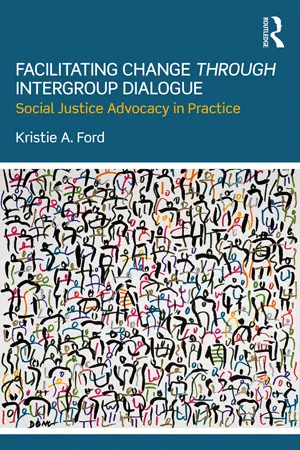
In order both to prepare for an increasingly diverse society and to help students navigate diverse learning environments, many institutions of higher education have developed programs that support student learning and competencies around inter- and intra-group relations. Facilitating Change through Intergroup Dialogue: Social Justice Advocacy in Practice traces the impact of Intergroup Dialogue (IGD) courses on peer-facilitators who delivered Skidmore College's IGD curricula over a five-year period. Through a series of in-depth qualitative interviews and auto-ethnographies, this book explores how former IGD facilitators are applying what they learned to their personal and professional lives three to five years post-college. By exploring facilitators' application of IGD skills, understanding of social justice, and the challenges inherent in this work, Facilitating Change through Intergroup Dialogue offers concrete strategies for supporting undergraduate students in their enduring efforts towards justice.
eBook - ePub
Facilitating Change through Intergroup Dialogue
Social Justice Advocacy in Practice
- 158 pages
- English
- ePUB (mobile friendly)
- Available on iOS & Android
eBook - ePub
Facilitating Change through Intergroup Dialogue
Social Justice Advocacy in Practice
About this book
Information
Part I
Contextualizing Intergroup Dialogue (IGD) Facilitation
1 Introduction
The Power of Dialogue
The work is the work … I am also human, and I am also doing the work internally too … I can’t turn away from it … it’s there … Social injustice keeps me motivated every day. (Jennifer)
Since Michael Brown, an unarmed Black teenager, was fatally shot by a White police officer in Ferguson, Missouri, in 2014, activism on U.S. college campuses has refocused public attention on racial inequities. Students continue to unite to raise awareness about racialized police brutality and shootings through Black Lives Matter rallies and Die-Ins (Natarajan, 2014). On an institutional level, students of color have also worked to highlight racial microaggressions, or the subtle daily comments or actions that communicate hostility towards people of color (Hunter, 2013, p. 62; Ross, 2015; Sue, Capodilupo, Torino, Bucceri, Holder, Nadal, & Esquilin, 2007), through campaigns like “I, Too, Am Harvard” (http://itooamharvard.tumblr.com/) and, more recently, #thisis2016 (Woo & Al-Hlou, 2016).
In 2015, support for student demands to improve the racial climate at the University of Missouri sparked similar protests across the country (Libresco, 2015). Since then, other grassroots movements have also emerged, including Black college athletes refusing to stand for the national anthem, controversy surrounding racialized mascots or buildings named after problematic historical figures, and free speech versus hate speech conversations in the wake of the 2016 Clinton-Trump presidential election (Bump, 2015; Dickerson & Saul, 2016; Dickey, 2016; Dreid & Najmabadi; Frosch & Audi, 2015; Kingkade, Workneh, & Grenoble, 2015; Hartocollis, 2016; Jaschik, 2016; Wong & Green, 2016).
In an analysis of the 51 colleges/universities with formal demands created by students, Libresco (2015) noted that 35 schools, or 69%, list mandatory diversity training for faculty and/or diversity-related classes for students as a top priority in hopes of improving campus race relations. Within this context, understanding the short-and long-term impact of race and social justice courses – courses that actively address the dynamics of power, privilege, and oppression in pursuit of a more equitable world – on student values and actions is essential.
As Nagda, Gurin, & Lopez (2003) stated, “universities and colleges serve as a pipeline, socializing and training prospective workers to fulfill economic interest. On the other hand, higher education institutions are also an arena for preparing citizens for a public democracy, for civic leadership and public service” (p. 165). Colleges and universities in the U.S. have a unique and multifaceted role in shaping the hearts and minds of students who enter their institutions (Nagda et al., 2003). From a functional perspective, they are tasked with the responsibility of instilling the skills that students will need to productively work in a global economy; from a more idealist perspective, they are also directly and indirectly preparing students to use their leadership abilities to make a difference in their communities (Nagda et al., 2003). In order to effectively teach students how to bridge content learning with hands-on experience, higher educational institutions are increasingly turning to applied social justice teaching practices including, but not limited to, service-learning, civic engagement, and inter-/intragroup dialogue (Diaz & Perrault, 2010; Engberg, 2004; Gurin, 1999; Mayhew & Fernandez, 2007). This book focuses specifically on inter-/intra-group dialogue (IGD) as one compelling form of social justice education (Ford, 2012; Ford & Malaney, 2012; Nagda et al., 2003; Nagda, Gurin, Sorensen, & Zúñiga, 2009; Nagda & Zúñiga, 2003; Nagda, Zúñiga, & Sevig, 1995; Sorensen, Nagda, Gurin, & Maxwell, 2009; Zúñiga, Nagda, Chesler, & Cytron, 2007). More concretely, in this book we explore how, if at all, 28 former IGD peer-facilitators are applying what they learned to their personal and professional lives three to five years post-college. We begin by providing an overview of relevant literature on social justice education and IGD; then, we outline the organization and objectives of our book.
Social Justice Education and Advocacy
Bell (1997) defined social justice in the following manner:
The goal of social justice education is full and equal participation of all groups in a society that is mutually shaped to meet their needs … [T]he process for attaining the goal of social justice … should be democratic and participatory, inclusive and affirming of human agency and human capacities for working collaboratively to create change (pp. 3–4).
Using Bell’s (1997) definition as a framework, Hackman (2005) articulated five key components connected to social justice education: (1) content mastery, (2) tools for critical analysis, (3) tools for social change, (4) tools for personal reflection, and (5) an awareness of multicultural group dynamics (pp. 103–104). Moreover, Landreman, Edwards, Balon, & Anderson (2008) argued that social justice educators must possess four competencies: knowing ourselves, knowing learners, designing outcomes-based activities, and co-creating facilitation (p. 3). Expanding upon this general framework, Mayhew and Fernandez (2007) contended that social justice education “centers the intersections of theory and practice (i.e., praxis) to intentionally consider process (e.g., teaching) and product (e.g., content, community action) in concert” (p. 61). In sum, ideally, social justice education should result in a cohort of students who have a nuanced sense of how to become social justice allies by “working with others to deconstruct systems of inequity” (Waters, 2010, p. 7). In other words, this approach should foster student empowerment and engagement in change actions based upon their social justice-related awareness, knowledge, and skills (Bell, 1997; Hackman, 2005; Landreman et al., 2008; Mayhew & Fernandez, 2007; Waters, 2010).
In addition, this body of literature focuses on the different stages of social justice advocacy and/or ally identity development (Broido, 2000; Broido & Reason, 2005; Edwards, 2006; Reason & Broido, 2005; Waters 2010). Edwards (2006), for instance, outlined three types of allyhood – allies for self-interest, altruism, and social justice: (1) allies for self-interest maximize their own gains within a racially structured society through individual interventions rather than acknowledging how they are implicated with the larger structural system of racism; (2) allies for altruism work for members of target groups, whom they sees as victims, in a (sometimes) patronizing effort to do the ‘right’ thing; and (3) allies for social justice work with members of oppressed groups, acknowledge their role in the racist system, and connect with other agent group members (adapted from Ford & Orlandella, 2015, p. 290). In the first and second types of allyhood, the focus remains on the self (“me”) or others (“them”); instead, when allying for social justice the organizing principle is around “us” and the need to empower and seek justice for everyone. Similarly, Waters’ (2010) model highlighted the three-stage maturation process required of racial justice advocates on cognitive, intrapersonal, and interpersonal levels. Focusing on White allies, stage one (the “initial” stage) is characterized by attributes like racial naiveté, adherence to dominant narratives, and homogenous (White) social networks. Stage two (the “intermediate” stage) involves increased awareness of differing social identities and perspectives, acknowledgement of systemic racial oppression and privilege, and fear of cross-racial interactions. Finally, the third stage (the “mature” stage) is distinguished by a “multifaceted, contextual, and culturally informed” world view (Waters, 2010, p. 5). During this developmental phase, allies have meaningful relationships with people of color, engage in anti-racist dialogue with other White people, and take action (Waters, 2010).
When conceptualizing an ally or justice-focused identity, however, it is also important to recognize the non-linear, fluid, and aspirational nature of this work that further complicates the practice of social justice (Edwards, 2006; Waters, 2010). As such, for the purposes of this book, we define social justice advocacy as the intentional, lifelong developmental process that people embark on, both individually and collectively, in hopes of creating a more just and equitable world around a range of social issues such as racism and white supremacy, classism, and heteropatriarchy.
Program on Intergroup Relations (IGR) and Inter-/Intra-Group Dialogue (IGD)1
A form of social justice education, the Program on Intergroup Relations (IGR) is a nationally recognized academic, credit-bearing program that originated at the University of Michigan in 1988 as a means of addressing racial tension (for more, see: www.igr.umich.edu). Its primary goal is to support student learning and competencies around inter-and intragroup relations, conflict, and social justice across a range of social identities, including race, gender, sexuality, social class, religion, and nationality. Since then, it has expanded to a number of other colleges and universities across the United States.
Under the umbrella of IGR, Intergroup Dialogue (IGD) is defined by Zúñiga, Nagda, Chesler, and Cytron (2007) as a facilitated, face-to-face encounter that aims to cultivate meaningful engagement between members of two or more social identity groups that have a history of conflict. A race dialogue, for instance, brings together People of Color and White People (POC/WHITE). The components that distinguish IGD from more traditional courses include (1) structured, small group interactions between two or more social identity groups, (2) engaged pedagogies that balance content and process knowledge, and (3) co-learning environment led by two trained peer-facilitators (Nagda, Gurin, Sorensen, & Zúñiga, 2009; Zúñiga et al., 2007). (Adapted and reprinted with permission of Taylor & Francis: Ford & Malaney, 2012.)
While IGD is the most common dialogue practice, Intragroup Dialogues, like the Multiracial Identity (MRID) or White Racial Identity (WRID), support the exploration of a single marginalized or privileged group identity (Adams, Bell, & Griffin, 2007). Structurally similar to POC/WHITE, in the MRID or WRID, students explore common experiences, issues of power, privilege, and oppression, and the meaning of their racial identities through an intersectional lens. While the curricula may slightly differ depending upon the focus of the dialogue, all the courses follow a four-stage pedagogical model,2 incorporate engaged learnin...
Table of contents
- Cover
- Half Title
- Title Page
- Copyright Page
- Dedication
- Contents
- List of Figures and Tables
- Foreword
- Acknowledgments
- List of Abbreviations
- PART I Contextualizing Intergroup Dialogue (IGD) Facilitation
- PART II IGD Facilitator Reflections
- PART III Beyond IGD Facilitation
- Contributors
- Index
Trusted by 375,005 students
Access to over 1.5 million titles for a fair monthly price.
Study more efficiently using our study tools.
Frequently asked questions
Yes, you can cancel anytime from the Subscription tab in your account settings on the Perlego website. Your subscription will stay active until the end of your current billing period. Learn how to cancel your subscription
No, books cannot be downloaded as external files, such as PDFs, for use outside of Perlego. However, you can download books within the Perlego app for offline reading on mobile or tablet. Learn how to download books offline
Perlego offers two plans: Essential and Complete
- Essential is ideal for learners and professionals who enjoy exploring a wide range of subjects. Access the Essential Library with 800,000+ trusted titles and best-sellers across business, personal growth, and the humanities. Includes unlimited reading time and Standard Read Aloud voice.
- Complete: Perfect for advanced learners and researchers needing full, unrestricted access. Unlock 1.5M+ books across hundreds of subjects, including academic and specialized titles. The Complete Plan also includes advanced features like Premium Read Aloud and Research Assistant.
We are an online textbook subscription service, where you can get access to an entire online library for less than the price of a single book per month. With over 1.5 million books across 990+ topics, we’ve got you covered! Learn about our mission
Look out for the read-aloud symbol on your next book to see if you can listen to it. The read-aloud tool reads text aloud for you, highlighting the text as it is being read. You can pause it, speed it up and slow it down. Learn more about Read Aloud
Yes! You can use the Perlego app on both iOS and Android devices to read anytime, anywhere — even offline. Perfect for commutes or when you’re on the go.
Please note we cannot support devices running on iOS 13 and Android 7 or earlier. Learn more about using the app
Please note we cannot support devices running on iOS 13 and Android 7 or earlier. Learn more about using the app
Yes, you can access Facilitating Change through Intergroup Dialogue by Kristie Ford, Kristie Ford,Kristie A. Ford, Kristie A. Ford in PDF and/or ePUB format, as well as other popular books in Education & Education General. We have over 1.5 million books available in our catalogue for you to explore.