Integrated Power Electronic Converters and Digital Control
eBook - ePub

Integrated Power Electronic Converters and Digital Control

  1. 350 pages
  2. English
  3. ePUB (mobile friendly)
  4. Available on iOS & Android
eBook - ePub

Integrated Power Electronic Converters and Digital Control

About this book

Because of the demand for higher efficiencies, smaller output ripple, and smaller converter size for modern power electronic systems, integrated power electronic converters could soon replace conventional switched-mode power supplies. Synthesized integrated converters and related digital control techniques address problems related to cost, space, flexibility, energy efficiency, and voltage regulation—the key factors in digital power management and implementation.

Meeting the needs of professionals working in power electronics, as well as advanced engineering students, Integrated Power Electronic Converters and Digital Control explores the many benefits associated with integrated converters. This informative text details boost type, buck type, and buck-boost type integrated topologies, as well as other integrated structures. It discusses concepts behind their operation as well specific applications.

Topics discussed include:


  • Isolated DC-DC converters such as flyback, forward, push-pull, full-bridge, and half-bridge


  • Power factor correction and its application


  • Definition of the integrated switched-mode power supplies


  • Steady-state analysis of the boost integrated flyback rectifier energy storage converter


  • Dynamic analysis of the buck integrated forward converter


  • Digital control based on the use of digital signal processors (DSPs)

With innovations in digital control becoming ever more pervasive, system designers continue to introduce products that integrate digital power management and control integrated circuit solutions, both hybrid and pure digital. This detailed assessment of the latest advances in the field will help anyone working in power electronics and related industries stay ahead of the curve.
Frequently asked questions

Yes, you can cancel anytime from the Subscription tab in your account settings on the Perlego website. Your subscription will stay active until the end of your current billing period. Learn how to cancel your subscription.
No, books cannot be downloaded as external files, such as PDFs, for use outside of Perlego. However, you can download books within the Perlego app for offline reading on mobile or tablet. Learn more here.
Perlego offers two plans: Essential and Complete
  • Essential is ideal for learners and professionals who enjoy exploring a wide range of subjects. Access the Essential Library with 800,000+ trusted titles and best-sellers across business, personal growth, and the humanities. Includes unlimited reading time and Standard Read Aloud voice.
  • Complete: Perfect for advanced learners and researchers needing full, unrestricted access. Unlock 1.4M+ books across hundreds of subjects, including academic and specialized titles. The Complete Plan also includes advanced features like Premium Read Aloud and Research Assistant.
Both plans are available with monthly, semester, or annual billing cycles.
We are an online textbook subscription service, where you can get access to an entire online library for less than the price of a single book per month. With over 1 million books across 1000+ topics, we’ve got you covered! Learn more here.
Look out for the read-aloud symbol on your next book to see if you can listen to it. The read-aloud tool reads text aloud for you, highlighting the text as it is being read. You can pause it, speed it up and slow it down. Learn more here.
Yes! You can use the Perlego app on both iOS or Android devices to read anytime, anywhere — even offline. Perfect for commutes or when you’re on the go.
Please note we cannot support devices running on iOS 13 and Android 7 or earlier. Learn more about using the app.
Yes, you can access Integrated Power Electronic Converters and Digital Control by Ali Emadi,Alireza Khaligh,Zhong Nie,Young Joo Lee in PDF and/or ePUB format, as well as other popular books in Technology & Engineering & Electrical Engineering & Telecommunications. We have over one million books available in our catalogue for you to explore.

chapter one

Non-isolated DC-DC Converters

The DC-DC converters are widely used in regulated switched-mode DC power supplies and DC motor drive applications. The input to these converters is often an unregulated DC voltage, which is obtained by rectifying the line voltage, and therefore it will fluctuate due to changes in the line voltage magnitude. Switched-mode DC-DC converters are used to convert the unregulated DC input to a controlled DC output at a desired voltage level [1].
The converters are very often used with an electrical isolation transformer in the switched-mode DC power supplies and almost always without an isolation transformer in the case of DC motor drives [2].
Buck (step down), boost (step up) converters and buck-boost are the basic converter topologies. There is a very wide choice of topologies available; each one has its own particular advantages and disadvantages, making it suitable for special power supply application [1], [2], [3], [4], [5] and [6]. Basic operation, advantages, drawbacks, and most common area of use for the most common topologies are discussed in the following sections.

1.1 Buck Converter

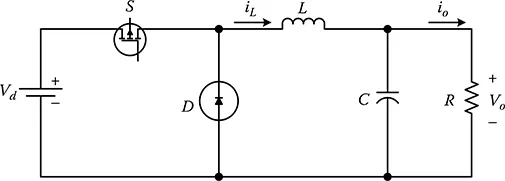
This is one of the non-isolated, very basic switching power supply topologies [3], [4]. The output voltage in this topology is always less than the input voltage and thus it is considered a buck converter. The power stage circuit is shown in Figure 1.1.
Depending on the current through the inductor L, the converter can be operated in two basic operating modes. One of them is continuous conduction mode (CCM) and the other is discontinuous conduction mode (DCM). The converter is said to be in CCM when the current through the inductor never reaches zero (for example, iL is always positive). On the other hand, if the inductor current reaches zero and stays zero for some time, the converter is said to be in DCM. The boundary between continuous and discontinuous conduction mode is known as critical continuous conduction mode (CCCM) or critical discontinuous conduction mode (CDCM).
When switch S is turned on, the input voltage is applied to inductor L and power is delivered to the output. Inductor current also builds up according to Faraday’s law. When the switch is turned off, the voltage across the inductor reverse and freewheel diode D becomes forward biased. This allows the energy stored in the inductor to be delivered to the output. This continuous current is then smoothed by output capacitor C.
Images
Figure 1.1 Buck converter.
The LC filter has an averaging effect on the applied pulsating input, producing a smooth DC output voltage and current, with very small ripple components superimposed. The average voltage-second across the inductor over a completer switch cycle must equal zero in the steady state.

1.1.1 Buck Converter in Continuous Conduction Mode

The operating mode starts when the switch is turned on. Here it is assumed that the converter is in continuous conduction mode and thus, initially, the inductor current is holding some minimum value. When the switch is on, negative voltage appears across the diode and it turns to off. Therefore, the current goes through the inductor. The inductor current increases line...

Table of contents

  1. Cover
  2. Half Title
  3. Title Page
  4. Copyright Page
  5. Dedication
  6. Table of Contents
  7. Preface
  8. Authors
  9. Chapter 1 Non-isolated DC-DC Converters
  10. Chapter 2 Isolated DC-DC Converters
  11. Chapter 3 Power Factor Correction
  12. Chapter 4 Integrated Switched-Mode Power Converters
  13. Chapter 5 Boost-Type Integrated Topologies
  14. Chapter 6 Buck-Type Integrated Topologies
  15. Chapter 7 Buck-Boost Type Integrated Topologies
  16. Chapter 8 Other Types of Integrated Topologies
  17. Chapter 9 Steady-State Analysis
  18. Chapter 10 Dynamic Analysis
  19. Chapter 11 Synchronous Rectification
  20. Chapter 12 Synchronous Rectification with Flyback and Forward Converters
  21. Chapter 13 Synchronous Rectification for Integrated High-Quality Rectifier-Regulators
  22. Chapter 14 Integrated Switched-Mode Power Supplies Applications
  23. Chapter 15 Review of Digital Control Techniques in Power Electronics
  24. Chapter 16 Implementation of Digital Control Using Digital Signal Processors
  25. Index