Since distribution systems account for up to 90% of all customer reliability problems, improving distribution reliability is the key to improving customer reliability. To make effective improvements, a basic understanding of distribution system functions, subsystems, equipment, and operation is required. This chapter presents fundamental concepts, terminology, and symbology that serve as a foundation of knowledge for reliability-specific topics. Careful reading will magnify the clarity and utility of the rest of this book.
1.1 Generation, Transmission, and Distribution
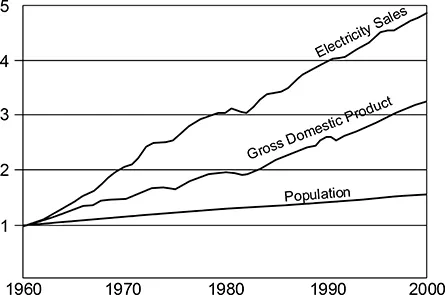
Electricity, produced and delivered to customers through generation, transmission and distribution systems, constitutes one of the largest consumer markets in the world. Electric energy purchases are 3% of the US gross domestic product and are increasing faster than the US rate of economic growth (see Figure 1.1). Numbers vary for individual utilities, but the cost of electricity is approximately 50% fuel, 20% generation, 5% transmission, and 25% distribution.
Reliable electric power systems serve customer loads without interruptions in supply voltage. Generation facilities must produce enough power to meet customer demand. Transmission systems must transport bulk power over long distances without overheating or jeopardizing system stability. Distribution systems must deliver electricity to each customer’s service entrance. In the context of reliability, generation, transmission, and distribution are referred to as functional zones.1
Figure 1.1 Growth of electricity sales in the US as compared to growth in gross domestic product and population (normalized to 1960 values). Electricity sales growth consistently outpaces population growth and GDP. Absolute energy usage is increasing as well as per-capita energy usage.
Each functional zone is made up of several subsystems. Generation consists of generation plants and generation substations. Transmission consists of transmission lines, transmission switching stations, transmission substations, and subtransmission systems. Distribution systems consist of distribution substations, primary distribution systems, distribution transformers, and secondary distribution systems. A simplified drawing of an overall power system and its subsystems is shown in Figure 1.2.
Generation Subsystems
Generation Plants produce electrical energy from another form of energy such as fossil fuels, nuclear fuels, or hydropower. Typically, a prime mover turns an alternator that generates voltage between 11 kV and 30 kV.
Generation Substations connect generation plants to transmission lines through a step-up transformer that increases voltage to transmission levels.
Transmission Subsystems
Transmission Systems transport electricity over long distances from generation substations to transmission or distribution substations. Typical US voltage levels include 69 kV, 115 kV, 138 kV, 161 kV, 230 kV, 345 kV, 500 kV, 765 kV, and 1100 kV.
Transmission Switching Stations serve as nodes in the transmission system that allow transmission line connections to be reconfigured.
Transmission Substations are transmission switching stations with transformers that step down voltage to subtransmission levels.
Subtransmission Systems transport electricity from transmission substations to distribution substations. Typical US voltage levels include 34.5 kV, 46 kV, 69 kV, 115 kV, 138 kV, 161 kV, and 230 kV.
Figure 1.2 Electric power systems consist of many subsystems. Reliability depends upon generating enough electric power and delivering it to customers without any interruptions in supply voltage. A majority of interruptions in developed nations result from problems occurring between customer meters and distribution substations.
Distribution Subsystems
Distribution Substations are nodes for terminating and reconfiguring subtransmission lines plus transformers that step down voltage to primary distribution levels.
Primary Distribution Systems deliver electricity from distribution substations to distribution transformers. Voltages range from 4.16 kV to 34.5 kV with the most common being 15-kV class (e.g., 12.47 kV, 13.8 kV).
Distribution Transformers convert primary distribution voltages to utilization voltages. Typical sizes range from 5 kVA to 2500 kVA.
Secondary Distribution Systems deliver electricity from distribution transformers to customer service entrances. Voltages are typically 120/240V single phase, 120/208V three phase, or 277/480V three phase.
1.1.1 Generation
Generation plants consist of one or more generating units that convert mechanical energy into electricity by turning a prime mover coupled to an electric generator. Most prime movers are driven by steam produced in a boiler fired by coal, oil, natural gas, or nuclear fuel. Others may be driven by nonthermal sources such as hydroelectric dams and wind farms. Generators produce line-to-line voltages between 11 kV and 30 kV.2
The ability of generation plants to supply all of the power demanded by customers is referred to as system adequacy. Three conditions must be met to ensure system adequacy. First, available generation capacity must be greater than demanded load plus system losses. Second, the system must be able to transport demanded power to customers without overloading equipment. Third, customers must be served within an acceptable voltage range.
System adequacy assessment is probabilistic in nature.3 Each generator has a probability of being available, a probability of being available with a reduced capacity, and a probability of being unavailable. This allows the probability of all generator state combinations to be computed. To perform an adequacy assessment, each generation state combination is compared to hourly system loads for an entire year. If available generation cannot supply demanded load or constraints are violated, the system is inadequate and load must be curtailed.
Generation adequacy assessments produce the following information for each load bus: (1) the combinations of generation and loading that require load curtailment, and (2) the probability of being in each of these inadequate state combinations. From this information, it is simple to compute the expected number of interruptions, interruption minutes, and unserved energy for each load bus. Load bus results can then be easily aggregated to produce the following system indices:
LOLE (Loss of Load Expectation) — The expected number of hours per year that a system must curtail load due to inadequate generation.
EENS (Expected Energy Not Served) — The expected number of megawatt hours per year that a system must curtail due to inadequate generation.
Most generation plants produce electricity at voltages less than 30 kV. Since this is not a sufficiently high voltage to transport electricity long distances, generation substations step up voltages to transmission levels (typically between 115 kV and 1100 kV). Current research utilizing high voltage cables in generators is able to produce electricity directly at transmission voltages and may eliminate the need for generation substations.
1.1.2 Transmission
Transmission systems transport electricity over long distances from bulk power generation facilities to substations that serve subtransmission or distribution systems. Most transmission lines are overhead but there is a growing trend towards the use of underground transmission cable (oil-filled, SF6 filled, extruded dielectric, and possibly superconducting).
To increase flexibility and improve reliability, transmission lines are interconnected at transmission switching stations and transmission substations. This improves overall performance, but makes the system vulnerable to cascading failures. A classic example is the Northeastern Blackout of November 9th, 1965, which left an entire region without electricity for many hours.
The North American Electric Reliability Council (NERC) was formed in 1968 as a response to the 1965 blackout to provide planning recommendations and operating guidelines for electric utilities. In 2007, NERC become the federal National Reliability Organization (NRO) under the Federal Energy Regulatory Commission (FERC). It changed its name to the North American Electric Reliability Corporation, and now has the authority to create and enforce federal reliability standards (including fines for noncompliance). The territory covered by NERC is divided into eight...