Natural attenuation has become an effective and low-cost alternative to more expensive engineered remediation. This new edition updates the principles and fundamentals of natural attenuation of contaminants with a broader view of the field. It includes new methods for evaluating natural attenuation mechanisms and microbial activity at the lab and field scales. Case studies, actual treatments and protocols, theoretical processes, case studies, numerical models, and legal aspects in the natural attenuation of organic and inorganic contaminants are examined. Challenges and future directions for the implementation of natural attenuation and enhanced remediation techniques are also considered.
eBook - ePub
Natural and Enhanced Attenuation of Contaminants in Soils, Second Edition
- 308 pages
- English
- ePUB (mobile friendly)
- Available on iOS & Android
eBook - ePub
Natural and Enhanced Attenuation of Contaminants in Soils, Second Edition
About this book
Information
1 | Managing Soil Contamination |
1.1 SITE AND SOIL CONTAMINATION
The label contaminated sites is often used to identify sites that have been found to have underlying soils that contain noxious substances that can cause serious injury to the immediate environment and its biotic receptors. These noxious substances are most often referred to as contaminants, pollutants and toxicants. They commonly occur in soils in connection with anthropogenic activities associated with the range of industries involved with the production of goods and services—including municipal and domestic services. Inadvertent spills, liquid and solid waste discharges, and waste containment and management strategies are also some of the sources of the contaminants.
For the discussions in this book, we will concentrate on the many aspects and factors that attend the application of natural and enhanced contaminant attenuation capabilities of soils for management and remediation of contaminated soils (in contaminated sites). Soil contamination is a central issue in contaminated ground since it is the mantle of the solid land mass that we call earth. To fully appreciate why soil contamination is a major issue and why managing implementation of remedial measures is also a major concern, two particular points need to be considered. Firstly, soils play a central role in sustaining life-support systems and all the other aspects associated with urbanization and industrialization, development and growth. Simply put, one could ask, “Why are soils so important a factor in our lives?” There are many answers to that one simple question—beginning with a realization of the fact that soil is not only a natural resource, but also a habitat and an essential element in the overall life-support systems of humankind, flora and fauna. In short, one needs to take into account the fundamental role and primary importance of soil in terms of a soil ecosphere in the overall context of a geoenvironment (see Figure 1.1). Soil is a natural capital of the geosphere and any degradation or reduction of its quality is a loss in its potential functionality. Two significant attributes of soil impacted by soil contamination are soil quality and site functionality. The term soil quality refers to the value of the soil in its many functional capabilities, i.e. what the soil can be used for, and the term site functionality refers to the many uses of site where the soil resides. These attributes, which describe the importance and role of soil in life supporting system, will be discussed in further detail in the latter part of this chapter.
Secondly, soil contamination degrades the value or usefulness of the site wherein the soil resides. The terms contaminated ground and contaminated site identify sites where soil contamination exists and where usefulness of the site (site functionality) is compromised. Further than that aspect is the potential of the contaminants in the contaminated site to become environmental mobile, thus presenting health threats to biotic receptors. These aspects will be discussed in brief in the latter part of this chapter and will be further discussed in the latter chapters of this book.
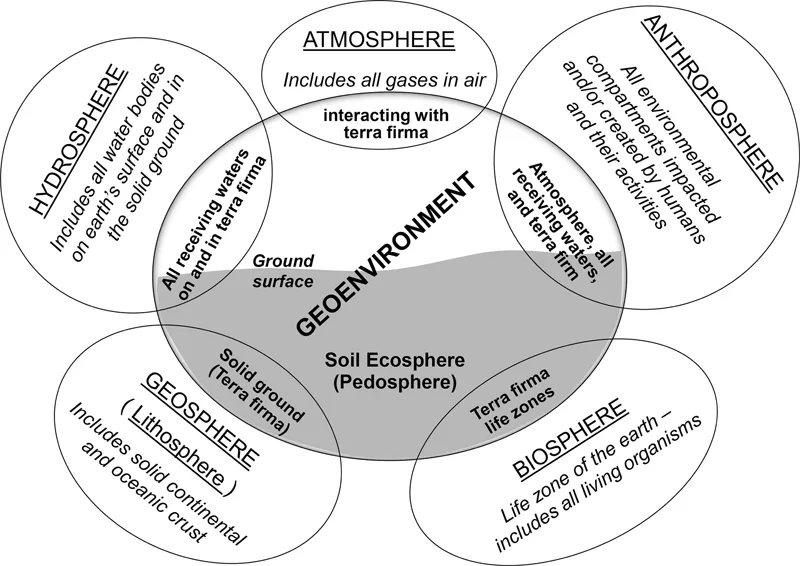
FIGURE 1.1 Venn diagram showing the various elements in the five ecosphere components (atmosphere, hydrosphere, geosphere, biosphere, and anthroposphere) that make up the geoenvironment. (From Yong, R.N. et al., Sustainable Practices in Geoenvironmental Engineering, CRC Press, Boca Raton, FL, 535, 2015.)
1.1.1 SOIL AND THE GEOENVIRONMENT
The term geoenvironment refers to the terra firma of the environment. Included in the geoenvironment are the receiving waters in the landscape, such as ponds, rivers, lakes, wetlands, estuaries, groundwater, and aquifers. The major constituent of terra firma is the soil ecosphere. Figure 1.1 shows the geoenvironment as a compartment consisting of various elements of the five ecosphere components (atmosphere, hydrosphere, geosphere, biosphere, and anthroposphere). These include a significant portion of the geosphere and portions of the atmosphere, hydrosphere, biosphere, and anthroposphere. The interactions of the elements from the different ecospheres in the land mass that contains the soil ecosphere create an environment that is specific to the land mass and all that lie within and on the land mass. This is what defines the geoenvironment. The soil ecosphere, which is the pedosphere, is the sum total of the interactions of the various compartments or ecospheres. This is the biophysical system wherein all the biotic and abiotic organisms in the various ecospheres interact, and is a system where the various individual elements and organisms interact singly or collectively to the advantage or detriment of the whole. It is easy to see why soil contamination is a condition that bears severe consequences. In essence, soil is an essential primary resource in the production of many of the goods required for life support.
The geosphere consists of the inorganic mantle and crust of the earth. These include the land mass, the oceanic crust, and the solid layers (soil and rock mass) stretching downward from the mantle and crust. The terra firma component of the geosphere forms the solid mass of the geoenvironment while the hydrosphere includes all forms of water on Earth such as the oceans, rivers, lakes, ponds, wetlands, estuaries, inlets, aquifers, groundwater, coastal waters, snow, ice, etc. Not all of these forms of water are in the geoenvironment. The geoenvironment contains all the receiving waters located within the terra firma in the hydrosphere. These include not only the rivers, lakes, ponds, inlets, wetlands, estuaries, coastal marine waters, groundwater, and aquifers, but also the coastal (marine) environment since these waters are impacted by the discharge of contaminants in the coastal regions from land surface runoffs, and discharge of polluted waters from rivers or streams.
The biosphere is the ecozone that contains all living organisms. However, only those life zones in or on terra firma from the biosphere are considered to be part of the geoenvironment. In respect to the geoenvironment, the elements of concern in the atmosphere are all the gases in air that interact with terra firma. Whilst the anthroposphere refers to all the ecospheres and their compartments impacted by humans and their activities, the geoenvironment aspects of the anthroposphere include only those compartments of the various ecospheres that interact with terra firma and its receiving waters.
1.1.2 CONTAMINANTS, POLLUTANTS, AND TOXICANTS
The terms contaminants, pollutants, and toxicants have been used in the literature in reference to perceived undesirable (noxious) substances on the ground surface and in the ground, e.g., contaminants in soil, pollutants in soil, contaminated ground, etc. without sufficient clarification as to the real import of the terms. These substances can include hazardous materials or elements, toxic substances, pollutants, and all other substances that are non-threatening to human health and the environment. For this book, the term contaminants used in the context of soil contamination refers to substances that are not indigenous to the location under consideration. More specifically, in the case of the soil ecosphere, the term contaminants refers to substances or materials that are not directly associated with soil formation, or simply put, “what soil is,” i.e., an accumulation of disintegrated rock fragments with particle sizes ranging from somewhere close to 100 mm to sizes that cannot be seen by the naked eye—less than 0.0001 mm (in the μm range)—obtained from the physical and/or chemical disintegration of rock. The subject of “what soil is” will be discussed in detail in Chapter 2.
Pollutants in soils are contaminants that have been or are classified by regulatory agencies as substances being harmful to the health of humans, other biotic receptors, and the environment. The toxic chemicals or compounds listed in the U.S. Environmental Protection Agency (EPA) Priority Pollutants List are good examples of pollutants associated with industrial activities which have been found in contaminated sites. These include chlorinated benzenes and ethanes, chlorinated phenols and naphthalenes, and pesticides—i.e., PCBs, PAHs, CHCs, VOC, POPs, etc. All pollutants are contaminants, but not all contaminants are pollutants.
Toxicants are contaminants that have been judged or classified by regulatory agencies as being toxic, and hence are harmful to human health and other biotic receptors. All toxicants are contaminants, but not all contaminants are toxicants. The discussions in this book will use the more general encompassing term contaminants in most instances, without necessarily meaning that these contaminants are pollutants or toxicants. When necessary, for emphasis or for clarity, the terms pollutants and/or toxicants will be used.
1.2 SOURCES OF CONTAMINANTS FOUND IN CONTAMINATED SITES
While the greater proportion of contaminants found in soils underlying contaminated sites in the natural landscape of the geoenvironment and in developed environments is to a very large extent directly or indirectly associated with anthropogenic activities, one should be aware that geogenic contaminants do exist as a natural consequence of soil formation and weathering. Natural causes or events can result in contaminating ground surface and/or soil, for example such phenomena as earthquakes, floods, tornadoes, landslides, and dust storms. The December 26, 2004, Banda Aceh and March 11, 2011, Fukushima earthquakes are good examples of not only sources of contaminants from distressed structures and infrastructures, but also sources of contaminants from the results of subsequent events, such as tsunamis and floods triggered by the earthquakes. The release of radioactive materials into the atmosphere from the explosions of Units 1, 2, and 3 of the Fukushima Daiichi Nuclear Power Plant buildings, in the period of March 12–15, 2011, resulted in contamination of ground surfaces by these same materials. Radioactive nuclides such as Kr, Xe, I, Cs, Sr, Ru, and Ce, released into the atmosphere contaminated a wide area of the surrounding land surface (Nakano and Yong, 2013). Radioactive cesium 137Cs, because of its strong photon energy and long half-life, is a pollutant of considerable concern, not only because of its presence on the land surface but also because of the potential for transport (infiltration) into the underlying soil. Anecdotal reports estimate that about 20% of 137Cs released in the explosions were deposited on the land surfaces between 60 and 400 km from the power plant site.
Many of the anthropogenic-related actions responsible for direct and/or indirect contamination of the geoenvironment and soil in particular can be attributed to the operation of life-support industries and activities, and production of goods and services. Figure 1.2 shows some of these activities and how they contribute or result in contaminating the underlying soil. While many of these are not deliberately designed or intended to contaminate the geoenvironment and the soil, they nevertheless are consequences derived as a result of anthropogenic actions.
Human activities in development, growth, and support of industrialization and urbanization produce waste streams and discharges that if not properly treated and contained will contaminate the geoenvironment—meaning that they will ultimately contaminate the underlying soil. The construction and operation of tailings dams to contain discharged tailings from resource mining activities, and the establishment and management of landfills, waste isolation, and barrier systems are activities that require total capture of waste products. Unfortunately, mishaps and long-term system competence issues will result in the release of contaminants into the ground and the surrounding soil. Wastewater and solid waste discharge, spills, leaks, and other forms of discharges to the land environment, together with leachates escaping from landfills designed to contain wastes and other hazardous materials in the land environment, are notable sources of contaminants. Other sources of contaminants in soils can be traced to the use of chemical aids in agricultural (agro) industry practices and in pest control such as fertilizers, herbicides, insecticides, pesticides, and fungicides. Agricultural activities in conjunction with agro industry will produce farm wastes, animal wastes together with fertilizers, insecticides, pesticides, etc. Herbicides and pesticides are: (a) persistent in the environment, (b) highly mobile, and (c) can accumulate in the tissues of animals, producing a variety of ill effects. These will serve as non-point source contaminants that find their way into the ground and receiving waters of the geoenvironment.
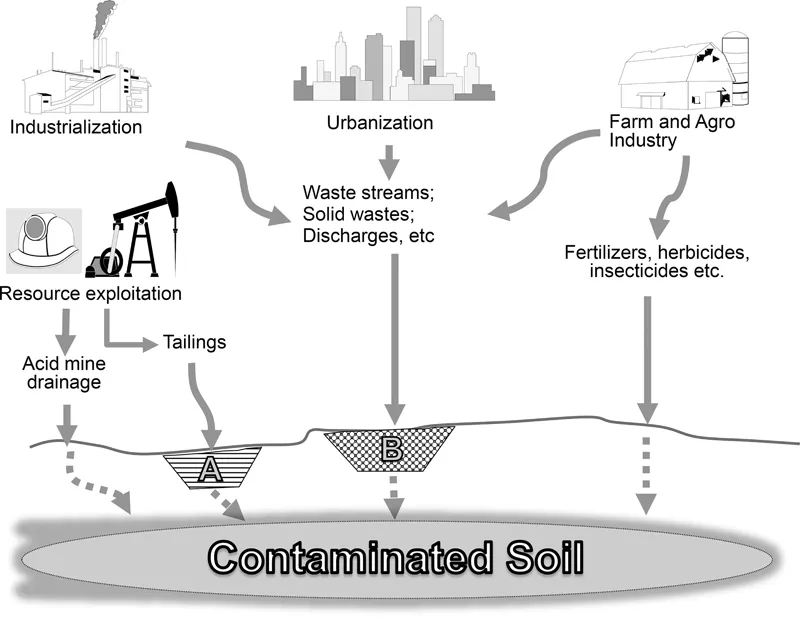
FIGURE 1.2 Sources of contaminants due to anthropogenic activities. Symbols A and B in trapezoids above Contaminated Soil refer to tailings pond (A) and waste landfill (B), respectively.
Table 1.1 gives a short account of some of the typical contaminants found in the waste streams of various industries, and Figure 1.3 gives a more detailed look at some of the kinds of discharges that find their way into the geoenvironment and the underlying soil. Some of the more common contaminants found in...
Table of contents
- Cover
- Half Title
- Title Page
- Copyright Page
- Table of Contents
- Preface
- Authors
- Chapter 1 Managing Soil Contamination
- Chapter 2 Nature of Soils
- Chapter 3 Soil-Water Relations
- Chapter 4 Natural Attenuation of Heavy Metals
- Chapter 5 Interactions and Fate of Organic Chemical Contaminants in Soils
- Chapter 6 Biological Transformation of Contaminants
- Chapter 7 Field Performance and Assessments
- Chapter 8 Application of Monitored Natural Attenuation
- Chapter 9 Monitored Natural Attenuation Enhancements
- Index
Trusted by 375,005 students
Access to over 1.5 million titles for a fair monthly price.
Study more efficiently using our study tools.
Frequently asked questions
Yes, you can cancel anytime from the Subscription tab in your account settings on the Perlego website. Your subscription will stay active until the end of your current billing period. Learn how to cancel your subscription
No, books cannot be downloaded as external files, such as PDFs, for use outside of Perlego. However, you can download books within the Perlego app for offline reading on mobile or tablet. Learn how to download books offline
Perlego offers two plans: Essential and Complete
- Essential is ideal for learners and professionals who enjoy exploring a wide range of subjects. Access the Essential Library with 800,000+ trusted titles and best-sellers across business, personal growth, and the humanities. Includes unlimited reading time and Standard Read Aloud voice.
- Complete: Perfect for advanced learners and researchers needing full, unrestricted access. Unlock 1.5M+ books across hundreds of subjects, including academic and specialized titles. The Complete Plan also includes advanced features like Premium Read Aloud and Research Assistant.
We are an online textbook subscription service, where you can get access to an entire online library for less than the price of a single book per month. With over 1.5 million books across 990+ topics, we’ve got you covered! Learn about our mission
Look out for the read-aloud symbol on your next book to see if you can listen to it. The read-aloud tool reads text aloud for you, highlighting the text as it is being read. You can pause it, speed it up and slow it down. Learn more about Read Aloud
Yes! You can use the Perlego app on both iOS and Android devices to read anytime, anywhere — even offline. Perfect for commutes or when you’re on the go.
Please note we cannot support devices running on iOS 13 and Android 7 or earlier. Learn more about using the app
Please note we cannot support devices running on iOS 13 and Android 7 or earlier. Learn more about using the app
Yes, you can access Natural and Enhanced Attenuation of Contaminants in Soils, Second Edition by Raymond N. Yong,Catherine N. Mulligan in PDF and/or ePUB format, as well as other popular books in Technology & Engineering & Ecology. We have over 1.5 million books available in our catalogue for you to explore.