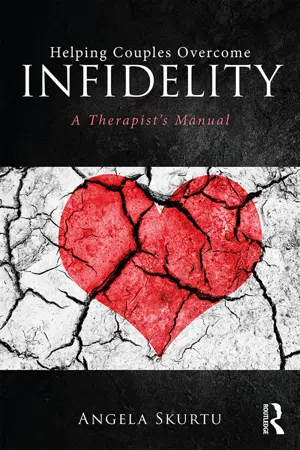
Helping Couples Overcome Infidelity provides clinicians with tangible, research-oriented intervention strategies that can guide couples through the aftermath of an affair. In the treatment of an affair, there are several key elements that couples need to work through as a team, including assessment, working through the crisis phase, rebuilding trust, acknowledging the pain infidelity causes, repairing relationship issues, creating a dynamic sex life, choosing to stay in or leave the relationship, and forgiveness. This book will cover nine milestones in detail and offer a framework for how clinicians can offer helpful treatment at each step. Also included are case studies of particularly challenging couples that the author has worked with and a section at the end of each chapter on therapist self-care.
- 114 pages
- English
- ePUB (mobile friendly)
- Available on iOS & Android
eBook - ePub
About this book
Information
Milestone 1 Reducing the Impact of the Affair
A middle-aged couple enters your therapy room. At first glance, they seem to be holding things together decently. They appear to be exchanging glances toward one another as they sit on your couch. As their therapist, you are not sure quite what the story is going to be, but you can definitely sense this is going to be a unique session. You ask your typical question, “What brings you into therapy today?” With another shared glance, the wife bursts into tears while the husband tries unsuccessfully to both console her and tell you their story. It was an affair. She found his texts with another woman on the phone just a week ago, and their lives have never been the same since.
For clinicians who regularly work with couples, this is not an uncommon story. In fact, for many clinicians this is rapidly becoming the most common case you work with. In my own therapeutic caseload, half of the clients I work with are in different stages of working through an affair. As a clinician you have a big job to help this couple, for many reasons. After an affair, couples experience many painful emotions. Initially, one of the most important tasks you can take is to help your clients avoid making the situation worse. Essentially, this chapter is meant to help you find ways to reduce the impact of the infidelity through crisis stabilization.
This task is incredibly important for several reasons, one being that emotions have a way of making people want to act in the moment. In dialectical behavior therapy (DBT), this is called “action urges” (Linehan, 1993). Each emotion a person experiences comes with a natural action urge. For example, anger has an action urge of wanting to fight or take flight. Sadness has the action urge of withdrawal/isolation or crying. The problem with an affair is that each individual partner in the relationship is likely experiencing multiple emotions at the same time – each one with its own natural action urges.
You will have clients who want to take action; serious actions that may not be the best choice during this high crisis situation. A big part of this chapter is meant to help you guide your clients not to act rashly. Ultimately, your job at the beginning of this type of therapy is to engage clients in crisis management, to validate each of their personal experiences with regards to the affair and the relationship, and to assess for various factors – historical, relational, and personal – that led to the affair and the resulting choices made.
Assessment
When you work with a couple affected by an affair, there are several aspects of the assessment process. First, you need to assess the damage that has been done. Was the affair long-term or short-term? How did the hurt partner find out about what happened? I try to go back and forth, asking each partner to add their part of the story. For example, when Linda and Bill came into session, Linda, the unfaithful partner, started the conversation. She explained that she had been texting other men through Craigslist and having long conversations without Bill knowing.
It is important to let each partner tell their story, but to also give a space for them to have some disagreements initially. It is quite common for the couple to go back and forth a little with their own ideas about the facts. One thing to assess here is how closely their stories align and what information is left to be explored. Some couples like Bill and Linda have already shared the entire story with each other and have already had multiple conversations about what happened and why. When you work with this client, a big part of your job is to start building trust with each partner and normalizing their experience. Building trust is one of the common factors associated with effective therapies (Sprenkle & Blow, 2004).
Other couples are engaged in holding patterns. The unfaithful partner doesn’t agree that it could be defined as an affair, while the hurt partner is actively trying to convince their partner of the fact that their action was an affair. In Gottman and Silver’s (2015) book, they describe this pattern as a cycle of criticism and defensiveness. The unfaithful partner feels criticized because they are accused of having an affair. They get defensive and turn the confrontation back around to the hurt partner, who becomes more hurt by the fact that their partner will not own up to their mistake. In cases like these, it can be helpful to see each partner in individual sessions to build trust without alienating the other partner. It is important to establish expectations about confidentiality as a couple if you divide clients, especially in the case of infidelity.
If you have a couple who doesn’t agree about what is considered an affair, it can be helpful to define an affair for them to rethink the issue. Essentially, an affair is simply a sexual or emotional relationship that took place outside of the partner’s awareness and would be considered a breach in the agreed upon relationship boundaries. Put another way, it is a “violation of relationship commitment in which sexual or emotional intimacy, or both is directed away from the primary relationship without consent of one’s partner” (Fife et al., 2013, p. 344). Another way of putting it is, “the breaking of trust and the keeping of secrets in an intimate partnership” (Schneider et al., 2012, p. 136).
Part of your assessment process may involve helping the unfaithful partner understand how their actions could be construed as an affair. The challenge is that sometimes the hurt partner has been badgering the unfaithful partner about this point. Even if they do finally agree that the choice they made was an affair, they may be angry about admitting it. As a clinician, you are walking a fine line between validating each partner without alienating the other partner.
Another aspect of assessment is to learn more about the couple as a whole. You should be asking questions about their lives before the affair. What brought them together? How long have they been committed or married? Do they have children? As you ask some of these questions, you may start to find out who knows what about the situation. Some couples want to share the information with the world, while others are so embarrassed that they have told no one.
Role of the Therapist
Helping couples work through an affair is notorious for being incredibly challenging. The reason is that essentially you are managing several roles all at once. Your clients need you to do all of the following: give advice; manage conflict; validate each partner for their individual experience; walk a tightrope between avoiding blame while also ensuring proper responsibility is taken; help them feel sane again; help them commit to therapy. This is a tall order to say the least. Let’s look at each role in more detail.
As an advice giver, your job is to try and clarify information for your clients in a way that helps them decide to move forward. It can help if you think of your client’s experience as an example of the grief cycle. An affair essentially is a huge loss for both parties. The hurt partner feels a loss for the relationship they once knew and understood. If they have just heard about the affair, you should assume they will be in shock and, potentially, be experiencing some denial, anger, and depression, or any of the components of the grief cycle. What they need at this time from you is guidance on what they should do next and how to manage this grief in a more productive way.
Another role is for you to manage conflict. Since we are discussing the milestone of reducing the impact, your clients need you to pay close attention to the different choices they could make that would cause harm. The longer you work with the problem, the easier it is to identify when something bad is likely to happen. For example, common bad choices people make at this time include: seeking revenge; telling every family member or friend without thinking about the consequences; having a revenge affair; having huge fights that really go nowhere and don’t help the situation; talking each other to death or to the point that the unfaithful partner is unapologetic. This list is by no means comprehensive.
When managing conflict, try to find ways to offer choices. Clients tend to respond best when they don’t feel forced to make any decision. I will say to clients,
It may not be a good idea to try to confront the “other” party at this time because things can get violent or ugly. However, I don’t know how I would handle myself in this situation. I respect your decision either way, but I am also trying to help you consider the consequences of your actions.
By putting the suggestion this way, I am offering both choices to the client while also respecting the painful grief they are experiencing.
Another role you must play is the supreme validator. We will cover this role in more depth in Chapter 2. Your job as a therapist is to help your clients feel understood and respected. However, you have to walk a very thin line in how you validate a couple addressing an affair. In every couples therapy session, couples need to feel respected and understood by their therapist. However, when you validate one partner, you can easily make the other partner feel alienated. One approach for avoiding this situation is to explain what you are doing to your clients so they know exactly what is going on. Here is an example of what I would say to a client,
My job is to validate both of you in therapy. If I validate one of you, I can alienate the other person. During sessions, I will point out times when I am doing this so you know that I am not necessarily taking your partner’s side and vice versa.
Once this is pointed out, then I can easily explain this at times when a partner starts to get defensive. I remind them validation is not necessarily taking someone’s side.
Finally, your job is to help the couple commit to therapy. “Affairs are considered by many experts to be one of the most damaging events for a relationship, second only to physical abuse” (Fife et al., 2013, p. 344). Since an affair is the ultimate betrayal for couples, many couples are left asking the question “Should I stay or should I go?” While we will cover this concept more in Chapter 4, at the beginning of therapy, your job is to take away the need to answer this question, at least for a while. I explain to my couples that in the first three months, most couples are very emotionally reactive. No one makes good decisions when they are highly emotional. Instead of choosing to stay in the relationship, sometimes you can get the couple to solely commit to therapy for the next few months (Fife et al., 2013). This can slowly help the couple to at least start taking steps forward.
This may seem like many roles, but the truth is that affair work is hard for this very reason. It can feel impossible because you need to become comfortable playing multiple roles. Once you are more aware of these roles, it becomes easier to identify which role to use when.
Helpful Interventions
Essentially, this chapter’s focus is on how to start the therapeutic process with clients in crisis after an affair. In Dupree et al.’s (2007) article about affair treatment, the authors suggest that the beginning of therapy is broken down into three main parts: de-escalation, assessment, and treatment planning. In the following section, I plan to cover a variety of tools/interventions that you can use as a therapist to perform these three things effectively. However, I encourage you to use these interventions as guides to build upon in your own practice.
Establishing a Timeline
Many couples who come into therapy are struggling with what they should feel. Am I normal? Why is this so hard? I hate him and I love him! I can’t stop thinking about this! I establish a rough timeline with couples of what they should expect at each stage of treatment. This timeline tends to help clients feel more comfortable through the process.
The timeline I describe looks like this:
You should expect the first three months to be the hardest. Most couples report feeling as though they are on an emotional roller coaster with really high highs and very low lows. During the first three months, your job is to try not to make the situation worse, but you will not do this perfectly. Next, during the three to six months after the initial phase, you will have longer periods of calm but still find yourselves going through emotional hurdles randomly. This will throw you off guard, but it is still completely normal. Often when this happens, couples will say things like, “we took three steps back!” You didn’t take three steps back, you are just going through the natural emotional ups and downs at a slower rate. Then from nine months and beyond, you will have longer bouts of peace, but will still find yourself getting triggered when certain things come up like special dates or cultural references that remind you of the affair.
One reason this timeline has been very helpful for my clients is that people come into therapy with unrealistic expectations for what it will take to improve the situation. The unfaithful partner usually wants a quick recovery and hates when the situation gets dragged up “again.” With this timeline in mind, they are able to reset their plan for what it may take to improve the situation. This timeline also helps the hurt partner feel like they don’t have to make a bunch of decisions right away, but they have time to figure out what is best for them.
This timeline comes from watching hundreds of clients work through the affair process. When they know what to expect, they feel less crazy. One thing I have observed is that in these first three months, the hurt partner does not trust any actions the unfaithful partner takes. After that three months passes, the hurt partner tends to become more receptive to relationship changes. I think this happens because after three months, they start to trust that their partner is not going to terminate the relationship.
Avoid Making Big Decisions
When people are emotionally reactive, they tend to make poor decisions. For example, I had a couple named Jim and Jane who were relatively logical people. They were in their early thirties, highly educated and had great senses of humor. However, when they got into a fight, it was as if they were completely different people. They would get very emotionally reactive and go on the defense. They would say mean things like, “I want a divorce,” or “You’re a terrible person!” When you would ask them if they really thought these things about their partner, they would often have a different story. They would report that this was happening out of anger, but that really they loved their partner very much and never wanted a divorce.
The difficult part about a couple going through an affair is that they have quite a few things to emotionally react to. For this reason, they are at a higher risk for making poor choices. One way to help a couple is to warn them of all the potential poor choices that people tend to make after an affair so they can avoid these choices. The following section will cover a few examples.
One thing couples do to make the situation worse is revenge affairs. For example, I had a couple named Charla and Timothy who had only been married for a year. Timothy had an affair about three months after they got married and Charla found out when Gina called to confess the mistake she had made. Charla then decided to go out for a night on the town without her wedding ring on and see if she could find a guy to have sex with her. She succeeded and then told Timothy what she had done. This started a new wave of arguments about who was right or wrong. She felt justified in that she did not cheat first. He felt deeply hurt because as he said, “Two wrongs do not make a right!”
While I understand the reason people want to take this sort of revenge, it usually only makes the situation worse. As a clinician, you can explain that while it is common for people to commit revenge affairs, if they want to work on things, they should refrain from taking this type of action.
Another bad decision people sometimes make is to commit violence of any kind against their partner or the “other” woman or man. Again, while it is understandable that an affair can produce serious feelings of hurt, anger, and jealousy, violence solves nothing and again makes the situation worse. As a clinician, you can suggest to your clients that if they want to commit an act of violence, they may need a safety plan to keep themselves from following through with the act, specifically because they can be imprisoned for the offense.
A third bad decision people sometimes make is to cleanse themselves of any physical reminders of the affair. For example, James found out that John had fallen in love with Chris and had been sexting with Chris for over six months in their bedroom while James was out of town for work trips. As a result, James wanted to remove everything in the house that reminded him of John’s affair. He wanted to burn the bed. He wanted to remove any clothes or underwear John might have worn during the affair. At one point, he even considered uprooting and moving out of their apartment.
While all of these wants are understandable, actually following through with these activities could prove quite costly. After the dust settles, sometimes people regret having made big decisions to move or give up a car. As a clinician, it can be helpful to explain that they should avoid making any big decisions like this until a few months have passed and they aren’t as emotionally reactive. Then, if they still want to purge when their reactivity is more controlled, they can make the choice at that time.
A final bad choice that is common is for the hurt partner to essentially “shit” on their partner constantly about the situation. To put it bluntly, they feel they have a right to constantly criticize, blame, and mistreat their partner. The hard thing is that they feel justified in this decis...
Table of contents
- Cover
- Half Title
- Title Page
- Copyright page
- Table of Contents
- Preface
- Acknowledgments
- Milestone 1 Reducing the Impact of the Affair
- Milestone 2 Acknowledgment of the Pain the Affair Caused
- Milestone 3 Clarity
- Milestone 4 Choosing to Stay or Leave
- Milestone 5 Repairing Unresolved Issues in the Relationship
- Milestone 6 Rebuilding Trust
- Milestone 7 Redefining the Relationship
- Milestone 8 Reclaiming a Healthy Sex Life
- Milestone 9 Forgiveness
- References
- Index
Trusted by 375,005 students
Access to over 1.5 million titles for a fair monthly price.
Study more efficiently using our study tools.
Frequently asked questions
Yes, you can cancel anytime from the Subscription tab in your account settings on the Perlego website. Your subscription will stay active until the end of your current billing period. Learn how to cancel your subscription
No, books cannot be downloaded as external files, such as PDFs, for use outside of Perlego. However, you can download books within the Perlego app for offline reading on mobile or tablet. Learn how to download books offline
Perlego offers two plans: Essential and Complete
- Essential is ideal for learners and professionals who enjoy exploring a wide range of subjects. Access the Essential Library with 800,000+ trusted titles and best-sellers across business, personal growth, and the humanities. Includes unlimited reading time and Standard Read Aloud voice.
- Complete: Perfect for advanced learners and researchers needing full, unrestricted access. Unlock 1.5M+ books across hundreds of subjects, including academic and specialized titles. The Complete Plan also includes advanced features like Premium Read Aloud and Research Assistant.
We are an online textbook subscription service, where you can get access to an entire online library for less than the price of a single book per month. With over 1.5 million books across 990+ topics, we’ve got you covered! Learn about our mission
Look out for the read-aloud symbol on your next book to see if you can listen to it. The read-aloud tool reads text aloud for you, highlighting the text as it is being read. You can pause it, speed it up and slow it down. Learn more about Read Aloud
Yes! You can use the Perlego app on both iOS and Android devices to read anytime, anywhere — even offline. Perfect for commutes or when you’re on the go.
Please note we cannot support devices running on iOS 13 and Android 7 or earlier. Learn more about using the app
Please note we cannot support devices running on iOS 13 and Android 7 or earlier. Learn more about using the app
Yes, you can access Helping Couples Overcome Infidelity by Angela Skurtu in PDF and/or ePUB format, as well as other popular books in Psychology & Mental Health in Psychology. We have over 1.5 million books available in our catalogue for you to explore.