Visual Leap is a how-to book for teachers, students and parents interested in making learning easier. In step-by-step fashion, it presents an effective, universal, visual method to teach students how to think independently and critically, and how to organize their ideas for any instructional purpose. The visual strategies are rooted in the science of human learning and are effective because they tap into the ways that we learn naturally.
The Visual Leap method simplifies teaching the skills of the Common Core State Standards and gives teachers explicit ways to differentiate instruction to meet the needs of all learners. The strategies work across many grade levels and subject areas and for a wide variety of instructional objectives across the curriculum, such as vocabulary acquisition, reading comprehension, writing, speaking, and listening.
Visual Leap offers easy ways to foster dynamic, creative, and critical thinking in the classroom, and provides teachers and students with a toolkit of problem-solving and learning strategies designed to serve them throughout their academic and professional lives.
“Visual Leap” is a metaphor and a prescription for a desperately needed shift in education. “Leap” symbolizes a transformation in the way we need to teach children, by refocusing on critical thinking and independent learning. “Visual” describes the type of strategies that our system must incorporate and promote. When I thought about it further, I realized that “leap” is also an acronym that stands for “learn, earn, achieve, perform.” I believe that these are the types of positive outcomes that we can expect from individuals who know how to use visual thinking strategically and deliberately.
Human beings possess a natural ability to think visually; it developed throughout our evolution and exists in the wiring of our brains. The purpose of this book is to provide a road map that helps teachers convey to students how to use this innate ability to make all kinds of learning easier and therefore maximize their intellectual potential. For students who learn these strategies, the tools may mean the difference between graduating and dropping out of school or college. For professionals—both teachers and students who have left school—the strategies become a set of tools for problem solving, innovating, and collaborating effectively. I challenge you to experiment with the methods and strategies in this book. Adapt them to your students’ needs and make them your own. It takes time, trust, and practice to add new tools to your teaching and learning toolkit, but these techniques are intuitive and surprisingly easy.
Visual Leap fits squarely in the constructivist camp long embraced by major educational organizations, including the Association for Supervision and Curriculum Development (ASCD), Center for Applied Special Technology (CAST), and International Society for Technology in Education (ISTE). Visual Leap strategies embody the central goal of the Common Core State Standards, which is to prepare students to be flexible thinkers who can reason, write, communicate, and adapt to the professional demands of an exciting and unpredictable future.
Chapter 1 discusses visual learning and introduces the term visual inquiry. Chapter 2 presents the cognitive science that forms the underpinning of the visual thinking strategies presented throughout the book. Chapter 3 explores the implications and imperatives of utilizing visual learning methods in the classroom.
Thank you for embarking on this journey with me. Let’s jump in!
CHAPTER 1
Visual Inquiry
How many times have you heard a person mention that she is a “visual learner”? This phrase means different things to different people, but to some degree all people are visual learners. The human brain is hardwired to think and learn visually. Our minds are pattern-seeking machines. This incredible mental asset makes the human brain the perfect tool for creativity and complex problem solving. We use our innate visual ability when we analyze and infer through observation and when we construct new objects by looking to see how others are built. It is possible, however, to use very similar visual processes to analyze ideas, understand concepts, communicate effectively, and even to write. This presents a powerful opportunity to make learning easier and more intuitive.
Consciously and strategically using our innate visual thinking ability to learn is a process I call visual inquiry. For our purposes, visual inquiry refers to a set of strategies that centers on the skill of creating meaningful, organized visual representations of ideas and concepts using webs and maps that show how ideas fit together. This book provides a step-by-step approach that explains how to do it, offers strategies for integrating visual inquiry into the classroom, and illustrates how to teach the skill to others. If we, as educators, can successfully transfer this skill to our students, we can transform learning.
Visual inquiry refers to a set of strategies that centers on the skill of creating meaningful, organized visual representations of ideas and concepts using webs and maps.
These visualizations can incorporate image, text, and spatial relationships. In some cases, depending on the tools used to make them, they can even utilize sound. Representations can be created with pencil and paper or with software, and with practice, they can be developed in the mind’s eye. The goal of visual inquiry is to allow the learner to analyze and represent information in an organized fashion so that it can be fully understood, evaluated, and analyzed. Visual inquiry is a highly creative process that involves free association, pattern recognition, and critical thinking. Though flexible, visual inquiry can be taught as a process that follows explicit guidelines, thus making it easy to teach, master, and use in diverse educational settings.
The most effective visual learning occurs when students create visualizations that follow a few broad principles and adhere to clear rules. Students can create diagrams collaboratively in groups, with teachers, or individually. The ideal workspace for visual thinking allows students to freely manipulate ideas like puzzle pieces. Many of my preferred tools for visual learning involve technology. Software programs such as Inspiration, apps such as Idea Flip, and web tools like Popplet—which allow users to combine pictures, text, and arrows to show visual relationships—are very good for this purpose, but so is pencil and paper. Most of the diagrams in this book were created using Inspiration Software, which is commonly used in many schools. In the resources section at the end of the book, you’ll find additional suggestions for software, apps, and books about visual thinking and learning.
As we will see more clearly in the chapters to come, using image, text, shape, and, in some cases, sound enables learners to take a nonlinear approach to thinking that utilizes the whole mind and matches the way human beings think and solve problems in the real world. We will prove this by visually mapping this process as it occurs in human communication. In doing so, we will identify the rules that govern this universally human way of learning and teach students how to apply those rules for diverse purposes. As teachers, we will know we have reached our goal of teaching students to think visually when they are able to diagram ideas for themselves and use those strategies independently. Then we will know we have given them a skill for life.
How Visual Learning Helps Students
Visual thinking has clear benefits in many curricular and skill development areas for students. According to analysis conducted by the Institute for the Advancement of Research in Education,1 visual learning techniques improve students’ ability to:
• Organize and analyze information
• Integrate new knowledge
• Clarify their thoughts
• Think critically
• Write with proficiency
• Retain information
• Comprehend what they are reading
• Understand and solve mathematical problems
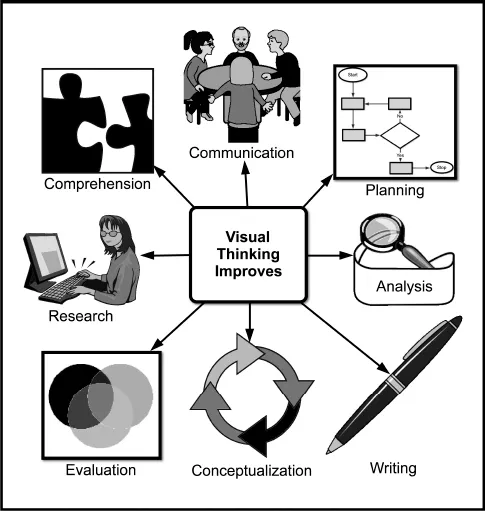
That list is compelling, but the benefits are even more basic. Visual inquiry provides a universal strategy for conceptualizing a problem. It helps learners see the big picture and analyze the evidence. For this reason, visual thinking helps at every phase of learning—from approaching a problem and developing a plan to seeing a project through to completion. This skill facilitates a learner’s ability to monitor her own progress and stay on track—or to get back on track when she gets derailed. Visual thinking decreases procrastination and increases perseverance. It helps the learner create a plan and provides a path for follow-through (fig. 1.1).
Students using visual thinking strategies learn to “see” their ideas develop and get a holistic picture of the entire scope of an idea, so they can more easily reflect on and assess their own thinking. Diagramming ideas—rather than writing them in sentence form—lets learners evaluate the strengths, weaknesses, sequence, and gaps in an argument without the distraction of punctuation, grammar, and spelling. For this reason, visual thinking is one of the most direct and powerful metacognitive strategies around.
FIGURE 1.1. Visual thinking improves achievement.
Mastering the process of visual inquiry will shave hours from students’ writing because it allows them to clarify their ideas before they begin to write. They will know their arguments are complete because they will see how ideas are connected. This method will allow them to organize and evaluate complex ideas and reveal relationships and patterns.
Working with ideas using a combination of image, space, and text helps students remember and assimilate information more effectively than when they simply see it written or hear it described. As students learn to represent ideas by combining multiple modalities—visual, spatial, textual, and auditory—they will make more connections, better understand relationships, and recall more information. Learning to think visually helps students become more creative, efficient, and effective learners. At all ages, whether as young children working on prewriting exercises or as older students tackling multifaceted projects and research papers, students can use visual inquiry to make complex tasks more manageable.
How Visual Learning Helps Teachers
Visual strategies help teachers as much as they help students. Why? Most students are comfortable learning visually, and when they are taught to think through problems in ways that engage their visual intelligence, they learn more easily. This book provides a simple method of working with content in order to make it accessible to students. As a benefit for the teacher, lesson planning becomes easier and faster, and classroom dialogue flourishes. When you begin to challenge students to think about problems visually, your teacher talk time will decrease and constructive student dialogue will increase.
Visual inquiry puts the messy job of learning squarely in the lap of students. Unlike teaching stalwarts like PowerPoint presentations, which are time-consuming to create and tend to put students in the passive role of recipient of information, visual strategies do the opposite. They thrust students into the role of the active learner who makes connections, pieces together understanding, and reaps the lasting benefit of assimilating new knowledge and learning how to learn. If this sounds scary or difficult, think again. It might well be the easiest and most impactful change you ever make to your teaching practice.
When you begin to challenge students to think about problems visually, your teacher talk time will decrease and constructive student dialogue will increase.
All students benefit from teaching that engages them in multiple ways. Visual inquiry methods offer a simple and effective strategy for reaching those students who learn best by working actively with information in multiple modalities that engage the whole mind. This group includes gifted students, students with ADHD or dyslexia, those on the autism spectrum, emerging readers and writers, and students functioning below grade level. These strategies support kinesthetic learners who thrive from direct interaction with content, visual-spatial learners who think primarily in pictures, as well as all types of divergent, nonlinear thinkers who need strategies to help them see relationships and make connections as they learn. The benefits of visual techniques are not limited to at-risk students. More traditional, auditory-sequential learners profit because these methods develop new thinking skills that strengthen less-used neural pathways. By augmenting their ability to think creatively, learn independently, and communicate ideas with others, they become more well-rounded, effective, and flexible thinkers.
Types of Visual Thinking
Visual thinking is individualistic—to a degree. Making meaningful representations of ideas requires learners to apply their own background knowledge, experience in the world, and personal preferences. However, universal rules guide the visual thinking process. There are many...
Table of contents
Cover
Half Title
Title Page
Copyright Page
Dedication
Table of Contents
Preface
Introduction: Why You? Why Now?
Part 1 Understanding the Visual Leap
Part 2 Putting Visual Inquiry into Practice
Part 3 Teaching Visual Thinking
Resources
Notes
Index
Acknowledgments
About the Author
Trusted by 375,005 students
Access to over 1.5 million titles for a fair monthly price.
Study more efficiently using our study tools.
Frequently asked questions
Yes, you can cancel anytime from the Subscription tab in your account settings on the Perlego website. Your subscription will stay active until the end of your current billing period. Learn how to cancel your subscription
No, books cannot be downloaded as external files, such as PDFs, for use outside of Perlego. However, you can download books within the Perlego app for offline reading on mobile or tablet. Learn how to download books offline
Perlego offers two plans: Essential and Complete
Essential is ideal for learners and professionals who enjoy exploring a wide range of subjects. Access the Essential Library with 800,000+ trusted titles and best-sellers across business, personal growth, and the humanities. Includes unlimited reading time and Standard Read Aloud voice.
Complete: Perfect for advanced learners and researchers needing full, unrestricted access. Unlock 1.5M+ books across hundreds of subjects, including academic and specialized titles. The Complete Plan also includes advanced features like Premium Read Aloud and Research Assistant.
Both plans are available with monthly, semester, or annual billing cycles.
We are an online textbook subscription service, where you can get access to an entire online library for less than the price of a single book per month. With over 1.5 million books across 990+ topics, we’ve got you covered! Learn about our mission
Look out for the read-aloud symbol on your next book to see if you can listen to it. The read-aloud tool reads text aloud for you, highlighting the text as it is being read. You can pause it, speed it up and slow it down. Learn more about Read Aloud
Yes! You can use the Perlego app on both iOS and Android devices to read anytime, anywhere — even offline. Perfect for commutes or when you’re on the go. Please note we cannot support devices running on iOS 13 and Android 7 or earlier. Learn more about using the app
Yes, you can access Visual Leap by Jesse Berg in PDF and/or ePUB format, as well as other popular books in Psychology & Education Standards. We have over 1.5 million books available in our catalogue for you to explore.