- 312 pages
- English
- ePUB (mobile friendly)
- Available on iOS & Android
eBook - ePub
Introduction to Food Biotechnology
About this book
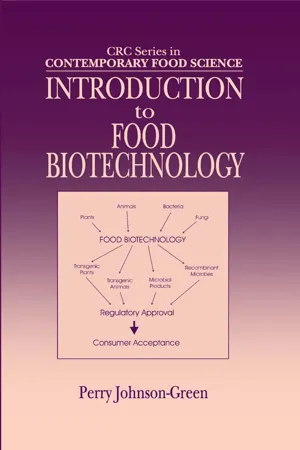
Universities throughout the US and the rest of the world offer Food Biotechnology courses. However, until now, professors lacked a single, comprehensive text to present to their students. Introduction to Food Biotechnology describes, explains, and discusses biotechnology within the context of human nutrition, food production, and food processing. Written for undergraduate students in Food Science and Nutrition who do not have a background in molecular biology, it provides clear explanations of the broad range of topics that comprise the field of food biotechnology.
Students will gain an understanding of the methods and rationales behind the genetic modification of plants and animals, as well as an appreciation of the associated risks to the environment and to public health. Introduction to Food Biotechnology examines cell culture, transgenic organisms, regulatory policy, safety issues, and consumer concerns. It covers microbial biotechnology in depth, emphasizing applications to the food industry and methods of large-scale cultivation of microbes and other cells. It also explores the potential of biotechnology to affect food security, risks, and other ethical problems.
Biotechnology can be used as a tool within many disciplines, including food science, nutrition, dietetics, and agriculture. Using numerous examples, Introduction to Food Biotechnology lays a solid foundation in all areas of food biotechnology and provides a comprehensive review of the biological and chemical concepts that are important in each discipline. The book develops an understanding of the potential contributions of food biotechnology to the food industry, and towards improved food safety and public health.
Information
Table of contents
- Cover Page
- Half Title
- Title Page
- Copyright Page
- Preface
- Author
- Table of Contents
- Chapter 1 The Scope of Food Biotechnology
- Chapter 2 Tools of the Trade
- Chapter 3 Gene Cloning and Production of Recombinant Proteins
- Chapter 4 Plant Biotechnology
- Chapter 5 Animal Biotechnology
- Chapter 6 Diagnostic Systems
- Chapter 7 Cell Culture and Food
- Chapter 8 Industrial Cell Culture
- Chapter 9 Ethics, Safety, and Regulation
- Index
Trusted by 375,005 students
Access to over 1.5 million titles for a fair monthly price.
Study more efficiently using our study tools.
Frequently asked questions
Yes, you can cancel anytime from the Subscription tab in your account settings on the Perlego website. Your subscription will stay active until the end of your current billing period. Learn how to cancel your subscription
No, books cannot be downloaded as external files, such as PDFs, for use outside of Perlego. However, you can download books within the Perlego app for offline reading on mobile or tablet. Learn how to download books offline
Perlego offers two plans: Essential and Complete
- Essential is ideal for learners and professionals who enjoy exploring a wide range of subjects. Access the Essential Library with 800,000+ trusted titles and best-sellers across business, personal growth, and the humanities. Includes unlimited reading time and Standard Read Aloud voice.
- Complete: Perfect for advanced learners and researchers needing full, unrestricted access. Unlock 1.5M+ books across hundreds of subjects, including academic and specialized titles. The Complete Plan also includes advanced features like Premium Read Aloud and Research Assistant.
We are an online textbook subscription service, where you can get access to an entire online library for less than the price of a single book per month. With over 1.5 million books across 990+ topics, we’ve got you covered! Learn about our mission
Look out for the read-aloud symbol on your next book to see if you can listen to it. The read-aloud tool reads text aloud for you, highlighting the text as it is being read. You can pause it, speed it up and slow it down. Learn more about Read Aloud
Yes! You can use the Perlego app on both iOS and Android devices to read anytime, anywhere — even offline. Perfect for commutes or when you’re on the go.
Please note we cannot support devices running on iOS 13 and Android 7 or earlier. Learn more about using the app
Please note we cannot support devices running on iOS 13 and Android 7 or earlier. Learn more about using the app
Yes, you can access Introduction to Food Biotechnology by Perry Johnson-Green in PDF and/or ePUB format, as well as other popular books in Technology & Engineering & Biotechnology. We have over 1.5 million books available in our catalogue for you to explore.