eBook - ePub
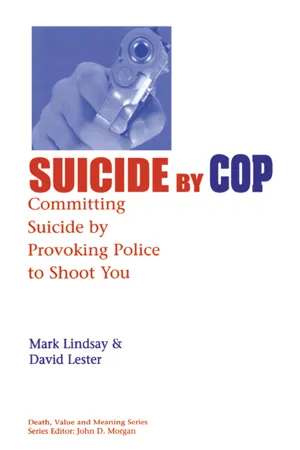
Suicide by Cop
Committing Suicide by Provoking Police to Shoot You
- 128 pages
- English
- ePUB (mobile friendly)
- Available on iOS & Android
eBook - ePub
About this book
This book examines what we know about the phenomenon of suicide by cop and places this behavior in a broader context. For example, some murder victims (perhaps as many as a quarter) provoke the murderer, to some extent, into killing them-so-called victim-precipitated homicide. In some cases, it has been suspected that murderers kill and act thereafter in such a way as to provoke the state into executing them. The authors then examine some of the issues specific to suicide by cop, such as whether there is a racial bias in these acts and what the legal implications are. Finally, they discuss the process of hostage negotiation (since those involved in suicide by cop often take hostages during the confrontation with police), the need to provide counseling for police officers involved in suicide-by-cop incidents, and how we might reduce the incidence of this behavior.
Information
SECTION 1
The Problem of Suicide-by-Cop
CHAPTER 1
Introduction
At 10.30 P.M. on November 14, 1997, 19-year-old Moshe Pergament, who was despondent over a $6,000 gambling debt, raced his new Honda Accord along the Long Island Expressway in a rainstorm for 40 minutes, sideswiping other cars. When officer Anthony Sica drew up behind him, with lights flashing, Pergament stopped his car, got out, and drew a gun. Officer Sica shouted for Pergament to drop the gun. Pergament held onto the gun and walked toward Sica. As Pergament drew closer, Sica shot him. The gun turned out to be a plastic replica of a .38 revolver. On the front seat of the Honda was a suicide note addressed “To the officer who shot me.” Rebecca Stincelli (undated) has reproduced the note.
Officer,
It was a plan. I’m sorry to get you involved. I just needed to die. Please send my letters and break the news slowly to my family and let them know I had to do this. And that I love them very much. I’m sorry for getting you involved. Please remember that this was all my doing. You had no way of knowing.
Moe Pergament.
The medical examiner ruled the death as homicide caused by gunshots, and the police report classified it as a justifiable homicide. These days we call it suicide-by-cop.
Sometimes the situation turns into a barricade incident. The offender may be killed by police or he may kill himself. Fuselier, Van Zandt, and Lancely (1991) reported the case of Jimmy Hyams, who on July 18, 1989, had a row with his daughter, Lisa, about her decision to move in with her boyfriend. His wife fled the house with their 7-year-old daughter, and Hyams shot Lisa with a .32 caliber semi-automatic pistol. He closed the door and held off the police for seven hours. He wounded a Suffolk County police officer and eventually killed himself.
The offender does not always get killed. Richard Parent (1998) described a case in August, 1989, in which an officer of the Royal Canadian Mounted Police in a suburb of Vancouver responded to a call about a drunken youth who was threatening his family with a knife. The 15-year-old teenager was hanging out of his broken bedroom window with a bayonet in his bloody hand. The officer entered the house, and the youth rushed the officer waving the bayonet. The officer retreated out to the driveway and back out into the street, pursued by the youth who was uttering threats. Other officers arrived, and the youth was subdued without further incident.
Although these kinds of incidents seem to be occurring with increasing frequency today, they are not a new phenomenon. Nor are they confined to North America. They are an interesting type of suicidal behavior, they often involve criminal behavior such as murder, and they present very difficult law enforcement problems. How should these individuals be handled, and can their lives be spared?
And what is often forgotten, these incidents cause tremendous trauma for the police officers involved. Officer Anthony Sica killed a man holding a toy gun. But he did not know this. Post-traumatic stress disorder is common for the police officers involved in these incidents, and counseling of the officer may be required if he or she is to continue to function effectively as a police officer.
This book will address the issues involved in suicide-by-cop and related phenomena. Chapter 2 will review the research on suicide-by-cop. What do we know about the phenomenon? In the second section (Suicide, Murder, and Cops), Chapters 3 and 4 will review other situations in which individuals commit suicide during confrontations with the police (typically by shooting themselves) and other situations in which police officers kill civilians (civilians who are not necessarily suicidal). These situations have some of the elements found in suicide-by-cop incidents, but differ in important ways.
In the third section (Looking at the Larger Context), we place the phenomenon of suicide-by-cop in a broader context. In Chapter 5, we review phenomena found in other cultures that resemble suicide-by-cop, such as “Crazy-Dog-Wishing-To-Die” among Native Americans in previous centuries. In Chapter 6, we review incidents of individuals running amok in America (or engaging in rampage murders, to use another term), and in Chapter 7, we review the literature on victim-precipitated murder in general. In Chapter 8, we explore the possibility that some murders seek suicide-by-execution, and in Chapter 9 we review the research on murder followed by suicide in general.
Section 4, the final section (A Look at the Issues) reviews some of the issues that suicide-by-cop raises for the criminal justice system. In Chapter 10, we discuss the racial issues involved in suicide-by-cop—does racial bias play a role? Chapter 11 presents some legal issues raised by such incidents. Chapters 12 and 13 discuss law enforcement issues, such as how to conduct hostage negotiations and whether police officers need counseling after being involved in such incidents. Finally, in Chapter 14 we discuss ways in which the incidence of suicide-by-cop might be reduced in our society.
CHAPTER 2
Suicide-By-Cop: What We Know
Suicide-by-cop refers to a situation in which, once police officers arrive on a scene, the individual purposely disobeys orders from the police to lay down his weapon and to surrender. The person then intentionally escalates the potential for the use of force by such acts as threatening the police officers or civilians in the area with a weapon, most commonly a gun. The police officers then are forced to escalate their response, often firing at the individual and killing the person in self-defense or to protect the civilians.
Suicide-by-cop is a lethal method of committing suicide because the would-be suicide knows that police officers are trained in the use of guns (and so in all likelihood will hit their target), are certain to have a gun, and will fire in life-threatening situations.
Richard Jenet and Robert Segal (1985) reported a typical case of suicide-by-cop. The perpetrator called 911 four times after 7 P.M. from a school reporting a burglary in progress. When the police arrived, they saw a man at the window who approached the front door. He opened it and fired one shot at the police officers. The stakeout unit and a police dog unit arrived and began to search the building. The suspect was spotted on the first floor, and he again fired a shot at the police and fled. The police dog detected the man on the second floor, whereupon he said, “I give up.” The officers secured the dog but, as the officers approached the man, he crouched down and pointed the gun at them. They shot and killed him. The weapon was a .22 caliber starter pistol and incapable of firing live cartridges.
The man turned out to be a male helper at the school, working split shifts. Seven months earlier, he had been admitted to a local psychiatric hospital after attempting suicide by cutting his wrists, and he was diagnosed as having a depressive neurosis.
Wilson, Davis, Bloom, Batten, and Kamara (1998) described an incident in which a 33-year-old white male was involved in a domestic dispute. When the police arrived, he went into his bedroom and pointed his rifle toward his own chest. He refused to come out, cocked and uncocked the rifle, and begged to be killed. The police tried to get his Rabbi and his psychiatrist to come and talk to him, but both refused. After an hour, police shot tear gas into the bedroom, and a police officer wearing a mask entered the room. The man tore the mask off the officer and shouted “I’ll kill you,” whereupon the officer shot and killed him.
In another case, a 21-year-old white male entered a police department with a loaded .357 Magnum pistol. He pointed it at the solitary police officer there and occasionally at himself, threatening to kill both of them. He fired two rounds and warned officers outside not to enter. He opened the door and fired at one officer but missed, whereupon two other officers shot and killed him. His blood alcohol level was 0.22%, and his urine indicated amphetamine use. He had been diagnosed as having a major depressive disorder and had previously attempted suicide several times.
Some cases of suicide-by-cop have unique features that may not be relevant to the other cases. For example, Bresler, Scalora, Elbogen, and Moore (2003) reported the case of a middle-aged man who attempted to provoke police officers into killing him (but failed to do so), who had a history of alcohol and substance abuse, and who had suffered severe brain trauma when hit by a truck while walking. After recovering from the coma and surgery, the man suffered from severe depressions and explosive rages. It was during one of his explosive rages that he fired his gun in his house and fled after his wife called the police. The police chased him to a wooded area whereupon he decided to kill himself by having the police shoot him in a gun battle. After an exchange of gunfire, he ran further into the woods and was eventually held at gun point by a farmer’s son, allowing the police to arrest him. The incidence of brain damage due to trauma is probably rare in most cases of suicide-by-cop, and so Bresler’s case has few implications for the phenomenon in general.
THE INCIDENCE OF SUICIDE-BY-COP
It is difficult to estimate the incidence of suicide-by-cop since there is no official “cause of death” which identifies this type of death. Robert Homant and Daniel Kennedy (2000a) reviewed surveys of incidents of suicide-by-cop and estimated that about 10 percent of incidents of deadly force involve suicide-by-cop. In 1990 in the United States, 289 people were killed by “legal intervention” using a firearm.1 If the 10 percent estimate for suicide-by-cop is valid, this suggests that about 29 incidents of suicide-by-cop might have occurred that year.2 In contrast, in 1990 there were 30,484 suicides in the United States (18,185 using firearms) and 25,144 homicides (17,498 using firearms).
THE MOTIVATION FOR SUICIDE-BY-COP
Clinton Van Zandt (undated) described the profile of the typical suicide-by-cop as follows. He is from the lower social classes and uses aggression as a way of responding to problems. He is seeking death because of depression and guilt, despair, or a desire to punish society for the wrongs it has committed against him. His philosophy of life leads him to view suicide as an unacceptable way of dying, whereas forcing others to kill him is acceptable because this makes him a victim of other people’s aggression. Thus, he will provoke the police to kill him, even to the extent of killing innocent people or police officers.
If he has killed a significant other prior to the confrontation with the police, then his death at the hands of the police may serve as a punishment for his crime. This suggests that, although he has apparently rebelled against the norms of society, especially in his violent behavior, he has internalized the values of the society, values which demand that criminal behavior be punished.
Kris Mohandie and Reid Meloy (2000) saw the possible motivations for suicide-by-cop as 1) an attempt to escape the consequences of criminal or shameful behavior, 2) using the confrontation with the police to try to reconcile with a significant other (such as a lover), 3) hoping to avoid the exclusion clauses in insurance policies which operate for the first year or two of taking out the policy,3 4) overcoming the moral prohibition against committing suicide, and 5) choosing an efficient method for suicide.
They gave an example of this type of suicide-by-cop incident. A civilian police department employee showed up at his estranged wife’s house, drunk, in order to try to reconcile with her. She let him in to use the bathroom, but then he refused to leave. She threatened to call the police, but he called them first and hung up on the dispatcher. When the police arrived, he grabbed a replica of a gun, but his son talked him out of confronting them. He was taken away for a psychiatric examination.
Mohandie and Meloy suggested that suicide-by-cop could be viewed as an expressive behavior; for example, a means of expressing hopelessness, depression, and desperation, a view of himself as a victim, a need to save face by being forcibly overwhelmed rather than surrendering, a need for power, a way to express feelings of rage and revenge, or a need to draw attention to himself or to his issues. To illustrate this type of suicide-by-cop incident, they presented the case of a man who had been evicted from his house and who had recently lost both parents and a son. He was sporadically unemployed, drank a lot, and was described by associates as “down in the dumps.” He confronted the police with a rifle and was shot to death. His manner of death expressed his hopelessness and his view of himself as a victim.
Vernon Geberth (1993) suggested that the two main motives for suicide-by-cop are that having another to kill you lessens 1) the sinfulness of the act and 2) the stigma associated with suicide. Some perpetrators are seeking punishment for their sins, real or imagined, while others do not have the courage to end their lives themselves. Some perpetrators may be seeking publicity in their deaths and so behave in a grandiose manner. Geberth also suggested a role for unconscious motives in that the police officer who kills and thereby punishes the perpetrator may be a surrogate or stand-in for the perpetrator’s parents whom the perpetrator hated. The perpetrator ensures his own self-destruction and forces the police officer (who symbolizes a surrogate pa...
Table of contents
- Cover
- Title Page
- Copyright Page
- Table of Contents
- SECTION 1 The Problem of Suicide-By-Cop
- SECTION 2 Suicide, Murder, and Cops
- SECTION 3 Looking at the Larger Context
- SECTION 4 Suicide-by-Cop: A Look at the Issues
- References
- Index
Trusted by 375,005 students
Access to over 1.5 million titles for a fair monthly price.
Study more efficiently using our study tools.
Frequently asked questions
Yes, you can cancel anytime from the Subscription tab in your account settings on the Perlego website. Your subscription will stay active until the end of your current billing period. Learn how to cancel your subscription
No, books cannot be downloaded as external files, such as PDFs, for use outside of Perlego. However, you can download books within the Perlego app for offline reading on mobile or tablet. Learn how to download books offline
Perlego offers two plans: Essential and Complete
- Essential is ideal for learners and professionals who enjoy exploring a wide range of subjects. Access the Essential Library with 800,000+ trusted titles and best-sellers across business, personal growth, and the humanities. Includes unlimited reading time and Standard Read Aloud voice.
- Complete: Perfect for advanced learners and researchers needing full, unrestricted access. Unlock 1.5M+ books across hundreds of subjects, including academic and specialized titles. The Complete Plan also includes advanced features like Premium Read Aloud and Research Assistant.
We are an online textbook subscription service, where you can get access to an entire online library for less than the price of a single book per month. With over 1.5 million books across 990+ topics, we’ve got you covered! Learn about our mission
Look out for the read-aloud symbol on your next book to see if you can listen to it. The read-aloud tool reads text aloud for you, highlighting the text as it is being read. You can pause it, speed it up and slow it down. Learn more about Read Aloud
Yes! You can use the Perlego app on both iOS and Android devices to read anytime, anywhere — even offline. Perfect for commutes or when you’re on the go.
Please note we cannot support devices running on iOS 13 and Android 7 or earlier. Learn more about using the app
Please note we cannot support devices running on iOS 13 and Android 7 or earlier. Learn more about using the app
Yes, you can access Suicide by Cop by Mark Lindsay,David Lester, PhD. in PDF and/or ePUB format, as well as other popular books in Psychology & Social Policy. We have over 1.5 million books available in our catalogue for you to explore.