eBook - ePub
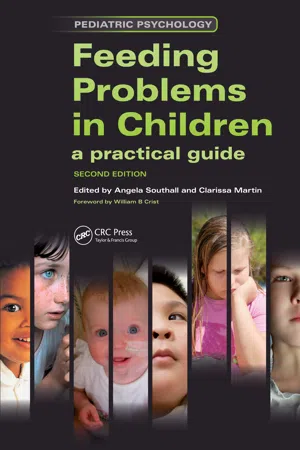
Feeding Problems in Children
A Practical Guide, Second Edition
- 374 pages
- English
- ePUB (mobile friendly)
- Available on iOS & Android
eBook - ePub
About this book
Feeding problems in children are relatively common, and often resolve themselves with little need for intervention. However, some categories of feeding problem are severe, persistent, and may be life-threatening without skilled involvement by professionals, including medical and surgical intervention. This revised and expanded Second Edition of Feeding Problems in Children deals with these severe and persistent problems, summarising the different kinds of work undertaken with children and their families in a number of countries. It first discusses the theoretical frameworks and perspectives, before moving on to explore clinical and applied research aspects of children's feeding. Finally, a comprehensive Clinical Practice Toolkit has been added to this edition, providing clinical models, checklists, model forms and reports. Featuring contributions from well-known international experts in the field, comprehensive and fully referenced, this book continues to be essential reading for all those practising or training in paediatrics in primary or secondary care, including paediatricians, GPs, gastroenterologists, psychologists, psychiatrists, therapists, paediatric nurses, health visitors and allied health professionals. 'Given the multi-cultural composition of today's communities, the decision by Drs Southall and Martin to include a chapter on cultural aspects to feeding was most insightful. This book, with its comprehensive coverage of the issues and a practical Toolkit with examples of materials from a multi-disciplinary practice, makes an essential contribution to the education of frontline clinicians dealing with feeding problems in young children.' - from the Foreword by William B Crist From reviews of the First Edition: 'A detailed guide, extensively referenced' FAMILY MEDICINE 'A useful addition to a hospital library or multi-disciplinary paediatric library' PHYSIOTHERAPY JOURNAL
Information
Part I Approaches
1 The development and disruption of feeding skills in babies and young children
Mary. Wickenden
Introduction
This chapter outlines the normal development of feeding skills from conception to 3 years as a foundation for looking at the ways in which this development may be disrupted either during these early stages or subsequently. It examines a number of situations where multi-disciplinary intervention may be necessary to help the child to eat and drink as normally as possible, and thus thrive. Feeding is of course a complex and biopsychosocial process that can be disrupted in a number of ways throughout childhood. However, in the early months and years, it is important to understand the normal development of oromotor and oral sensory skills, and where appropriate assessment of these skills, in order to gain an overall picture of the child with possible feeding problems. Additionally, specific assessment of the child's parallel overall development, in particular gross motor and communication skills, may reveal important factors that contribute to a wider view of the problem. Sometimes assessment of a child's oromotor skills is necessary to exclude neurological difficulties, and so enable a focus on sensory and experiential, or move overtly psychological or environmental aspects of the feeding problem.
It is often difficult to isolate any specific oral problems from the perhaps much more obvious developmental and or behavioural difficulties that may abound and this is when a multi-disciplinary approach becomes crucial. Previously, there was a tendency to categorise children with no obvious oromotor problems as having a 'behavioural feeding problem'. However, this dichotomous categorisation has not proved very helpful, as it immediately raises further questions about why these children are apparently poor feeders or actively 'anti-feeding'. The possibility of very real sensory disturbance either as a soft neurological effect or as a result of experience is now acknowledged as contributing to some children's feeding problems. Thus, the child's inability to respond normally to sensation (i.e. either over or under-responding or both) needs to be considered as the possible, less easily identified root of the difficult behaviour, which is more obvious. This is not to say that primary psychological causes of feeding problems do not exist (and they are discussed amply elsewhere in this book) but that caution should be exercised when ruling out subtle oral-motor or oral-sensory disorders. 'Behavioural' resistance to mealtimes may have its origins in difficulty with the movements and sensations of eating and drinking and may be linked to particular medical diagnoses and experiences.
In order to appreciate the often multi-factorial nature of feeding problems, it is necessary to understand something of the development of the skills needed for eating and drinking. An overview of the normal development of feeding skills up to 3 years is presented. In addition, the ways in which this development can be disrupted in the context of various medical conditions and interventions are discussed.
Normal Development of Oral Skills Conception to Birth
The process of taking in and swallowing food or drink involves three linked anatomical and physiological regions connected to each other anatomically and by neurological systems. These are:
- the oral cavity (including activity of the lips, tongue and palate)
- the pharynx (where food is directed safely backwards and down during the swallow)
- the oesophagus leading to the stomach.
Oral activity begins very early in life, well before it is needed for feeding proper. Mouth opening in response to perioral stimulation can be seen in the foetus from around 9.5 weeks gestation, and between 10 and 17 weeks swallowing is evident. The foetus is swallowing amniotic fluid at this stage (500-1000 mL/day), and problems with swallowing can be indicated by polyhydramnios (excess amniotic fluid) during pregnancy. By 26-28 weeks, the main reflexive pathways are established. At 32 weeks a clear gag reflex is observable, quickly followed by the emergence of the cough reflex. These two reflexes are essential for airway protection immediately after birth and throughout life.
Sucking is a reflex that also begins in utero, although it has little nutritional purpose apart from hydration at this stage. It is important to distinguish between the two different types of suck. The non-nutritive suck is first seen in the foetus between 18 and 24 weeks. This is a fast (two sucks per second), 'non-feeding' suck that although rhythmical does not need to be coordinated with swallowing.
Figure 1.1: Human foetus male 19 weeks.

Breathing after birth is through the nose and is not interrupted by non-nutritive sucking because no fluid is being taken in. There is substantial evidence that this suck has comforting, settling and organising effects on the baby (Field et al., 1982; Law-Morstatt et al., 2003; Measel and Anderson, 1979).
In most neonatal care units, non-nutritive sucking is actively encouraged by the provision of dummies. It is this fast, shallow action that is observable when babies suck their thumb in utero and on a dummy or other object once born. Sometimes they will also suck non-nutritively on a breast nipple or bottle teat in between bursts of nutritive sucking. The second type of suck is the nutritive or 'active feeding' suck, which is more mature and complex and is designed to deal with fluid. This type of suck can be seen first in the 34-37-week-olds, and it necessitates coordination of the suck, swallow and respiration. Again, it is strongly rhythmical, but is much slower (one suck per second) and appears more effortful. The usual pattern is for suck and swallow to be in a one-to-one relationship (i.e. suck and swallow alternating). Again, breathing is nasal and remains smooth and rhythmical, although there is a momentary pause in respiration during the swallow. Normally, a swallow is always followed by expiration, and this makes good sense, as it protects the baby's airway by expelling any material that might be in the laryngeal region threatening to be aspirated into the airway. After 40 weeks gestation, the number of sucks per swallow normally increases to two or three so that feeding will be faster and more efficient.
Sucking occurs in a 'burst-pause' pattern, where a series of nutritive sucks is followed by a rest period. Babies under 37 weeks manage three to five sucks in a burst and then pause for an equal interval before starting up again. They often delay swallowing and breathing until the pauses rather than integrating them into the sucking sequence. They may therefore have periods of apnoea during feeding and may appear breathless and in need of rests. Babies more than 37 weeks usually sustain nutritive sucking in bursts of 10-30 sucks and then pause for a shorter time, before another burst (more than 2 seconds between sucks counts as a pause). This is obviously more efficient as swallowing and breathing are integrated into the sequence, and there is proportionately more feeding time and less resting as the baby matures.
Babies will sometimes change to non-nutritive sucking during feeding, presumably to rest and breathe without the interruption of swallowing. Sucking is a flexion activity, the body being curled up with the limbs held bent and in towards the body. The ideal position for efficient feeding both in utero and post-delivery is therefore a flexed one. Premature babies are often unable to maintain this position and need help to stay flexed through careful handling by the carer. For more on feeding position in relation to breastfeeding infants and their mothers, refer to Chapter 8.
Birth to three months
Efficient feeding is usually established within a few hours or days of birth in the normal term baby weighing 1900 grams. At this stage, it is a reflex-driven activity, is coordinated, smooth, rhythmical and regulated by the baby whether breast or bottle-fed. Non-nutritive sucking can be seen at non-feeding times, particularly in the 30 minutes before a feed when the baby is hungry. The baby is easily able to make the transition from non-nutritive activity to a nutritive suck within a matter of seconds on receiving a nipple or teat in the mouth. The jaw and cheeks are very active in sucking and can be seen vigorously pumping up and down. The tongue makes predominantly forwards and backwards movements, with most activity in the body and back of the tongue, the tip being tucked under the teat. The tongue forms a central groove that helps to propel the milk back towards the pharynx. The lips are open but not very active at this stage. There are two phases to the suck, expression and suction. This early sucking pattern is often referred to as 'suckling'. Both motor and sensory components are important in facilitating control of the bolus and timing the trigger of the swallow. For more detailed information about early feeding development, the reader is referred to Arvedson (2006).
The development of these complex, coordinated skills is rapid. Physiological, neuroanatomical and psychological aspects of feeding interweave in a dynamic and fast-changing way. The more experience the baby has, the more refined and efficient the system becomes. During the first few months of life, patterns of feeding behaviour become established. A typical normal baby will manage about 113 grams of milk in 5 minutes and 227 grams in 10-15 minutes. The baby controls the speed, volume and timing of bursts and pauses during feeding. The burst-pause pattern is very obvious on observation and has been likened to early conversation, as it has a turn-taking element. Often the mother will say something to the baby during the pauses, and eye contact seems to be maintained. This is felt to be an important foundation for the mother-child relationship (see Chapter 4). The mother quickly becomes an expert at interpreting the baby's feeding activity and is able to make judgments about whether he or she is hungry, full or uncomfortable.
Three to six months
During the second 3 months of life, the dynamic feeding system continues to change and develop. The baby will now be fast and efficient at sucking and will probably also be getting very good at expressing hunger, discomfort or satiation clearly. The amount of milk taken in per suck increases and so the volume of feed taken gradually increases over time, and the frequency of feeds decreases. By 6 months the baby has three or four 240 mL feeds per day.
The physical position in which young babies are fed complements their anatomy at this stage. Up to about 3 months the proportions and arrangement of structures in the pharynx are different from those of older infants, children and adults. The small baby effectively has anatomical protection from the dangers of aspiration (penetration of food into the airways) by virtue of the position of the larynx and tongue. The larynx is much higher up in the neck, tucked under the tongue, and the epiglottis and soft palate can make contact. Thus, the normal position in which to feed a young baby is a supine one. Aspiration, even in the neurologically compromised child, is unlikely. However, between 3 and 6 months, this arrangement evolves so that the proportions and relationships become more like those of an older child. The chance of penetration of material into the airway is actually greater in the mature anatomy, and the position of the head becomes important, especially in the child with possible dysphagia.
As the child develops good head control and then sitting balance, the mother automatically starts to adapt the feeding position to a more upright, semi-sitting one. The sucking pattern matures as the tongue begins to move up and down as well as backwards and forwards and the lips become more active in sealing around the teat.
At some time during this stage, the mother will wean the baby on to runny, pureed food from a spoon. Initially the baby takes this new food texture using old oral motor skills, that is continuing to suck. However, over a few weeks or months, many of the early feeding reflexes fade away and the child learns to have more volitional control over oral movements and develops a new range of movements, particularly of the jaw and tongue. The mother gradually expands the range of tastes and textures that the baby will accept and enjoy. The development of taste preferences is discussed elsewhere in this book (see Chapter 5). Different textures of food provide valuable learning opportunities for the baby, from both the sensory and motor points of view. The sensations of different textures and tastes (e.g. slimy, granular, hot and cold) stimulate the child to perceive, tolerate and habituate to a variety of foods.
The perception of the differences between textures seems to stimulate the development of a broader range of motor skills. The absence of a teat or nipple in the mouth leaves more space for tongue-tip movement. The child gradually learns to control food coming off the spoon with more discrete jaw, lip and tongue movements. There is a suggestion in the literature that the introduction of an increasing range of textures of food at this developmental stage is an important critical period, which if missed, may lead to greater difficulty with textures and faddiness later (Arvedson, 2006).
Six months to one year
During the next 6 months the infant will play an increasingly active part in mealtimes. They will be learning early self-feeding skills, such as holding a biscuit and grabbing at the spoon. The range of tastes and textures eaten will expand greatly during this time. Children will manage to eat quite hard foods, such as breadsticks and carrots, mainly by sucking them and breaking pieces off. They are unlikely to choke, as large lumps will easily be ejected by a strong cough and a push out by the tongue. Chewing is at a preliminary stage, effectively an up and down 'munching' movement. Many babies may be weaned on to drinking from a cup or spouted beaker at this stage, although...
Table of contents
- Cover Page
- Half title
- Title Pages
- Copyright
- Contents
- Series Introduction
- Dedication
- Foreword
- About The Editors
- List Of Contributors
- Introduction
- Part I Part Approaches
- Part II Applications
- Part I Part Approaches
Trusted by 375,005 students
Access to over 1.5 million titles for a fair monthly price.
Study more efficiently using our study tools.
Frequently asked questions
Yes, you can cancel anytime from the Subscription tab in your account settings on the Perlego website. Your subscription will stay active until the end of your current billing period. Learn how to cancel your subscription
No, books cannot be downloaded as external files, such as PDFs, for use outside of Perlego. However, you can download books within the Perlego app for offline reading on mobile or tablet. Learn how to download books offline
Perlego offers two plans: Essential and Complete
- Essential is ideal for learners and professionals who enjoy exploring a wide range of subjects. Access the Essential Library with 800,000+ trusted titles and best-sellers across business, personal growth, and the humanities. Includes unlimited reading time and Standard Read Aloud voice.
- Complete: Perfect for advanced learners and researchers needing full, unrestricted access. Unlock 1.5M+ books across hundreds of subjects, including academic and specialized titles. The Complete Plan also includes advanced features like Premium Read Aloud and Research Assistant.
We are an online textbook subscription service, where you can get access to an entire online library for less than the price of a single book per month. With over 1.5 million books across 990+ topics, we’ve got you covered! Learn about our mission
Look out for the read-aloud symbol on your next book to see if you can listen to it. The read-aloud tool reads text aloud for you, highlighting the text as it is being read. You can pause it, speed it up and slow it down. Learn more about Read Aloud
Yes! You can use the Perlego app on both iOS and Android devices to read anytime, anywhere — even offline. Perfect for commutes or when you’re on the go.
Please note we cannot support devices running on iOS 13 and Android 7 or earlier. Learn more about using the app
Please note we cannot support devices running on iOS 13 and Android 7 or earlier. Learn more about using the app
Yes, you can access Feeding Problems in Children by Angela Southall,Clarissa Martin in PDF and/or ePUB format, as well as other popular books in Medicine & Nutrition, Dietics & Bariatrics. We have over 1.5 million books available in our catalogue for you to explore.