- 272 pages
- English
- ePUB (mobile friendly)
- Available on iOS & Android
eBook - ePub
About this book
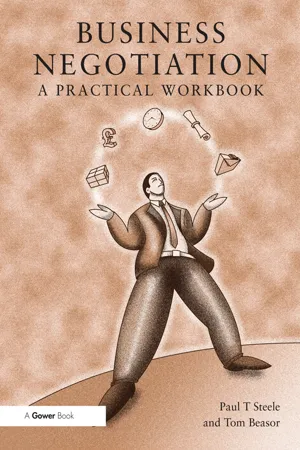
Getting to grips with negotiation quickly is straightforward and easy with this practical guide. Written in simple language, with a host of practical exercises to support the text, it is designed for any negotiator who wants to develop their knowledge, increase confidence and develop skills. Starting by demonstrating the importance negotiation plays in both commercial and interpersonal relationships, Business Negotiation then takes the reader through 20 developmental steps which cover: objective setting and planning; the first phases of negotiation; managing movement; and completing the deal. Each step features a knowledge and skill building exercise, tips and techniques including: ¢ Example scripts ¢ Negotiation tactics ¢ Practical exercises ¢ Dilemmas and suggested solutions ¢ Key points. In a highly interactive style, this book provides a learning route to skilled negotiation. Written by experts in the field of negotiation, it gives a clear picture of all aspects of the subject and arms the reader with a wealth of ideas and examples for their next negotiation.
Information
Part 1
Introduction to Negotiation
1
Negotiation – What is it?
We recognize the skill with which an experienced helmsman negotiates a busy harbour to tie up, being mindful of charted hidden dangers and the unpredictability of the behaviour of other users. But are we always aware that we should be exercising a similar degree of skill and attention to detail in handling our interpersonal relationships? Statistics on the rising trend of divorce make for grim analysis of most domestic scenes, but are we any better equipped to deal with commercial difficulties? We doubt it, if only because the nature of negotiation and the impact it has on relationships has yet to be widely understood. All too often we see people exchange information, test understanding and then make a decision – and believe they have negotiated. Well, they haven’t.
Negotiation Defined
Using a workable definition, we see negotiation as
A process through which parties move from their initially divergent positions to a point where agreement may be reached.
Let us examine negotiation from a practical viewpoint using it in an everyday example:
The compact disc player
A couple bought a CD player from a well-known electronic goods stockist located out of town. They travelled home some miles away. Following the manufacturer’s instructions carefully, they set it up and plugged it in. It was lifeless. A phone call to the stockist elicited a typically brusque response: ‘Bring it in and we will see what can be done about it.’
Any summary of this opening scenario would be incomplete if it failed to identify customer dissatisfaction and a potential for a marked difference of opinion between the parties:
Having reflected on the irony of being invited to spend more in order to obtain a reliable product, the customer rang the sales manager with a number of observations:
- A separate return journey was inconvenient.
- Time lost could profitably be spent elsewhere.
- There were costs for petrol and parking which would be eliminated if the retailer collected.
- There would be loss of goodwill if the matter was not resolved satisfactorily.
The sales manager was somewhat taken aback. It was not normal custom and practice to reimburse costs.
The customer, sensing the Manager’s hesitation, pressed his point and said a set of classical CDs and a box of VHS tapes would be an acceptable recompense.
In due course the customer called in at his convenience and collected a new CD player, which was unboxed, fully tested and reboxed in his presence, along with a gift-wrapped parcel of high quality discs and tapes accompanied by a letter of apology. The customer went away satisfied with the outcome and still frequents the shop.
Points to Ponder
Jot down your initial reaction to these points.
- As the customer how would you have proceeded differently?
- When did the negotiation actually begin?
- Do you think the customer’s demands were aimed too high? What would you have asked for?
- What behavioural approach did the customer use?
- What other methods could the customer have effectively employed?
- Do you think parity has been satisfactorily restored between the parties to their mutual satisfaction?
Our View
- In asking this question we are concerned with intuitively identifying and exploring possible alternative styles of approach that could have been adopted. We are looking at high and stretching objectives but ones that maintain our credibility. We are also aiming to provide ourselves with the widest choice of options depending on both the commercial opportunities and the different people involved.The buyer has done well to avoid putting ‘markers’ down by refraining from setting an upper limit on what can be achieved. A ‘marker’ is usually a figure – a price, a delivery period, a number of days holiday – that is your ideal position in any negotiation. By putting a marker down you immediately put a ceiling on what you can achieve, and you could prevent the other party moving further in your favour.In this example a mixture of logic, used with low key emotion, has yielded a satisfactory beginning.
- If you have to ask yourself when a negotiation started then you can almost certainly be sure that you are too late. A negotiation begins at the very first point at which either party has the opportunity to influence the other. It could have begun with a letter or might have started even earlier. Many customers will have been influenced by the store’s reputation or advertising.
- Aiming high allows room for manoeuvre. Incremental adjustments can favourably influence the atmosphere and actions of the other party. Aim as high as possible. Research indicates that those people who ask for more, gain more. However, do not take up a position so extreme as to damage your credibility.
- Whereas logic was clearly evident, there was a hint of a more emotive appeal which could have been based on customers’ rights had the stockist not been amenable to reason.
- Discreet threat can be employed in circumstances where power is seen to best serve the interests of the party resorting to it. When one party has leverage there is always a temptation to use it. Applied skilfully, this is a very legitimate approach. Conducted poorly, such coercion is seen as overpowering and destructive.It is better to use brains before brawn. Heavy handed threats have a tendency to backfire on you, particularly when used against parties whose cooperation you may need at some point in the future.Another approach, much in favour in Anglo-Saxon culture, would have been to use compromise. It differs from bargaining in that it applies to reaching an understanding on a single issue by agreeing to a satisfactory midpoint. A willingness to compromise could be a sign of potential weakness and the customer avoided this approach by the use of several different variables. Compromise when used in Anglo-Saxon culture denotes a desire to ‘split the difference’. We believe that this should be a tactic of last resort and should remain at the tail end of the negotiator’s repertoire.
- This has to be a matter for both parties. Each will have had their own objectives and each will be seeking a different outcome. It is not a sign of weakness that a negotiator is dissatisfied with the outcome. Experi...
Table of contents
- Cover
- Half Title
- Title
- Copyright
- CONTENTS
- Acknowledgements
- Introduction
- PART 1 INTRODUCTION TO NEGOTIATION
- PART 2 PRACTICAL NEGOTIATION
- Index
Trusted by 375,005 students
Access to over 1.5 million titles for a fair monthly price.
Study more efficiently using our study tools.
Frequently asked questions
Yes, you can cancel anytime from the Subscription tab in your account settings on the Perlego website. Your subscription will stay active until the end of your current billing period. Learn how to cancel your subscription
No, books cannot be downloaded as external files, such as PDFs, for use outside of Perlego. However, you can download books within the Perlego app for offline reading on mobile or tablet. Learn how to download books offline
Perlego offers two plans: Essential and Complete
- Essential is ideal for learners and professionals who enjoy exploring a wide range of subjects. Access the Essential Library with 800,000+ trusted titles and best-sellers across business, personal growth, and the humanities. Includes unlimited reading time and Standard Read Aloud voice.
- Complete: Perfect for advanced learners and researchers needing full, unrestricted access. Unlock 1.5M+ books across hundreds of subjects, including academic and specialized titles. The Complete Plan also includes advanced features like Premium Read Aloud and Research Assistant.
We are an online textbook subscription service, where you can get access to an entire online library for less than the price of a single book per month. With over 1.5 million books across 990+ topics, we’ve got you covered! Learn about our mission
Look out for the read-aloud symbol on your next book to see if you can listen to it. The read-aloud tool reads text aloud for you, highlighting the text as it is being read. You can pause it, speed it up and slow it down. Learn more about Read Aloud
Yes! You can use the Perlego app on both iOS and Android devices to read anytime, anywhere — even offline. Perfect for commutes or when you’re on the go.
Please note we cannot support devices running on iOS 13 and Android 7 or earlier. Learn more about using the app
Please note we cannot support devices running on iOS 13 and Android 7 or earlier. Learn more about using the app
Yes, you can access Business Negotiation by Paul T Steele,Tom Beasor in PDF and/or ePUB format, as well as other popular books in Personal Development & Business General. We have over 1.5 million books available in our catalogue for you to explore.