- 226 pages
- English
- ePUB (mobile friendly)
- Available on iOS & Android
eBook - ePub
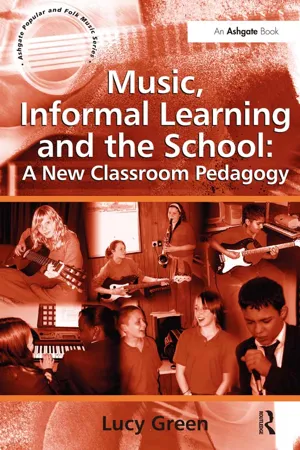
Music, Informal Learning and the School: A New Classroom Pedagogy
About this book
This pioneering book reveals how the music classroom can draw upon the world of popular musicians' informal learning practices, so as to recognize and foster a range of musical skills and knowledge that have long been overlooked within music education. It investigates how far informal learning practices are possible and desirable in a classroom context; how they can affect young teenagers' musical skill and knowledge acquisition; and how they can change the ways students listen to, understand and appreciate music as critical listeners, not only in relation to what they already know, but beyond. It examines students' motivations towards music education, their autonomy as learners, and their capacity to work co-operatively in groups without instructional guidance from teachers. It suggests how we can awaken students' awareness of their own musicality, particularly those who might not otherwise be reached by music education, putting the potential for musical development and participation into their own hands. Bringing informal learning practices into a school environment is challenging for teachers. It can appear to conflict with their views of professionalism, and may at times seem to run against official educational discourses, pedagogic methods and curricular requirements. But any conflict is more apparent than real, for this book shows how informal learning practices can introduce fresh, constructive ways for music teachers to understand and approach their work. It offers a critical pedagogy for music, not as mere theory, but as an analytical account of practices which have fundamentally influenced the perspectives of the teachers involved. Through its grounded examples and discussions of alternative approaches to classroom work and classroom relations, the book reaches out beyond music to other curriculum subjects, and wider debates about pedagogy and curriculum.
Information
Chapter 1
Introduction
The aims and rationale of this book
–Michael: Just play it once, just play it once.
–Ross: I’ll go (plays guitar riff).
–Michael: You don’t need to play that, so when I go (starts to play) if you be silent (guitar plays) and then you go silent for (bass plays).
–Ross: I know! So I’ll just go (guitar plays).
–Billy: Are we going to have to do chords?
–Ross: Yeah, what we doing after that bit?
–Michael: Work out the first bit first. If we get the first bit done, so at least we can perform, and then (inaudible). ’Cause we’re still not sure what Ross is doing.
All start attempting to play/improvise on their instruments.
CD comes on. They play along with the CD.
–Billy: It’s too loud.
–Michael: So when I go (plays guitar) you be silent, ‘cause it’s quite hard.
–Ross: Come on, shall we just start again, shall we just listen to it?
–Billy: We’re only doing the first one though aren’t we?
CD comes on again.
–Michael: Drums don’t come in yet.
–Ross: You play five, you don’t need to do that.
(Broadacres High School, concealed field recording)
The above extract is from a ‘fly-on-the-wall’ recording of a group of 13- to 14-year-old pupils working together in a school practice room. They were taking part in a research and development project which introduced and evaluated new pedagogical methods in the music classroom. The project’s approach derived from a study of the informal learning practices of popular musicians (Green 2002a), and represented an attempt – which might at first seem an impossible task or a contradiction in terms – to bring informal music learning practices into the formal environment of the school classroom. The project became part of a major national music education programme in England called ‘Musical Futures’, and the resulting teaching strategies and curriculum resources are already available for teachers’ use (Green with Walmsley 2006; <www.musicalfutures.org/PractionersResources.html>). But the aim of this book is to present a more detailed and theoretical analysis of what went on during the project, how things occurred, why, and what benefits and challenges the project seemed to offer to music education.
The book considers how pedagogy in the music classroom could draw upon the world of informal popular music learning practices outside the school, in order to recognize, foster and reward a range of musical skills and knowledge that have not previously been emphasized in music education. It investigates how far it is possible and desirable to incorporate informal music learning practices into formal music education; how the incorporation of such practices can affect young teenagers’ skill and knowledge acquisition processes, and how such practices can change the ways pupils listen to, understand and appreciate music in and beyond the classroom. It raises questions about pupils’ motivations towards music education, their autonomy as learners, and their capacity to work co-operatively together without instructional guidance from teachers.
In so doing, it considers how informal practices can affect teachers’ approaches and perspectives in ways that we have, as music educators, often left unquestioned or taken for granted. Bringing informal learning practices into a school environment is challenging for teachers. It can appear to throw up conflicts with their existing views of professionalism, and may at times seem to run against official educational discourses, pedagogical methods and curricular requirements. But I hope to show that any conflict is more apparent than real. For informal learning practices can introduce fresh, constructive ways for music teachers to understand and approach their work, and worthwhile new perspectives on pupils’ capacities and needs. Through examining such issues, the book touches on further current debates about pedagogy as well as curriculum, offering grounded examples and discussions of alternative approaches to classroom work and classroom relations, that may have relevance to a variety of curriculum subjects.
In the pupils’ words quoted above, we can glimpse many of the themes that will be considered in greater depth as the book goes along. The task they were engaged in had not been broken down into a series of progressively demanding steps, but instead they were holistically approaching a piece of ‘real-world’, professionally produced music. They had no notation or other form of written instructions in front of them, but were using their ears to copy what they heard on a CD. Only one of them had any previous experience of instrumental tuition, yet they were all attempting to communicate instructions and ideas to each other through musical gestures and sounds; and were engaging in embryonic instrumental performance and improvisational skills. They had been given no instruction to analyse the music, yet they were beginning to listen structurally, observe entries and count repetitions. There was no teacher in the room, yet they were focused on the task. They had not been given separate or explicit roles, but were co-operating as a group, and trying to sort out what one of them should do as they worked towards a performance. Most importantly, perhaps, they had been given no guidance about how to approach the task, but they were engaging in self-directed, co-operative learning. Not only had they selected the content of the curriculum themselves – that is, the song that they were copying – but they were also responsible for organizing and structuring their own teaching and learning strategies.
Pupil motivation and take-up of music as a curriculum subject have never been high or widespread. Over the last forty years or so, music educators have made radical shifts towards raising motivation and widening participation. This has involved re-thinking the role of music as a minority subject that catered mainly for the success of children who took instrumental lessons, and that focused centrally on classical and folk music, singing and musical literacy. Music educators, along with teachers in many other subjects, have challenged the notion of education as a stable body of knowledge and skills which are unquestioningly possessed by teachers, and which should be imparted to pupils, regardless of whether such knowledge and skills are equally useful, relevant or valid for all pupils, or whether all pupils are equally capable of absorbing them. This challenge has included closing the gap between ‘high’ and ‘low’ musical cultures, and between ‘Western’ and ‘non-Western’ musics, and has involved recognizing and valuing pupils’ ‘own’ musical cultures by bringing them into the curriculum.1
However, until recently one area within music education has remained relatively unaffected – that of pedagogy. For although the above changes brought in a huge range of music as new curriculum content, this new content was largely approached through traditional teaching methods. Thus a new gap opened up, particularly in the realm of popular, as well as jazz and ‘world’ musics. For whilst a huge range of such musics have entered the curriculum, the processes by which the relevant musical skills and knowledge are passed on and acquired in the world outside the school, have been left behind. These processes in most cases differ fundamentally from the processes by which skills and knowledge tend to be passed on and acquired in formal music education settings. In this sense, popular, jazz and world musics – and indeed other previous curriculum content including folk and traditional musics, and even in some ways classical music itself – have been present in the school more as a simulacrum of the real thing than the real thing itself.
Many young people who go on to become skilful and successful popular musicians report that the music education they received at school was unhelpful, or worse, detrimental. For some, instrumental lessons, even in popular music genres, also provided a negative and often short-lived experience (see, for example, Green 2002a, pp. 127–76). We can surmise that many children and young people who fail and drop out of formal music education, far from being either uninterested or unmusical, simply do not respond to the kind of instruction it offers. But until very recently, music educators have not recognized or rewarded the approaches involved in informal music learning, nor have they been particularly aware of, or interested in, the high levels of enthusiasm and commitment to music displayed by young popular or other vernacular musicians.
In my previous book, How Popular Musicians Learn, I investigated popular musicians’ informal learning practices, specifically with a view to what those practices could tell us as music educators. From my findings I hypothesized that such learning practices could possibly enhance motivation and increase a range of musical skills, in ways that were largely missing from pedagogy and from the school curriculum. I also considered that such practices could make music education more inclusive for pupils of all abilities and backgrounds, particularly those who have found it difficult or impossible to make their musicality shine in formal environments. In addition, I had observed that popular musicians seem to have a wide appreciation and respect for a range of musical styles going beyond the familiar, perhaps more so than other people of the same age who are not musicians. Therefore, I hypothesized that through informal ways of approaching music-learning, school pupils could also be brought to expand their appreciation of music, both in relation to what they already know and to what lies beyond it. Through this, the approaches could, I believed, help to demystify the world of music, including its commercial manifestations, making pupils more confident of their own musicality in relation to notions of musical value and musical ability, more discerning, or more ‘musically critical’.
The final chapter of that book put forward a number of suggestions for adopting and adapting informal popular music learning practices within various formal music education settings, not as a substitute, but as a complement running side by side with existing approaches. The project on which the present book is based gave the opportunity to try out some of those suggestions in practice, within school classrooms.2
For the remainder of this introductory chapter I will first briefly discuss the main characteristics of informal popular music learning practices as these occur outside the school. Then I will explain in general terms how these characteristics were incorporated into the aims and strategies of the project, and will situate the project in relation to the historical context of music education in the present day. Finally I will outline the research methods used.
Background research: how popular musicians learn
The exact ways in which popular musicians go about acquiring their skills and knowledge vary between different sub-styles of popular music, different social and cultural contexts, and from one individual learner to another – the more so precisely because of the general lack of formal systematization involved in such learning. Increasing numbers of popular music learners nowadays are taking advantage of formal provision such as instrumental lessons on electric guitars, drums and other instruments that are almost wholly associated with popular music, and for which it would have been difficult to find a professional, formal teacher even a few decades ago. Some musicians nowadays also take national qualifications, from elementary exams right up to post-graduate degrees in popular music. There is in addition fast-growing provision through community music networks and many other organizations outside formal education, which is often referred to as ‘non-formal’ music education. However, such formal and non-formal provisions still mainly act as supplements or extensions to popular musicians’ informal practices. These informal practices continue to form the essential core of most popular musicians’ learning, and run alongside any additional formal or non-formal activities. Overall, in spite of differences between sub-styles of popular music, context, provision and individual musicians, informal popular music learning practices are undertaken, in one way or another, by nearly all popular musicians in nearly all sub-styles of popular music, in ways that can be characterized by a number of generalizable features.3
‘Enculturation’, or immersion in the music and musical practices of one’s environment, is a fundamental factor that is common to all aspects of music learning, whether formal or informal. However, enculturation plays a more prominent part in some learning practices and with relation to some styles of music than others. In the traditional music of many countries, young children are drawn into group music-making activities on a daily basis, both within the home and beyond, almost from birth. Through being included in music-making by adults and older children around them, they pick up musical skills in ways that are similar to how they pick up linguistic skills.4 These skills include all three of the main ways by which we engage with music: performing (whether playing or singing, even at a basic level), creating (whether composing or improvising) and listening (to ourselves and/or to others).
Most folk and traditional musics of the world are learnt by enculturation and extended immersion in listening to, watching and imitating the music and the music-making practices of the surrounding community. In some folk and traditional musics, as well as in art musics of the world such as Indian classical music, and to a large extent in jazz, there are also systems of ‘apprenticeship training’ whereby young musicians are introduced, and explicitly trained or just generally helped by an individual adult or a ‘community of expertise’.5 In such environments, older musicians might provide specific guidance, as in a ‘master-apprentice’ or ‘guru-shishya’ relationship; or they may allow learners to ‘sit in’ with a band or join a group of older musicians, as in jazz or African drumming. Most importantly, the older musicians act as expert musical models whom learners can talk to, listen to, watch and imitate.
Popular musicians also tend to acquire musical skills and knowledge, first and foremost through being encultured in, and experimenting with, the music which they are familiar with, which they like, and which they hear around and about them. This involves early experimentation with an instrument or the voice, and discovering what different sounds they can make through trial and error, before stringing sounds together into embryonic musical phrases, rhythms or harmonies.
However, there are some crucial differences between how most folk and traditional musics are passed on, and how most Western popular musics are passed on – differences which it is tempting to overlook, but which are very significant for music education. They include, firstly, the fact that, unlike in most folk and traditional fields, most young popular musicians in Western or Westernized musical cultures are not regularly surrounded by an adult community of practising popular musicians who they can talk to, listen to, watch and imitate, or who initiate them into relevant skills and knowledge. Hence young popular musicians tend to engage in a significant amount of solitary learning. Secondly, in so far as a community of practice is available to young popular musicians, it tends to be a community of peers rather than ‘master-musicians’ or adults with greater skills. The significance of this is profound, as it affects the entire way in which skills and knowledge are transmitted in the popular music field, taking the onus of transmission away from an authority figure, expert or older member of the family or community, and putting it in large measure into the hands of groups of young learners themselves.
By far the overriding learning practice for most popular musicians, as is already well known and is also clear from existing studies, is to copy recordings by ear. It seems an extraordinary fact that this practice has developed in only the eighty or ninety years that have elapsed since the spread of recording technologies, across many countries of the world, through the activities of children and young people, basically in isolation from each other, outside of any networking or formal structures, and largely without adult guidance. I wish to distinguish between two extreme ways of conceiving of this practice, each situated at the opposite ends of a pole. At one extreme there is what I call ‘purposive listening’ (Green 2002a), that is, listening with the conscious purpose of adopting and adapting what is heard into one’s own practices. At the opposite extreme there is ‘distracted listening’. This occurs when music is heard in the background, but is not attended to in a focused way, so that it enters the mind almost entirely through unconscious enculturation. Not only purposive listening, but also distracted listening carry on beyond the early learning stages and into professional realms.
Copying recordings is almost always a solitary activity, but as already indicated, solitude is not a distinguishing mark of the popular music learner. On the contrary, group activities occurring in the absence of adult supervision or guidance are of great importance. They are characterized by two aspects. One is ‘peer-directed learning’. This involves the conscious sharing of knowledge and skills, or even explicit peer teaching, through, for example, demonstration of a rhythm or chord by one group member for the benefit of another. The other aspect is ‘group learning’, where there is no conscious demonstration or teaching as such, but where learning takes place through watching and imitation during music-making, as well as talking about music during and outside of rehearsals.
Bands are formed at very early stages, even if the players have little control over their instruments and virtually no knowledge of any chord progressions, licks or songs; or even if they have no instruments to play. Often they start up a band or a series of bands within a few months o...
Table of contents
- Cover
- Half Title
- Dedication
- Title Page
- Copyright Page
- Table of Contents
- General Editor’s preface
- Acknowledgements
- 1 Introduction
- 2 The project’s pedagogy and curriculum content
- 3 Making music
- 4 Listening and appreciation
- 5 Enjoyment: making music and having autonomy
- 6 Group co-operation, ability and inclusion
- 7 Informal learning with classical music
- 8 Afterword
- Appendix A Information about schools
- Appendix B The project stages in brief
- Bibliography
- Index
Trusted by 375,005 students
Access to over 1.5 million titles for a fair monthly price.
Study more efficiently using our study tools.
Frequently asked questions
Yes, you can cancel anytime from the Subscription tab in your account settings on the Perlego website. Your subscription will stay active until the end of your current billing period. Learn how to cancel your subscription
No, books cannot be downloaded as external files, such as PDFs, for use outside of Perlego. However, you can download books within the Perlego app for offline reading on mobile or tablet. Learn how to download books offline
Perlego offers two plans: Essential and Complete
- Essential is ideal for learners and professionals who enjoy exploring a wide range of subjects. Access the Essential Library with 800,000+ trusted titles and best-sellers across business, personal growth, and the humanities. Includes unlimited reading time and Standard Read Aloud voice.
- Complete: Perfect for advanced learners and researchers needing full, unrestricted access. Unlock 1.5M+ books across hundreds of subjects, including academic and specialized titles. The Complete Plan also includes advanced features like Premium Read Aloud and Research Assistant.
We are an online textbook subscription service, where you can get access to an entire online library for less than the price of a single book per month. With over 1.5 million books across 990+ topics, we’ve got you covered! Learn about our mission
Look out for the read-aloud symbol on your next book to see if you can listen to it. The read-aloud tool reads text aloud for you, highlighting the text as it is being read. You can pause it, speed it up and slow it down. Learn more about Read Aloud
Yes! You can use the Perlego app on both iOS and Android devices to read anytime, anywhere — even offline. Perfect for commutes or when you’re on the go.
Please note we cannot support devices running on iOS 13 and Android 7 or earlier. Learn more about using the app
Please note we cannot support devices running on iOS 13 and Android 7 or earlier. Learn more about using the app
Yes, you can access Music, Informal Learning and the School: A New Classroom Pedagogy by Lucy Green in PDF and/or ePUB format, as well as other popular books in Education & Education Theory & Practice. We have over 1.5 million books available in our catalogue for you to explore.