1
ADVANCES IN 4G
COMMUNICATION NETWORKS
A 5G Perspective
M. BALA KRISHNA AND
STEFAN SCHWARZ
Contents
1.1 Introduction
1.2 Evolution toward 5G Networks
1.3 Challenges in 5G Networks
1.4 Emerging Trends in 5G Networks
1.4.1 Multiple Radio Access Technology (M-RAT)
1.4.2 OFDM and Multiple MIMO Systems
1.4.3 Device-to-Device Communication Systems
1.4.4 Software-Defined Networks
1.4.5 Cloud Technologies for 5G RANs
1.4.6 Machine-Type and Human-Type Communications
1.4.7 New Carrier-Type Cell Systems
1.5 LTE/LTE-A 4G and Beyond Technology
1.5.1 Overview of LTE Release 8/9 Features
1.5.2 LTE Release 10 (LTE-A) Enhancements
1.5.3 Further Enhancements of Releases 11, 12, and Beyond
1.6 MIMO Enhancements: 3D Beamforming, Full-Dimension MIMO, and Massive MIMO
1.6.1 3D Beamforming and Full-Dimension MIMO
1.6.2 Massive MIMO
1.7 mmWave Communication Technology
1.7.1 mmWave for 5G Cellular
1.7.2 60 GHz WLAN and WPAN
1.8 Conclusions
1.9 Future Research Directions
List of Abbreviations
References
1.1 Introduction
Long-term evolution advanced (LTE-A) and fourth-generation (4G) communication networks implement a multicellular architecture over traditional IP networks and offload the network traffic from a macro base station to multiple small-cell base stations. This approach improves network performance. Advanced coding, multiplexing (orthogonal frequency division multiplexing [OFDM]), multiple access (orthogonal frequency division multiple access [OFDMA]), intercell interference (ICI) mitigation (enhanced intercell interference coordination [eICIC]), and antenna synchronization (multiple-input-multiple-output [MIMO]) techniques are used in 4G and beyond networks to improve spectrum efficiency and achieve high throughput rates (100 Mbps to 10 Gbps). Even though 4G networks accommodate heterogeneity in network interfaces and device connectivity, challenging aspects such as exploding data, dynamic network traffic technology, efficient spectrum allocation, resource sharing, and energy management are yet to be resolved. Software-defined radio (SDR) and cognitive radio (CR) networking features are yet to be explored for managing spectral and network resources.
The limitations of 4G networks are due to (1) the increasing demands of ever-growing devices and users; (2) requirement of robust, reliable, and high-quality audio and video streaming services; (3) coordinating macro- and small-cell networks; (4) computational complexities in dense deployment of small cells; (5) sustaining high mobility and addressing handover issues; (6) dynamic network topology for varying spectrum allocation; (7) minimizing end-to-end latencies; and (8) data transmission in high-speed vehicular networks.
1.2 Evolution toward 5G Networks
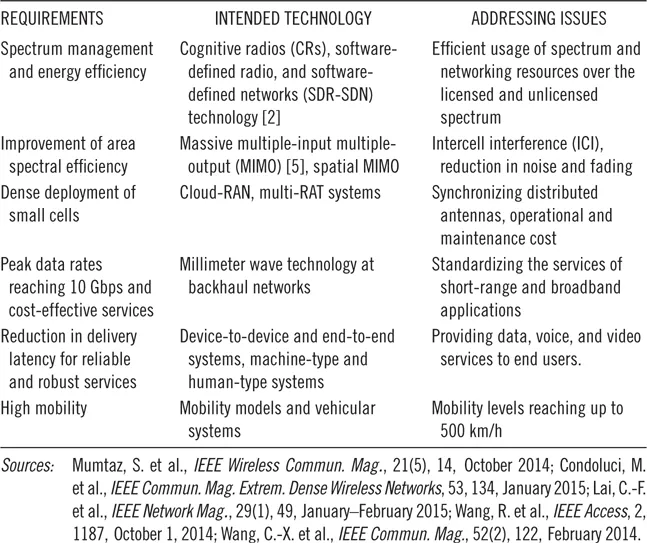
Fifth-generation (5G) networks aim to achieve high-speed data transfer rates (in tens of Gbps) to meet the exploding demands of millions of users per square kilometer. High user density escalates the network traffic to TB/km and user mobility to 400–500 km/h. Latencies are minimized by considering device-to-device (D2D) [1] and machine-to-machine (M2M) supporting systems in 5G networks. Table 1.1 enumerates the requirements, technology, and addressing issues in 5G networks.
Table 1.1 Requirements, Technology, and Addressing Issues in 5G Networks
1.3 Challenges in 5G Networks
The challenges in 5G networks are as follows:
Increase in spectrum bandwidth, transmission rate, and traffic density
Design of small-cell infrastructure [1] (based on femtocells and microcells with eNBs) to increase the spectrum efficiency and decrease the load of base station
Ultradense networks, multiple radio access technologies (M-RATs), and mobile crowd sensing
Exponential increase in data traffic based on multimedia live streaming, multivideo conferencing, Internet Protocol television (IP-TV), and so on
D2D and M2M [2] connectivity
Mobility management for high-speed vehicular network
Energy management in cellular communication
Network virtualization and software-defined network (SDN)
Mobile vehicular cloud management
1.4 Emerging Trends in 5G Networks
5G communication systems aim to extend the services of wireless technology with respect to cloud services, heterogeneous device connectivity, vehicular mobility, and distinct connectivity for indoor and outdoor users using multiple MIMO antennas. Indoor wireless communication for short-range distance uses Wi-Fi, femtocells, ultra-wideband (UWB), and millimeter wave (mmWave) technology. Outdoor wireless communication for long-range distance uses microcells, macrocells, large antenna arrays, and intermediate relay head nodes to communicate with indoor systems and gateway nodes in the network.
1.4.1 Multiple Radio Access Technology (M-RAT)
M-RAT supports a broad range of radio access technologies [6] such as 2G, 3G, Third Generation Partnership Project (3GPP), and 4G networks under a coexistent networking system [4] known as multiple radio access networks. Traditional high-speed access wireless local area network (WLAN) operates with a number of access points to support a high density of user and devices in the network. The M-RAT system offloads the network traffic from high-density areas to adjacent microcells or picocells to facilitate seamless connectivity and handover management in the cellular network. M-RAT systems use unlicensed and licensed spectrum bands that allow cooperative reuse of Global System for Mobile Communications (GSM) spectrum in LTE networks to achieve a high throughput rate.
1.4.2 OFDM and Multiple MIMO Systems
OFDM and multiple MIMO technologies [1] improve the pairing and spectrum reuse capabilities that allocate an optimum number of physical resource blocks in the communication channel. D2D communication systems upgrade the number of devices through radio link control and packet data control techniques [5]. Communication system is enhanced by using diverse multiple accessing schemes for uplink (single-carrier FDMA) and downlink (OFDMA) signals. Control mechanisms are applied in physical and medium access control (MAC) layers of LTE-A to regulate the network traffic.
1.4.3 Device-to-Device Communication Systems
Device-to-Device (D2D) communication systems are short-range systems that utilize licensed and unlicensed spectrum bands to share the radio access and minimize the load in the ...