The methodology of "Reflections on Death, Dying and Bereavement" is mainly philosophical. It is intended to complement scriptural and theological studies. The volume has five main sections that are further divided by chapter. The first section contains foundational considerations. Since the belief in a continuation of life after death or reunion with deceased loved ones offers consolation to many people, the book examines the possibility of human immortality. Various rational arguments are also presented.
eBook - ePub
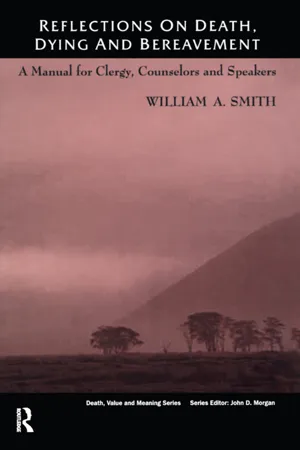
Reflections on Death, Dying and Bereavement
A Manual for Clergy, Counsellors and Speakers
- 100 pages
- English
- ePUB (mobile friendly)
- Available on iOS & Android
eBook - ePub
Reflections on Death, Dying and Bereavement
A Manual for Clergy, Counsellors and Speakers
About this book
Information
CHAPTER 1
Human Immortality
The belief in a life after death, be it from religious faith or logical deduction, has been a source of consolation to the dying and the bereaved since the early days of Christianity and even, longer ago, among the ancient Egyptians. This “afterlife” concept can involve various rewards and punishments, depending on the religious belief. Christians see it as more spiritual (“presence of the beatific Vision—God”); some Muslims see it as involving physical pleasures. Many hope to be united once again with dead relatives, ancestors, friends, or, as Socrates hoped, famous personages (the Apology).
Technically, the duration of this afterlife would be aeviternal, that is, a life that had a beginning (therefore not eternal) but will have no end (therefore not temporal). Some have speculated about the possibility of God’s eventually annihilating (moving from being to nothingness) all human souls. Reason would allow for such a possibility, although Christian revelation would seem to hold for everlasting happiness or even punishment. Most feel that if the soul is intrinsically capable of unending existence (is not corruptible), it would seem unreasonable to destroy it. As religious persons we would certainly hope for eternal life with God, and with Augustine we pray for the gift of faith: “Lord I believe; help thou my unbelief.”
However, what is the clergyperson to do when faith fails someone? What if he or she is asked to give and explain the reasons for his or her own faith—meaning rational arguments rather than the professed faith of the individual? The clergyperson usually does not have the advantage of a calm, unemotional setting, as does, for example, a classroom lecturer. Interrogation by grief-stricken family members or even by the dying person can take place in a hospital, at a wake, or when surrounded by relatives at a post-funeral gathering. These situations can be very tense and filled with high emotion.
Therefore, let me briefly outline the approach of “rational argument” to this presentation of immortality. First, a fact: corruption of the body begins immediately after death. This disintegration can be staved off temporarily by the embalming process, refrigeration, and the airless condition of a coffin. Nevertheless, the brain and nervous system have ceased to function. If the afterlife involves acts of knowledge (conscious use of intellect) and acts of love (functioning of the will, now in the presence of God), then something other than the brain must be the source of intellectual and voluntary operations. If I am nothing more than my body, then at death “I” (my “self”) am finished. Immortality can be had only through my actions (e.g., works of art, music, or literature) or my children; but there can be no consciousness of personal survival because there is no personal survival. Thus immortality, survival of consciousness, requires some aspect or factor of my being to be other than physical or material, not subject to corruption or disintegration after death. The history of philosophy gives us terms like “psyche,” “soul,” or “mind” to represent this part of our human makeup. Platonists believe that this combination of psyche and soma (the body) is a union of two separate entities (or substances). Strict Aristotelians would see it as a duality of co-principles making up the one human being.
A student once asked me whether any kind of survival after death is possible if there is no God. I must admit that I had never fully reflected on this question, but I think we would have to say that if one’s soul is a finite, contingent entity, it would necessarily have to come under the power of some cosmic force in order to be preserved in existence. Humans know this “force” that conserves the “finite” universe by many names, but I think the existence of this Being must be accepted. Never open Pandora’s box unless you can reclose it!
I would divide the argument for the spiritual soul into two general types or approaches: the traditional and the nontraditional. The traditional approach considers the characteristics of physical beings: physical/material entities are quantified, measurable, divisible. The laws of physics restrict them to one area of space at any single moment of time (spatial-temporal limitations). Physical beings are big, rough, smooth, hard, soft, dark, and light. The brain, which materialistic philosophers believe is “the mind,” fits these characteristics. However, another type of reality does not fit: namely, ideas. Ideas or concepts, such as love, beauty, and justice, have no size or shape or weight. They are immaterial: they have only meaning. The question is, can brain cells have not only an understanding of justice, or love of neighbor, but also a concern about these virtues? And what about free will? If the mechanistic concept of the human person is the true one, then we are nothing more than flesh-and-blood “machines.” But machines such as car engines and computers are not “free.” True, we have instinctive “drives,” like sex and hunger, which are a result of having bodies, but these drives can be controlled because their purposes are understood by our power of reflection and we acknowledge a moral law. We can reject sexual temptations, but animals cannot. Humans diet or reject cholesterol-laden foods for the higher good of their own health.
To summarize: we have conceptualization, recognition of the moral law, freedom from some mechanistic laws of matter, and the power of reflection. Many people do not believe the brain, as magnificent as it is, can be the fully adequate cause of these powers in humans.
By the non-traditional approach I mean the use of extrasensory perception (E.S.P.) phenomena and “near death experiences.” E.S.P. phenomena include mental telepathy, clairvoyance, and precognition. Mental telepathy, the transference of thought from one person’s mind to another’s without the use of words or signs (speech or writing), bypasses the Aristotelian epistemological/psychological theory that all knowledge begins in the senses. Clairvoyance is also knowledge, but knowledge of events that have taken place beyond the range of the “naked” senses and knowledge gained without artificial means such as radio. If this power really exists, it is a transcendence of the space and place limitations of matter. Precognition is real knowledge of future events. This would be a transcendence of time limitations, because the future area of time has, as yet, no reality. It is difficult to determine how many reports of these events are authentic. One could check the writings of Drs. J. B. Rhine and Louisa Rhine, formerly of the Duke University Parapsychology Laboratory. This transcending of the space-time limitations of physical being would seem to indicate a nonphysical power source within us and therefore something incorruptible. The famed English philosopher Bertrand Russell (see Chapter 3), was somewhat impressed by these investigations but nevertheless did not accept the existence of a spiritual soul.
In his book Life After Life, Raymond Moody, M.D. (1975) brought to light the phenomenon of what is perhaps, finally, some empirical evidence of the survival of a soul. Moody deals with stories of people who have clinically (not irreversibly) died and been resuscitated. After resuscitation, these people reported autoscopic experiences (out-of-the-body experiences, which involve looking down or back at medical personnel working on one’s body), meeting dead relatives, seeing a very bright light at the end of a tunnel, and, for some, undergoing a judgment of their life (which most said was conducted in a friendly atmosphere—a part of the experience that I certainly hope is authentic).
Although Moody admitted that all the cases mentioned were not of the same scientific and investigative rigor, he must be given credit for making a beginning and opening himself up to criticism.
Other studies in this area were done by Michael Sabom, M.D. (1982), in Recollections of Death. And a comparative study of some Americans and some Indian sub-continent Hindus was done by Karlis Osis, Ph.D., and Elendur Haraldsson, Ph.D. (1977), in At the Hour of Death.
In conclusion, while we know that these “arguments” do not convince everyone, they are certainly worthy of consideration and expanded study. If memory serves me right, a respected Jesuit Gregorian University cosmologist once paraphrased Shakespeare: “There are more things in heaven and earth, Aristotle, than were thought of in your philosophy.”
SUPPLEMENTARY TEXTS
Twenty-Third Psalm
Surely goodness and mercy shall follow me all the days of my life; and I will dwell in the house of the Lord forever.
The Roman Ritual (used in the Catholic funeral service)
May the angels lead you into Paradise, may the Martyrs receive you at your coming and take you to Jerusalem, the Holy City. May the choirs of angels receive you … and may you have life everlasting.
St. Thomas Aquinas (1225-1274): Summa of Theology (Summa Theologica) (1894 Latin edition)
Whether the Human Soul is Something Subsistent?
I answer that … the principle of intellectual operation which we call the soul of man, is a principle both incorporeal and subsistent … able to understand the nature of all bodies … it is impossible for the intellectual principle to be a body … for it to understand by means of a bodily organ since because of the determinate knowledge of a specific organ … it would not be able to know all bodies.…
Therefore the intellectual principle which we call the mind or the intellect has an operation proper to itself in which the body does not share … we must conclude therefore, that the human soul … is something incorporeal and subsistent (I, q. 75, a. 2, c).
In article 6, Aquinas concludes that “everything that has an intellect naturally desires always to exist”; and that “a natural desire cannot be in vain. Therefore, every intellectual substance is incorruptible.”
This question from the Summa of Theology philosophically complements the famous text from the first letter of Paul to the Corinthians:
For the trumpet will sound, the dead will be raised incorruptible, and we shall be changed. For that which is corruptible must clothe itself with incorruptibility and that which is mortal must clothe itself with immortality … then the word that is written shall come about: “Death is swallowed up in victory. Where, O death is your victory? Where, O death is your sting?”
H. D. Gardeil, O.P. (b. 1900): Initiation a la Philosophie de St. Thomas d’Aquin—Psychologie, Vol. III (1956).
The soul, however, has no composition of matter and form or of any constituent parts. The soul is pure form, utterly simple, having its own act of existence.… Of its very nature, then, it is incorruptible, which is to say immortal (p. 227).
Curt J. Ducasse (1881–1969)
Professor at Brown University, in his book A Critical Examination of the Belief in the Life After Death (1961), Ducasse makes his famous distinction between the physical and the psychical: “things called ‘material’ … are perceptually public or can be made so” (p. 40); “events, processes, denoted by the term psychical or ‘mental’ are the inherently private ones … thoughts, emotions … volitions” (p. 45).
Although Ducasse set the stage for the traditional “arguments” for immortality he chose a different route. In a May 1947 lecture entitled “Is a Life After Death Possible?” he concludes:
To the present writer, as to McTaggart,1 it does seem that if survival is a fact, then the plausible form it might take would be rebirth on earth, perhaps after an interval occupied by the individual in distilling out of the memories of a life just ended such wisdom as his reflective powers enabled him to extract. And this conception of survival also seems to be the one which would put man’s present life on earth in the most significant perspective [emphasis in original].
Aristotle (384-322 B.C.): De Anima
Turning now to the part of the soul with which the soul knows and thinks….
Thus that in the soul which is called the mind (by mind I mean that where by the soul thinks and judges) is, before it thinks, not actually any real thing. For this reason it cannot reasonably be regarded as blended with the body;…
… while the faculty of sensation is dependent upon the body, mind is separate from it (Bk. III, Ch. 4).
Note: There is no unity of interpretation of Book III, but one must wonder: if Aristotle rejected Plato’s “World of Forms/Ideas,” what would we do in the next world?
Plato (427-347 B.C.): Phaedo (Socrates), “World of Ideas”
And now, O my judges, I desire to prove to you that the real philosopher has reason to be of good cheer when he is about to die, and that after death he may hope to obtain the greatest good in the other world.… Do we believe that there is such a thing as death?… Is it not the separation of soul and body?
Your favorite doctrine, Socrates, that knowledge is simply recollection … would be impossible unless our soul had been in some place before.… here then is another proof of the soul’s immortality.
Charles Sanders Peirce (1839-1914)
American philosopher, logician, mathematician. Peirce’s doctrine of “Synechism” was the doctrine that all that exists is continuous and therefore rules out the ultimate dualism between mind and matter: “What we call matter is not completely dead, but merely mind hidebound with habits” (6.102).
In an 1881 passage he wrote, “The one intelligible theory of the universe is that of objective idealism, that matter is effete mind, inveterate habits becoming physical laws” (6.25).
Note: “Effete” here means worn out. See also 1.436 on material bodies having a psychical substratum. Quotations are from The Collected Papers of Charles Sanders Peirce, 8 volumes (Hartshorne and Weiss, 1931).
Sir James Jeans (1877-1946)
English astrophysicist. In his book Physics and Philosophy (1942), Jeans distinguished the “man-sized” world from the conceptual world of subatomic physics:
These conjectures [of science] we...
Table of contents
- Cover
- Title Page
- Copyright Page
- Dedication
- Table of Contents
- Preface
- Acknowledgments
- September 11, 2001
- Introduction
- CHAPTER 1 Human Immortality
- CHAPTER 2 The Problem of Evil and Human Suffering
- CHAPTER 3 Reflections of Philosophers, Novelists, Poets, and Other Writers on Life, Death, and Immortality
- CHAPTER 4 Grief and Bereavement
- Appendix I. Suicide and Euthanasia
- Appendix II. The Hospice Movement
- Appendix III. The Funeral Director
- Conclusion
- Bibliography
- Index
Trusted by 375,005 students
Access to over 1.5 million titles for a fair monthly price.
Study more efficiently using our study tools.
Frequently asked questions
Yes, you can cancel anytime from the Subscription tab in your account settings on the Perlego website. Your subscription will stay active until the end of your current billing period. Learn how to cancel your subscription
No, books cannot be downloaded as external files, such as PDFs, for use outside of Perlego. However, you can download books within the Perlego app for offline reading on mobile or tablet. Learn how to download books offline
Perlego offers two plans: Essential and Complete
- Essential is ideal for learners and professionals who enjoy exploring a wide range of subjects. Access the Essential Library with 800,000+ trusted titles and best-sellers across business, personal growth, and the humanities. Includes unlimited reading time and Standard Read Aloud voice.
- Complete: Perfect for advanced learners and researchers needing full, unrestricted access. Unlock 1.5M+ books across hundreds of subjects, including academic and specialized titles. The Complete Plan also includes advanced features like Premium Read Aloud and Research Assistant.
We are an online textbook subscription service, where you can get access to an entire online library for less than the price of a single book per month. With over 1.5 million books across 990+ topics, we’ve got you covered! Learn about our mission
Look out for the read-aloud symbol on your next book to see if you can listen to it. The read-aloud tool reads text aloud for you, highlighting the text as it is being read. You can pause it, speed it up and slow it down. Learn more about Read Aloud
Yes! You can use the Perlego app on both iOS and Android devices to read anytime, anywhere — even offline. Perfect for commutes or when you’re on the go.
Please note we cannot support devices running on iOS 13 and Android 7 or earlier. Learn more about using the app
Please note we cannot support devices running on iOS 13 and Android 7 or earlier. Learn more about using the app
Yes, you can access Reflections on Death, Dying and Bereavement by William Smith,William A Smith in PDF and/or ePUB format, as well as other popular books in Theology & Religion & Mental Health in Psychology. We have over 1.5 million books available in our catalogue for you to explore.