This title was first published in 2001: This book brings together the experiences of a diverse range of leading human rights advocates and activists to demonstrate strategies for protecting human rights. The volume identifies strategic problems and approaches and offers a range of strategies that hold promise for sanctioning human rights offenders and for inhibiting the behaviour of those who might otherwise engage in such activities. The contributors include, inter alia, Noam Chomsky, Justice Richard Goldstone of the Constitutional Court of South Africa who served as Chief Prosecutor of the UN War Crimes Tribunals for the former Yugoslavia and Rwanda, and David Rawson, United States Ambassador to Rwanda during the tragic genocide. Those who work in the disparate field of human rights increasingly understand the need to see the system strategically rather than piecemeal. This volume captures their insights and looks at both private and public actors, including the uses and limitations of international fora to prosecute violations. The focus is expanded to include private actions because political issues too often interfere with enforcement of human rights laws - allowing violators to hide behind the unwillingness of national governments to take action.
eBook - ePub
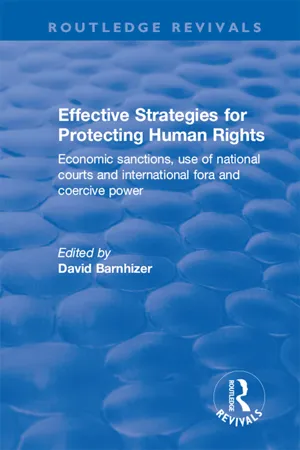
Effective Strategies for Protecting Human Rights
Economic Sanctions, Use of National Courts and International fora and Coercive Power
- 294 pages
- English
- ePUB (mobile friendly)
- Available on iOS & Android
eBook - ePub
Effective Strategies for Protecting Human Rights
Economic Sanctions, Use of National Courts and International fora and Coercive Power
About this book
1 Human Rights as a Strategic System
The human rights regime is not working as an effective system because virtually no one is afraid of the possibility of sanctions, and many of the violators feel that the gains from their actions outweigh the unlikely legal consequences that might ensue. Human rights norms must be enforced and human rights approached as a strategic system in which prevention and enforcement are core commitments. High-sounding phrases are meaningless and even counterproductive or destructive if there is no enforcement or the enforcement is weak, inconsistent or unfair. Lack of enforcement and other appropriate and timely action destroys the integrity of any system. As part of effective enforcement, application of effective sanctions to violators is critical.
It is vital to begin the process of intervention and putting pressure on emerging violators before the worst of the violations arise. This is obviously difficult in many instances because we may not know that there are going to be problems at an early enough time and by the time it is obvious the momentum may be too great. But given the tragedies in Cambodia, Rwanda, Kosovo, Bosnia, Chechnya and far too many other countries we are no longer entitled to innocence. In Rwanda, the analysis by David Rawson and Mark Drumbl make it painfully obvious that we knew what was happening but simply didn’t move to stop the killing. As Richard Goldstone observes from the perspective of his being an African, the great powers whose support is necessary to mobilize the resources, political will, and power required for effective intervention didn’t move until genocide revisited Europe. Disasters in Africa, Asia and Latin America simply were not close enough to home. Even then, Europe and the United States waited far too long to act—allowing the momentum of the situation to build to the point that violators gained confidence that they could act with impunity. A result was that while an aggressive political and economic intervention at an early enough point may well have prevented or at least mitigated the Bosnia/Kosovo disasters, delay resulted in a costly, destructive and questionable military action.
The time to investigate, monitor and create pressure—even to the extent of using military force intelligently—is before the Kosovos, Rwandas and East Timors get started or at least before they build irreversible momentum. This requires that we anticipate what could happen, obtain very good intelligence about what is happening, and initiate measures before the violations get going. Taking anticipatory actions to preempt the potentially unfolding crisis is, however, one of the things we do worst in virtually everything we do. Instead our political systems wait for a problem to become a crisis before we even begin talking about it, and then allow crises to become tragedies before our political leaders are willing to act.
Risking Desensitization through Atrocity
A steady and continuing stream of situations can be pointed to in which tragedies that we wish were just the stuff of horror fiction novels offer terrible examples of “man’s inhumanity to man.” There are the examples of “ethnic cleansing” and genocide such as are found in Kosovo and elsewhere in the Balkans. Add to this the murder of almost a million people in Rwanda, two million in Cambodia by the Khmer Rouge, and the murder and maiming of tens of thousands of innocent civilians by rebels in Sierra Leone. The toll is compounded by the unknown number of Kurds killed by Turkey and Iraq, the widespread murders and other human rights violations in East Timor by Indonesia, and the Russian actions against civilians in Chechnya. The extreme scale, viciousness and depravity of these slaughters make it seem almost trivial to worry about matters such as several hundred deaths in the current conflict between Palestinians and Israelis. In such a context what is the meaning of 500 deaths spread over seven months? What do a hundred systematic rapes mean in the context of the extermination of a culture by mass murder? What does ruthless suppression of the Falun Gong movement by the Chinese government mean in the context of genocide? Of course, these “minor” human rights violations are of great importance, and we must resist the inevitable tendency to become desensitized by the sheer scale and frequency of human rights violations.
But even needing to ask this question reveals the potential for desensitizing effects that can result from being inundated with continual reports about the brutalization of people on a scale beyond human comprehension. In our increasingly sensationalized world dominated by the visual media, we have experienced an inflationary spiral of human rights violations in which the violations must either be done massively, or the victims must be the most successful competitors in the struggle to achieve access to the information media to “tell their story” and gain compassion by becoming the cause celebre of the moment. Media access is a finite and scarce commodity but it is a key part of victimized groups’ ability to better sell their plight to a world that possesses a limited attention span and even less political will to fight terror and injustice. It almost seems that two stark alternatives exist—the celebrity whose rights are violated, or the death and torture of enormous numbers of victims. In this strangely distorted context, the current Israeli-Palestinian conflict seems somewhat of an aberration—explainable primarily by the mobilization of a massive and continuing volume of media coverage that should arguably be focused on more serious situations of continuing and widespread human rights abuses and suffering while the Palestinians and Israelis are left to work out their essentially domestic dispute.
In this bipolar reality of scale versus the celebrity “quasi-martyr,” the person violated, he or she whom we can call the “celebrity victim,” must have a face and identity sufficient to dramatize the violators’ acts and capture the world’s attention. Examples are Salman Rushdie who is under a sentence of death for supposedly blaspheming Islam, and Aung San Suu Kyi, the Nobel Prize winning leader of Burma’s opposition to its military dictatorship. Suu Kyi provides a particularly striking example of a compelling and courageous figure who, though alive, serves through her continuing house arrest as a form of quasi-martyred lightning rod for the Burmese people and their quest for democracy. The other extreme is that the tragedy must reach such an enormous scale that the sheer weight of what is occurring shakes us out of our state of indifference and shames us into acting. In the middle of this continuum are many acts that are severe violations of human rights but that we either ignore or minimize. This occurs because the cultural contexts are so different, no political constituency exists in the most powerful nations that links intimately enough to the victims to generate the political pressure to act, or the country where the violations are occurring have no perceived strategic importance to the U.S. or Europe. In far too many instances, however, racism and ethnocentrism minimizes the importance of African, Asian and Latin American lives.
The Need for Strategic Honesty
In exploring effective strategies for human rights protection it is particularly important that we surrender any lingering naivete about the inherent goodness of human nature. Human rights strategies grounded on a false sense of the innate humanity of people will inevitably fail. While it is entirely understandable why we cling to fictions about our “godliness,” there are striking differences between who we are, who we want to be, and who we pretend we want to be. The gap is captured with great pathos by the robot Radius, speaking to the human Alquist, in Karel Capek’s, R.U.R.—a play dealing with the theme of dehumanization caused by technological “progress.” As difficult and unpalatable as the honesty might be, we must be honest about how we often act when not constrained by some powerful force that either guides our actions toward good ends or deters us through fear and self-interest. Radius responds to a question from Alquist:
Radius: “Slaughter and domination are necessary if you want to be like men. Read history, read the human books. You must domineer and murder if you want to be like men …. We have read books. We have studied science and the arts. The Robots have achieved human culture.”1
Radius’ comments concerning human nature possess poignant power because they come from a different, if not more objective perspective. Their power also derives from the juxtaposition of our being measured based on what humans actually do rather than on what we proclaim ourselves to be. Radius damns us by his observations that are not derived from some Platonic ideal offered by humans as a self-serving description of what we ought to be, but a starkly revealing portrait of what we actually are.
The Importance of a Comprehensive Strategic Focus
This book and its companion volume, Effective Strategies for Protecting Human Rights: Prevention and Intervention, Trade and Education, brings many of the most important but disparate pieces of the human rights arena together as a strategic system. The volume first concentrates on reminding us about several of the deepest political philosophies and issues of human rights. This is done to emphasize why protecting the core values of our fundamental humanity is so important. It addresses issues of inconsistent human rights conduct by major powers such as the United States in Kosovo, East Timor and Turkey and emphasizes the responsibility of citizens to develop the political will needed to alter the equation. This criticism of U.S. policy and citizen responsibility is developed eloquently by Noam Chomsky. Other critical themes are developed, such as the continuing use of torture by governments and the need to become more sophisticated in our strategies against those who employ such “methodologies” of governance (Johnson and Kelsch). James Wilson analyzes the new forms of slavery that have emerged to plague millions of innocent people throughout the world and to suggest how the new International Criminal Court might assume jurisdiction over this crime against humanity. An important reminder is offered by Bonnie Kemess of the American Friends Service Committee that human rights violations are not simply something “out there” that is engaged in solely by dictatorial regimes. She graphically reveals that many of the abuses that regularly occur in American prisons are fairly defined as violations of the prisoners’ human rights. The essay by Ratna Kapur concerns women’s rights and feminism in the Third World, with a particular focus on the empowerment to be gained by freedom rather than an exclusive focus on the victimization of women. Robert Charlick also offers important perspectives in his analysis of the core values of secular humanism on the kinds of value systems that are needed to make progress in the human rights domain.
The chapters then explore the strong use of both private and public law to increase the exposure and accountability of human rights violators. But as many of the authors make clear, dealing with human rights as a comprehensive and strategic system involving prevention, reconstruction, and sanctions is not simply a matter of having strong laws on paper. Nor is it only an issue of creating enforcement, monitoring and restorative institutions that possess superficially appropriate and seemingly impressive mandates. Chapters by Brian Concannon, Jr., Jennifer Moore and Kate Robertson reveal the importance of restorative strategies and the need for understanding the specific contexts and cultures in which you are working. This is particularly demonstrated in Concannon’s description of the work in Haiti by the Bureau des Avocats Internationaux that he manages.
The ultimate focus of the strategic analysis is on the quality of national and international efforts to actually implement moral, legal and regulatory strategies adequate to the requirements of effective human rights protection. But the challenges of achieving effective human rights protection can not be overstated. A main obstacle to an effective human rights system is the excruciating complexity of the institutions and actors and the intertwining of so many needs and objectives. In part failure to achieve an effective system to protect human rights is a problem of insufficient political will. But the slow progress and failure have been products of weak laws, norms, and institutions—along with the lack of political will. These are caused by many factors, but it must be said that the factors include deliberate weakening of human rights institutions by those who fear they might be called to account for their actions.
While such actors as China and Russia leap to mind, there is no question that the United States also must shoulder significant blame for the weakness of human rights protections. Political considerations and strategic and economic alliances such as with Turkey and Indonesia have caused us to ignore situations in which allies we consider essential for various reasons engage in serious violations of human rights. Chomsky brings these issues out in the most powerful way, arguing that the United States not only looks the other way in relation to extreme human rights violations by allies such as Turkey, Indonesia and Colombia but has even cynically assisted and facilitated the violations. This strategic hypocrisy means that we have tended to pick on the relatively easy targets for maximum propaganda effect. And if the truth be told, we haven’t even done a particularly good job in those situations in Haiti, Rwanda and other countries. Former U.S. Ambassador to Rwanda, David Rawson, brings this to the forefront as he outlines the ineptness and “turf” fights that he witnessed in Rwanda as the international community sought to establish a war crimes tribunal. Good intentions are not enough. We need to ask what is needed to make our systems of prevention and intervention, humanitarian response, and enforcement work effectively in relation to human rights.
A. Focus, Action, Political Will
Human rights protection—including prevention and detection, and humanitarian responses to aid victims and assist in the rebuilding of societies devastated by atrocities—requires clear focus, strong action, sustained and powerful political will to provide continuing support for action and to pressure political decision-makers. It also requires the dedication of resources at levels adequate to the various tasks that are required to protect against human rights violations, rebuild shattered societies and sanction violators. Protecting human rights requires the ability and willingness to impose intelligent and appropriate sanctions, and to stimulate the political will needed to demand and sustain the implementation of those sanctions. The inability to “stay the course” with appropriate sanctions weakens the entire system of non-military sanctions. Of course, the initial selection of inappropriate or inappropriately targeted non-military sanctions is itself a serious strategic problem—as is the use of sanctions such as in Iraq where the consequences fall on ordinary people who are demonstrably incapable of creating enough opposition to influence the actual target—Saddam Hussein.
B. Monitoring and Investigative Strategies
Achieving the essential degree of strength in human rights protection requires increasing our capabilities on many levels. These include improving our ability to monitor and investigate violations. These critical functions are described in volume two, Effective Strategies for Protecting Human Rights: Prevention and Intervention, Trade and Education, by Peter Takirambudde, Ann Cooper, Jason Clay, Christopher Decker and Edward Halpin. But strong protection of human rights also necessitates insisting that human rights considerations be placed centrally into the rules of the inexorably expanding international trading regime that is currently under attack for trampling on humanitarian concerns to achieve increased trade efficiencies. Chapters in volume two by Marianne Mollmann, Malini Mehra, David Bamhizer, Frank Garcia and Jorge Varela focus on these concerns. If globalization and the free market are inevitable forces—as they appear to be—it is time to hold them to the expansive rhetoric of openness and of enhanced democratization that their advocates often use to justify the shift to a large-scale market economy. It is appropriate to demand that the trading regime use the power and influence that accrues to its institutional actors from the expansion of economic activity and increased financial integration as mechanisms through which victims of human rights abuses are protected and violators deterred or punished. Otherwise globalization rhetoric is nothing more than warmed over and repackaged “trickle down” propaganda of the kind that has long characterized what passes for political discourse in the United States. But it is an even thinner gruel than the pap offered by American neo-conservatives who are at least fortunate enough to be working intellectually within a relatively coherent national system that possesses countervailing values and institutions.
But such democratic institutions simply do not exist in many of the countries whose people are being displaced by the market and export-driven imperatives of globalization—and many of the elites in those countries will work to prevent the development of such democratic institutions. The mistake made by many advocates of free-market globalization is that they conveniently fail to understand that it is not the economic methodology that makes these cultures anti-democratic, it is the deep values of the cultures themselves. Arguments that the economic mechanism of “free-market globalization” ineluctably compels a variant of “Truth, Justice and the American Way” is at best a sign of naivete and little real experience in many of those countries.
C. Educational and Training Strategies
Educational and training strategies are also particularly important aspects of effective protection of human rights. This thread runs through both volumes but is brought out most explicitly in volume two. These educational and training strategies are, however, not simply directed at the general education of people regarding the importance of human rights ideals. At least as important is the need to focus education and training strategies on a diverse range of distinct constituencies that either nurture or inhibit our ability to protect human rights. These distinct constituencies include potential violators, monitors, investigators and relief providers. They also include judges, defense lawyers and prosecutors, as well as journalists and academics. Richard Wilson’s analysis of the resource constraints imposed on defense counsel in German and Japanese war crime trials involving the defense of Admiral Karl Doenitz and General Tomoyuki Yamashita offers examples of what should be required if the proceedings are to incorporate the fundamental fairness that is an essential requirement of justice. Brian Concannon’s description of the work of the Bureau des Avocats Internationaux in Haiti relates to training of judges, prosecutors and police as part of efforts to bring Haitians to justice who had played important roles in tortures and massacres in that country.
The aim of some of the human rights education is to convince potential violators to behave in more humane ways—either because it is the right thing to do or, more likely, because there is a high probability that there will be serious consequences to them for their inhumane behavior if they pursue that path. Eric Carlson’s discussion in volume two of self-interested and morality-based strategies for human rights education of the military from Latin American countries at the U.S. Army’s School of the Americas offers an important example. Anne Goldstein expands the insight into the functions of education and training as she describes an important project that concentrates on judicial training in human rights. Shulamith Koenig offers descriptions of her work in training communities to understand their human rights and the establishment of “human rights cities.” Hias Bantekas brings to the foreground methods of educating and mobilizing the public awareness of human rights violations and the need for action.
D. The Limits of Deterrence Strategies
To be successful, such deterrence and educational strategies require that the recipients must believe there is a reasonably high probability they will suffer consequences if they violate others’ intrinsic human rights. For potential violators, however, there is not only t...
Table of contents
- Cover
- Half Title
- Title Page
- Copyright Page
- Table of Contents
- Notes on the Authors
- Preface
- 1 Human Rights as a Strategic System
- 2 Human Rights Priorities and Responsibilities for Citizens
- 3 Torture in the U.S.—Connecting International Human Rights Standards to Abuse in American Prisons
- 4 Tactical Innovations for Human Rights
- 5 The Bureau des Avocats Internationaux, a Victim-Centered Approach
- 6 Toward a More Responsive Sovereignty: Confronting Human Rights Violations through National Reconstruction
- 7 Protecting Civilians in Conflict and Post-Conflict Reconstruction
- 8 Babe Politics and the Victim Subject: Negotiating Agency in Women’s Human Rights
- 9 Human Rights and the Future of International Politics: “Realism” and Global Humanism
- 10 A Different Look at Sovereignty
- 11 International Jurisdiction and Prosecutorial Crimes
- 12 Coping with Chaos while Acting Justly: Lessons from Rwanda
- 13 The United States’ Approach to International Human Rights Law
- 14 Prosecuting Violations of Human Rights in U.S. Courts: A Primer for the Justice Department on the Convention against Torture
- 15 Why the International Criminal Court Should Have Jurisdiction Over Contemporary Forms of Slavery
- 16 Will History Repeat Itself? Case Studies of Systemic Constraints on Defense Counsel in Historic International War Crimes Trials and the Need for Resource Parity
- 17 The (Al)lure of the Genocide Trial: Justice, Reconciliation, and Reconstruction in Rwanda
- 18 The Rights of Indigenous Peoples to a Healthy Environment and Use of Natural Resources under International Human Rights Law
- 19 Civil Remedies for Gross Human Rights Violations
- 20 Holding Multinational Corporations Accountable for Human and Environmental Rights Abuses
- Index
Trusted by 375,005 students
Access to over 1.5 million titles for a fair monthly price.
Study more efficiently using our study tools.
Frequently asked questions
Yes, you can cancel anytime from the Subscription tab in your account settings on the Perlego website. Your subscription will stay active until the end of your current billing period. Learn how to cancel your subscription
No, books cannot be downloaded as external files, such as PDFs, for use outside of Perlego. However, you can download books within the Perlego app for offline reading on mobile or tablet. Learn how to download books offline
Perlego offers two plans: Essential and Complete
- Essential is ideal for learners and professionals who enjoy exploring a wide range of subjects. Access the Essential Library with 800,000+ trusted titles and best-sellers across business, personal growth, and the humanities. Includes unlimited reading time and Standard Read Aloud voice.
- Complete: Perfect for advanced learners and researchers needing full, unrestricted access. Unlock 1.5M+ books across hundreds of subjects, including academic and specialized titles. The Complete Plan also includes advanced features like Premium Read Aloud and Research Assistant.
We are an online textbook subscription service, where you can get access to an entire online library for less than the price of a single book per month. With over 1.5 million books across 990+ topics, we’ve got you covered! Learn about our mission
Look out for the read-aloud symbol on your next book to see if you can listen to it. The read-aloud tool reads text aloud for you, highlighting the text as it is being read. You can pause it, speed it up and slow it down. Learn more about Read Aloud
Yes! You can use the Perlego app on both iOS and Android devices to read anytime, anywhere — even offline. Perfect for commutes or when you’re on the go.
Please note we cannot support devices running on iOS 13 and Android 7 or earlier. Learn more about using the app
Please note we cannot support devices running on iOS 13 and Android 7 or earlier. Learn more about using the app
Yes, you can access Effective Strategies for Protecting Human Rights by David Barnhizer in PDF and/or ePUB format, as well as other popular books in Law & Law Theory & Practice. We have over 1.5 million books available in our catalogue for you to explore.