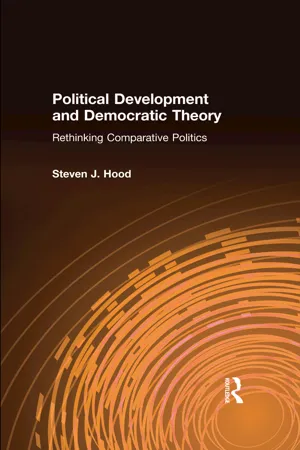
eBook - ePub
Political Development and Democratic Theory
Rethinking Comparative Politics
- 188 pages
- English
- ePUB (mobile friendly)
- Available on iOS & Android
eBook - ePub
About this book
Most comparativists have assumed that democratization is best understood by looking at regimes in the transition and consolidation phases of democracy without really considering the essence of democracy - liberal rights and democratic virtues. Democracy is seen as a mechanistic process without considering the ideas that build democratic regimes. This book begins afresh by proposing that comparativists need to consider democracy to be a combination of rights and virtues, and that the difficulties of democratic transitions, consolidation, and maintenance are essentially problems relating to balancing rights and virtues in the regime. How do we reemphasize these aspects of democracy at a time when comparative literature focuses almost solely on democratic procedure? By combining the best elements of comparative theory and liberal democratic philosophy, Hood argues that comparativists can sharpen the scholarly tools we need to understand both the problems of democratization and maintaining democracy. He provides the reader with a valuable overview of comparative theory and how our abandonment of political philosophy has led to our acceptance of social science methods that can only lead to superficial analyses of democratizing regimes and established democracies.
Information
1
The Spirit of Democracy
Czech president Vaclav Havel is one of those rare human beings who can articulate a vision of democracy that is both practical and ethical. His words engender hope for a better world. He has struggled to keep democratic hope alive throughout his career as a playwright, dissident, and politician. While under the watchful eye of the Czechoslovakian communists, Havel called upon people everywhere to examine competing claims about how we should live our lives and learn to trust our consciences above all other appeals to authority. He admonished us to resist the "irrational momentum of anonymous, impersonal, and inhuman power—the power of ideologies, systems, apparat, bureaucracy, artificial languages, and political slogans." Havel's message then and now is that by virtue of being human, we are free. Using language that would be familiar to the American founding fathers, Havel teaches us that living as free individuals liberates the highest aspirations and dignities of which human beings are capable.
We must not be ashamed that we are capable of love, friendship, solidarity, sympathy, and tolerance, but just the opposite: We must set these fundamental dimensions of our humanity free from their "private" exile and accept them as the only genuine starting point of meaningful human community. We must be guided by our own reason and serve the truth under all circumstances as our own essential experience.1
Havel's stirring defense of freedom, conscience, and morality is echoed in the courageous calls for democracy that we hear from every corner of the globe. The heroes of democracy share Havel's vision of human potential as they fight for and strive to preserve freedom. They are student voices heard in Beijing's Tiananmen Square calling for Chinese democracy. They are the lamentations of Las Madres de la Plaza de Mayo or "Mothers of the Disappeared" in Buenos Aires, who protest the torture, imprisonment, and death of their children at the hands of government thugs. Democracy is understood as a feeling, a unity of hope captured in the simple utterance of a shopkeeper in Mexico City following the first freely contested presidential election in Mexico. "The people finally showed that we are more powerful than any political party, even a dictatorship like the Partido Revolucionario Institucional [Institutional Revolutionary Party (PRI)]. Now we are in control."2
The fervor felt for democracy is more than a love for civil rights. Democracy embodies a faith that a more moral, prosperous, and dignified way of living exists than being ruled by others. Democracy represents liberty and responsibility, the pursuit of happiness, and civic duty. Many keep the promise of democracy alive. Courageous democrats continue to forge ahead in countries where democracy is still a distant hope, in countries trying to solidify democratic gains, and in established democracies where vigilance is needed to keep democratic hope vibrant. But while the promise of democracy remains alive, our scholarship on democracy has become moribund.
Comparative politics has done a good job of analyzing elite behavior and the importance of political bargaining, but we have failed to offer a comprehensive picture of the democratic promise. We have failed to capture the spirit of democracy. The reason for our failure is that we do not understand democratic philosophy. In fact, comparativists are largely ignorant of democratic philosophy and political philosophy in general. We teach our students what we know, which is primarily a few decades of social science methodology, but we are illiterate when it comes to knowing something about the great philosophies that examine democracy. We miss essential elements that explain deeper and more sophisticated reasons why countries democratize and why citizens in established democracies lose faith in their governments.
This book is about democratic development and the promise of democracy. An explosion of studies has surfaced in the last decade that analyze the processes of democratization. This book sorts out the major theories that scholars have developed to explain democratic development, offers some criticisms of these theories, and reintroduces a few timeless insights on democratization that have been overlooked by comparativists. Comparative politics has come to accept theory about democratization and democracy that is too narrow in its perspective and limited in its ability to fully explain the appeal and promise of democracy. This book calls for a comprehensive framework to study democratic development—one that takes into consideration the quality of democracy, including liberal rights and virtues. It offers a standard to judge the quality of democracy in any country. We need a framework that goes beyond our mechanical and technical explanations of democracy and instead looks at democracy as a comprehensive regime that improves people's lives better than an authoritarian regime. No attempt is made to introduce new theory here but instead to suggest that comparativists consider more fully the contributions thinkers like Alexis de Tocqueville have made in understanding modern democracy. This will help us better appreciate why so many countries have embraced democracy and why our attention to the democratic transition and consolidation processes has caused us to overlook a great deal of the substance of democracy.
A Democratic Consensus?
The twentieth century provides startling examples of human beings trying to establish the best regime. Ancient and modern philosophers have theorized about the best regime. During the nineteenth century, the democratic advances in America, France, and Britain provided powerful evidence that democracy, notwithstanding its flaws, benefited humankind in ways never before realized. Until recently, however, democracy was only practiced in a handful of countries. Alongside the development of democratic institutions in a few Western countries, industrialization, colonization, imperialism, impoverishment, and war demanded the attention of political leaders and social reformers everywhere. Unfortunately, many of these nondemocratic leaders and reformers blamed democratic countries for the problems nondemocratic countries experienced. Others admired democracy but believed that other kinds of regimes were better suited to the specific conditions of their countries. As former Singapore president Lee Kuan Yew suggests, the "Western liberalism" of the United States is admirable, but ultimately "certain basics about human nature do not change. . . . Westerners have abandoned an ethical basis for society, believing that all problems are solvable by good government, which we in the East never believed possible."3 By the late 1980s, authoritarian regimes in most of their varieties faltered and began to liberalize. The foreign policies of Western countries reflected a greater earnestness in supporting democratic reform, and comparativists took renewed interest in the study of democratization. One scholar, Francis Fukuyama, enthusiastically proclaimed an "end to history," an end to authoritarianism, and a permanent victory for democracy. Democracy, it seemed, was the realization of the final goal of the history of humankind, the successful outcome of a long developmental process.4
We will briefly look at the reasons why authoritarianism has been rejected in so many countries and what key influences have encouraged democratization. Next, we will turn to a discussion of why there is a rebirth of scholarship devoted to democratization by comparativists and explain why it has been difficult to reach a common understanding of democracy. Then we will sketch out what we mean when we speak of transition to democracy, democratic consolidation, and established democracy.
The Collapse of Authoritarianism
The most urgent goal of any authoritarian regime, whether it be based on a totalitarian, religious, economic, moral, or any other principle, is to stay in power. The tools used to stay in power may differ somewhat due to the particular principles the regime is attempting to uphold. A Marxist regime must mobilize all resources at its disposal in pursuit of accomplishing the goal of the revolution. If the regime fails to convince the people of the primacy of the revolution, the regime loses its reason for existing, and a political collapse may be imminent.5 Nontotalitarian authoritarian regimes may point to economic dangers, moral imperatives, evil forces within the country, or aggressive neighbors as justifications for their monopolizing power. This kind of regime may determine what coercive instruments are needed to enforce the monopoly of political power.
There are many kinds of authoritarian regimes. Leaders in Iran, Saudi Arabia, and Egypt rely on various interpretations of Islam to maintain power. Others, like the Confucian countries of East Asia, may claim that certain cultural attributes are superior to the messiness, disorder, and license that they perceive to exist in democratic states and therefore legitimize their brand of authoritarianism. Many heads of state all over the globe point to the necessity of economic growth as a precondition to democratic development. Leaders in Cote d'Ivoire, Liberia, and Haiti speak to the necessity of using armed force due to internal and external security concerns. The presidents of Peru, Argentina, and Russia claim to be democratic, even though the transition to democracy has stalled.
Authoritarian regimes may or may not seek experts outside of government to help them. They may tolerate some levels of free speech or discourage political discourse everywhere except within exclusive government circles of power. They may be able to employ brilliant economic plans or have no idea how to encourage economic growth. They may seek racial harmony, or instigate racial conflict. They may genuinely love their country and care deeply for the welfare of the people living in their countries, or they may despise the people and care only about themselves. They may have many friends among democratic countries, or few friends. They may have been respected by the United States at one time for their benevolent treatment of people living in their countries, only to be subsequently criticized by Washington for failing to become fully democratic.
Authoritarian governments may be led by a sultan, a fascist dictator, a military junta, a communist party politburo, a Western-educated professional, scholar, or religious leader, or a group of leaders that constitute a ruling body. Some authoritarian leaders respect democratic institutions that have developed in the West and elsewhere. Some are even willing to admit that democracy is the goal to which their country aspires, even though little or no progress is made year after year in reaching that goal. The common feature in understanding authoritarianism is that most authoritarians do not trust the people or the regime's political opponents. Authoritarians believe that they, by themselves, are best able to run the government and administer policies on behalf of the country. They fear opposition and the threat of opposition. Authoritarian regimes are ever suspicious of political opponents and fear circumstances that could lead to their loss of power. They may speak of political rights, but they are careful not to elaborate a specific notion of rights in any detail for fear of setting in motion calls for liberalization and democracy.
Authoritarian regimes can be dangerous to themselves, the people they rule, and to neighboring countries. While some may enjoy political calm and economic development for several years or decades, unexpected circumstances may become the catalyst for the regime taking harsh measures against its people. The growth of a small opposition movement, criticism within government ranks, public outcry over the handling of a specific problem, or even the occurrence of a natural disaster will heighten tension within an authoritarian regime. Under these circumstances, nervous leaders begin to identify political enemies and issue threats. Tension builds and good will is destroyed. As groups and interests collide, these difficulties can result in calls for democratization, liberalization without democratization, attempts to increase repression, political coups, or intense political crises. People living in such countries may or may not support efforts to democratize and may even opt for rule by the existing regime, even though the leaders may be resented for their repressive ways, corruption, and extravagant lifestyles. Regime opponents may demand replacement of the regime without opting for democracy, but political bargaining and negotiations may lead to democracy without any grassroots support for democracy. Sometimes democracy does not even emerge as an option as calls for a just and moral, benevolent authoritarian regime are renewed.
But does a truly benevolent authoritarian regime exist—one where people are respected and enjoy equal treatment under the law? Where peace and prosperity are lasting? Where people have sufficient faith that the regime will not behave in an unfair manner? Leaders in some states, for example, make the claim that they live by the doctrines of Islam and therefore provide what is best for the people. However, scholars and religious leaders do not agree that this is the case. Most scholars believe that leaders of countries in the Islamic world use Islam as a tool to maintain exclusive political rule, rather than as a moral code to guide their lives, and they point out the contradictions between Islamic religious doctrine and political practice.6
From time to time philosophers have suggested that benevolent authoritarian regimes could develop that rival democracy in their capacity to administer justice and freedom. Yet, pending some unknown set of circumstances that would introduce such a political regime, most comparativists are united in their belief that democracy is the only form of government capable of providing adequate protection for people to function in a climate without fear. Political practices are based on such lofty ideals as justice, tolerance, equality, and freedom rather than threats, imprisonment, and death.
The Rise of Democracy
As disillusion and failure grow among despotic regimes in all their forms, key influences have helped bring about a reconsideration of democracy. Democracy's advocates are found in every corner of the globe and represent a variety of interests. An overlapping network of international, regional, economic, and religious influences are united in their calls for democracy.
International Democratic Influences
Most international organizations encourage and operate by democratic procedure. These organizations provide valuable lessons to authoritarian leaders and very often carry the moral authority and representation of the world's most respected democracies. Organizations like the United Nations (UN) often carry considerable political power, making it impossible for states like the Soviet Union and China to decline membership. Membership in the UN requires member states to operate by democratic rules. The influence of foreign policies of democratic countries also has a significant impact in promoting democratic values worldwide. The UN, the European Union, and human rights organizations openly encourage democratic reform. They offer incentives of financial aid, technological assistance, and membership in their organizations for progress made in the areas of market reform, human rights, and democratic development. The United States and other countries have made greater efforts to link trade and other exchanges between themselves and nondemocratic countries on the basis of political reform. As authoritarian states become democratic, other authoritarian states find themselves increasingly isolated in the international community. This increases pressure on existing regimes to reform or risk driving their countries into economic ruin and political estrangement.
The steady increase in the number of democratic countries (from 69 in 1989 to 117 in 1999 by one organization's estimate) has set a new standard of governance.7 The opportunities to maintain authoritarianism at home and still enjoy the support of the United States and other countries has diminished considerably. The United States no longer has an urgent need of making friends with whomever opposes communism. This has freed critics of authoritarianism in the United States and elsewhere to encourage authoritarian regimes to make democratic compromises. A simultaneous explosion has taken place in the nu...
Table of contents
- Cover
- Half Title
- Title
- Copyright
- Dedication
- Contents
- Preface
- 1. The Spirit of Democracy
- 2. The Transition from Authoritarianism to Democracy
- 3. Consolidating Democracy
- 4. Maintaining Democracy
- 5. Conclusion: Rethinking Comparative Politics
- Notes
- Bibiliography
- Index
Trusted by 375,005 students
Access to over 1.5 million titles for a fair monthly price.
Study more efficiently using our study tools.
Frequently asked questions
Yes, you can cancel anytime from the Subscription tab in your account settings on the Perlego website. Your subscription will stay active until the end of your current billing period. Learn how to cancel your subscription
No, books cannot be downloaded as external files, such as PDFs, for use outside of Perlego. However, you can download books within the Perlego app for offline reading on mobile or tablet. Learn how to download books offline
Perlego offers two plans: Essential and Complete
- Essential is ideal for learners and professionals who enjoy exploring a wide range of subjects. Access the Essential Library with 800,000+ trusted titles and best-sellers across business, personal growth, and the humanities. Includes unlimited reading time and Standard Read Aloud voice.
- Complete: Perfect for advanced learners and researchers needing full, unrestricted access. Unlock 1.5M+ books across hundreds of subjects, including academic and specialized titles. The Complete Plan also includes advanced features like Premium Read Aloud and Research Assistant.
We are an online textbook subscription service, where you can get access to an entire online library for less than the price of a single book per month. With over 1.5 million books across 990+ topics, we’ve got you covered! Learn about our mission
Look out for the read-aloud symbol on your next book to see if you can listen to it. The read-aloud tool reads text aloud for you, highlighting the text as it is being read. You can pause it, speed it up and slow it down. Learn more about Read Aloud
Yes! You can use the Perlego app on both iOS and Android devices to read anytime, anywhere — even offline. Perfect for commutes or when you’re on the go.
Please note we cannot support devices running on iOS 13 and Android 7 or earlier. Learn more about using the app
Please note we cannot support devices running on iOS 13 and Android 7 or earlier. Learn more about using the app
Yes, you can access Political Development and Democratic Theory by Steven J. Hood in PDF and/or ePUB format, as well as other popular books in Politics & International Relations & Labour Economics. We have over 1.5 million books available in our catalogue for you to explore.