Student retention continues to be a vexing problem for all colleges and universities. In spite of the money spent on creating programs and services to help retain students until they achieve their academic and personal goals, and graduate, the figures have not improved over time. This is particularly true for minority students, who have a greater attrition rate than majority students. Demographic information shows that the minority population in the United States is growing at a faster rate than the majority. It is imperative that educational institutions find ways to help improve retention rates for all students but particularly minority students. Retention rates should not differ appreciably among different racial/ethnic groups."The Journal of College Student Retention: Research, Theory and Practice" is the only scholarly, peer-reviewed journal devoted solely to college student retention. It has published many articles on minority student retention, and this topic continues to garner much attention. This book is a compilation of the very best of these articles, selected on the basis of reviews by a cadre of experts in the education field. The articles discuss African American, Latino/Latina, Asian and Asian Pacific, Native American, and biracial students, and institutional commitments to retaining a diverse student population. For those interested in this vital area, the collection will teach and inspire them to achieve greater heights and pay additional attention to retaining minority students in our colleges and universities.
eBook - ePub
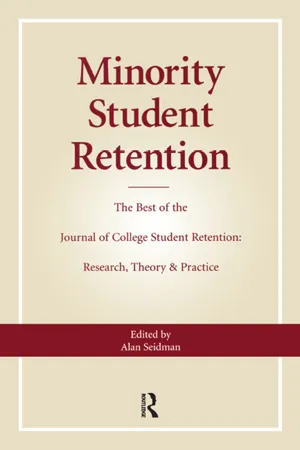
Minority Student Retention
The Best of the "Journal of College Student Retention: Research, Theory & Practice"
- 318 pages
- English
- ePUB (mobile friendly)
- Available on iOS & Android
eBook - ePub
Minority Student Retention
The Best of the "Journal of College Student Retention: Research, Theory & Practice"
About this book
Information
SECTION 1
African-American Students
CHAPTER 1
Correlates of Retention for African-American Males in Community Colleges
The retention rates of African-American men in community colleges are among the lowest of all ethnic groups nationally. This study analyzes organizational data for three cohorts of men in a longitudinal design for three semesters (N = 202), and uses logistic regression to identify the factors that best predict retention. The importance of high school grades, age, number of courses, a positive view of personal skills, clear high goals, and the early identification of a college major appear to be salient for this group and offer implications for practice.
Although the civil rights movement of the 1960s remains only a distant memory, issues of equal access to higher education and barriers to desirable employment with higher earnings continue to be a reality for many African Americans. The evidence of unequal opportunities is evident by the staggering proportion (26 percent) of African Americans living below the poverty level (U.S. Census Bureau, 1997). While African Americans make up 12.8 percent of the American population, they comprise 40 percent of the chronically poor (Shinagawa & Jang, 1998). In addition, African Americans have an unemployment rate that is double that of the general population (Shinagawa & Jang, 1998).
The demographic statistics for male African Americans are equally dismal. Black men in American society confront formidable challenges to success including lower achievement scores in basic subject areas, higher likelihood of placement in programs for students with learning disabilities, higher likelihood of school suspension, and are the frequent victims of lowered expectations by educational professionals (Reed, 1988). While the number of African-American men enrolled in the nation’s colleges and universities has increased slightly during the 1990s, it remains disturbingly low (Reisberg, 1999). African Americans are the only racial group in which females appear to frequently attain greater rewards than males. Cuyjet (1997) commented that “a cursory look around most predominantly white campuses (unless one is standing in a location frequented by the football and basketball athletes) probably reveals the fact that black women attend college in proportionally larger numbers than black men” (p. 5). The proportion of African-American men who graduate from high school, achieve a bachelor’s degree or higher, enter the labor force, or become managers or business professionals is lower than the proportion of African-American women who achieve these same milestones (Shinagawa & Jang, 1998).
The reasons for the unique gender differences may be quite complex. Lee (1994) posits that the combination of racial discrimination and lowered socioeconomic status experienced by many African Americans creates a complex array of historical and social interactions that ultimately blend to inhibit success. Majors and Billson (1992) have labeled this phenomenon “subjective cultural realities for black males” (p. 109).
Facts and figures support the commonly accepted nexus between high achievement and higher education, especially for African Americans. The U.S. Census Bureau (1998) indicated the median income of African Americans with only a high school diploma as $18,683, as compared to $31,047 for those with a bachelor’s degree. Most would agree that the negative outcomes of un- and under-employment so prevalent among African-American males could be alleviated and reduced with larger scale, more focused efforts in post-secondary education. While the goal may be obvious and simplistic, the avenue to achieving the goal—widespread success in college—is not obvious, direct, nor easily attained.
Community colleges are the predominant entry point for postsecondary instruction for the majority of students of color, including African Americans (Chenoweth, 1998; McCool, 1984; Nora & Rendon, 1990). But the retention of these students remains an important yet perplexing and complicated issue at community colleges, where most students commute, have employment and/or family responsibilities, and are generally poorer than traditional four-year college students (Tinto, Russo, & Kadel, 1994). These students must cope with personal issues such as family or financial problems, lack of child care, and job demands concurrent with the demands of college (Kerka, 1995). Thus, many community college students, especially African-American males, do not achieve their educational goals. Data from the Beginning Postsecondary Student Survey (BPS)-Second Follow-up (National Center of Education Statistics, 1994) indicates that only 16.6 percent of African Americans who began their education in community colleges in 1989-90 could be traditionally classified as persisters.1 This finding is consistent with previous research indicating that African Americans are about 22 percent more likely than their white counterparts to leave college prior to goal completion (Carter & Wilson, 1993; Porter, 1990). Among African-American males in community colleges, the retention rate is even more shocking—less than 10 percent (Chenoweth, 1998).
PURPOSE OF THE STUDY
The under-representation of African-American men has serious repercussions not only for the men themselves, but also for our nation as a whole. Whenever a group of individuals is not interacting and achieving at optimum levels, the country is robbed of talent that could enrich the lives of many. We are compelled to question the deplorable retention rates among this important population subsample and to determine factors and subsequent policy to provide academic success. Since the majority of African-American men who begin postsecondary instruction do so at community colleges, it seems intuitive that the identification of factors that promote retention and subsequent success in these institutions is a worthy and important endeavor. Because there has been so little research on this group, the present study was designed not to test a well-elaborated framework of hypotheses but instead to explore the following questions:
• What are the significant factors predicting retention among African-American males in an urban community college?
• Do the factors promoting retention vary with respect to number of semesters enrolled? In other words, do the same factors that promote retention through the first semester also promote retention through the second semester? And what factors will continue to promote retention in a third semester?
CONCEPTUAL FRAMEWORK
A variety of relevant independent variables are suggested in the conceptual literature concerning theories of integration, attrition, and status attainment among community college students.
Integration
The dominant paradigm in retention research posits that academic achievements and social relations with college peers promote learning and retention. Tinto (1975) defined academic integration as identification with, and the degree of achievement (e.g., courses completed) according to, the scholarly standards of an institution. Social integration has been defined as student peer relations consisting of friendship, informal academic discussions and efforts, and shared extra-curricular activities. Theoretically, the student’s academic integration and social relations are assumed to influence several attitudes, including college completion goals, which in turn affect retention and persistence in college. Extensive research on four-year colleges has provided substantial support for this theory (Braxton, Sullivan, & Johnson, 1997; Cabrera, Nora, & Casteneda, 1993; Kuh, Schuh, Whitt & Associates, 1991; Pascarella & Terenzini, 1991; Tinto, 1975, 1993, 1998).
Status Attainment and Attrition
Other perspectives place greater emphasis on the social contexts outside the campus, particularly family socioeconomic status and the influence provided by family and friends (Bean, 1980; Hauser & Featherman, 1975; Metzner & Bean, 1987; Sewell, Hauser, & Featherman, 1976). Despite differences in emphasis, these perspectives overlap with integration theory in noting the impact of academic achievement and college completion goals on retention. A considerable amount of research in four-year colleges has provided support for these frameworks (Cabrera, Nora, & Casteneda, 1993; Pascarella & Terenzini, 1991; Tinto, 1993).
In a review of the relevance of these four-year college theories for community college students, Maxwell (1998) concluded that the limited amount of research available on community colleges is inconclusive regarding the impact of social integration on retention. Because the differences between students at four-year and two-year campuses are many, including patterns of residence, ethnicity, gender, parental education and income, and age, there is reason to question the relevance of the four-year theories. Other independent variables in community college research which have also manifested conflicting and inconclusive effects on retention include age of the student, GPA, full/part-time attendance, and day/evening attendance (Brooks-Leonard, 1991; Feldman, 1993; Fischbach, 1990; Grimes, 1997; Pascarella, Smart, & Ethington, 1986; Voorhees, 1987; Webb, 1989),
Several independent variables reported in the community college research literature display a more consistent pattern of relations with student retention, though the number of studies is quite limited and most of them were conducted one or more decades ago. The majority of these few studies did involve multi-racial samples, which included African-American males. Factors found to be positively correlated with retention included high school grades (Feldman, 1993; Fischbach, 1990), number of course credits earned (Grimes, 1997; Webb, 1989), academic self-confidence (Webb, 1989), certainty of major (Webb, 1989), and high educational goals (Feldman, 1993; Pascarella & Chapman, 1983; Voorhees, 1987; Webb, 1989).
After an extensive review of the persistence research on minorities, Nora (1993) concluded that there were no “theoretically based” studies of African-American community college students. However, there has been research comparing male and female African-American students in other kinds of institutions (Allen & Haniff, 1991; Coates, 1987; Plummer, 1995). And, in fact, there have been a few investigations of the outcomes for African-American males in community colleges (Carroll, 1988; Lin & Vogt, 1996; Weis, 1985). Carroll’s (1988) findings were consistent with the above studies which reported that high educational goals were positively correlated with retention.
Given the uncertain applicability of four-year college theories to two-year college students, we have followed an exploratory strategy that relies partially on these theories and also on other variables associated ...
Table of contents
- Cover
- Title Page
- Copyright Page
- Dedication
- Table of Contents
- Introduction
- SECTION 1 African-American Students
- SECTION 2 Latino/a Students
- SECTION 3 Asian and Asian Pacific Students
- SECTION 4 Native American Students
- SECTION 5 Biracial Students
- SECTION 6 Institutional
- Contributors
- Index
Trusted by 375,005 students
Access to over 1.5 million titles for a fair monthly price.
Study more efficiently using our study tools.
Frequently asked questions
Yes, you can cancel anytime from the Subscription tab in your account settings on the Perlego website. Your subscription will stay active until the end of your current billing period. Learn how to cancel your subscription
No, books cannot be downloaded as external files, such as PDFs, for use outside of Perlego. However, you can download books within the Perlego app for offline reading on mobile or tablet. Learn how to download books offline
Perlego offers two plans: Essential and Complete
- Essential is ideal for learners and professionals who enjoy exploring a wide range of subjects. Access the Essential Library with 800,000+ trusted titles and best-sellers across business, personal growth, and the humanities. Includes unlimited reading time and Standard Read Aloud voice.
- Complete: Perfect for advanced learners and researchers needing full, unrestricted access. Unlock 1.5M+ books across hundreds of subjects, including academic and specialized titles. The Complete Plan also includes advanced features like Premium Read Aloud and Research Assistant.
We are an online textbook subscription service, where you can get access to an entire online library for less than the price of a single book per month. With over 1.5 million books across 990+ topics, we’ve got you covered! Learn about our mission
Look out for the read-aloud symbol on your next book to see if you can listen to it. The read-aloud tool reads text aloud for you, highlighting the text as it is being read. You can pause it, speed it up and slow it down. Learn more about Read Aloud
Yes! You can use the Perlego app on both iOS and Android devices to read anytime, anywhere — even offline. Perfect for commutes or when you’re on the go.
Please note we cannot support devices running on iOS 13 and Android 7 or earlier. Learn more about using the app
Please note we cannot support devices running on iOS 13 and Android 7 or earlier. Learn more about using the app
Yes, you can access Minority Student Retention by Alan Seidman in PDF and/or ePUB format, as well as other popular books in Education & Higher Education. We have over 1.5 million books available in our catalogue for you to explore.