- 168 pages
- English
- ePUB (mobile friendly)
- Available on iOS & Android
eBook - ePub
Contracting for Project Management
About this book
In all but the smallest of projects the project sponsor inevitably has to buy in the goods and services of other suppliers. This requires people to make contracts so that they know the basis on which they are working with each other and to deal with any disagreements that subsequently arise. So a knowledge of contracting specifically for project management is essential if a project is to avoid difficulties and reach a successful conclusion. This book concentrates specifically on the contracting issues that surround projects of any size.
1 Roles and responsibilities in project contract management
Nigel Smith
No organization has all the skills required to do anything but the most simple of projects. Additional skills required for the completion of projects must be bought in from external sources. In this chapter, we consider the roles required throughout the project supply chain, particularly during the design and construction stages, and what contract types are available to provide the additional roles in different ways. The contract is the mechanism by which:
- the project organization is created;
- project managers are employed;
- goods and services are procured;
- the commercial nature of the project process is defined.
It is important for project managers to be aware of how to operate effectively using the contractual procedures to optimal advantage. This chapter reviews the roles of different parties to a project and different contracting practices designed to provide the client organization with those services. It covers the traditional approach and some of the more recent but now common practices, as well as emerging ones. The chapter also describes standard terms for project managers and comments on future trends.
Project Procurement
Ideas for projects arise from many sources, including strategic planning, market forecasts, process re-engineering or suggestion by a speculative developer. A client considers the viability of these concepts to determine the extent to which it wishes to participate. This varies from client to client and project to project, from being a wholly internal, private project executed by direct labour to a public sector concession awarded to an external promoter. Whatever delivery structure is adopted, similar functions need to be undertaken, many of which must be sourced from outside the client's organization. The roles and responsibilities for the management of a project can be viewed as a hierarchical sequence of interlinked functions (Figure 1.1). These cascade down from the strategic, market and commercial drivers acting on the client and progress through the various parties in the entire supply chain. Due to the range of types of procurement strategies used in projects, this generic diagram may use separate tides for groups which in practice might be a single organization or even a single individual. Further, the rationale for the linkages included in the diagram would have to be modified to remain compatible with the structure and numbers of parties involved in the project.
One of the most important decisions to be taken after the client is satisfied with the project concept and viability is the choice of procurement strategy. This has to identify the number of parties involved and their responsibilities. This is not always straightforward and it is important to remember there are always alternative procurement routes available for any project. A number of differing sources estimate that the selection of the most effective procurement strategy compared with possible strategies could produce cost savings of about 8 per cent. This is significant when it is remembered that profit margins in construction are frequently of the order of 1-2 per cent.
In this chapter, we consider a number of different procurement strategies available to fulfil the roles illustrated in Figure 1.1. We start by considering the traditional approach, and then describe others as variants on this model. Ultimately, it is the client who must determine the procurement strategy to its optimal advantage.
The Traditional Project Contract Strategy
As a starting point for the consideration of the roles and responsibilities of parties to a project suitable for all types of business, engineering or industry, we consider the traditional structure used extensively in the UK construction industry. This involves three parties:
- A client who initiates and sanctions a project.
- A consultant who undertakes the feasibility and design.
- A contractor who is responsible for implementing the project.
Procurement strategies adopted by a project must recognize the prevailing culture and structure of the indigenous construction industry, as these will have a major influence on the effectiveness of any strategy adopted. In the UK
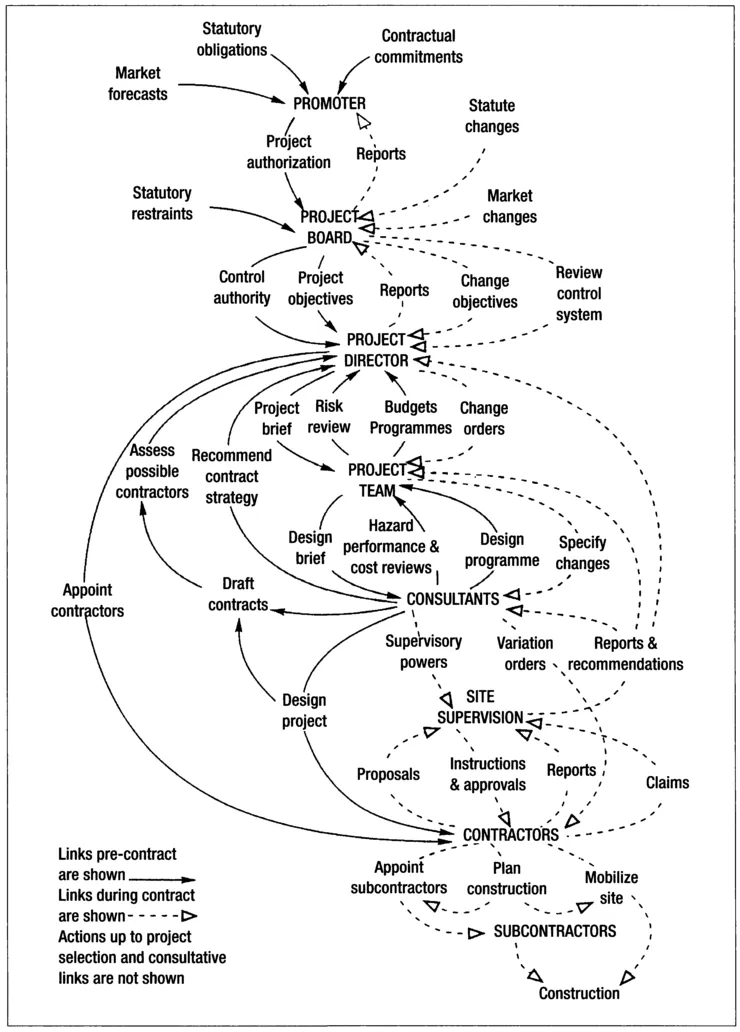
Figure 1.1 Roles and responsibilities in the project supply chain
Source: After Nunos and Wearne (1984)
Source: After Nunos and Wearne (1984)
construction industry, it has long been common practice to combine many of the roles in Figure 1.1 into the three fundamental roles listed above. Although not as popular as it was 20 years ago, this traditional procurement strategy still accounts for more than 50 per cent of all heavy civil engineering construction in the UK. It is also the basis for the Institution of Civil Engineers standard forms of contract, of which the seventh edition is the most recent version (1999). This strategy will therefore be outlined as a template against which other procurement strategies can be evaluated.
The Client
In the traditional procurement strategy, the client is the organization which desires the project, often owns the site, usually funds the project and is frequently the end-user. (Often in property development the client is the developer, the eventual owner a financial institution and the end-user an organization that rents the building.) It is also assumed that the client organization will contain the project board and the project manager who will have the authority and expertise to commence the procurement of the design and construction phases of the project. From Figure 1.1, it can be seen that this equates to the internalization of the roles and links associated with Promoter, Project Board, Project Director and Project Team. Nevertheless these functions remain and have to be undertaken effectively.
The Consultant
Consultants or consulting engineers are charged with three main functions:
- Management of the design process.
- Assistance in tendering and contract administration.
- Site supervision.
Typically, a design brief or scope of works is prepared by the client organization and consultants are selected on the basis of the quality of service provision and fee competition. The successful consultant will then have direct contact with the client.
Changes are now occurring to improve the working of the traditional system. For some time, the ICE Conditions of Contract (1999) has been the most widely used model form of contract in the UK. This is despite its being based on the assumption that the consultant as well as being paid by the client is also the independent arbiter of the contract. However, in 1995 the ICE issued the Engineering and Construction Contract, which recognized for the first time the roles of 'designer', 'project manager' and 'site supervisor' as 'client agent' roles, with their duties and responsibilities defined accordingly. The role of independent arbiter is replaced by an external 'adjudicator', whose fees are paid equally by client and contractor (see Chapter 9). This was a major component of the Latham Report (1994). As we shall see, this new contract can apply to almost the complete range of procurement strategies and several clients are considering it as a direct replacement for contracts used in the traditional procurement strategy.
The Main Contractor
Traditionally, a single main contractor would be appointed, usually after the completion of the design, to undertake construction only. The contractor would have responsibilities for planning the works, mobilization, construction and opening or commissioning. However, the traditional procurement system contains some inherent characteristics that adversely affect and restrict the effective construction of the works. First, by precluding the contractor from the earliest stages of a project, the opportunity to incorporate construction expertise at an early and cost-effective stage is wasted and subsequent changes enforced by requirements of practicability are often costly. Second, the client and consultant may have been working on the project for many months or, on large projects, for a number of years. But at tender stage a contractor is given between eight and ten weeks to understand the project, to liaise with members of the supply chain, to assess the risk and to produce a tender price. This tender price has to be high enough to protect the contractor from the consequences of risks for which it has responsibility, but low enough to be successful in a competitive tendering system based on the lowest evaluated price being successful. Third, there is often pressure from the client for the contractor to commence work on site at the earliest possible opportunity. This is usually a false economy as a short period of pre-construction planning time can often result in substantial time and cost savings on site. These savings can often be shared in some way with the client.
Subcontractors
In the simplest form of contract, the main contractor may undertake the complete contract. However, it is common practice to make use of specialist subcontractors to undertake sections of the works. The subcontractor will have specific knowledge and expertise, with appropriately trained staff, which enables it to undertake specialist work more competitively than the main contractors. With or without subcontractors, there will also be a supply chain of varying complexity consisting of vendors, suppliers and service providers.
The Project Manager
So where in the traditional procurement system is the project management expertise? It is common for many organizations to 'manage by projects' and to employ key personnel as project managers. Indeed the client, the consultant, the contractor and the subcontractor may all have project managers. However, in terms of the complete project, it is the client's project manager that is considered to have responsibility for all the phases of a project and to execute the project management function. At some level inside the client organization, possibly the Board of Directors, a decision has to be made to authorize the project and to determine the terms of reference of the project manager. Terms are discussed in greater detail later in this chapter.
The Procurement Process
One of the first actions of the project manager, after determining viability and degree of risk, is to determine the project objectives. In all projects the primary targets, time, cost and performance are important. However, it is likely that one will be dominant. There are a host of secondary and tertiary targets which need to be considered. Typically the degree of involvement of the client and/or the project manager, the innovation required, interfaces with external organizations, inclusion of international organizations and many other factors need to be considered to establish the clear aims of the project. Only if the project purpose and objectives can be clearly defined can the most appropriate procurement strategy be identified. However, events might occur that require modifications or changes to the project objectives, and constant monitoring is necessary. This cycle is illustrated in Figure 1.1 between the Project Board and Project Director.
The project manager then has to consider his or her own internal project team and the other main parties, the consultant and contractor. The project team conduct risk analyses and investment appraisal, undertake feasibility studies, develop the project brief and determine the procurement strategy. For each contract the project manager considers the project objectives in terms of the combined selection of an organizational structure, a contract type, a tendering strategy and a model form of contract. In the traditional procurement strategy the consultants are appointed on the basis of a project design brief and competitive tendering. The project team and the consultant will interact during the design process and in the preparation of construction contract documentation. After completion or substantial completion of the design, the contractor is appointed on the basis of a priced bill of quantities and competitive price. It is usual for the project team to have undertaken a prequalification exercise prior to tender. This is popular with both clients and contractors. Clients favour prequalification because it removes financially or technologically weak organizations and ensures a large competitive 'pool' of contractors, each of which is appointable. It is also popular with contractors because prequalification removes organizations without the necessary skills, experience and management expertise and allows them to compete with peer group members who will have similar costs and overheads. Interestingly enough the appointment of a subcontractor is more likely to be based on negotiation of the price with the organization identified as being the 'best partner' than on open competition.
As mentioned above, other parties involved in the project may have their own internal staff with the job title project manager. Their role is to act as the point of contact between the client's project manager and the organization's own staff and to manage their own component of the project to meet their predetermined targets and objectives. It is therefore an important part of the project team's brief to try to harmonize the goals of these other project managers with those of the client's project manager and of the project as far as is practicable.
For the rest of this chapter it is the role of the client's project manager, or the organization undertaking that role, which will form the basis for discussion, thereby providing a view through the whole project life cycle. The client's project manager has responsibilities, some of which are contractual and others non-contractual. Model forms of contract differ in their structure and in the allocation of risks and obligations. Consequently, the client's project manager could find most of the contractual roles imposed from a contract of engagement or employment and might not have a direct contractual role in the contract between client and contractor, as in the ICE seventh edition Conditions of Contract (1999). Alternatively, the client's project manager could have a main contract role with specific obligations and duties, as discussed earlier in regard to the ICE new engineering document conditions of contract (1995).
Alternative Project Contract Strategies
Other established procurement strategies exist in construction and in other sectors and discipl...
Table of contents
- Cover
- Half Title
- Title
- Copyright
- Contents
- List of figures
- Notes on contributors
- Preface
- 1 Roles and responsibilities in project contract management
- 2 Contracts and payment structures
- 3 Farsighted project contract management
- 4 Standard forms of contract
- 5 Contract law
- 6 Partnering, benchmarking and incentive contracts
- 7 Procurement
- 8 Bidding
- 9 Managing variations, claims and disputes
- Index
Trusted by 375,005 students
Access to over 1.5 million titles for a fair monthly price.
Study more efficiently using our study tools.
Frequently asked questions
Yes, you can cancel anytime from the Subscription tab in your account settings on the Perlego website. Your subscription will stay active until the end of your current billing period. Learn how to cancel your subscription
No, books cannot be downloaded as external files, such as PDFs, for use outside of Perlego. However, you can download books within the Perlego app for offline reading on mobile or tablet. Learn how to download books offline
We are an online textbook subscription service, where you can get access to an entire online library for less than the price of a single book per month. With over 1.5 million books across 990+ topics, we’ve got you covered! Learn about our mission
Look out for the read-aloud symbol on your next book to see if you can listen to it. The read-aloud tool reads text aloud for you, highlighting the text as it is being read. You can pause it, speed it up and slow it down. Learn more about Read Aloud
Yes! You can use the Perlego app on both iOS and Android devices to read anytime, anywhere — even offline. Perfect for commutes or when you’re on the go.
Please note we cannot support devices running on iOS 13 and Android 7 or earlier. Learn more about using the app
Please note we cannot support devices running on iOS 13 and Android 7 or earlier. Learn more about using the app
Yes, you can access Contracting for Project Management by J. Rodney Turner in PDF and/or ePUB format, as well as other popular books in Business & Business General. We have over 1.5 million books available in our catalogue for you to explore.