There is a growing evidence base that documents the social, environmental and economic benefits that urban trees can deliver. Trees are, however, under threat today as never before due to competition for space imposed by development, other hard infrastructures, increased pressure on the availability of financial provision from local authorities and a highly cautious approach to risk management in a modern litigious society.
It is, therefore, incumbent upon all of us in construction and urban design disciplines to pursue a set of goals that not only preserve existing trees where we can, but also ensure that new plantings are appropriately specified and detailed to enable their successful establishment and growth to productive maturity.
Aimed at developers, urban planners, urban designers, landscape architects and arboriculturists, this book takes a candid look at the benefits that trees provide alongside the threats that are eliminating them from our towns and cities. It takes a simple, applied approach that explores a combination of science and practical experience to help ensure a pragmatic and reasoned approach to decision-making in terms of tree selection, specification, placement and establishment. In this way, trees can successfully be incorporated within our urban landscapes, so that we can continue to reap the benefits they provide.
Chapter 1: So what have urban trees ever done for us?
We are left in awe by the nobility of a tree, its eternal patience, its suffering caused by man and sometimes nature, its witness to thousands of years of earth’s history, its creations of fabulous beauty. It does nothing but good, with its prodigious ability to serve, it gives off its bounty of oxygen while absorbing gases harmful to other living things. The tree and its pith live on. Its fruits feed us. Its branches shade and protect us. And finally, when time and weather brings it down, its body offers timber for our houses and boards for our furniture. The tree lives on.
George Nakashima (American architect, woodworker and furniture maker)
1.1 INTRODUCTION
In 2008, the planet reached an important milestone. The world population, as a whole, moved from being predominantly rural to becoming mainly urban (UN Department of Economic and Social Affairs, Population Division, 2008). This trend is set to intensify, and it is predicted that by 2050, two-thirds of the world’s population will be city-dwelling (UN Department of Economic and Social Affairs, Population Division, 2014). In Europe, approximately 80 per cent of the population will be living in urban areas by 2020 (European Environment Agency, 2006). Almost 90 per cent of the British population was already living in urban areas by 1991 (Denham & White, 1998), and this propensity for urban living is likely to be matched by seven other European countries by 2020 (European Environment Agency, 2006). The social and environmental implications of this are obviously enormous.
It is true that urban expansion, if adequately planned for, has the potential to improve peoples’ access to health care, education, housing and other services. It is also true that we have been exploiting trees within our urban landscapes, for the benefits they provide us, since the sixteenth century. This use of trees within urban centres reached its peak with the garden city movement and workers’ colonies of the mid to late nineteenth century (Lawrence, 2006), where pressure from social reformers to increase access to green open space not only helped in urban beautification, but also improved the life of city inhabitants from all social classes. Formal street tree planting formed part of this urban greening and spread rapidly from London into urban development schemes for other UK cities and commercial centres, where it was seen as a symbol of civilisation. The result of this recognition of the importance of providing city populations with street trees and access to green open space means that many of the finest examples of our existing urban trees are a legacy from the Victorian era. It is sometimes sobering to consider that the longevity of some of these urban trees has proved to be greater than that of the built form around them.
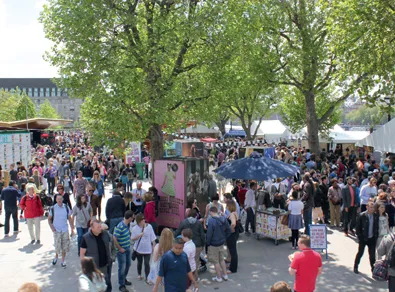
Figure 1.1 A busy pedestrian thoroughfare, a food market, a sunny day, dappled shade from trees, what’s not to love? The Southbank, London.
However, the unending development of an increasingly urban society places an evermounting reliance upon built infrastructures and technology to provide the services and goods required to enable that society to function efficiently. The urban heat island effect, the expansion of impermeable surfaces, the inevitable increase in the total energy consumption and the concomitant additional air pollution this creates, lead to an ever-increasing decoupling and independence from ecological systems. Somewhat perversely, it is the solar shading, surface water attenuation, air quality improvements and increased physical and mental well-being (ecosystem services) provided by these ecological systems, of which urban trees and other vegetation are part, which play such an important role in making our cities more pleasant places to be.
Designers are readily cognisant of the aesthetic qualities but infrequently of the other physical and environmental benefits and how trees can improve our mental well-being. This chapter provides an overview of how trees can be used to provide a more beautiful, comfortable, productive and liveable urban landscape. It will also investigate why, despite more trees being planted overall, we are finding fewer and fewer large species trees within our cities, typically due to conflicts during construction and the close proximity of hard, grey infrastructures. It is, after all, these larger trees that are better placed to deliver more of the environmental benefits for a greater period of time than smaller, shorter-lived species. Many of the large canopy tree species we plant have the genetic potential to survive for well over 100 years, yet the redevelopment cycle of many urban plots will be significantly less at, perhaps, 60–80 years. To realise this potential for longevity, however, we must ensure that the trees we plant establish within the site selected and are equipped with the necessary resources to grow to productive maturity.
1.2 GREEN INFRASTRUCTURE, A DEFINITION
The concept of ‘green infrastructure’ has gained political momentum in recent years, with much popularity among the various levels of decision-makers, from parliamentary and local politicians, government departments and agencies, through to land planning, landscape and urban design professionals. It appears to have originated in the United States from a report submitted to the Governor of Florida by the Florida Greenways Commission (Firehook, 2015). The report states that ‘The Commission’s mission is to create a system of greenways for Florida, a green infrastructure as carefully planned and as well funded as our built infrastructure (like electric power and transportation systems)’ (Florida Greenways Commission, 1994). The linking of the two words, green and infrastructure, was intended to raise awareness that the planning of ‘natural systems’ must be considered on an equal basis with other traditional grey infrastructures (Firehook, 2015). More general circulation of the term followed the May 1999 publication of Towards a Sustainable America, produced by the President’s Council on Sustainable Development. Here, the term was described thus: ‘the network of open space, airsheds, watersheds, woodlands, wildlife habitats, parks, and other natural areas that provides many vital services that sustain life and enrich the quality of life’ (1999).
Since then, many different people have used the term in many different ways, but however it is described, the emphasis, as with any description of an infrastructure, must be on the importance of the benefits provided for people. Mark Benedict and Edward McMahon have been instrumental in helping to define what green infrastructure is and in their book Green Infrastructure: Linking landscapes and Communities, they offer the following: ‘An interconnected network of natural areas and other open spaces that conserves natural ecosystem values and functions, sustains clean air and water, and provides a wide array of benefits to people and wildlife’ (Benedict & McMahon, 2006). They go on to emphasise ‘that it is planned and managed for its natural resource values and for the associated benefits it confers’ (Benedict & McMahon, 2006). A traditional conservation approach is likely to focus on environmental preservation and restoration in isolation, and this often results in conservation being antagonistic or in opposition to development. A green infrastructure approach, while acknowledging the need for residential, commercial and business development, is more strategic and co-operative. It provides a framework which enables the conservation of natural areas and the provision of additional designed green space to be identified and prioritised within planned development. In this way, land use is optimised for physical, utility and ecosystem service provision, for the benefit of all. In line with any other infrastructure, it is important to consider the fact that planning and management are part of the package. In order to safeguard open areas, green spaces, trees and woodlands, and to capitalise on the benefits provided by them, a strategic approach must be adopted with a clear, logical and achievable vision as its intended goal. It is also worth pointing out that green infrastructures should operate at all spatial scales, from urban cores out to the surrounding countryside (URBED, 2004). Without this approach, green and other open spaces can become a collection of isolated and disparate, undeveloped or abandoned sites, rather than an interconnected system that is planned, protected, managed, and at times, restored.
Although considered fairly new, the concept of green infrastructure planning certainly is not. The American landscape architect, Frederic Law Olmstead’s scheme for Boston’s famous Emerald Necklace consists of a 445 hectare (1,100 acres) chain of parks and green spaces, linked together by a network of drives, rides and walks. The chain begins in the downtown area of the city and broadly cuts a sweeping arc, linking Boston Common and Boston Public Garden with Back Bay Fens, Olmstead Park, Jamaica Pond and the Arnold Arboretum, to terminate at Franklin Park, south-west of the city. The project originally started life in 1878 with the restoration of The Back Bay Fens for reasons of sanitation. The Back Bay area was originally tidal salt marsh that had become so contaminated with raw sewage and industrial effluent that it posed a significant health risk to residents of surrounding neighbourhoods. Olmstead realised that not only could it be cleaned and restored to its original salt marsh condition, but it could be used as a flood defence wetland, possibly the first of its kind to be constructed (Spirn, 1995). Beyond the restoration work, an interceptor sewer was added, as was a parkway, footpaths and horse rides to provide recreation facilities for visitors. Boston’s first tram service was also constructed to service the newly created park. Collectively, these facilities and functions formed a landscape system that managed the removal of sewage, provided safeguard against flooding and accommodated the recreational needs of the people of Boston (Spirn, 1995). Green infrastructure, therefore, refers to more than the natural areas alone; it can also include constructed landscapes and facilities. The importance is that there are some ecological, social and economic benefits associated with its existence.
There is also confusion sometimes between the use of terms green infrastructure and urban forest. In the United Kingdom, the now defunct National Urban Forestry Unit defined the urban forest as: ‘all the trees and woods in an urban area: in parks, private gardens, streets, around factories, offices, hospitals and schools, on wasteland and in existing woodland. Urban forestry is the planned approach to the planting and management of trees and woods in towns’ (National Urban Forestry Unit, 1999). The Society of American Foresters add a little more detail to the practice of urban forestry, in The Dictionary of Forestry, thus: ‘the art, science, and technology of managing trees and forest resources in and around urban community ecosystems for the physiological, sociological, economic, and aesthetic benefits trees provide society’ (Helms, 1998). The urban forest, therefore, is considered an element within green infrastructure.
1.3 DESIGNERS’ TOOLKIT
In design terms, trees have always been seen as one of the urban planner’s most useful tools. They can improve urban landscapes by bringing an aesthetic value, helping to soften hard surfaces, guiding and framing views and by providing a setting for buildings, helping the user and viewer to negotiate that transition from tall built forms to ground level. They can be used to help delineate spaces by introducing visual and physical separation between areas, informing a hierarchy of use. They can deflect the eye to aid circulation. They can concentrate the view to guide movement, helping to inform direction, destination and a sense of arrival. They increase visual diversity by introducing shape and form, often bringing a leafy sense of calm to a setting. They can also introduce vibrancy and excitement with some quite spectacular colour displays during otherwise dull times of the year. Despite all these aesthetic qualities they bring to the landscape, urban trees are being threatened as never before due to reduced local authority budgets, increased development pressure, public apathy and a risk-averse insurance industry.
Trees in Towns II was a research project commissioned by the Department of Communities and Local Government, which investigated the condition and management of the urban tree population in England (Britt & Johnston, 2008). The report highlighted that, on average, over 24 per cent of the local authority trees planted in public open space and 23 per cent of the trees planted along highways die before they become established. These findings have been substantiated by other later research studies (Jack-Scott, Piana, Troxel, Murphy-Dunning & Ashton, 2013; Roman, Battles & McBride, 2014) for publicly owned trees, but may even be higher than this for trees in private ownership (Jack-Scott, Piana, Troxel, Murphy-Dunning & Ashton, 2013). A contemporaneous review of London’s street trees for the London Assembly, entitled ‘Chainsaw Massacre’ (GLA, 2007), highlighted a worrying trend in the progressive reduction of the overall tree canopy cover. Despite 48,000 trees being planted and 40,000 being removed, across London as a whole between 2002 and 2007, twelve of the thirty-three boroughs still reported a net loss in publicly owned tree stock for the same period. In many instances, large mature trees are being replaced with smaller, shorter-lived varieties (GLA, 2007). These findings were echoed by ‘Trees in Towns II’, which found that what is happening in London appears to be common to other urban conurbations throughout the UK (Britt & Johnston, 2008). If these trend...
Table of contents
Cover
Half Title
Title Page
Copyright Page
Table of Contents
Foreword
Acknowledgements
1 So what have urban trees ever done for us?
2 Tree structures and function – how do trees work?
3 Urban soils and functional trees
4 Site assessment and analysis
5 Plant production
6 Tree planting and establishment: technical design
7 Disorders, pests and diseases
8 Trees, regulations and law
9 An integrated approach to green infrastructure
Appendix 1: Specifications for engineered rooting substrates
Appendix 2: The collection and analysis of soil samples
Appendix 3: Tree inspection checklist
Appendix 4: Simple field test (ADAS method)
Index
Trusted by 375,005 students
Access to over 1.5 million titles for a fair monthly price.
Study more efficiently using our study tools.
Frequently asked questions
Yes, you can cancel anytime from the Subscription tab in your account settings on the Perlego website. Your subscription will stay active until the end of your current billing period. Learn how to cancel your subscription
No, books cannot be downloaded as external files, such as PDFs, for use outside of Perlego. However, you can download books within the Perlego app for offline reading on mobile or tablet. Learn how to download books offline
Perlego offers two plans: Essential and Complete
Essential is ideal for learners and professionals who enjoy exploring a wide range of subjects. Access the Essential Library with 800,000+ trusted titles and best-sellers across business, personal growth, and the humanities. Includes unlimited reading time and Standard Read Aloud voice.
Complete: Perfect for advanced learners and researchers needing full, unrestricted access. Unlock 1.5M+ books across hundreds of subjects, including academic and specialized titles. The Complete Plan also includes advanced features like Premium Read Aloud and Research Assistant.
Both plans are available with monthly, semester, or annual billing cycles.
We are an online textbook subscription service, where you can get access to an entire online library for less than the price of a single book per month. With over 1.5 million books across 990+ topics, we’ve got you covered! Learn about our mission
Look out for the read-aloud symbol on your next book to see if you can listen to it. The read-aloud tool reads text aloud for you, highlighting the text as it is being read. You can pause it, speed it up and slow it down. Learn more about Read Aloud
Yes! You can use the Perlego app on both iOS and Android devices to read anytime, anywhere — even offline. Perfect for commutes or when you’re on the go. Please note we cannot support devices running on iOS 13 and Android 7 or earlier. Learn more about using the app
Yes, you can access The Urban Tree by Duncan Goodwin in PDF and/or ePUB format, as well as other popular books in Architecture & Sustainability in Architecture. We have over 1.5 million books available in our catalogue for you to explore.