eBook - ePub
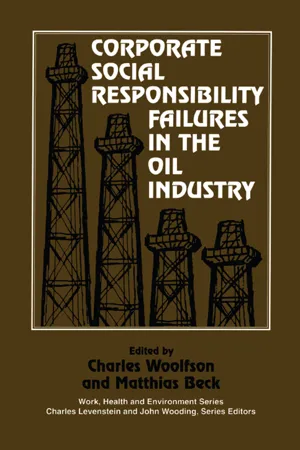
Corporate Social Responsibility Failures in the Oil Industry
- 170 pages
- English
- ePUB (mobile friendly)
- Available on iOS & Android
eBook - ePub
Corporate Social Responsibility Failures in the Oil Industry
About this book
Corporate Social Responsibility Failures in the Oil Industry directly challenges the oil industry's claims of corporate good citizenship, now widely advanced as part of a global public relations initiative. The volume spans the industry's reach, from the troubled waters of the UK offshore Continental Shelf, with its horrendous legacy of the Piper Alpha oil rig disaster, to the inhospitable shores of Newfoundland with its own tragic legacy of lost lives; to the new frontier of oil corporate colonialism in the former Soviet Union and the icy plains of Alaska. The central theme of violations of basic labour rights and of health and environmental protection standards will make uncomfortable reading in the boardroom. It is equally essential reading for those who seek to improve the position of workers and industries within the oil industry's global reach.
CHAPTER 1
Corporate Social Responsibility
in the International
Oil Industry
in the International
Oil Industry
INTRODUCTION
The year 2003 marked the fifteenth anniversary of the Piper Alpha disaster, the world’s worst offshore oil disaster. The Piper Alpha oil production platform, owned by Occidental Petroleum, was situated in the UK sector of the North Sea, off the coast of Northern Scotland, 110 miles northeast of Aberdeen. It began oil production in 1976, exporting oil to the onshore terminal at Flotta in the Orkney Islands, and gas to the St. Fergus terminal in Grampian. Its platform was linked to a number of other production platforms in the North Sea providing a key junction box for the onward export of hydrocarbons. On the night of July 6, 1988, Piper Alpha was consumed by a series of fires and explosions.
THE CAUSES OF THE PIPER ALPHA DISASTER
The immediate cause of the Piper Alpha disaster appears to have been the ignition of a low-lying cloud of gas condensate. The official investigation into the disaster identified as the immediate cause, a gas release following the removal of a key pump for maintenance purposes and its replacement by a blank flange. When a second pump tripped, the crew started what they thought was the alternative pump as the relief system, unaware that the previous shift had already removed it. In so doing, a chain of events was initiated that led to an uncontrolled gas emission, and, later on, to an initial explosion at 10:00 P.M. when the escaping gas found a source of ignition.
The initial explosion resulted in a large crude oil fire that engulfed the north end of the platform in dense black smoke. The fire was spread by oil leaking from the main oil pipeline to shore and from ruptured pipelines carrying oil and gas from the linked Claymore and Tartan platforms. Between 10:00 P.M. and 11:20 P.M. there were two further cataclysmic explosions caused by pipeline ruptures and, at this time, large sections of Piper Alpha’s topsides began to disintegrate and fall into the sea. Despite the visible conflagration on Piper Alpha, the linked oil platforms continued to export oil and gas to Piper Alpha thus feeding the inferno, because, in the words of the official inquiry the responsible managers were “reluctant to take responsibility for shutting down oil production” [1]. Summarizing these events, a survivor is quoted, “The Piper did not burn us; it was the other rigs that burnt us.”
From the very first moment of the disaster, all of the platform emergency systems proved to be inadequate. The initial explosion knocked out the control room and disabled power supplies and communications. Survivors spoke of an eerie silence that descended on the platform, as the familiar background noise of generators and plant abruptly ceased. The fire-water deluge system had been out of commission for several months and was inoperable. The parts of the system that did operate did so only with the remnants of water left in the system.
Most of the persons on board the installation were in the accommodation area, many in the cinema room. Others, who were on duty, made their way to the galley area in accordance with installation emergency procedures. However, the smoke and flames enveloping the accommodation area made the anticipated mode of evacuation by helicopter or lifeboat impossible. After ten minutes, the lighting in the galley area failed and panic began to set in. Within another fifteen minutes, dense smoke began to penetrate the galley area. Men were forced to crawl along the floor to escape the smoke, using wet towels to assist their breathing. Others were quickly overcome. According to one survivor, Ed Punchard, with the rupture of the gas-import riser from the Tartan at 10:20 P.M., “the conflagration was multiplied tenfold”:
Eleven and a half miles of eighteen-inch-diameter gas pipeline started to release hydrocarbon gas at a pressure of 1,800 p.s.i. The effects were devastating. A fireball shot out from below the centre of the jacket, enveloped the platform and rose to a height of some 700 feet. The roar was blood-curdling and it did not stop for the next four hours [2].
Eventually, some of the men decided individually, or as a group, to ignore the company advice to wait in the accommodation area for rescue. They realized that to remain on the platform was to face certain death. There was no systematic attempt to lead the men out. Those who survived did so either because of sheer luck or because of their familiarity with the platform layout. The entire 18-man catering crew, whose knowledge of the platform outside the accommodation area was minimal, perished, as did the 81 personnel who remained in the accommodation area. Of those who left the area, 28 survived. Among the total of 61 survivors, some had jumped into the sea from heights of 175 feet. Many of those who escaped were horribly burned on their hands and feet as the platform literally melted under them. For those who made it to the water their grim struggle for survival was by no means over. With the platform disintegrating above them, and the sea on fire around them, the only hope for survival was to be plucked from the water quickly.
As dawn broke on the morning of July 7, most of the superstructure of what had been Piper Alpha had been incinerated or had collapsed into the sea. What was left of the platform was a smouldering, tangled heap of metal and the still-burning remains of a gas flare. Of the 167 who died that night, 30 remained missing, presumed dead.
CORPORATE DENIAL AND JUDICIAL ACCOUNTABILITY
Occidental’s response to the disaster was a textbook case of corporate denial. While the offshore oil industry as a whole, represented by the United Kingdom Offshore Operators’ Association (UKOOA), sought to salvage its own reputation, Occidental’s management remained reluctant to acknowledge responsibility. Glen Shurtz, chairman of Occidental Petroleum (Caledonia) maintained, “We have always practised the management of safety. Offshore it’s our number one priority.” Shurtz had little else to say and steadfastly refused to take part in any public debate on the causes of the disaster or subsequent criticism of the company’s safety management practices. Times, of course, have changed, and today, if faced with a “crisis event” on the scale of Piper Alpha, a corporation would in all likelihood call on the services of any number of “corporate reputational management consultants,” a burgeoning industry that, in itself, reflects growing sensitivity to issues of accountability rather than the will of companies to act responsibly.
Occidental, even before the Piper Alpha disaster, was not a company with a pristine safety record. On the contrary, in 1984 it had narrowly escaped a near disaster that required a mass evacuation of its platform. In 1987, it experienced a fatal incident caused by key factors that were present in the later disaster. The company had failed to learn from its mistakes, even though it was fined on a number of occasions prior to the Piper Alpha explosion.
The issue of attitudes toward judicial accountability with respect to the crimes of oil companies is exemplified by the Piper Alpha disaster. After some deliberation, Peter Fraser, the Lord Advocate, then Scotland’s chief legal officer (a Conservative political appointment), took the view that the public interest would not be served by a prosecution.
Fraser became minister of state at the Department of Trade and Industry, where he had responsibility for export trade promotion and overseas investment, with particular emphasis on the oil and gas industry, and was minister of energy until May 1997. Today, as Lord Fraser of Carmyllie QC, he is listed in the current Register of Lords’ Interests under “Remunerated directorships” as 1) nonexecutive chairman, JKX Oil and Gas pic, an oil and gas exploration and production company with license interests in the Ukraine, the United States, Italy, and the Caspian Sea; and 2) nonexecutive chairman of “theoilsite.com,” which specializes in e-tendering solutions for the oil and gas industry worldwide. This company is no mere “dot-com” bubble, however. It also has as its nonexecutive director, Pierre Godec. Godec is a key figure in the United Kingdom Offshore Operators’ Association, and managing director of Elf Exploration UK pic, a subsidiary part of the successor company to Occidental in the Piper field. Peter Fraser is also listed as 3) nonexecutive director, International Petroleum Exchange, Europe’s largest energy market, best known for its futures contracts in North Sea Brent crude oil and 4) nonexecutive director of Ram-energy Ltd, an independent exploration and production company which operates primarily in the United States. Lastly, Fraser is listed as 5) nonexecutive director of TotalFina Elf Upstream UK Ltd, one of the world’s largest oil conglomerates [3].
The recruitment of former U.K. Ministers of Energy to the senior boardrooms of the oil multinationals stretches back to the 1980s [4]. Such linkages illustrate the power of the oil industry to create “revolving doors” at the highest level of the State, although there is no guarantee that former politicians will actively intervene on behalf of the industry at a higher level.
THE DELEGITIMATION OF CORPORATE POWER
The public at large increasingly viewed the legal system as a veil behind which corporate negligence would go unpunished. On the morning after the official report of the disaster was published, the Scottish tabloid the Daily Record ran a banner headline with two succinct words—“CHARGE THEM!” [5].
What happened on Piper Alpha, in many ways, could have happened on any of the platforms in the U.K. offshore sector. Piper Alpha was a disaster that many had predicted and yet their warnings had not been heeded. In this respect, the disaster had many features in common with other disasters that had occurred in the mid- to late 1980s. Those resulting in multiple fatalities in the United Kingdom included the sinking of the Herald of Free Enterprise, The Marchioness riverboat on the Thames, and the seemingly unending, series of rail disasters, beginning with Clapham Junction through to Ladbroke Grove, Hatfield and Potters Bar. Internationally, a seemingly endless list of disasters such as Bhopal, Westray, Exxon Valdez, and Chernobyl served to undermine public confidence in the ability of the state to regulate, and of corporations to conduct their activities in a manner that prevents harm to the public and consumers. In each of these disasters, management failure was subsequently identified as a crucial factor. Add to this the succession of financial governance scandals occurring over two decades, especially in the United Kingdom and the United States, and it is easy to see why public confidence in corporate behavior has severely eroded.
In the United Kingdom, these events led to backlash, which undermined public trust in the ability of corporations to act responsibly. The roots of current calls for reform of the law with respect to all forms of corporate governance and the demands for greater accountability spring from this period. However, as we write, the U.K. government is still equivocating over long-awaited plans to introduce corporate killing legislation that would criminalize companies for gross failures in safety management that result in deaths of employees. Announcing draft legislation, the responsible U.K. minister conceded:
There is great public concern at the criminal law’s lack of success in convicting companies of manslaughter where a death has occurred due to gross negligence by the organisation as a whole. … The law needs to be clear and effective in order to secure public confidence and must bite properly on large corporations whose failure to set or maintain standards causes a death [6].
Occidental, however, not only escaped prosecution but was given assistance by the U.K. government in the form of Petroleum Revenue tax relief, which resulted in the construction of a new £780 million platform, Piper Bravo, largely funded by taxpayers. Legal proceedings were initiated by Elf, as successor company to Occidental Petroleum, against the offshore contracting companies working on the platform at the time of the disaster. This was an attempt to recover losses inherited from Occidental associated with compensation payments to contractors’ personnel. These proceedings resulted in the longest running court case in Scottish legal history. The result was a legal victory for the oil majors over the contractors in which the relatives of the victims had, yet again, to endure the raking over of the events of the disaster. Attempts to mount a private prosecution against Occidental for corporate homicide (manslaughter) foundered due to lack of finances. Occidental Petroleum was allowed to disengage from its operations in the U.K. sector with scarcely a whisper of official condemnation. In the memorable words of an offshore union leader, Occidental was allowed to “tiptoe away” from the North Sea, unmolested by the judicial authorities. History provides its own jolting ironic footnotes. In the Sunday Times Top 500 listed companies for 2001, Occidental Petroleum ranks 422nd. It continues as a major and profitable operator in the energy industry. Occidental Petroleum has now acquired, and is operating, some of the assets of the Enron Corporation.
CHAMPIONS OF “GOOD GOVERNANCE”
Nowadays most multinational companies attempt to portray themselves as champions of good governance. Meanwhile, where ethical, political, and social conflicts occur, they resort to the mantra of “globalization.” Globalization, accordingly, imposes pressures that can be met only if individual national governments accommodate the multinationals’ requirements. Frequently, then, the debate on corporate standards and behavior is being shaped by the interests of multinationals. Recognizing this, the Canadian corporate criminologist Harry Glasbeek describes the contemporary corporate social responsibility movement as “the latest in Maginot lines to save capitalism,” the final but flawed line of defense against invasive demands for corporate accountability [7]. When World War I ended, the French generals swore never to let the Germans invade again. The Maginot Line was an impressive network of fortified barriers built for defense against a land invasion along the Franco-German border. It created a false sense of security, insofar as the German forces simply sent their divisions around the end of the line and invaded through neutral Belgium. Although notorious as a universal metaphor for bungling, a revisionist view holds that the defensive system in fact was not the blunder it has been made out to be, but rather a model of clever engineering and technological accomplishment. We suggest this makes the metaphor particularly apt. If that is so, then finding a way around the latest Maginot Line of corporate social responsibility is politically, socially, and ethically imperative.
PRINCIPLES OR PROFIT? GOOD CORPORATE CITIZENSHIP
Oil multinationals are among the most aggressive players in the contemporary corporate social responsibility movement. In many respects these efforts can be traced to the special position that oil occupies in the political economy of multinational-state interactions.
Oil production necessitates the temporary or permanent cession of property rights by the state to the c...
Table of contents
- Cover
- Title Page
- Copyright Page
- Table of Contents
- INTRODUCTION Oil and the Contradictions of Development
- CHAPTER 1 Corporate Social Responsibility in the International Oil Industry
- CHAPTER 2 The Piper Alpha Disaster and Industrial Relations in Britain’s Offshore Oil Industry
- CHAPTER 3 Safety and Industrial Relations in the Newfoundland Offshore Oil Industry Since the Ocean Ranger Disaster in 1982
- CHAPTER 4 BP’s Baku-Tbilisi-Ceyhan Pipeline: The New Corporate Colonialism
- CHAPTER 5 Northern Exposure
- CHAPTER 6 Loaded Dice: Multinational Oil, Due Process, and the State
- AFTERWORD Oil and Corporate Crime: The Russian Connection
- SELECTED BIBLIOGRAPHY
- ABOUT THE EDITORS
- CONTRIBUTORS
- INDEX
Trusted by 375,005 students
Access to over 1.5 million titles for a fair monthly price.
Study more efficiently using our study tools.
Frequently asked questions
Yes, you can cancel anytime from the Subscription tab in your account settings on the Perlego website. Your subscription will stay active until the end of your current billing period. Learn how to cancel your subscription
No, books cannot be downloaded as external files, such as PDFs, for use outside of Perlego. However, you can download books within the Perlego app for offline reading on mobile or tablet. Learn how to download books offline
Perlego offers two plans: Essential and Complete
- Essential is ideal for learners and professionals who enjoy exploring a wide range of subjects. Access the Essential Library with 800,000+ trusted titles and best-sellers across business, personal growth, and the humanities. Includes unlimited reading time and Standard Read Aloud voice.
- Complete: Perfect for advanced learners and researchers needing full, unrestricted access. Unlock 1.5M+ books across hundreds of subjects, including academic and specialized titles. The Complete Plan also includes advanced features like Premium Read Aloud and Research Assistant.
We are an online textbook subscription service, where you can get access to an entire online library for less than the price of a single book per month. With over 1.5 million books across 990+ topics, we’ve got you covered! Learn about our mission
Look out for the read-aloud symbol on your next book to see if you can listen to it. The read-aloud tool reads text aloud for you, highlighting the text as it is being read. You can pause it, speed it up and slow it down. Learn more about Read Aloud
Yes! You can use the Perlego app on both iOS and Android devices to read anytime, anywhere — even offline. Perfect for commutes or when you’re on the go.
Please note we cannot support devices running on iOS 13 and Android 7 or earlier. Learn more about using the app
Please note we cannot support devices running on iOS 13 and Android 7 or earlier. Learn more about using the app
Yes, you can access Corporate Social Responsibility Failures in the Oil Industry by Charles Woolfson, Matthais Beck, Charles Woolfson,Matthais Beck in PDF and/or ePUB format, as well as other popular books in Business & Business General. We have over 1.5 million books available in our catalogue for you to explore.