- 146 pages
- English
- ePUB (mobile friendly)
- Available on iOS & Android
eBook - ePub
Managing Project Uncertainty
About this book
Dealing effectively with uncertainty requires today's project manager to be familiar with a broad spectrum of strategies, encompassing both 'hard' and 'soft' methods. This theme of unified thinking (i.e. the need to selectively draw upon a wide range of strategies in any given situation) will differentiate the book from its contemporaries. By picking up where traditional risk management techniques begin to fail, it brings together leading-edge thinking from a variety of disciplines and shows how these techniques can be used to conquer uncertainty in projects. The ability to make good decisions when faced with uncertainty is the real challenge. It is a universal truth that a decision is only as good as the information it is based on. But good information is often hard to come by, and all projects are vulnerable to the unknown and the unknowable. Thus, uncertainty becomes the sworn enemy of the project manager. Wherever we try to analyse, quantify, plan and act, uncertainty lies in wait to surprise us with its ambiguity and unpredictability. It lurks in every stage of the project lifecycle: in the planning (how long will this really take?), the initiation (this isn't the situation I expected!), the execution (who could have foreseen that happening?), and even the completion of a project (where are the expected benefits?). But managing uncertainty is a lot more than just applying risk management techniques. It requires a deep appreciation of how uncertainty arises and, by recognising its different guises, the appropriate strategies can be formulated. If we can learn how to reduce uncertainty, we can make better management decisions and increase the chances of the project succeeding. This book addresses five key questions: ¢ Why is there uncertainty in projects? ¢ How do you spot the symptoms of uncertainty, preferably at an early stage? ¢ What can be done to avoid uncertainty? ¢ What strategies can be used to deal with project uncertainty? ¢ How can both the individual and the organisation learn to cope more effectively in the future? The reader is assumed to be a either a project management professional, or a senior manager looking for ways to improve project management strategy within their organisation. As such, a foundation in project management basics is assumed, although not essential. The book then builds on this by exposing new ideas and concepts, and shows how these can be harnessed to tackle uncertainty in its many guises.
Chapter 1
Living With Uncertainty
Life is short, the art is long, opportunity fleeting, experiment treacherous judgment difficult.
– Hippocrates, ancient Greek physician.
Living in an Uncertain World
Winston Churchill, a man not known for his lack of hubris, once wrote with the benefit of hindsight, ‘I ought to have known. My advisors ought to have known and I ought to have been told, and I ought to have asked.’ (Churchill 2005). In just a few words he captured both the nature of uncertainty and an important insight into how to tackle it.
Churchill was writing about a pivotal moment in the Second World War. In 1941–2 the British Government considered Singapore to be well-defended and unlikely to fall to the Japanese. It formed a vital part of the plan to bring the war in the Far East to a rapid end. Yet despite its strategic importance, little was done to explore the uncertainties underpinning these key assumptions. The reality was that Singapore was far more vulnerable to a Japanese invasion than anyone realized. Its capitulation came as a terrible blow to the Allies, although with hindsight many of the events could have been foreseen.
The modern project manager is rarely afforded the luxury of hindsight. The threats posed by uncertainty are real and immediate, and the stakes on a project are often high. The project manager faces a conundrum: decisions must be made now about future situations which are inherently uncertain.
It is no secret that many projects fail, regardless of the business sector. IT projects are notoriously disaster-prone, not necessarily because of technological failure but more often due to their inherent complexity. In the mid 90s, influential surveys such as those conducted by Bull and the Standish Group were reporting on average only 16 per cent of projects were classified as successful, 53 per cent were ‘impaired’ and 31 per cent were outright failures (for example, Bull 1998). More than a decade on, little seems to have changed. Recent surveys (for example, CA 2007) suggest that a third of all projects significantly exceed their budget. Of the reasons given, more than half of projects suffer from poor forecasting, and a third attribute problems to dependencies between multiple projects. As programmes become more ambitious and complex, the potential for uncertainty to wreak havoc only increases.
The goal of this book is to understand what gives rise to uncertainty, to recognize its symptoms and explore strategies for keeping it under control. Although uncertainty arises in many aspects of business, we will restrict the discussion to the context of uncertainty within projects, not day-to-day business uncertainty. A project differs from routine business in a number of important respects. Projects have set goals to be achieved. They have a fixed beginning and end. Within this time span, finite resources (typically measured in terms of cost and effort) must be used judiciously to achieve the objectives.
Sometimes a group of projects are initiated which will jointly achieve the broader strategic aims of a programme of work. Programme goals are typically ambitious – perhaps to open up a new market, or build a new infrastructure, or develop a new product. Programmes will often have co-dependent projects; therefore if a problem occurs in one place it may affect neighbouring projects and threaten the entire programme. Thus, the challenges of managing programme uncertainty are often much greater.
At the centre of this complex web of task sits the programme or project manager, marshalling and directing the available resources, and often expected to make critical decisions in less than ideal circumstances which nevertheless have far-reaching consequences.
As Churchill realized, the art of managing uncertainty depends hugely on how much we are able to understand the realities of the situation. In part, this means developing an awareness of what is known and, to some extent, what is unknown. Timeliness is also vital: it is not enough to wait to be informed. As we will see in later chapters, in order to manage project uncertainty effectively, the project manager must ask the right questions, be continually sceptical of the answers received and act where possible only on the basis of impartial evidence.
Novelty Breeds Uncertainty
There are no shortage of examples of projects which have got into severe difficulties in the face of overwhelming uncertainty. Many share a common feature: the pursuit of a goal never before achieved. In D.R. Myddelton’s illuminating book, They Meant Well: Government Project Disasters he wryly observes, ‘The frontiers of knowledge ... are also the frontiers of ignorance.’ (Myddelton 2007)
Ambitious projects are commonplace in modern business. Increased competition drives businesses to set up more daring projects to win market share or explore new operational domains. To cope with these changes, organizational structures have to become more fluid. Plus, the speed of change in business means an inevitable shift away from the safe, repeatable ways of working towards highly original and innovative projects – what some researchers (for example, Loch, DeMeyer and Pich 2006) refer to as novel projects.
A novel project breaks the mould. It often ventures into unfamiliar areas of technology, process or marketplace. A novel project confronts situations for which there is little prior knowledge or experience to act as a guide. This is where the dangers posed by uncertainty are at their greatest.
Mission to Jupiter
John Casani knows a thing or two about novel projects. For more than a decade in the late 70s and early 80s, he was the project manager for NASA’s flagship space exploration project, the Galileo mission. Coordinating multi-disciplinary teams of scientists and engineers from every continent, he steered the project through political infighting, budgetary crises and overcame numerous technical and engineering uncertainties (Meltzer 2007).
The challenges were immense. Galileo’s main objective was to travel more than 2.4 billion miles and enter a precise orbit around Jupiter, dropping a scientific instrument package through Jupiter’s atmosphere and relaying vast quantities of data back to mission control. The navigational task alone was likened to ‘firing an arrow from Los Angeles to New York and missing the bull’s-eye by six inches.’ In such a remote, hostile environment, plenty of uncertainty remained even after decades of planning and preparation. Just one tiny problem during the journey could wreck the entire programme.
There was also plenty of uncertainty to contend with back on Earth. On no less than four separate occasions, the project was threatened with cancellation. After years of planning, the unexpected loss of the Challenger shuttle forced the team to use a less powerful upper stage rocket. It meant Galileo could not reach Jupiter unless it performed a complicated (and risky) series of gravity-assist flybys.
Then as Galileo finally approached Jupiter, the programme hit its most serious problem: a high gain antenna providing the vital data link back to Earth failed to deploy properly. Without the science data, the mission would be a failure. Eventually, the team were able to reconfigure a secondary antenna and drip-feed most of the data back, though only at painfully slow speeds.
What makes the Galileo programme such an interesting case study is not just the enormous efforts that went in to finding and eliminating uncertainty, but the resilience of the programme when problems did occur. Right from the start the Galileo team built the programme around strategies which allowed it to respond to the unexpected, even capitalizing in some cases on opportunities that presented themselves. One of Casani’s successors, Eilene Theilig said, ‘I really like watching people presented with a problem, and using their creativity to overcome it. And we’ve had lots of examples of that.’
In the light of these lessons, later chapters will examine more closely how a project can develop greater resilience to uncertainty.
Risk Versus Uncertainty
In common use, words such as doubt, uncertainty, risk and ambiguity are often used interchangeably, but to develop a detailed understanding of why uncertainty arises and how it can be controlled, we need clearer definitions. (Refer to the Glossary for more detail.) Crucially, there is an important distinction between risk and uncertainty. It is easy to fall into the trap of thinking that by managing risk we are also managing uncertainty: the two are not the same.
Let us first examine what we mean by risk. A risk has the following attributes:
- For a risk to exist, we must be able to conceive of the threat it embodies.
- A risk can be quantified, usually in terms of the likelihood and severity of its consequences, but sometimes in more tangible ways.
- A risk describes a vulnerability. By analysing a risk we build up a better picture of where the project is vulnerable and its implications.
- If a risk can be identified, so can a mitigation plan (that is, a sequence of events which will either reduce the likelihood of the risk occurring, or reduce its consequences if it does occur). However, we may choose not to follow a mitigation plan if it is not deemed to be cost-effective.
Notice that for a risk to be identified, we must have a basic level of knowledge concerning the problem. What is the threat? What impact might it have? Where is the project vulnerable and how might we fix this? This is a knowledge-centric view. If there are sufficiently important things we don’t know, these can be represented as a series of risks for the project.
Uncertainty is much less susceptible to analysis; it is what is left behind when all the risks have been identified. Uncertainty represents a threat, but we cannot be sure what form it takes otherwise we would identify it as a risk. We may be able to see that there is a gap in our understanding but unlike a risk, we don’t know what it is we don’t know. Not until uncertainty manifests itself into a specific problem is the nature of the threat revealed – and by then it may be too late to deal effectively with the consequences.
Many writers (for example, Chapman and Ward 2003 and Loch, DeMeyer and Pich 2006) define uncertainty as the source of risk. Extending this idea a little further, we can derive the following relationship:
- uncertainty is the intangible measure of what we don’t know;
- risk is the statement of what may arise from that lack of knowledge.
It follows that two kinds of uncertainty exist: the kind that we start out with before we make any attempt at analysing the risks, (which we will call inherent uncertainty) and the uncertainty that remains once all the risks have been identified (which we will call latent uncertainty). This means that the process of risk analysis (that is, the steps taken to identify and quantify project risks) transforms some – but not all – of the inherent uncertainty into risks. What remains is latent uncertainty (see Figure 1.1).
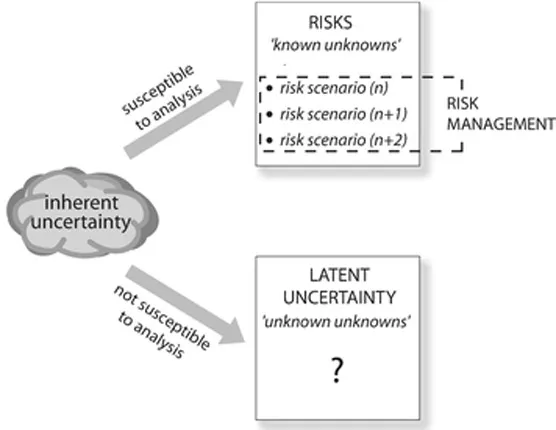
Figure 1.1 The relationship between risk and uncertainty. Risks can be identified by analysing the inherent uncertainty of a project. But inevitably some uncertainty remains, no matter how thorough the analysis. This is termed ‘latent uncertainty’.
Risk management is a vital tool. It reduces the overall level of uncertainty associated with the pr...
Table of contents
- Cover
- Half Title
- Dedication
- Title
- Copyright
- Contents
- List of Figures
- List of Tables
- Preface
- 1 Living With Uncertainty
- 2 Uncertainty in Project and Programme Plans
- 3 Problem-Solving Strategies For Managing Uncertainty
- 4 Knowledge-Centric Strategies
- 5 Anticipation Strategies
- 6 Resilience Strategies
- 7 Learning Strategies
- Glossary
- Bibliography
- Index
Trusted by 375,005 students
Access to over 1.5 million titles for a fair monthly price.
Study more efficiently using our study tools.
Frequently asked questions
Yes, you can cancel anytime from the Subscription tab in your account settings on the Perlego website. Your subscription will stay active until the end of your current billing period. Learn how to cancel your subscription
No, books cannot be downloaded as external files, such as PDFs, for use outside of Perlego. However, you can download books within the Perlego app for offline reading on mobile or tablet. Learn how to download books offline
Perlego offers two plans: Essential and Complete
- Essential is ideal for learners and professionals who enjoy exploring a wide range of subjects. Access the Essential Library with 800,000+ trusted titles and best-sellers across business, personal growth, and the humanities. Includes unlimited reading time and Standard Read Aloud voice.
- Complete: Perfect for advanced learners and researchers needing full, unrestricted access. Unlock 1.5M+ books across hundreds of subjects, including academic and specialized titles. The Complete Plan also includes advanced features like Premium Read Aloud and Research Assistant.
We are an online textbook subscription service, where you can get access to an entire online library for less than the price of a single book per month. With over 1.5 million books across 990+ topics, we’ve got you covered! Learn about our mission
Look out for the read-aloud symbol on your next book to see if you can listen to it. The read-aloud tool reads text aloud for you, highlighting the text as it is being read. You can pause it, speed it up and slow it down. Learn more about Read Aloud
Yes! You can use the Perlego app on both iOS and Android devices to read anytime, anywhere — even offline. Perfect for commutes or when you’re on the go.
Please note we cannot support devices running on iOS 13 and Android 7 or earlier. Learn more about using the app
Please note we cannot support devices running on iOS 13 and Android 7 or earlier. Learn more about using the app
Yes, you can access Managing Project Uncertainty by David Cleden in PDF and/or ePUB format, as well as other popular books in Business & Business General. We have over 1.5 million books available in our catalogue for you to explore.