- 240 pages
- English
- ePUB (mobile friendly)
- Available on iOS & Android
eBook - ePub
About this book
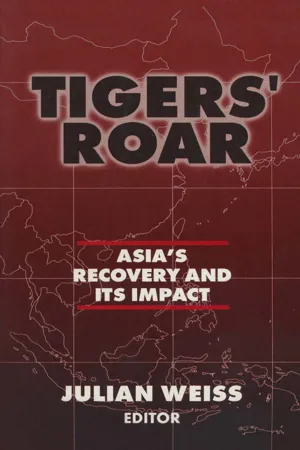
Despite Asia's protracted economic troubles, the region is poised to recover and perhaps become stronger than ever. This timely work identifies the major challenges facing Asia's Four Tigers (Singapore, Taiwan, South Korea, and Hong Kong), Japan, China, and their Southeast Asian neighbors (Thailand, Indonesia, Malaysia, and the Philippines) as the region increases it role and stature on the world stage. Highly regarded Asia policy makers and opinion shapers consider such key questions as: What is the appropriate response to China's ascent? Are there prospects for U.S.-Asian partnerships (in such areas as the environment)? Is economic cooperation between both sides of the Pacific realistic? How can Americans gain from Asia's attempts to rebuild her institutions? And will East Asia and the United States adjust to a multi-polar security and economic milieu?
Trusted by 375,005 students
Access to over 1.5 million titles for a fair monthly price.
Study more efficiently using our study tools.
Information
Subtopic
Business GeneralIndex
EconomicsPart I
A Region in Transition
ASEAN, East Asia and the Pacific Rim: Thoughts on the New Regionalism
A New East Asia
There is a rising sense of East Asian identity. In a November 1999 summit, Association of Southeast Asian Nations (ASEAN) leaders and their counterparts from the non-ASEAN “Three” (China, Japan, and South Korea) sent a strong signal. Other meetings—notably the foreign ministers’ first ever meeting in July 2000, after the ASEAN ministerial meeting—are instructive.
Functional cooperation is starting in finance. A system by which ASEAN countries exchange information and comment on each other’s policies is being expanded to include the Three. In March 2000, ASEAN and Three finance ministers agreed on stand-by arrangements for currency swaps in the event of sudden raids on currencies by foreign investors. Some suggest grander measures. The idea of an Asian Monetary Fund (AMF), first proposed by Japan in 1997 and summarily dismissed by the United States and others, is being reconsidered. Others propose a common currency or a version of the European Union (EU) model.
These ideas signal a change. In the past decade, the Asia-Pacific Economic Cooperation (APEC) forum was the preferred framework. APEC embraced the United States, Canada, Chile, Australia, New Zealand and others to build a community spanning the Pacific Rim. In matters of security, the ASEAN Regional Forum included Russia, Europe and India. And East Asia was never seen as a separate group except when Malaysian prime minister Dr. Mahathir Mohammed proposed an East Asian Economic Grouping (EAEG). This, like the AMF, is challenged by fellow Asians as well as by the United States. ASEAN united Southeast Asia at the sub-regional level, but little cooperation existed among countries in Northeast Asia.
It is against this context that a “new” regionalism—acknowledging that East Asia is broader than ASEAN, yet narrower than the entire Asia-Pacific—is emerging. The “ASEAN plus Three” formula appeals to many policy-makers.
Drivers of Regionalism
Why has this sense of regionalism arisen? Asia has no strong and enduring history of unity and accepted commonality, either in polity, culture, language or religion. The antecedents of East Asian regionalism have been brief and contested: in the fifteenth century, when the Ming empire of China ruled the waves and extracted an acceptance of suzerainty from kingdoms in East and Southeast Asia; and during the wartime Japanese “co-prosperity sphere.” Neither set a happy precedent.
Why, then, East Asia now? Several factors are at play. The now-ending economic crisis is one; new crises should be expected. The need for forms of cooperation have grown. Cooperation to manage existing integration explains, in part, the new regionalism—and regionalism is thus a process for dealing with globalization, and as such constitutes a forward-looking perception that should be welcomed.
The monetary crisis spurred frustration among APEC, the Asian Regional Forum (ARF) and the IMF, and added to the perception that the United States—in its present unipolar moment—largely ignores the region. America failed to lead international institutions like APEC and the WTO in a quest for economic remedies. Questions over the United States were also felt in regional security issues. Notwithstanding the importance of American security engagement as a foundation for region-wide peace, Asians seem ambivalent. We swing between fearing the United States will either ignore us or—on the other hand—intervene unilaterally according to the whims of the American populace. East Asians desire a sustained and consultative American engagement, but domestic American politics hinder this process.
Then there is ASEM, the Asia-Europe Meetings held since the 1990s. ASEM’s goal was not to build a community for all but to have an inter-civilizational dialogue between two regions. In this sense, ASEM is built upon the supposition that East Asia has an identity, although an institution or recurring process are still lacking.
Some Cautionary Notes
Some believe that East Asia must imitate Europe. There is talk, for instance, of a common currency, an East Asian free-trade area and an Asian monetary fund. These ideas, and even perhaps a grand vision of union, might be possible over the longer-term. But we should recognize East Asia’s limits: The first is the American presence. Japan and South Korea in Northeast Asia and Thailand and the Philippines in Southeast Asia have defense alliances with the United States. In addition, U.S.-based multinational corporations are major investors in these countries.
American roots in the region stem from the Cold War era, when East Asia was beset by poverty and instability. Some (especially in China) see in this the play of U.S. neo-imperialism. But others consider Washington a relatively benign power. Without American engagement, the region loses security balance; there is no collective framework for peacekeeping and other measures. Incidents in East Timor expose weaknesses in ad-hoc solutions. Resentment over Australia’s intervention—and Prime Minister Howard’s unfortunate comment that his country would serve as an American deputy—were telling. East Asia is concerned over U.S. hegemony and with Washington’s tendency to shift between ignorance and unilaterally-guided intervention. The United States remains a vital non-regional actor. If it strongly opposes the nascent institutional identity of the region, such identity will fail. If Washington is comfortable with the idea—or even supportive—there is no guarantee of success, but chances increase significantly.
The second limiting factor is that of China-Japan relations. These relations are troubled by suspicion, notwithstanding high levels of Japanese investment in the PRC. The politics of apology/amnesia with respect to World War II trouble Japan’s ties with Korea and with ASEAN. Yet ASEAN maintains a pragmatic emphasis on trade, investment, and other aspects of the relationship. This is a sharp change from the 1970s, when the Japanese premier’s visit to the region was marked by street protests. To a far lesser extent, South Korea under President Kim Dae Jung has taken steps towards reconciliation.
China-Japan relations are adversely impacted by American involvement. Japan is dependent on the bilateral alliance with the United States, and when China-U.S. relations are strained, the Chinese view Japan as America’s junior partner. Conversely, when Washington-Beijing links are improving, Japan shows concern that its special place vis-à-vis the United States is threatened. Also, crises have erupted with regard to Taiwan-related strains on Beijing-Tokyo relations.
History, present circumstances, and future prospects point to a need for reconciliation between China and Japan as a foundation for East Asia. Japan must come to terms with its past, building a future that includes its neighbors as partners. And Japan’s role is further complicated by a decade-long recession and lackluster attempts at domestic financial reform. The jury is still out on her efforts—and on the strategy of massive public spending to boost GDP. One strand—exemplified by Tokyo’s governor Ishihara—is a narrow nationalism. Such a stance would likely lessen chances for reconciliation between Japan and her neighbors. A second strand among non-bureaucratic elites—seen in Taichi Sakaiya’s writings—calls for radical reform and “internationalization.” Until internal debates take place, Japan’s role as a regional leader is in doubt. Similarly, leadership in an Asian Monetary Fund is debatable. Therefore, Japan cannot be the main actor in East Asia, and it has been suggested that smaller-sized and medium-sized countries such as South Korea and those of ASEAN have a greater role to play than their power would dictate.
What East Asia Might Be, and What It Should Not Be
The driving forces and limits of the nascent sense of East Asia suggest regionalism should have the following characteristics:
1. Open and Flexible Caucus, Not an Exclusive Group or Bloc:
Given the existence of both larger and smaller institutions (Asia-Pacific and international, ASEAN), there is little need for another organization. The new East Asian regionalism might serve best as a caucus to discuss mutually acceptable positions. These could be raised before larger, already established, institutions.
Given the existence of both larger and smaller institutions (Asia-Pacific and international, ASEAN), there is little need for another organization. The new East Asian regionalism might serve best as a caucus to discuss mutually acceptable positions. These could be raised before larger, already established, institutions.
2. Functionality, Not a Politically Fixed Nature:
There is a need for management and cooperation in the face of both integration and globalization. Economic and financial cooperation has been emphasized; “ASEAN Plus Three” is possible. This formula would exclude some important economic players, such as Hong Kong, Taiwan, and Australia, in favor of much smaller economies.
There is a need for management and cooperation in the face of both integration and globalization. Economic and financial cooperation has been emphasized; “ASEAN Plus Three” is possible. This formula would exclude some important economic players, such as Hong Kong, Taiwan, and Australia, in favor of much smaller economies.
3. Issue-Led Leadership, Not Great Powers:
In traditional regionalism models, central leadership is critical. Without a historical reconciliation between China and Japan, however, centralization is not possible. East Asia lacks any single figure who is acceptable to all sides and who is able to handle the task of leadership. Medium-sized countries might therefore lead the region. Limited forms of leadership— with different countries handling different issues—are also possible. Such leadership would arise from initiatives taken by individual states. On investment and development assistance, for example, Japan’s stature might be acceptable, whereas Singapore might hold the central position on free-trade initiatives. Thailand and Malaysia could be entrusted with regional peace-keeping. Leader countries would shift according both to the abilities of individual countries and to the views reflected in region-wide caucuses. Japan might represent the group’s views in the G-8; China might play a similar role in the UN Security Council.
In traditional regionalism models, central leadership is critical. Without a historical reconciliation between China and Japan, however, centralization is not possible. East Asia lacks any single figure who is acceptable to all sides and who is able to handle the task of leadership. Medium-sized countries might therefore lead the region. Limited forms of leadership— with different countries handling different issues—are also possible. Such leadership would arise from initiatives taken by individual states. On investment and development assistance, for example, Japan’s stature might be acceptable, whereas Singapore might hold the central position on free-trade initiatives. Thailand and Malaysia could be entrusted with regional peace-keeping. Leader countries would shift according both to the abilities of individual countries and to the views reflected in region-wide caucuses. Japan might represent the group’s views in the G-8; China might play a similar role in the UN Security Council.
ASEAN’s chairmanship of the ARF could be shared with its Northeast Asian neighbors, at least in function if not in form. East Asia would continue the ASEM process with a surer sense of itself as a region.
4. Coalitions of the Willing:
The above principles suggest East Asian regionalism should not be a fixed bloc with permanent membership and permanent leaders. A framework for “coalitions of the willing” can arise on specific issues. Such coalitions may dissolve or evolve to new issues, and they would work with existing regional and sub-regional institutions such as APEC, ARF, and ASEAN. The idea of coalitions might even extend beyond East Asia to include Australia or parts of Europe. The proposed ASEAN Free Trade Area link to New Zealand and Australia was an early example of flexible regionalism. Such coalitions could play a vital role in the development of larger institutions. If the Japan-Singapore trade agreement comes to pass, it will be the first Northeast-Southeast Asia economic link.
The above principles suggest East Asian regionalism should not be a fixed bloc with permanent membership and permanent leaders. A framework for “coalitions of the willing” can arise on specific issues. Such coalitions may dissolve or evolve to new issues, and they would work with existing regional and sub-regional institutions such as APEC, ARF, and ASEAN. The idea of coalitions might even extend beyond East Asia to include Australia or parts of Europe. The proposed ASEAN Free Trade Area link to New Zealand and Australia was an early example of flexible regionalism. Such coalitions could play a vital role in the development of larger institutions. If the Japan-Singapore trade agreement comes to pass, it will be the first Northeast-Southeast Asia economic link.
If East Asia’s new regionalism draws from these principles, it would not displace existing institutions, including ASEAN. Instead, a framework for different initiatives and coalitions would surface, stimulating existing processes and institutions. East Asian representation in the IMF and other bodies is an alternative goal. If these principles are used, a considerable departure from the European experience will have been effected, largely because of adverse existing realities and a determined wish to launch initiatives despite them.
Some Concluding Comments: What Next?
East Asia’s new regionalism demands both a vision and bold steps. This is in contrast to incremental steps, taken in APEC and ARF, whose pace slowed—or failed—during the economic and financial crisis. East Asia may not be ready for more than incremental initiatives in cooperation based upon recognized needs. Nevertheless, these initiatives could lead to more grandiose steps, much as collaboration in the coal and steel industries was a first phase in Europe’s supra-nationalist experiments. In order to succeed, other developments—including a China-Japan reconciliation—would also have to occur.
In the context of this background and likely scenarios, what can be done? In light of this question, I offer the following comments and suggestions:
Financial Cooperation
Financial cooperation should proceed within the framework of the (1999) Manila Declaration. ASEAN Plus Three is a firm basis for this, but other relevant players—Hong Kong, Taiwan and Australia—should be included.
Free Trade
With the stalling of the WTO and APEC, regional, sub-regional, and bilateral efforts assume a new importance. Efforts by Singapore and New Zealand for a free trade agreement were announced at the 1999 APEC Summit and concluded within the year. The Japan-Singapore economic pact mentioned above is another worthy initiative, as is Singapore’s move to offer the ASEAN Free Trade Area (AFTA) privileges to non-AFTA members.
Economic Cooperation
Many aspects of East Asian economies are complementary. Nevertheless, a number of sectors—especially between China and the newer ASEAN members—are competitive. Rationalization and regional industrial policies are challenges; vested interests will resist removal of trade protections they enjoy. Yet, progress may nevertheless be possible.
An area that may have special potential is the “new” economy, the “e-economy,” which may have fewer vested interests resisting harmonization and cooperation than do traditional economies. Similarly, initiatives that use or drive the new economy may be fruitful areas of cooperation. The linking of security exchanges might be one step.
The Environment
ASEAN has made attempts to address environmental issues directly at senior government levels. However, there is no forum in East Asia—or in the Asia-Pacific—to take similar action. Such a forum should be created to establish links between environmental issues and economic prospects, to raise environmental awareness, and to ensure better coordination among environmental (and possibly other) agencies. In this way, a broader East Asian process can assist (not displace) local initiatives.
There are also parallels between Indonesia’s haze pollution and environmental problems in Northeast Asia. The incidents of acid rain and yellow dust storms are worthy of attention, and greater collaboration— through joint research, information exchange, etc.—may assist affected countries at both ends of East Asia.
Piracy
There is a common regional and international interest in keeping the seas of the region safe for commercial vessels. This is especially so with respect to the Strait of Malacca, a vital international shipping lane. Piracy in the Strait is increasing; this implies such potential hazards as criminal activity, increased accidents, etc. Regional cooperation among Singapore, Malaysia and Indonesia would be useful. There is a role for financial assistance from Japan, but patrols should first be accepted by other states.
In general, East Asia regionalism may be evidenced in areas of recognized interdependence and need. It is useful to distinguish between differing transnational issues. There are economic, psychic, moral, and physical spillovers, including the movement of refugees, human rights abuses, neglect of labor rights protection, and so on. Increased cooperation is more likely when spillovers are economic and physical because in such cases both the interdependence and the need to manage it are more apparent (moral and psychic interdependence is inherently less obvious). Trends are perceptible but there is no certainty. Negotiations have increased and cooperation has begun in some areas. But talks can turn cold while cooperation can cease, or be limited with no further progress.
In the immediate future, East Asian regionalism has one over-riding need: to explain itself to the United States and to others, distinguishing it from the earlier (and rejected) EAEG. It should also be explained that Washington is not being deliberately excluded and that security issues will be neither placed at the top of the agenda nor dealt with cautiously. Non-Asians will realize that APEC and ARF are now well established, a fact giving justification for East Asia’s move toward regionalism.
Such a construction of East Asia may fall far short of the grand vision some advocate. But it will be easier for now to create dialogues and functional bi- or multilateral initiatives that might serve in future as a foundation for more extensive cooperation.
Note
Paper prepared for the Asian Leaders 2000 Conference, Beijing, April 2000, organized by the Asia-Australia Institute.
East Asia’s Transnational Challenges: The Dark Side of Globalization
Introduction
On June 20, 2000, British customs inspectors conducted a routine check of a vegetable truck that had entered the United Kingdom at the port city o...
Table of contents
- Cover
- Half Title
- Title Page
- Copyright Page
- Table of Contents
- Foreword
- Foreword
- Introduction
- Part I: A Region in Transition
- Part II: Changes in Business
- Part III: The High-Tech Sphere
- Part IV: Defense/Security
- Part V: Quest for Civil Societies and Political Harmony
- Part VI: Ecology, Energy, and Resources
- Part VII: People, Society, Culture and the Urban Edge
- Part VIII: Dragons, Tigers and Would-Be Tigers
- Contributors
- Index
Frequently asked questions
Yes, you can cancel anytime from the Subscription tab in your account settings on the Perlego website. Your subscription will stay active until the end of your current billing period. Learn how to cancel your subscription
No, books cannot be downloaded as external files, such as PDFs, for use outside of Perlego. However, you can download books within the Perlego app for offline reading on mobile or tablet. Learn how to download books offline
Perlego offers two plans: Essential and Complete
- Essential is ideal for learners and professionals who enjoy exploring a wide range of subjects. Access the Essential Library with 800,000+ trusted titles and best-sellers across business, personal growth, and the humanities. Includes unlimited reading time and Standard Read Aloud voice.
- Complete: Perfect for advanced learners and researchers needing full, unrestricted access. Unlock 1.5M+ books across hundreds of subjects, including academic and specialized titles. The Complete Plan also includes advanced features like Premium Read Aloud and Research Assistant.
We are an online textbook subscription service, where you can get access to an entire online library for less than the price of a single book per month. With over 1.5 million books across 990+ topics, we’ve got you covered! Learn about our mission
Look out for the read-aloud symbol on your next book to see if you can listen to it. The read-aloud tool reads text aloud for you, highlighting the text as it is being read. You can pause it, speed it up and slow it down. Learn more about Read Aloud
Yes! You can use the Perlego app on both iOS and Android devices to read anytime, anywhere — even offline. Perfect for commutes or when you’re on the go.
Please note we cannot support devices running on iOS 13 and Android 7 or earlier. Learn more about using the app
Please note we cannot support devices running on iOS 13 and Android 7 or earlier. Learn more about using the app
Yes, you can access Tigers' Roar by Julian Weiss in PDF and/or ePUB format, as well as other popular books in Economics & Business General. We have over 1.5 million books available in our catalogue for you to explore.