- 266 pages
- English
- ePUB (mobile friendly)
- Available on iOS & Android
eBook - ePub
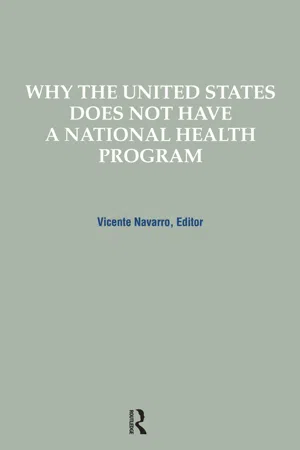
Why the United States Does Not Have a National Health Program
About this book
This book shows how the insurance industry and the medical industrial complex are the major influences in the health policy of the United States. They, and not the people, are those who determine the policies of the U.S. government. The volume shows how the United States could indeed provide comprehensive and universal health benefits coverage to the majority of the U.S. population at lower costs than the current health care nonsystem.
Information
SECTION II
The Reality: The Problems in U.S. Health Care
CHAPTER 5
Should We Abolish the Private Health Insurance Industry?
Thomas Bodenheimer
During 1989, U.S. health policy debate has experienced an important shift. For the first time in over 15 years, health analysts are giving consideration to the development of a publicly run single-payer health financing mechanism that would replace the current privately dominated multiple-payer health system. The attractiveness of the single-payer mechanism is its ability to solve simultaneously the growing problems of uninsurance and health care inflation. In particular, debate over the merits of the Canadian single-payer model, initiated by Physicians for a National Health Program in its January 1989 proposal (1), has intensified in medical staff meetings at diverse hospitals, in conferences of professional organizations, in board rooms of major U.S. corporations, in Congressional committee hearings, and in the media.
A central feature of the single-payer model developed by the Physicians for a National Health Program is the abolition of the private health insurance industry and the concentration of all health care payments in the hands of a publicly run health fund that pays hospitals, physicians, and other health providers. The health insurance industry is a $150 billion business employing tens of thousands of people, a central feature of the U.S. health care landscape over the past 40 years. It is no small matter to propose the extinction of such an important enterprise. This article proposes to address the question: should the private health insurance industry be abolished?
HEALTH CARE AS A RIGHT VERSUS THE INSURANCE PRINCIPLE
In seeking a method to finance health care, societies can choose between two fundamentally different conceptions: (a) the principle of health care as a right, and (b) the insurance principle that people get what they pay for. These principles are in conflict.
The Right to Health Care
Legally, health care is not a right in the United States (2, 3). But in constructing a conception of health and society, the current legal status of health care as a right is irrelevant. The important question becomes: should there be a right to health care in the United States?
Philosophers, ethicists, medical professionals, and health policy experts have written hundreds of pages on this question (4-8). Utilizing a variety of theories of justice, many conclude that health care should be a right while others disagree. Hundreds more pages are spent searching for the meaning of the right to health care. Does it mean universal entitlement to every available medical therapy, or does society set limits? Do people (e.g., smokers) who damage their own health have the same rights as others? How should payment for health services relate to amount of use or to personal income? Rather than summarizing these matters here, I refer the reader to Victor Sidel’s concise discussion of “The Right to Health Care: An International Perspective” (9).
Among those who search for the meaning of health care as a right, a consensus formulation reads something like this: the right to health care means that society has a duty to allocate an adequate share of its total resources to health-related needs, and that each person is entitled to a fair share of such services as determined by medical need rather than by income, political power, or social status (10, p. 194; 11). A simpler formulation would be: all people should have equal access to a reasonable level of health services regardless of income.
Physicians, philosophers, or lawyers aside, whether or not health care should be a right in the United States is not primarily a medical, ethical, or legal issue; it is a political issue. Few would disagree that in a democracy, the majority should decide.
In fact, the majority has spoken. Our modern opinion-expressing mechanism, the public opinion poll, strongly indicates that the American people believe that health care should be a right. Polls conducted in 1968, 1975, and 1978 asked: is adequate medical care “a privilege that a person should have to earn, or a right to which he [sic] is entitled as a citizen?” In all three surveys, over 75 percent said health care should be a right (12). A 1986 poll asked: in general, do you think all Americans should have access to the same quality of care regardless of ability to pay for it? Eighty-six percent answered yes (13). In a 1988 Harris poll, 90 percent of the public felt that everyone is entitled to health care “as good as a millionaire could get.” Sixty-eight percent of physicians agreed (14). It is true that people will not always back up their surveyed sentiments with political support if the monetary cost is too high. But in fact, several polls show that people would be willing to pay more for health care (15). Considering evidence from many years of public opinion polling, it is undeniable that Americans show overwhelming sentiment for the proposition that health care is a right.
Moreover, the United States is surrounded by nations that have enacted entitlement to health care into their legal systems. A recent survey shows that a large number of nations in the Western Hemisphere include the right to health services in their constitutions (3). In a New England Journal of Medicine editorial, Drs. Berwick and Hiatt observe: “Americans have no right to health care. In this respect, we stand almost alone among the industrialized nations of the world” (16). The Universal Declaration of Human Rights, passed by the United Nations General Assembly, affirms a right to medical care (17). Not only has the United States ignored the opinions of the great majority of its own citizens on this issue, it also stands apart from the community of nations.
How does one translate the principle of health care as a right into a health care financing mechanism? Recall the consensus formulation of health care as a right: all people should have equal access to a reasonable level of health services regardless of income. This principle has two major implications for the financing of health care: (a) financial barriers to health care should not be greater for people who need more care than for those who need less care, and (b) financial barriers to health care should not be greater for people of lower income than for people of higher income.
The Insurance Principle
An alternative principle for financing health care is the insurance principle. The elements of the insurance principle are clearly spelled out in Robert Holtom’s book Underwriting Principles and Practices (18), published by the National Underwriter Company, a prestigious organization representing the insurance industry.
According to Holtom, the principles of insurance are embodied in the science of underwriting. Underwriting is a systematic technique for evaluating, selecting (or rejecting), classifying, and rating risks. (The term “risk” refers to the object of the insurance: a home, a car, or in the case of health insurance, a person.) Underwriters also establish the standards of coverage and amount of protection to be offered to each acceptable risk and the amount of premium to be charged. Holtom affirms that “The principal responsibility of an underwriter is to make a profit for his company” (18, p. 12).
Profit is best ensured through the system of classifying risks—separating people into homogeneous groups. Young, generally healthy people might make up one classification, healthy middle-aged people another classification, and elderly and disabled people yet another. Each risk (person or group) is categorized as a preferred risk, standard risk, or substandard risk based on the probability of loss, i.e., on the likelihood that the person will contract an illness that generates a claim against the insurer. Thus members of the young group might be considered preferred risks, the middle-aged group standard risks, and the elderly/disabled group substandard risks. People with a very high likelihood of loss—for example human immunodeficiency virus (HIV)-positive individuals—are classified as unacceptable risks and become uninsurable.
Under the insurance principle, each classification is supposed to generate profit; thus the premiums of the young healthy group are not used to help subsidize the greater expense of the elderly or disabled groups. The more likely the loss, the higher the premium. In our classification scheme, the young group would have the lowest premiums, the middle-aged group higher premiums, and the elderly/disabled the highest. Naturally, the only way for the insurer to generate profit from the substandard risk group is to charge its members extremely high premiums (18, pp. 142-149).
Insurance terminology defines a hazard as a condition that increases the likelihood of loss. Coronary heart disease or cancer is clearly a hazard in the field of life insurance. One category of hazard is accusingly termed “moral hazard,” referring to a greater likelihood of loss because of deliberate or dishonest acts of the insured. An act of arson by a landlord hoping to collect fire insurance on a deteriorating property certainly deserves the appellation of “moral hazard.” But health insurers and health care analysts of conservative persuasion utilize the term “moral hazard” to describe the behavior of people who seek more medical care because they have health insurance (18, p. 18). A prime cause of the high costs of care, according to this mode of thinking, is that most people abuse health insurance by overusing health care, thereby forcing insurers to raise premiums unnecessarily. The assumptions of this line of reasoning are (a) that people love to visit their physicians and do so simply because they are insured, and (b) that patients decide what medical care they will receive. In fact, physicians determine the majority of the demand for medical care, a fact that invalidates the “moral hazard” argument. But whatever the case, taken from the viewpoint of health care as a right, it is desirable that people seek more care by virtue of being insured; improvement in access to care is the very reason health insurance was invented.
Health insurers, nonetheless, attempt to reduce the burden of “moral hazard” by including in their policies deductible and coinsurance provisions, payments meant to discourage people from seeking care. In addition, to prevent people from buying health insurance immediately after contracting a serious illness (behavior considered as highly “morally hazardous”) insurers have preexisting illness clauses that exclude coverage for a certain period of time for illnesses that existed before the insurance was obtained.
What does the insurance principle imply for the financing of health care? First, people who need more health care must pay more than people who need less health care. This is the case because people needing more health care are placed in a different classification than people needing less health care and are charged higher premiums. Second, people with lower incomes must pay a greater proportion of their income for health care than people with higher incomes. This is true because within each classification of risks, insurance premiums for people with lower incomes are equal to those of people with higher incomes, with the result that lower-income people pay a higher...
Table of contents
- Cover
- Title Page
- Copyright Page
- Table of Contents
- Introduction
- Section I: The Myths: Their Reproduction in the Political, Media, and Academic Spheres
- Section II: The Reality: The Problems in U.S. Health Care
- Section III: Why There Is Not a National Health Program
- Section IV: The Struggle
- Section V: Some False Solutions
- Section VI: The Solution for the United States
- Contributors
- Index
Trusted by 375,005 students
Access to over 1.5 million titles for a fair monthly price.
Study more efficiently using our study tools.
Frequently asked questions
Yes, you can cancel anytime from the Subscription tab in your account settings on the Perlego website. Your subscription will stay active until the end of your current billing period. Learn how to cancel your subscription
No, books cannot be downloaded as external files, such as PDFs, for use outside of Perlego. However, you can download books within the Perlego app for offline reading on mobile or tablet. Learn how to download books offline
Perlego offers two plans: Essential and Complete
- Essential is ideal for learners and professionals who enjoy exploring a wide range of subjects. Access the Essential Library with 800,000+ trusted titles and best-sellers across business, personal growth, and the humanities. Includes unlimited reading time and Standard Read Aloud voice.
- Complete: Perfect for advanced learners and researchers needing full, unrestricted access. Unlock 1.5M+ books across hundreds of subjects, including academic and specialized titles. The Complete Plan also includes advanced features like Premium Read Aloud and Research Assistant.
We are an online textbook subscription service, where you can get access to an entire online library for less than the price of a single book per month. With over 1.5 million books across 990+ topics, we’ve got you covered! Learn about our mission
Look out for the read-aloud symbol on your next book to see if you can listen to it. The read-aloud tool reads text aloud for you, highlighting the text as it is being read. You can pause it, speed it up and slow it down. Learn more about Read Aloud
Yes! You can use the Perlego app on both iOS and Android devices to read anytime, anywhere — even offline. Perfect for commutes or when you’re on the go.
Please note we cannot support devices running on iOS 13 and Android 7 or earlier. Learn more about using the app
Please note we cannot support devices running on iOS 13 and Android 7 or earlier. Learn more about using the app
Yes, you can access Why the United States Does Not Have a National Health Program by Vicente Navarro in PDF and/or ePUB format, as well as other popular books in Medicine & Pharmaceutical, Biotechnology & Healthcare Industry. We have over 1.5 million books available in our catalogue for you to explore.