Although there are numerous books on alternative accounting methods, such as Lean accounting, none focus on the impact of time and how accounting practices can be modified to acknowledge the power of time. This book addresses this need.
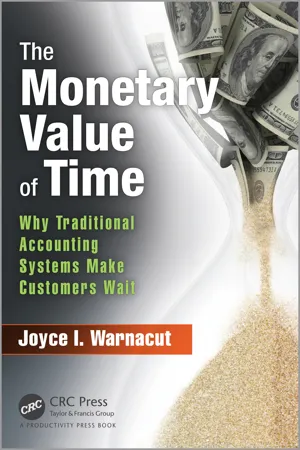
The Monetary Value of Time: Why Traditional Accounting Systems Make Customers Wait presents a framework for assessing the value of time in terms of organizational strategy and competitive advantage. The framework presented will enable organizations to develop consistent measures and ensure that their cost accounting system isn't motivating behaviors that add to lead time and make customers wait.
The framework outlined in this book is relevant to the managerial and cost accounting practices in today's manufacturing environment, which is increasingly moving away from mass production to custom manufacturing. The framework is supported by high-level metrics, which are reinforced by operational metrics. This is supported by accounting data that recognize the value of time. Pricing models that incorporate the concept of time are presented.
The book provides many examples of how the use of standard costing and traditional accounting practices in a high-mix/low-volume production environment can produce contradictory or even inaccurate results that form the basis for poor decisions that may actually move your organization farther from its objectives.
The book arms readers with options for overcoming traditional barriers by applying direct costs at an item level, while applying overheads at a macro or value stream level. For example, while GAAP requires overhead application for inventory valuation, a common misconception is that overhead must be applied at an item level. In fact, overhead can be absorbed by one journal entry.
Demonstrating the linkages between time-based accounting data and meaningful business metrics that drive bottom line results, the book presents methods and metrics that have been successfully applied by the author in manufacturing environments.
eBook - ePub
The Monetary Value of Time
Why Traditional Accounting Systems Make Customers Wait
- 170 pages
- English
- ePUB (mobile friendly)
- Available on iOS & Android
eBook - ePub
About this book
Information
1 Net Present Value: Just the Tip of the Iceberg

The idea that money available at the present time is worth more than the same amount in the future due to its potential earning capacity. This core principle of finance holds that, provided money can earn interest, any amount of money is worth more the sooner it is received. The value today, of cash or cash flows to be received in the future, is called net present value, abbreviated as NPV.
where
t is the time of the cash flow
i is the rate of return that could be earned on an investment in the financial markets with similar risk; the opportunity cost of capital
N is the total number of periods
Rt is the net cash flow, that is, cash inflow minus cash outflow, at time t
One finance formula that does acknowledge the value of time is NPV. Present value is simply the sum of a series of cash flows over time in terms of present dollars. It factors in inflation and what you could make investing your money elsewhere. This formula applies an interest rate based on the assumption that money today is worth more than money tomorrow. This is the accounting version of “a bird in the hand is worth two in the bush.”
The formula is regularly applied to evaluate a series of returns on an investment—typically equipment—to incorporate a time value associated with the immediate outflow of funds and the periodic inflow of savings generated by the investment. What if we applied this same concept to shortening the time our customers have to wait for their product?
Assume that we have a customer who buys $1,000,000 worth of product each year. Our cost is $900,000, which generates $100,000 profit per year. The manufacturing process is intensive, and we spend the whole year producing the product that is delivered in one annual shipment. What if we were able to improve our processes and deliver quarterly shipments of $250,000? How about monthly shipments of $100,000?
Using an interest rate of 5%, the analysis is shown in Figures 1.1 through 1.3.
If we buy our raw materials of $900,000 up front and make one sale per year of $1,000,000, the net present value of our investment at a rate of 5% is $52,381 (Figure 1.1). If we buy 1/4 of our materials at the start of each quarter and ship every 90 days, we will yield $25,000 per quarter based on $250,000 of sales less $225,000 of materials. The present value of our investment at a rate of 5% is $86,303 (Figure 1.2). If we buy our materials at the start of each month, and ship every 30 days, we yield $8,333 per month based on $83,333 of sales less $75,000 of materials. The present value of our investment at a rate of 5% is $97,809 (Figure 1.3). Simply by shortening the cycle between buying materials and shipping product, we have generated an additional value of $45,428 ($97,809 − $52,381).

Figure 1.1 The net present value of annual shipments.

Figure 1.2 The net present value of quarterly shipments.

Figure 1.3 The net present value of monthly shipments.
The important concept is to look closely at the time line, from the point the order is received to the point where the cash is collected. Any reduction in this time line will improve customer responsiveness and cash flow at the same time.
Therefore, not only does the customer get accelerated delivery, we also add value by using our money more efficiently and turning it faster. This is the money value of time, and the foundation of velocity.
In the chapters to come, you will discover that the one time-based cost that accountants recognize, the time value of money, is only the tip of the iceberg. Time is a lot more money than just the cost of capital. Accounting does not put a value on the cost of waiting and queues. Nor does it value the cost of consuming resources to produce things that cannot be quickly converted to cash. In each of the examples above, the product cost is reported as 90% with a 10% profit margin, even though there is a vast difference in cash velocity and customer responsiveness between the options.
2 Velocity Improves Productivity and Working Capital
Velocity is a measurement of the rate and direction of motion. It measures both speed and direction. In business terms, this means not only shortening response times, but also doing so by making the correct directional decisions.
Velocity may be the most neglected, and at the same time, the most important financial metric of our time. In Execution: The Discipline of Getting Things Done by Larry Bossidy and Ram Charan (2002), the impact of velocity is discussed as follows:
Building to order means producing a unit after the customer’s order is transmitted to the factory. The system squeezes time out of the entire cycle from order to delivery. This system minimizes inventory at both ends of the pipeline, incoming and outgoing. Building-to-order improves inventory turnover, which increases asset velocity, one of the most under-appreciated components of making money. Velocity is the ratio of sales dollars to net assets deployed in the business (plant and equipment, inventories, and AR minus AP). Higher velocity improves productivity and reduces working capital. It also improves cash flow, the life blood of any business, and can help improve margins as well as revenue and market share.
The more time we squeeze out of the process, the more attractive make to order becomes. Just think about the financial impact of eliminating forecast errors, obsolete inventory, and reducing warehouse space requirements! Lower inventories also improve the accuracy of financial reporting, because as you eliminate inventory, you also eliminate the magnitude of valuation errors caused by poor cutoffs, incorrect cost data, and incorrect perpetual inventory levels. We need to break through the thinking that small runs are bad and move to matching production to demand. Dell revolutionized the computer industry with their assemble-to-order business model and 80 inventory turns per year. As our response time decreases, the need to make ahead also diminishes. Manufacturers that consider inventory to be business as usual need to ask, “What would it take to eliminate inventory? What changes in my process, my perceptions, and my systems would be required to make all of my products to order?”
Business velocity refers to a company’s ability to generate operational speed while heading in the right direction. Operational speed does not necessarily mean working faster; it means that all waste, waiting, and unnecessary activities are eliminated from the process. The right direction means that the activities to save time and eliminate waiting must be focused on the activities that will make the greatest impact on overall customer response time. This requires that focus is put on processes or operations that are on the critical path. In other words, does the compression of time in the process reduce overall lead time? In order to determine this, the business process must be mapped to determine where the greatest opportunities lie. While many mapping tools exist, one tool that clearly incorporates time is the concept of MCT (manufacturing critical Path time) as presented by Rajan Suri (2010). MCT is a time-based metric that defines lead time in a precise way so that it properly quantifies an organization’s total system-wide waste.
2.1 MEASURING LEAD TIME
An MCT map is a graphic representation of the flow of an order through the specified subset of an org...
Table of contents
- Cover Page
- Title Page
- Copyright Page
- Contents
- Author
- Introduction
- Chapter 1 Net Present Value: Just the Tip of the Iceberg
- Chapter 2 Velocity Improves Productivity and Working Capital
- Chapter 3 Case Study: Velocity Impact on Results
- Chapter 4 Product Cost
- Chapter 5 What Does GAAP Have to Do with It?
- Chapter 6 Variation, or Stuff Happens
- Chapter 7 Labor: Direct or Indirect? Cross-Trained or Specialized?
- Chapter 8 Simplified Time-Based Accounting
- Chapter 9 Pricing Strategies under High Mix/Low Volume
- Chapter 10 Is Inventory a Liability or an Asset?
- Chapter 11 More on Simplified Time-Based Accounting
- Chapter 12 Time-Based Metrics
- Chapter 13 Time-Based Cost Justifications
- Chapter 14 A Road Map for Implementing Time-Based Accounting
- Chapter 15 Making Customers Wait
- References
- Index
Trusted by 375,005 students
Access to over 1.5 million titles for a fair monthly price.
Study more efficiently using our study tools.
Frequently asked questions
Yes, you can cancel anytime from the Subscription tab in your account settings on the Perlego website. Your subscription will stay active until the end of your current billing period. Learn how to cancel your subscription
No, books cannot be downloaded as external files, such as PDFs, for use outside of Perlego. However, you can download books within the Perlego app for offline reading on mobile or tablet. Learn how to download books offline
Perlego offers two plans: Essential and Complete
- Essential is ideal for learners and professionals who enjoy exploring a wide range of subjects. Access the Essential Library with 800,000+ trusted titles and best-sellers across business, personal growth, and the humanities. Includes unlimited reading time and Standard Read Aloud voice.
- Complete: Perfect for advanced learners and researchers needing full, unrestricted access. Unlock 1.5M+ books across hundreds of subjects, including academic and specialized titles. The Complete Plan also includes advanced features like Premium Read Aloud and Research Assistant.
We are an online textbook subscription service, where you can get access to an entire online library for less than the price of a single book per month. With over 1.5 million books across 990+ topics, we’ve got you covered! Learn about our mission
Look out for the read-aloud symbol on your next book to see if you can listen to it. The read-aloud tool reads text aloud for you, highlighting the text as it is being read. You can pause it, speed it up and slow it down. Learn more about Read Aloud
Yes! You can use the Perlego app on both iOS and Android devices to read anytime, anywhere — even offline. Perfect for commutes or when you’re on the go.
Please note we cannot support devices running on iOS 13 and Android 7 or earlier. Learn more about using the app
Please note we cannot support devices running on iOS 13 and Android 7 or earlier. Learn more about using the app
Yes, you can access The Monetary Value of Time by Joyce I. Warnacut in PDF and/or ePUB format, as well as other popular books in Business & Accounting Standards. We have over 1.5 million books available in our catalogue for you to explore.