This important book fills two interrelated gaps in the field of psychology, first by developing a Marxist orientation to psychology and second by explaining how psychological pioneer Lev Vygotsky contributed greatly to this trend. Through outlining core principles in Marxist psychology, the book offers a framework for continuing Vygotsky's Marxist legacy in new areas of the field.
This book first documents the neglect in Vygotskyian studies of his deep use of Marxist concepts, and then subsequent chapters overcome this neglect. They explain the use of many Marxist concepts in his theoretical and methodological writings, demonstrating how Vygotsky utilized specific Marxist meanings in his work on consciousness, signs, development, imagination, creativity, secondary language acquisition, and unit of analysis. Chapters also address how Vygotsky dealt with incompatible theories and methodologies, illustrating how Marxist and Vygotskyian psychology can grow from anti-Marxist, anti-Vygotskyian approaches to psychology, such as psychoanalysis.
This book marks an original contribution to the field of psychology, offering a new understanding of both Vygotsky's work and cultural and Marxist psychology. Furthermore, it expands the field of Marxism to include psychology. It will be of interest to all students and researchers of cultural, educational, and developmental psychology as well as the history of psychology. It will also appeal to social theorists and Marxist scholars.
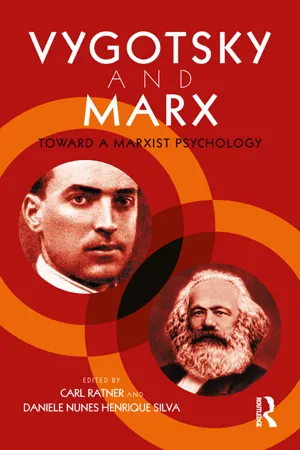
eBook - ePub
Vygotsky and Marx
Toward a Marxist Psychology
- 208 pages
- English
- ePUB (mobile friendly)
- Available on iOS & Android
eBook - ePub
Vygotsky and Marx
Toward a Marxist Psychology
About this book
Trusted by 375,005 students
Access to over 1.5 million titles for a fair monthly price.
Study more efficiently using our study tools.
Information
1
MARXIST PSYCHOLOGY, VYGOTSKY’S CULTURAL PSYCHOLOGY, AND PSYCHOANALYSIS
The double helix of science and politics
I. Marx, Marxist psychology, and Vygotsky
Whereas most treatment of Vygotsky’s relation to Marxism explores the manner in which he utilized Marx’s concepts and methodology, here, I invert this and explore the manner in which Marxist psychology can utilize Vygotsky’s concepts and methodology.
This chapter explains how a Marxist psychology can be constructed that draws on Marx’s social theory regarding the structure of society, the relation of psychology to social structure, and human nature. Vygotsky is used for his important contribution to fleshing out some of these elements.
Marx and Vygotsky are shown to enrich each other. On the one hand, Vygotsky adds the crucial psychological dimension to Marxism through his brilliant theorizing about the academic discipline of psychology and his empirical research on specific psychological processes. On the other hand, Marxism provides the foundation for Vygotsky’s Marxist psychology and indicates how it can be developed beyond what Vygotsky accomplished. Vygotsky was unable to fully apply Marxist political philosophy to all psychological topics, or even to all of the topics that he touched upon. As Luria says: “The system of human psychology on which Vygotsky worked all his life was never completed. He did not leave us a personally completed and rebuilt science” (in Levitin, 1982, p. 173). It is thus necessary for us to thoroughly articulate Marxist political philosophy so that it can deepen Vygotsky’s work and be extended to psychological phenomena in general.
For instance, Vygotsky emphasized language as the basis of thought. Marx and Engels cautioned that language is grounded in social life and reflects its features; it is not an independent realm. In The German Ideology, they say,
One of the most difficult tasks confronting philosophers is to descend from the world of thought to the actual world. Language is [construed as] the immediate actuality of thought. Just as philosophers have given thought an independent existence, so they were bound to make language into an independent realm. This is the secret of philosophical language, in which thoughts in the form of words have their own content. The problem of descending from the world of thoughts to the actual world is turned into the problem of descending from language to life.
We have shown that thoughts and ideas acquire an independent existence in consequence of the personal circumstances and relations of individuals acquiring independent existence. We have shown that exclusive, systematic occupation with these thoughts on the part of ideologists and philosophers, and hence the systematisation of these thoughts, is a consequence of division of labour, and that, in particular, German philosophy is a consequence of German petty-bourgeois conditions. The philosophers have only to dissolve their language into the ordinary language, from which it is abstracted, in order to recognise it, as the distorted language of the actual world, and to realise that neither thoughts nor language in themselves form a realm of their own, that they are only manifestations of actual life.
(Marx and Engels, 1932/1968, Chapter 3)
Advancing Vygotsky’s Marxism must utilize Marx and Engels’ criticism of philosophical idealism to develop a historical-materialist conception of language as the basis of psychology.
Marxist psychology is a dialectical integration of two fields: Marxism and psychology. It is faithful to both and corrective of both. Marxist social theory is extended to the distinctive domain of psychology where it initiates fruitful hypotheses, corrects theoretical issues, and identifies methodological errors (with both positivism and postmodernist/individualistic qualitative methodology). Marxist psychology is an internal development of psychology that fills its intellectual voids, corrects its errors, and resolves its contradictions and controversies. Conversely, psychology is extended to Marxism, where it contributes specific theories and research about phenomena such as emotions, memory, learning, socialization, mental illness, and developmental processes. These correct certain Marxist concepts that are psychologically uninformed. Of course, the psychological theories, conclusions, and methodologies are adjusted to Marxist principles and, reciprocally, introduce adjustments to those principles.
Marxist psychology avoids reducing psychological theory and methodology to Marxist economic formulations or political activism. On the contrary, Marxist psychology retains the distinctive contributions of psychology and utilizes these to enrich Marxism. Yaroshevsky put this as follows:
Vygotskiy viewed Marxist psychology not as a school but as the only scientific psychology. … Vygotsky believed that transformation of psychology on the basis of Marxism did not in any way mean abandoning all previous [academic] work. Every effort thought to gain insight into the psyche … would necessarily be incorporated into it [Marxist psychology] in a modified form.
(Cited in Levitin, 1982, p. 53)
This is illustrated in Figure 1.1.
Marxist psychology must be developed by Marxists who are grounded in the discipline of psychology – its theories, methodologies, research findings, and interventions. Marxist psychology cannot be developed on the purely philosophical level of Marxian-Hegelian theory, or Freudian or Lacanian theory, that is ignorant of these psychological details.
Vygotsky saw Marxism as a model whereby a philosophical doctrine is applied to a concrete science. That task could not be tackled by the direct introduction of the universal categories and laws of dialectical materialism into the concrete sciences. Equally fruitless was the approach whereby isolated utterances from Marxist works were thought to provide a ready-made psychology, i.e., a solution to the question of the specifics and laws of the human psyche. To apply Marxism to a particular science, it was necessary to work out a methodology, i.e., a system of concepts which could be applied to that particular science.
(Levitin, 1982, p. 54)

FIGURE 1.1 Marxist psychological science
Vygotsky states this as follows:
The direct application of the theory of dialectical materialism to the problems of psychology is impossible. … Like history, sociology is in need of the intermediate special theory of historical materialism which explains the concrete meaning for the given group of phenomena of the abstract laws of dialectical materialism. In exactly the same way, we are in need of an as yet undeveloped but inevitable theory of psychological materialism as an intermediate science which explains the concrete application of the abstract theses of dialectical materialism to the given field of phenomena.
[…] In order to create such intermediate theories – methodologies, general sciences – we must reveal the essence of the given area of phenomena, the laws of their change, their qualitative and quantitative characteristics, their causality; we must create categories and concepts appropriate to it, in short, we must create our own Das Kapital – its own concepts of class, basis, value, etc. – in which it might express, describe, and study its object.
[…] In order to create such intermediate theories – methodologies, general sciences – we must reveal the essence of the given area of phenomena, the laws of their change, their qualitative and quantitative characteristics, their causality; we must create categories and concepts appropriate to it, in short, we must create our own Das Kapital – its own concepts of class, basis, value, etc. – in which it might express, describe, and study its object.
(1997a, p. 330)
Dialectical materialism is a most abstract science. The direct application of dialectical materialism to the biological sciences and psychology, as is common nowadays, does not go beyond the formal logical, scholastic, verbal subsumption of particular phenomena, whose internal sense and relation is unknown, under general, abstract, universal categories.
(Ibid., p. 331)
Vygotsky is saying that dialectical philosophy cannot suffice as a psychological theory because it is devoid of concrete knowledge of psychological phenomena, just as it is devoid of biological knowledge. Consequently, it is limited to general, abstract dialectical categories. “We do not need fortuitous utterances, but a method; not dialectical materialism, but historical materialism” (ibid., p. 331).
Vygotsky implies that even historical materialism is insufficient for constructing a complete psychological theory because it is ignorant of concrete psychological processes, the essence of the given area of phenomena, the laws of their change, their qualitative and quantitative characteristics, and their causality. Historical materialism does not contain categories and concepts appropriate to psychology. This is why Vygotsky says we must create a specifically psychological theory that he calls “psychological materialism.” It is based upon dialectical materialism and historical materialism; however, it contributes a specifically psychological dimension to these. This is how Marxist psychology enriches Marxism.
In The Psychology of Art, Vygotsky (1925/1971) explains the relationship between art and Marxism:
I propose to remain content with the methodological and theoretical laws of the psychological examination of art, along with every other attempt, pointing out the essential importance of finding a place within the Marxist doctrine of art. Here my guideline has been the well-known Marxist position that the sociological view of art does not deny its aesthetic consideration; on the contrary, it opens wide the door to it and presupposes it, in Plekhanov’s words, as its complement.
Vygotsky emphasizes the distinctive, “emergent” nature of the esthetic realm and advocates that Marxism make a space for it without reducing it to the political economy.
Vygotsky made important advances in psychology and in Marxism by developing the distinctive features of psychology that force Marxism to expand to incorporate them in its theory. Where Marx and Engels say, “language is practical consciousness,” Vygotsky uses language as the basis of thought/cognition. Vygotsky took Marx and Engels’ (1932/1968, p. 42) statement that “consciousness takes the place of instinct” in humans, and expanded consciousness as the entire basis of psychology: “Development of thinking has a central, key, decisive significance for all the other [psychological] functions and processes…. All other special functions are intellectualized, reformed, and reconstructed under the influence of these crucial successes that thinking achieves” (Vygotsky, 1998, p. 81). This is a psychological insight made by a psychologist steeped in the field of psychology; it extends Marxism into the full nature of human psychology.
Vygotsky developed psychology along Marxist lines (infused with Marxist thinking) more profoundly and scientifically than anyone ever has. Consequently, while Vygotsky argues that Marxist psychology is the only scientific psychology, we must add that Vygotskyian psychology is the only adequate Marxist psychology. Marxist psychology (i.e., scientific psychology), which certainly incorporates ideas from various scholars, must be based upon Vygotsky’s ideas. It is impossible for psychoanalytically oriented psychologists, or critical psychologists, to engage with Marxist psychology while disregarding Vygotsky. It is intellectually irresponsible as well to ignore the best scientific contribution to Marxist psychology.
Marxist psychology uses Marxism and psychology to enrich each other without reducing either to the other. Marxist psychology must research psychological issues that extend Marxism and psychology beyond their traditional domains.
We need:
• a Marxist psychology of emotions
• a Marxist psychology of sexuality/gender
• a Marxist psychology of memory
• a Marxist psychology of intelligence
• a Marxist psychology of perception
• a Marxist psychology of development
• a Marxist psychology of language
• a Marxist psychology of self/personality
• a Marxist psychology of the body
• a Marxist psychology of mental disorders
• a Marxist psychology of psychobiological processes. For example, Marxist psychology needs a psychology of brain localization of psychological phenomena. This is far removed from conventional Marxist topics; however, it enriches Marxism. The question is whether emotions, memory, self-concept, attention, problem-solving, mental illness, and language are localized in prefigured brain centers (modules) with unique neurophysiological properties capable of processing unique psychological features, or whether the cortex is a general, flexible, unspecified processing apparatus in which any psychological function can be processed in any location. This technical matter is relevant to Marxism because it concerns the question of whether psychological functions are preformed modules that are biologically determined through localized, distinctive physiological factors or whether the cortex does not determine psychology’s features through the inherent properties of cortical centers but is, rather, a general information processing center of psychological features that are cultural in nature, origin, formation, and function. Evidence is on the side of the latter, which makes brain localization (modularity) an interesting and important support for Marxist psychology. This is an important example of how technical, psychobiological, non-Marxist psychological issues have a strong bearing on Marxist theory and science.
• a Marxist psychology that explains why and how psychological phenomena are formed by cultural factors and processes. This is crucial for extending Marxism to subjectivity and consciousness. It avoids empiricism that simply correlates phenotypical psychological expressions with social events without explaining how or why the correlation exists.
Central to Marxist psychology is the revolutionary politics of Marxism that critiques the existing social system and directs its reorganization toward a more fulfilling one. This must be built into the theory, constructs, methodology, and interventions of psychology; it must permeate, structure, and direct all of these scientific elements. This political dimension makes Marxist scientific psychology unique. It enhances scientific psychology; it does not detract from it. This is a point of emphasis in this chapter.
I argue that cultural psychology is the most fruitful psychological approach for linking psychology and Marxism in a Marxist psychology. Cultural psychology is consistent with Marxist psychology, which enables it to utilize Marxist concepts in cultural psychology, and academic psychology, and enables it to introduce psychological theories, methodologies, interventions, and data into Marxism. This...
Table of contents
- Cover
- Half Title
- Title Page
- Copyright Page
- Dedication
- Table of Contents
- Notes on contributors
- Introduction: recovering and advancing Vygotsky’s Marxist psychology
- PART I Toward a Marxist psychology
- PART II Marxist epistemological and methodological aspects of Vygotsky’s psychology
- PART III Psychological applications of Vygotsky’s Marxism
- Index
Frequently asked questions
Yes, you can cancel anytime from the Subscription tab in your account settings on the Perlego website. Your subscription will stay active until the end of your current billing period. Learn how to cancel your subscription
No, books cannot be downloaded as external files, such as PDFs, for use outside of Perlego. However, you can download books within the Perlego app for offline reading on mobile or tablet. Learn how to download books offline
Perlego offers two plans: Essential and Complete
- Essential is ideal for learners and professionals who enjoy exploring a wide range of subjects. Access the Essential Library with 800,000+ trusted titles and best-sellers across business, personal growth, and the humanities. Includes unlimited reading time and Standard Read Aloud voice.
- Complete: Perfect for advanced learners and researchers needing full, unrestricted access. Unlock 1.5M+ books across hundreds of subjects, including academic and specialized titles. The Complete Plan also includes advanced features like Premium Read Aloud and Research Assistant.
We are an online textbook subscription service, where you can get access to an entire online library for less than the price of a single book per month. With over 1.5 million books across 990+ topics, we’ve got you covered! Learn about our mission
Look out for the read-aloud symbol on your next book to see if you can listen to it. The read-aloud tool reads text aloud for you, highlighting the text as it is being read. You can pause it, speed it up and slow it down. Learn more about Read Aloud
Yes! You can use the Perlego app on both iOS and Android devices to read anytime, anywhere — even offline. Perfect for commutes or when you’re on the go.
Please note we cannot support devices running on iOS 13 and Android 7 or earlier. Learn more about using the app
Please note we cannot support devices running on iOS 13 and Android 7 or earlier. Learn more about using the app
Yes, you can access Vygotsky and Marx by Carl Ratner, Daniele Nunes Henrique Silva, Carl Ratner,Daniele Nunes Henrique Silva in PDF and/or ePUB format, as well as other popular books in Psychology & Developmental Psychology. We have over 1.5 million books available in our catalogue for you to explore.