- 232 pages
- English
- ePUB (mobile friendly)
- Available on iOS & Android
eBook - ePub
The Bid Manager’s Handbook
About this book
The original Bid Manager's Handbook continues to provide an invaluable resource in the battle to win new business. Winning significant business on the right terms is an increasingly complex, challenging and time-consuming task, and a successful bid is a vital part of any business offering its services or products to another. This book will help you to enhance the probability of success in winning bids at the desired margins and to set up and run effectively a bid management team. The Handbook is aimed at sales staff managing multi-disciplinary bid teams, and project and technical managers who find themselves managing a bid to support a sales campaign. Taking a practical approach and using real-life examples, David Nickson leads the reader through every stage of planning for, producing and delivering a bid. Crucially it also shows how to save time - the most important commodity in any bid - without affecting quality. Now the original Bid Manager's Handbook has been repackaged to include additional material that expands on the writing and editorial side of the bid, the use of bid management software and the bid review process.
Trusted by 375,005 students
Access to over 1.5 million titles for a fair monthly price.
Study more efficiently using our study tools.
Information
CHAPTER 1
Introduction
To be persuasive, we must be believable. To be believable, we must be credible. To be credible, we must be truthful. (Edward R. Murrow)
This book is aimed at anyone who has to write, manage, or contribute to a bid for new or repeat business in any context. If you have picked up this book, this probably means you! In most corporate, as well as smaller-sized businesses, government/non-governmental agencies and charitable organizations bidding for new business is a vital activity. The problem is, not everyone gets it right. This book will help you:
- make sure that you know what needs to be done;
- know how to present the information to the prospective client effectively;
- identify the skills that are needed to get the job done.
Even more importantly it will show you how to save time, the most important commodity in any bid as it is always in short supply.
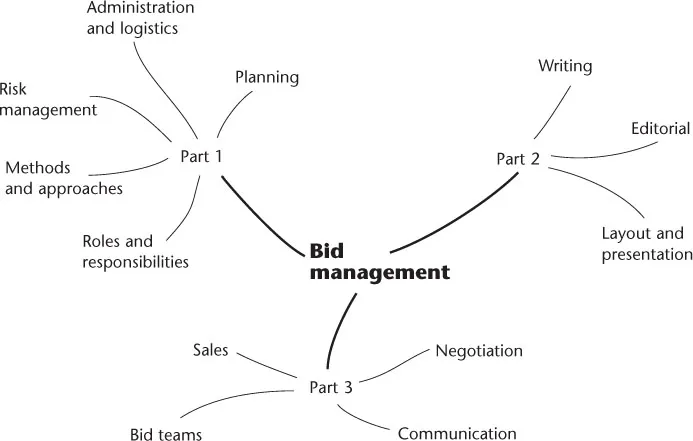
Figure 1.1 Mind Map®: Bid management
Bids occur in all market sectors, both public and private. The chances of anyone working for more than a few years in any arena without being involved in a bid of some form are relatively small. So although this book is targeted at those who have to manage bids, it also contains useful information for anyone working on a bid.
The reader is provided with practical help on managing bids, writing contributions for them, supporting them, coping with the impact they have on the organization and surviving them in general. Hints, tips and checklists are backed up with case studies based upon real-life experiences.
The Mind Map® in Figure 1.1 provides an overview of how the book fits together. Each part has been written to work on its own, although some cross-references were inevitable if repetition was to be kept to a minimum.
Note. There are many terms in popular usage for the recipient of a bid – prospect, customer, client, procurer and so on. In this book the term ‘client’ has been adopted because, regardless of whether the bid is successful or not, you have a working relationship with them.
What is a bid?
Definition. A bid is an approach to a client in order to gain significant new or repeat business.
It is also a collection of information, including a price and costs, put together often by a team to support a business case. The bid document can range from a few pages with a little budgetary justification, all the way through to a multi-volume, thousand page plus submission for major government procurements such as Private Public Partnerships (PPP). Similarly, the value of such bids can range from a few thousand pounds through to hundreds of millions of pounds.
What every bid has in common is that it has to be produced within a highly charged and competitive environment, to a fixed timetable and often to a fixed budget. In this book we hope to support the bidding process for the medium to large bids in this range, bids where there is a significant organizational and editorial task to be performed across departments, territories, job functions and even between disparate companies.
Talk to anyone who has worked on a bid and the one thing they always tell you is that, ‘there’s never enough time’. The primary goal of this book is to enable the reader to make the best use of the time available and work effectively to produce a high-quality bid with the smallest amount of hassle. (Although a bid is defined as the overall process and the proposal as a deliverable, their usage is often interchangeable. The author makes no apology for this.)
Key point. Why is not a bid the same as a project? Because it really does have a fixed timetable and the deliverable is not negotiable. The Bid Manager is there to get the bid out with the resources available to the highest quality possible. There are no rewards for coming in under budget or finishing early. The goal is to support the winning of the business. This makes Bid Managers different from project managers.
Why do we do them?
The short answer is, ‘To gain significant new business or funding’. A more considered response is to:
- persuade the client to buy your solution, accept your proposition;
- define the solution you are offering;
- set client expectations of what they will receive;
- determine the price of what you supply;
- limit your liability.
A bid can be an important vehicle for selling a solution, a product, a service, a portfolio of services and products. A successful bid often provides the basis for the contract between the supplier and the client for supply, and therefore takes on a more strategic role for the business.
Bids and proposals are sometimes only part of the selling process. Some companies maintain such a close a relationship with the client that they never have to write a proposal, or, at least, not until long after the sale has gone through!
Good bids and proposals, on their own may not win you business – bad ones, however, will lose it!
In other words a bid/proposal has two principal, and sometimes conflicting, functions, that of a selling tool and a (sometimes legally binding) commitment to supply. This book looks closely at the writing skills needed to help resolve this conflict (see Part 2).
Structure
The book is organized into three main parts.
- Bid management;
- Writing and editorial;
- Personal skills.
Each part addresses the key aspects of bid management and, as stated earlier, can be used separately to meet the requirements of different readers.
‘Bid management’ is concerned with the what, where and when of bids in general and in particular. ‘Writing and editorial’ deals with how to put across a strong message in writing, how to deal with the requirement to address multiple audiences within the one document, and how to produce a consistent proposal from a multiplicity of sources. The last part, ‘Personal skills’, deals with the abilities that a Bid Manager will need to have to cope with the human aspects of running a bid, for example managing the bid team, negotiating for resources, communicating sales themes, etc. Each chapter contains case studies to illustrate the point and, where appropriate, checklists for the Bid Manager’s use. These checklists are also presented in a collated form on separate pages at the end of the book. These can then be photocopied for repeated use on new bids and proposals.
The parts are themselves structured as follows:
Part 1 Bid Management | |
Roles and responsibilities | What a Bid Manager does - common variations in scope for different organizations. Job description, bid teams and interface with sales. |
Methods and approaches | Strategies for running bids, keeping it quick and adaptable. Use of a bid brief and reviews to produce high-quality product. |
Risk | Risk management for Bid Managers. Sources of risk, impact and probability. Effect of change. Documentation. |
Administration and logistics | Bid files and bid briefs, documenting who does what, progress checking without tears. Documentation and meetings, use of technology, staff and facilities. |
Planning | Sample plans, flexibility vs the need to keep control, what activities you need to allow for - how long do some things really take? Resources and activities, typical deliverables, cost of bidding. |
Part 2 Writing and Editorial | |
Writing skills | Aimed at bid/proposal authors and contributors to the bids, helping technical and specialist writers to cope with non-specialist audiences. Style, matching to audience. Fact, feature, benefit. Letters and emails, writing management summaries. |
Editorial skills | Pulling together differing styles, matching styles to readers. Use of templates, style, spelling and grammar, tracking progress. |
Layout and presentation | What you should/should not have on the page - basics of presenting information. Sample layouts, binders, covers and spines, presentations and style guides. |
Part 3 Personal Skills | |
Communication | Communications strategies and tactics for Bid Managers, communicating messages to the team and the client. Presentations, different media, what works and what does not. Meetings and facilitation. |
Teams | How to get people to work together, what goes ... |
Table of contents
- Cover Page
- Title Page
- Copyright Page
- Contents
- List of Figures
- 1 Introduction
- PART 1 Bid Management
- PART 2 Writing and Editorial
- PART 3 Personal Skills
- Appendix: Bid Brief Template BID BRIEF for Client Name/Procurement Reference Numbers Version 1.0 NN/MMM/YY
- Glossary
- Additional Reading
- Index
Frequently asked questions
Yes, you can cancel anytime from the Subscription tab in your account settings on the Perlego website. Your subscription will stay active until the end of your current billing period. Learn how to cancel your subscription
No, books cannot be downloaded as external files, such as PDFs, for use outside of Perlego. However, you can download books within the Perlego app for offline reading on mobile or tablet. Learn how to download books offline
Perlego offers two plans: Essential and Complete
- Essential is ideal for learners and professionals who enjoy exploring a wide range of subjects. Access the Essential Library with 800,000+ trusted titles and best-sellers across business, personal growth, and the humanities. Includes unlimited reading time and Standard Read Aloud voice.
- Complete: Perfect for advanced learners and researchers needing full, unrestricted access. Unlock 1.5M+ books across hundreds of subjects, including academic and specialized titles. The Complete Plan also includes advanced features like Premium Read Aloud and Research Assistant.
We are an online textbook subscription service, where you can get access to an entire online library for less than the price of a single book per month. With over 1.5 million books across 990+ topics, we’ve got you covered! Learn about our mission
Look out for the read-aloud symbol on your next book to see if you can listen to it. The read-aloud tool reads text aloud for you, highlighting the text as it is being read. You can pause it, speed it up and slow it down. Learn more about Read Aloud
Yes! You can use the Perlego app on both iOS and Android devices to read anytime, anywhere — even offline. Perfect for commutes or when you’re on the go.
Please note we cannot support devices running on iOS 13 and Android 7 or earlier. Learn more about using the app
Please note we cannot support devices running on iOS 13 and Android 7 or earlier. Learn more about using the app
Yes, you can access The Bid Manager’s Handbook by David Nickson in PDF and/or ePUB format, as well as other popular books in Business & Business General. We have over 1.5 million books available in our catalogue for you to explore.