- 400 pages
- English
- ePUB (mobile friendly)
- Available on iOS & Android
eBook - ePub
MIMO System Technology for Wireless Communications
About this book
For broadband communications, it was frequency division multiplexing. For optical communications, it was wavelength division multiplexing. Then, for all types of networks it was code division. Breakthroughs in transmission speed were made possible by these developments, heralding next-generation networks of increasing capability in each case. The basic idea is the same: more channels equals higher throughput. For wireless communications, it is space-time coding using multiple-input-multiple-output (MIMO) technology.
Providing a complete treatment of MIMO under a single cover, MIMO System Technology for Wireless Communications assembles coverage on all aspects of MIMO technology along with up-to-date information on key related issues. Contributors from leading academic and industrial institutions around the world share their expertise and lend the book a global perspective. They lead you gradually from basic to more advanced concepts, from propagation modeling and performance analysis to space-time codes, various systems, implementation options and limitations, practical system development considerations, field trials, and network planning issues. Linking theoretical analysis to practical issues, the book does not limit itself to any specific standardization or research/industrial initiatives.
MIMO is the catalyst for the next revolution in wireless systems, and MIMO System Technology for Wireless Communications lays a thorough and complete foundation on which to build the next and future generations of wireless networks.
Trusted by 375,005 students
Access to over 1.5 million titles for a fair monthly price.
Study more efficiently using our study tools.
Information
1
Spatio-Temporal Propagation Modeling
CONTENTS
1.1 Introduction
1.2 Directional Channel Modeling
1.2.1 Ring of Scatterers
1.2.2 Discrete Uniform Distribution Model
1.2.3 Geometrically Based Single-Bounce (GBSB) Statistical Channel Models
1.2.3.1 Geometrically Based Circular Model (Macrocell Model)
1.2.3.2 Geometrically Based Elliptical Model (Microcell Model)
1.2.3.3 Elliptical Subregions Model
1.2.3.4 Elliptical Model with Dense Discrete Scatterers
1.2.4 Gaussian Wide Sense Stationary Uncorrelated Scattering (GWSSUS)
1.2.5 A Stochastic Spatio-Temporal Propagation Model (SSTPM)
1.2.6 Extended Saleh-Valenzuela Model
1.2.7 Gaussian Scatter Density Model
1.2.8 Gaussian AoA — Laplacian Power Azimuth Spectrum
1.2.9 Semi-Elliptical Geometrical Model
1.2.10 Lognormal Distribution of Local Angular Spread (AS), Delay Spread (DS), and Shadow Fading (Macrocells)
1.3 MIMO Propagation Modeling
1.3.1 Deterministic Propagation Modeling with Ray Tracing
1.3.2 Stochastic Propagation Modeling
1.3.2.1 The 3GPP MIMO Channel Model
References
1.1 Introduction
The evolution of wireless communications from analog to digital led to the enhancement of early propagation models, which provided information about power, in order to also consider time delay information. Further consideration of the space domain either with space diversity or smart antennas or, nowadays, MIMO systems has also pushed the evolution of propagation modeling toward more complex spatio-temporal considerations.
In this context, there is a plethora of radiowave propagation models, each developed and used for different applications. The right choice is critical for specific analyzes and depends on system and operational parameters such as the environment, speed, accuracy, cost and ease of use. Generally, experience has shown that for scenarios and parameters that are not very site specific, sufficient accuracy can be achieved at reasonable simulation speeds, with stochastic models. On the other hand, for more site-specific scenarios, more complex ray-tracing models that employ geographical databases are required to provide reasonable accuracy, but at the cost of increased run times.
This chapter starts with models that were developed in an attempt to describe propagation characteristics for space diversity and smart antenna applications. Then models developed to provide the necessary channel information for MIMO applications are discussed. Obviously, measurement campaigns played a key role in the development of these models, and hence, important results from such activities are reported for both cases.
Several references are cited throughout this chapter, but there are some good sources of information that the reader will find particularly useful, such as [1–5].
1.2 Directional Channel Modeling
Figure 1.1 shows that there are three different sources of scattering that affect signal propagation between the base station and the mobile:
1. Scatterers around the mobile station (MS): Similar height or higher than the mobile, hence, the received signal at the mobile usually arrives with wide angular spread.
2. Scatterers around the base station (BS): Generally, the energy arrives at the BS from identifiable clusters, which correspond to different propagation mechanisms (e.g., single reflections from high objects or from rooftop diffractions or street-guided propagation with multiple reflections from the building walls, etc.). For different operational scenarios there are different characteristics, e.g., in macrocells (BS at the same level or above the surrounding scatterers), multipath is contained within a relatively small angular spread with relatively low delay spread. In microcells (BS below rooftops), the angular spread is larger than in the macrocell case.
3. Multipath from remote scatterers is another possibility, e.g., in rural operational scenarios. It is usually contained within a very small angular spread but contributes large delay spread.
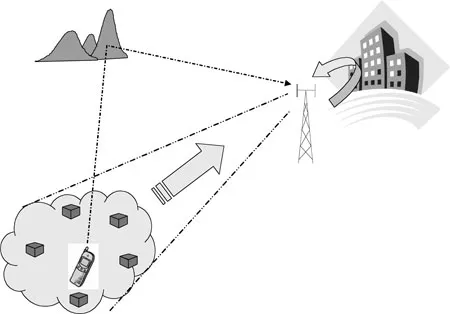
FIGURE 1.1
Scattering sources for radiowave propagation modeling.
Scattering sources for radiowave propagation modeling.
From Figure 1.1 we can see that each signal from the kth user experiences a different multipath environment, described by the amplitude (αi,k), phase (Ψi,k), time delay (τi,k), Doppler shift, and Angle-of-Arrival (AoA) components (time varying). A convenient way to characterize the radio channel is through its channel impulse response, which when modified to consider the AoA of the multipath components for an antenna array, produces the vector channel impulse response:
where a(φi,k,, θi,k) is the complex array respo...
Table of contents
- Cover
- Half Title
- Title Page
- Copyright Page
- Table of Contents
- 1 Spatio-Temporal Propagation Modeling
- 2 Theory and Practice of MIMO Wireless Communication Systems
- 3 Information Theory and Electromagnetism: Are They Related?
- 4 Introduction to Space–Time Coding
- 5 Feedback Techniques for MIMO Channels
- 6 Antenna Selection in MIMO Systems
- 7 Performance of Multi-User Spatial Multiplexing with Measured Channel Data
- 8 Multiuser MIMO for UTRA FDD
- 9 Multifunctional Reconfigurable Microelectromechanical Systems Integrated Antennas for Multiple Input Multiple Output Systems
- 10 Multi-Antenna Testbeds for Wireless Communications
- 11 Gigabit Mobile Communications Using Real-Time MIMO-OFDM Signal Processing
- 12 Network Planning and Deployment Issues for MIMO Systems
- Index
Frequently asked questions
Yes, you can cancel anytime from the Subscription tab in your account settings on the Perlego website. Your subscription will stay active until the end of your current billing period. Learn how to cancel your subscription
No, books cannot be downloaded as external files, such as PDFs, for use outside of Perlego. However, you can download books within the Perlego app for offline reading on mobile or tablet. Learn how to download books offline
Perlego offers two plans: Essential and Complete
- Essential is ideal for learners and professionals who enjoy exploring a wide range of subjects. Access the Essential Library with 800,000+ trusted titles and best-sellers across business, personal growth, and the humanities. Includes unlimited reading time and Standard Read Aloud voice.
- Complete: Perfect for advanced learners and researchers needing full, unrestricted access. Unlock 1.5M+ books across hundreds of subjects, including academic and specialized titles. The Complete Plan also includes advanced features like Premium Read Aloud and Research Assistant.
We are an online textbook subscription service, where you can get access to an entire online library for less than the price of a single book per month. With over 1.5 million books across 990+ topics, we’ve got you covered! Learn about our mission
Look out for the read-aloud symbol on your next book to see if you can listen to it. The read-aloud tool reads text aloud for you, highlighting the text as it is being read. You can pause it, speed it up and slow it down. Learn more about Read Aloud
Yes! You can use the Perlego app on both iOS and Android devices to read anytime, anywhere — even offline. Perfect for commutes or when you’re on the go.
Please note we cannot support devices running on iOS 13 and Android 7 or earlier. Learn more about using the app
Please note we cannot support devices running on iOS 13 and Android 7 or earlier. Learn more about using the app
Yes, you can access MIMO System Technology for Wireless Communications by George Tsoulos in PDF and/or ePUB format, as well as other popular books in Technology & Engineering & Electrical Engineering & Telecommunications. We have over 1.5 million books available in our catalogue for you to explore.