Promoting Cultural Sensitivity in Supervision: A Manual for Practitioners provides a roadmap for practicing and experienced supervisors to promote and integrate cultural sensitivity into the core of their work. This book is organized into four seamless, interrelated sections that are essential to developing a Multicultural Relational Perspective (MRP) in supervision: conceptual, structural, strategies and techniques, and evaluation tools. The Conceptual section provides an overview of the theory that underpins a MRP, and the Structural section provides the reader with two specific strategies for concretizing the conceptual framework. The Strategies and Techniques section includes a variety of chapters which provide supervisors and supervisees with hands-on tools for navigating difficult diversity-related conversations in supervision and beyond, as well as an array of exercises that supervisors can employ to enhance cultural sensitivity. The Evaluation Tools section provides sample instruments that can be implemented to evaluate the objectives of the entire supervisory process. For the convenience of readers, additional photocopiable supervisory resources have also been included at the end of the manual. This manual is intended for supervisors, trainers, clinicians, and trainees.
eBook - ePub
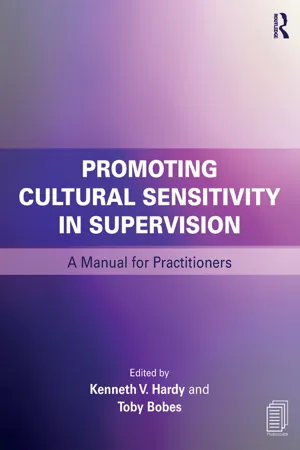
Promoting Cultural Sensitivity in Supervision
A Manual for Practitioners
- 168 pages
- English
- ePUB (mobile friendly)
- Available on iOS & Android
eBook - ePub
Promoting Cultural Sensitivity in Supervision
A Manual for Practitioners
About this book
Information
Part I
CONCEPTUAL CONSIDERATIONS
1
Core Supervisor Competencies
Supervisors have the power and privilege and therefore the responsibility to deliberately initiate conversations about cultural diversity. Supervision should be “a deliberate educational process” with teaching and learning strategies that are proactive, purposeful, and intentional (Borders, 2001, pp. 417–418). The core competencies listed below, and throughout this chapter, are based upon these premises.
A more comprehensive coverage of these core competencies may be found in Culturally Sensitive Supervision and Training: Diverse Perspectives and Practical Applications (Hardy & Bobes, 2016).
1. Be a “broker of permission” to give voice to previously silenced topics.
2. Introduce dimensions of diversity in the initial supervision or class to set the tone to explicitly acknowledge and validate the lived experiences of group members of diverse backgrounds.
3. Explicitly name and address the impact of power relations and privilege upon relationships.
4. Engage in critical self-reflection and self-interrogation.
5. Expand on knowledge of self and deepen understanding of “Self in Relationship to Other.”
6. Be alert to discomforts and emotional responses when diversity/multicultural issues arise.
7. Effectively manage culturally-based hot buttons or emotional triggers.
8. Promote awareness of and sensitivity to the anatomy of socio-cultural oppression.
9. Highlight, deconstruct, and make visible the invisible trauma wounds of socio-cultural oppression.
10. Embrace “Both-And Thinking.”
11. Utilize the “Validate, Challenge, and Request Approach,” a requisite skill for engaging in difficult dialogues.
12. Recognize that all relationships are cross-cultural.
13. Demonstrate the ability to hold meaningful and progressive conversations about culture and context.
14. Distinguish between awareness and sensitivity.
15. Be curious and sensitive about how language informs the supervisee’s experiences.
16. Embrace a stance of compassion, humility, and curiosity.
17. Focus upon the multiple levels of interaction and interconnection at various systems levels.
18. Create culturally informed questions.
19. Embrace cultural diversity and social justice.
20. Differentiate between cultural diversity and social justice.
We believe the core competencies contribute significantly to the promotion of culturally sensitive and culturally competent supervision and training. Hardy and Laszloffy (1995) write:
Training programs devoted to preparing culturally competent therapists must recognize and attend to the distinction between awareness and sensitivity. Awareness is primarily a cognitive function; an individual becomes conscious of a thought or action and processes it intellectually. Sensitivity, on the other hand, is primarily an affective function; an individual responds emotionally to stimuli with delicacy and respectfulness. Although these functions appear unique and separate, each is shaded with nuances of the other. Essentially, awareness involves a conscious sensitivity, and sensitivity involves a delicate awareness.
The unifying themes of these core competencies are thinking relationally, contextually, and culturally.
MULTILAYERED REALITIES IN SUPERVISION
Thinking Relationally—Thinking Contextually/Culturally
Viewing the multilayered realities in supervision enhances our abilities to develop a larger conceptual framework for conducting supervision and to operationalize the core supervisor competencies. Developing a cognitive map or framework is an important “conceptual leap” so that supervisors are aware of what they are doing and why they are doing it (Borders, 1992).
The Multicultural Relational Perspective (MRP) is a worldview that provides an in-depth and comprehensive framework for clinical supervision. The MRP is a philosophical stance that is the conceptual foundation for this Manual. This approach is predicated on the premise that therapy and supervision are parallel processes and are organized around the following beliefs and values:
•The centrality of relationships and the notion that human suffering is located within relationships.
•That cultural factors are salient contextual variables in our lives and must be attended to with humility, sensitivity, and competence.
•That our understanding of socio-cultural trauma and the hidden wounds associated with it are essential to clinical effectiveness.
•That an acute exploration of the self of the therapist and self of the supervisor issues are critical to the provision of effective therapy and supervision.
•That clinicians explore and understand the role their biases (unconscious and otherwise) may have on therapy and supervision.
DEVELOPING SUPERVISION—A QUANTUM LEAP
Supervisors take a quantum leap in their development as they transition from being a therapist to being a supervisor. This shift requires a significant leap in thinking, skills, and professional identity (Steiny, 2010). Developing SuperVision requires extraordinary vision, the ability to look beyond what is spoken, make the invisible visible, and cast a wide net to continually search for all relevant contexts and meanings. In a sense, supervisors are visionaries, “people who look beyond the day-to-day routine” (Roberts, 2002, p. 335).
Developing SuperVision means to broaden our focus so that we are “thinking relationally,” “thinking systemically,” and “thinking contextually.” We believe that an effective framework for conducting clinical supervision is one that is based on a more contextual understanding of ourselves, our supervisees, our society, our history, and our clients’ lives (McGoldrick & Hardy, 2008). We need to keep context in view so that we work from a truly inclusive orientation. Viewing therapy and supervision from inclusive cultural perspectives offers “a sense of hope and belonging” (2008, p. xi) and a voice for all participants.
A CONCEPTUAL FRAMEWORK FOR SUPERVISION
Thinking Relationally
“Thinking Relationally” is an umbrella concept predicated on the belief in the centrality of relationships and the notion that human suffering is located within relationships. Supervision interventions should be relationally based and reflect the supervisor’s attunement to and emotional resonance with the needs and feelings of supervisees and clients, especially when working with those whose cultural backgrounds are different from their own.
Learning to Think Relationally is key to the development of an MRP. Supervisors can help promote and foster relational thinking by encouraging supervisees to continuously explore the connectedness and interactions between all matter, especially those that are often considered disparate. While the range of possibilities and potential foci for exploration are virtually infinite, we have identified 10 core domains of interest we routinely highlight in supervision. The domains of interest we emphasize to promote “Both/And” or relational thinking are as follows:
1. Affect and Cognition—Too often our work highlights one of these entities to the exclusion of the other. With regard to affect and cognition, the supervisee is consistently encouraged to consider how each affects and is affected by the other. When one is elevated or scrutinized to the virtual exclusion of the other, the supervisee is encouraged to consider both the other as well as whatever underlying meaning, if any, that might be attached to why it has been excluded or marginalized. In adherence with the MRP, the supervisee is also encouraged to consider the role that both affect and cognition play at every level of the therapeutic-supervisory relationship.
2. Past and Present—The dichotomy between “past” and “present” is replete throughout the field. The dichotomy has informed theoretical approaches which either promote the saliency of “history” (the past) or the wisdom of looking forward and focusing on the “here and now” (the present). The MRP asserts that it is virtually impossible to disentangle the past and present, thus its focus is on the intersection of the two. The significance and implications of “the future” are also examined within this context as well.
3. Health and Pathology—The MRP stresses the importance of supervisors reminding supervisees of the potential interlocking dimensions of health and pathology. Thus it is important to help supervisees think critically and relationally about the ways in which there can be strands of health contained in pathology and vice versa.
4. Ecology, Psychology, and Biology—The use of each of these terms in this context is metaphorical. Ecology is used to refer to the socio-cultural context in which one is embedded. In other words, one’s environment in the broadest sense of the word. Psychology, on the other hand, is used to refer to one’s mind, i.e., one’s mental, spiritual and/or psychological state. And finally, Biology refers to the (physical) body. In everyday life these three spheres of living are inextricably meshed. Being mindful of the interrelationship of these concepts in supervision is essential to the development of relational thinking and the MRP.
5. Functional and Dysfunctional—”Functional” and “dysfunctional” are often considered in rigidly segregated ways that frequently obscure the intricate intertwinement that can exist between the two concepts. The MRP recognizes that it is highly possible to have functionality embedded within a web of dysfunction, as well as dysfunction contained in functionality.
6. Problems and Solutions—Supervisors are encouraged to invite supervisees to think about “problems” and “solutions” within the scope of their clinical work rather than o...
Table of contents
- Cover
- Half Title
- Title Page
- Copyright Page
- Table of Contents
- List of Figures
- Preface
- Acknowledgments
- Part I: Conceptual Considerations
- Part II: Structural Considerations
- Part III: Strategies and Techniques
- Part IV: Evaluation Tools
- Handouts and Resources
- Index
Trusted by 375,005 students
Access to over 1.5 million titles for a fair monthly price.
Study more efficiently using our study tools.
Frequently asked questions
Yes, you can cancel anytime from the Subscription tab in your account settings on the Perlego website. Your subscription will stay active until the end of your current billing period. Learn how to cancel your subscription
No, books cannot be downloaded as external files, such as PDFs, for use outside of Perlego. However, you can download books within the Perlego app for offline reading on mobile or tablet. Learn how to download books offline
Perlego offers two plans: Essential and Complete
- Essential is ideal for learners and professionals who enjoy exploring a wide range of subjects. Access the Essential Library with 800,000+ trusted titles and best-sellers across business, personal growth, and the humanities. Includes unlimited reading time and Standard Read Aloud voice.
- Complete: Perfect for advanced learners and researchers needing full, unrestricted access. Unlock 1.5M+ books across hundreds of subjects, including academic and specialized titles. The Complete Plan also includes advanced features like Premium Read Aloud and Research Assistant.
We are an online textbook subscription service, where you can get access to an entire online library for less than the price of a single book per month. With over 1.5 million books across 990+ topics, we’ve got you covered! Learn about our mission
Look out for the read-aloud symbol on your next book to see if you can listen to it. The read-aloud tool reads text aloud for you, highlighting the text as it is being read. You can pause it, speed it up and slow it down. Learn more about Read Aloud
Yes! You can use the Perlego app on both iOS and Android devices to read anytime, anywhere — even offline. Perfect for commutes or when you’re on the go.
Please note we cannot support devices running on iOS 13 and Android 7 or earlier. Learn more about using the app
Please note we cannot support devices running on iOS 13 and Android 7 or earlier. Learn more about using the app
Yes, you can access Promoting Cultural Sensitivity in Supervision by Kenneth V. Hardy, Toby Bobes, Kenneth V. Hardy,Toby Bobes in PDF and/or ePUB format, as well as other popular books in Psychology & Education in Psychology. We have over 1.5 million books available in our catalogue for you to explore.