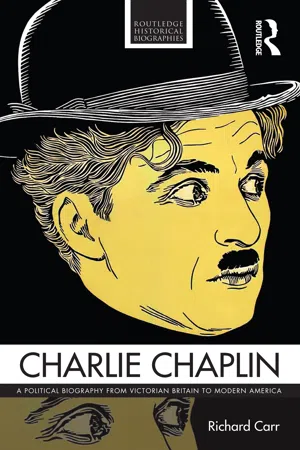
Richard Carr's Charlie Chaplin places politics at the centre of the filmmaker's life as it looks beyond Chaplin's role as a comedic figure to his constant political engagement both on and off the screen.
Drawing from a wealth of archival sources from across the globe, Carr provides an in-depth examination of Chaplin's life as he made his way from Lambeth to Los Angeles. From his experiences in the workhouse to his controversial romantic relationships and his connections with some of the leading political figures of his day, this book sheds new light on Chaplin's private life and introduces him as a key social commentator of the time.
Whether interested in Hollywood and Hitler or communism and celebrity, Charlie Chaplin is essential reading for all students of twentieth-century history.
Trusted by 375,005 students
Access to over 1.5 million titles for a fair monthly price.
In the mid-1930s a globally known figure began to pen an account for the American magazine, Collier’s Weekly. This author was a regular contributor to the serial, writing on issues including press freedom and the future of publicity. Yet on this occasion our narrator turned his hand to the undeniably traumatic events of 9 May 1901:
In a room in St Thomas’s Hospital, London, a man lay dying. He had had a good life – a full life. He had been a favourite of the music halls. He had tasted the triumphs of legitimate stage. He had won a measure of fame as a singer. His home life had been happy. And now Death had come for him. While he was yet in the prime of manhood, with success still sweet in his mouth, the curtain was falling – and forever. The other windows of the hospital were dark. In this one alone a light burned. And below it, outside in the darkness, shivering with cold and numbed with fear, a child stood sobbing … The dying man and the child outside the window both bore the same name – Charles Chaplin.1
Despite the dramatic, almost cinematic tone here, the author of this retrospective was not Charlie Chaplin himself. Nor was it Alistair Cooke, Thomas Burke, Upton Sinclair or any of the other prominent literary and cultural commentators who often reflected on the ‘meaning’ of Chaplin. Instead, this piece of journalism was written by Winston Churchill (see Figure 1.1) – at the time of publication marooned in the political wilderness before his stridently anti-Nazi oratory, and the actions of Hitler himself, brought this maverick hurtling back into favour in the eyes of his fellow countrymen.
Figure 1.1 Numerous global politicians speculated on Chaplin’s background, including, here, Winston Churchill.
Courtesy of the Churchill Archives Centre, Churchill College, UK
Although they were politically dissimilar as we will see, Chaplin and Churchill always got on rather well. Winston visited Charlie on the set of what would become the 1931 film City Lights, while Charlie stayed at Chartwell when back in Britain promoting the same product. Highlighting this connection from the outset is not merely to begin with some interesting trivia. Instead the Chaplin–Churchill friendship suggests three important issues that will run throughout this book. The first is Chaplin’s political malleability. Although broadly of the left, Chaplin was terribly interested in political ideas generally, and rather impressed by aristocratic figures of the right. The Astors – Lady Nancy and Viscount Waldorf (both Conservative MPs) – got on famously with Charlie, and were indicative of a series of relationships where Charlie provided the frisson of fame and glamour, and such well-to-do couples the political table talk. Certainly, politicians of whatever tribe were keen to glad hand this modern icon. For example, presaging the modern obsession with the ‘selfie’, Waldorf recorded in his 1926 diary that during a trip to Hollywood he was ‘photoed with [Charlie] of course’.2 Perhaps this was no big deal. But what was more intri guing – for a man of the left – was that during his 1931 promotional tour of the UK Charlie missed several engagements, including visiting the children then studying at his old school because, as the left-leaning Daily Herald newspaper sardonically noted, he was ‘detained at the Astors’.3 In February or March 1931 you were far more likely to find Chaplin at the Prime Ministerial residence of Chequers, or dining at the House of Commons, than in a leftist discussion group, or dolling out the produce to real-life Little Tramps in a soup kitchen. Throughout the book, as we will see, Charlie’s politics could be slippery. His deeds did not always match his words.
The second issue that the Churchill article suggests was the regularity in which politics intersected with Charlie’s life, particularly from those wishing to project a particular ‘meaning’ onto his childhood. This occurred for good and ill. When, in 1933, Chaplin was reported as saying he would make his next picture without his famous moustache for fear of invoking comparisons with Hitler (a stance that would clearly be reversed by The Great Dictator in 1940), the Nazi press in Berlin responded that ‘the creator and leader of the new Germany stands much too high to even hear the barking of a dog from London’s ghetto’.4 Chaplin’s origins were both mythologised by the man himself and by those desiring to talk him up or down. But his entire life – involving as it did such extraordinary highs and lows – was innately political, experiencing capitalism at both ends of the income scale from being reliant on the charity of Victorian Londoners to becoming one of the wealthiest men in America. As such, it is impossible to do Chaplin’s life justice by reference to the film studio or the antics in his bedroom alone. The man lived a very political experience.
The third theme, by no means a point limited to Churchill’s slightly overly dramatic prose, was just how ambiguous and shrouded in mystery Chaplin’s life actually was. The later sex scandals, flirtations with communism and manic personality we will get to, but public understanding of his origins – given how important they were to the man who would become the world’s most famous filmmaker – was perhaps the haziest of a rather hazy lot. We may not expect a cheque-chasing piece of journalism from a cash-strapped Winston Churchill to be strictly accurate in all the dotting of the i’s and crossing of the t’s, but the fact that his excerpt described Chaplin’s father’s ‘home life’ as ‘happy’, and that Churchill would go on to state that ‘his death brought a safe, comfortable world crashing about Charlie’ was certainly stretching credulity, as this chapter will set out.
Yet, if misleading, Churchill’s intentions were at least benign enough – something that could not always be said for those who speculated on Chaplin’s past. Nazi references to Chaplin’s ‘ghetto’ background were just the tip of the iceberg. Guesses as to Charlie’s allegedly ‘real’ name competed with one another to be the most stereotypically Jewish, while speculation on the location of his birth was an equally enjoyable parlour game for many in the press. One 1935 article claimed that Charlie was the son of a Chaim Kaplan, a tailor from Whitechapel in London’s East End – then known for its significant Jewish population.5 On the back of such tall tales both the FBI and British Special Branch would later investigate allegations that he had been born Israel Thornstein, with either a German or Franco-Jewish background. Another press account (from which both intelligence agencies seemed to have gathered much of their interest in Chaplin) accurately asserted that ‘accounts of his birth are as vague as those concerned with the nativity of divinities’, yet went on to report the second-hand gossip that ‘Charlie’s father was a French pantomimic clown, his mother an English Jewess’.6 In Canada The Toronto Standard even carried a completely fabricated quote from Charlie that upon returning to London at the height of his fame, ‘I set out immediately to find the house in which I was born, and when I reached the ghetto I saw the frightful loneliness and need of my brother Jews’.7 This was wrong on many levels. With The Great Dictator in pre-production in the late 1930s this would reach something of a crescendo when pro-Nazi elements in the American press published a list of ‘Big Money Jewish Names’ that labelled Chaplin as a Jew originally named Tonstein.8 The story did not go away.
All this was simply made up. His father Charles Senior’s roots lay in Protestant Suffolk, England and, although stories of a maternal gypsy connection lingered, Charlie’s mother Hannah could trace her family tree through South London. Yet, interestingly, the notion of a more ‘exotic’ heritage was a lie occasionally peddled by Charlie himself in early interviews. There are a variety of possible explanations of this – Charlie may have done so either to embellish or deflect from the very real and tragic nature of his childhood. His half-brother Sydney also had a Jewish father, and there was no doubt an element of solidarity with someone he cared deeply about. Charlie may just have been bored at the relentless grind of publicity. But it was also a legend able to gain some currency because, as one Special Branch letter put it, ‘although his claim to have been born in London on 16th April 1889 has been accepted by the Passport Office since at least 1920 … we cannot find particulars of his birth at [record keeping facility] Somerset House’.9 Whoever Special Branch’s ‘source[,] which is usually considered fairly reliable’, actually was, it subsequently transpired that there was not a shred of evidence to back up his claim that Chaplin had been born in Fontainebleau or Melun in France either.10 Perhaps this informant had just read the papers and passed on the gossip to the authorities.
For all its mystery, this was far from an unusual state of affairs, however. When his son entered the world Charles Senior had been on stage in Hull in the north of England and thus missed Charlie’s birth. As David Robinson notes, it was easy for ‘music hall artists, constantly moving from one town to another’ to ‘put off and eventually forget’ formalities such as registering births.11 In May 1889 an edition of the music periodical The Magnet recorded that ‘on the 15th ultimo, the wife of Mr. Charles Chaplin, [was delivered] of a beautiful boy’. This may (or may not) have been a day out, but it certainly stands as at least as powerful an argument for Chaplin’s British birth as anything waged against this.12 Charlie himself later placed his birth as taking place at eight o’clock on 16 April 1889 East Lane, Walworth, South London.13 In a neat coincidence, his future nemesis Adolf Hitler entered the world in Brannau-am-Inn, Austria only four days later.
The descent
Before we get to the difficulties of Chaplin’s childhood, a further contextual point needs to be added. As his son entered the world in 1889, the twenty-six-year-old Charles Senior was undoubtedly a professional success. Kenneth Lynn records that, after the start of his career in 1887, his ‘pleasing baritone voice and sophisticated manner soon brought him top billings … He became sought after as well by music publishers, who realized that having his name and photograph on their sheet strengthened sales.’14 Having progressed artistically from mimic to storytelling singer (often about staple topics such as mothers-in-law or nagging wives), between 1890 and 1896 several of Charles Snr’s recordings were released to commercial success. Like his son, this would provide a platform to work in America, and in August 1890 Charles Snr appeared at Union Theatre, New York for several weeks. At least initially, his father’s career was something of a triumph.
Certainly the music hall in which mother, father and Charlie himself would make their names held a special place in Victorian life. In the 1880s there were about 500 music halls in London, and by the 1890s it was estimated that the biggest 35 were catering to a combined audience of more than 45,000 people an evening. This was not welcomed by all it must be said. As Gareth Stedman Jones notes, while middle-class religious communities tried to foster a similar devotion among the worker class, late Victorian England’s ‘dominant cultural institutions were not the school, the evening class, the library, the friendly society, the church or the chapel, but the pub, the sporting paper, the race course and the music hall’.15 The fare provided by the latter sought to highlight ‘the peculiarities of the working-class situation in London’, which could often be precarious. Few music hall performers could therefore progress without at least one of ‘fatalism, political scepticism, the evasion of tragedy or anger, or a stance of comic stoicism’ within their armoury.16 A certain world-weariness, no doubt partially imbued by the free-flowing alcohol around such premises (despite, again, middle-class disproval), was a natural product of anyone raised in such an environment.17 So it would be with Charlie.
The younger Charlie’s geographic hinterland would be South London, and much of this would indeed appear, as in Churchill’s account, rather Dickensian. But it did not start this way. Due to his father’s artistic success Charlie Chaplin began his life in a relatively well-to-do environment. As Charlie recorded in My Autobiography, in his early years ‘our circumstances were moderately comfortable; we lived in three tastefully furnished rooms’.18 The Chaplins could even afford a housemaid at this stage, and the reminiscences of the early 1890s in his autobiography are relatively misty-eyed and nostalgic. As he recorded: ‘London was sedate on those days. The tempo was sedate; even the ho...
Table of contents
Cover
Half Title
Series Page
Title Page
Copyright Page
Contents
List of figures
List of tables
Acknowledgements
Chronology
Introduction: A very political life
1 Chaplin’s England
2 To shoulder arms? Charlie and the First World War
3 Moscow or Manchester? Chaplin’s views on capitalism before the Depression took hold
4 Sex, morality and a tramp in 1920s America
5 Between Churchill and Gandhi: A comedian sees the world
6 Modern Times and the Great Depression
7 The Tramp and the dictators
8 Comrades and controversy
9 A citizen of the world
Conclusion
Select bibliography
Index
Frequently asked questions
Yes, you can cancel anytime from the Subscription tab in your account settings on the Perlego website. Your subscription will stay active until the end of your current billing period. Learn how to cancel your subscription
No, books cannot be downloaded as external files, such as PDFs, for use outside of Perlego. However, you can download books within the Perlego app for offline reading on mobile or tablet. Learn how to download books offline
Perlego offers two plans: Essential and Complete
Essential is ideal for learners and professionals who enjoy exploring a wide range of subjects. Access the Essential Library with 800,000+ trusted titles and best-sellers across business, personal growth, and the humanities. Includes unlimited reading time and Standard Read Aloud voice.
Complete: Perfect for advanced learners and researchers needing full, unrestricted access. Unlock 1.5M+ books across hundreds of subjects, including academic and specialized titles. The Complete Plan also includes advanced features like Premium Read Aloud and Research Assistant.
Both plans are available with monthly, semester, or annual billing cycles.
We are an online textbook subscription service, where you can get access to an entire online library for less than the price of a single book per month. With over 1.5 million books across 990+ topics, we’ve got you covered! Learn about our mission
Look out for the read-aloud symbol on your next book to see if you can listen to it. The read-aloud tool reads text aloud for you, highlighting the text as it is being read. You can pause it, speed it up and slow it down. Learn more about Read Aloud
Yes! You can use the Perlego app on both iOS and Android devices to read anytime, anywhere — even offline. Perfect for commutes or when you’re on the go. Please note we cannot support devices running on iOS 13 and Android 7 or earlier. Learn more about using the app
Yes, you can access Charlie Chaplin by Richard Carr in PDF and/or ePUB format, as well as other popular books in Politics & International Relations & 19th Century History. We have over 1.5 million books available in our catalogue for you to explore.