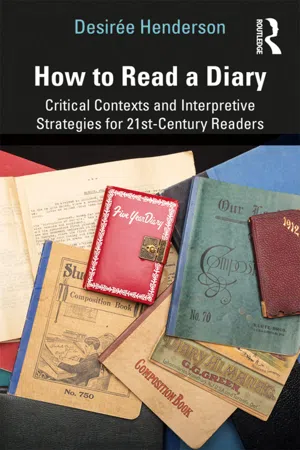
How to Read a Diary is an expansive and accessible guidebook that introduces readers to the past, present, and future of diary writing. Grounded in examples from around the globe and from across history, this book explores the provocative questions diaries pose to readers: Are they private? Are they truthful? Why do some diarists employ codes? Do more women than men write diaries? How has the format changed in the digital age? In answering questions like these, How to Read a Diary offers a new critical vocabulary for interpreting diaries. Readers learn how to analyze diary manuscripts, identify the conventions of diary writing, examine the impact of technology on the genre, and appreciate the myriad personal and political motives that drive diary writing. Henderson also presents the diary's extensive influence upon literary history, ranging from masterpieces of world literature to young adult novels, graphic novels, and comics. How to Read a Diary invites readers to discover the rich and compelling stories that individuals tell about themselves within the pages of their diaries.
eBook - ePub
How to Read a Diary
Critical Contexts and Interpretive Strategies for 21st-Century Readers
- 196 pages
- English
- ePUB (mobile friendly)
- Available on iOS & Android
eBook - ePub
How to Read a Diary
Critical Contexts and Interpretive Strategies for 21st-Century Readers
About this book
Information
1Introducing the Diary
The most commonly held beliefs about diaries are:
Diaries are private.
Diaries are truthful.
Diaries are feminine.
Diaries are unliterary.
Diaries are narcissistic.
Diaries are obsolete.
Some have described these ideas as myths, and like most myths, they contain enough truth to appear authoritative while greatly understating the complex reality. The pervasiveness of these ideas has led many to dismiss diaries as unworthy of sustained attention or analysis. By contrast, this book prepares readers to critically examine diaries in order to discover how multifaceted they are when not reduced to clichés. In fact, this book argues that what may seem self-evident about diaries turns out to be far more complicated and much more interesting. Reconsidering these characterizations of the diary also necessitates a reconsideration of the genre’s prominent descriptors: What is privacy, and why do we expect private writing to be honest and trustworthy? Can autobiographical writing be evaluated for truthfulness when it is filtered through the lens of individual perception or memory? Why are some genres feminized and what are the consequences of this characterization? What kinds of writing get counted as literary, and why? Is self-reflection inherently narcissistic or could it be empowering or healing? Do certain kinds of writing cease to have relevance, particularly when new media become popular? While the primary task of this book is to prepare readers to interpret diaries, answering these questions will allow us to explore many important cultural, historical, and literary issues that have implications far beyond the genre of the diary.
This chapter sets the stage for the project of reading diaries by addressing three foundational topics: the challenge of defining the diary, the origins and history of the genre, and why reading a diary is different from reading other kinds of literature. Although we will move into more complex issues in subsequent chapters, defining key terms and presenting an overview of diary history are important first steps in developing readers’ understanding of the genre. I wrap up this chapter by suggesting that, in addition to being intellectually rigorous in our interpretation of diaries, we also benefit from being emotionally engaged and open to the possibility of falling in love with the diary.
Why “Diary”?
In this book, I use the term diary instead of the other well-known and related term journal. Some people view these terms as interchangeable. Others find it useful to distinguish between them, but there is no consensus among scholars, the general public, or diarists themselves regarding what the two terms mean. For instance, some think of diary as referring to more emotionally expressive writing and journal as referring to fact-based records of daily life, but others believe the exact reverse is true. Given the instability of these terms, I do not find it useful to differentiate them. Instead, in this book I employ diary to refer to the genre as a whole for two reasons. The first is practical: The word journal has so many different meanings (referring to periodicals and newspapers, for instance) that it is not particularly useful as a search term. It would benefit readers and the field of diary studies more generally if in the future diary were employed as a default label, keyword, and subject heading, making it easier to locate and consolidate information and resources. The second reason is conceptual: In using diary, I seek to make an intervention, recovering the word and the genre it describes from its status as a feminized, minimized, and even shameful form of writing. The popular children’s book Diary of a Wimpy Kid opens with the narrator stating, “let me get something straight: This is a JOURNAL, not a diary,” and the corresponding illustration imagines him being punched and called a “sissy” for writing a diary (Kinney 1; see Figure 1.1). The text makes clear that the pejorative perception of the word diary is linked to misogynist and homophobic attitudes that deserve to be dismantled. I hope to contribute to a reconsideration of these views by exploring how the diary became feminized, why this is considered to be a negative characterization, and how diaries can teach us to rethink entrenched ideas about identity and self-representation. I use diary throughout this book in order to destigmatize and normalize the word, affirming its usefulness as a genre designation.

Figure 1.1Diary of a Wimpy Kid by Jeff Kinney. Copyright © 2007 Wimpy Kid, Inc. Used by permission from Amulet Books, an imprint of Harry N. Abrams, Inc. New York. All rights reserved
What Is a Diary?
Dictionaries and handbooks of literary terms offer numerous formal definitions of the diary, but let’s start with what diarists say within the pages of their diaries.
A journal is a record of experiences and growth, not a preserve of things well done or said. I am occasionally reminded of a statement which I have made in conversation and immediately forgotten, which would read much better than what I put in my journal. It is a ripe, dry fruit of long-past experience which falls from me easily, without giving pain or pleasure. The charm of the journal must consist in a certain greenness, though fresh, and not in maturity. Here I cannot afford to be remembering what I said or did, my scurf cast off, but what I am and aspire to become. (January 24, 1856)Henry David Thoreau (American, 1817–1862)
What sort of diary should I like mine to be? Something loose-knit and yet not slovenly, so elastic that it will embrace anything, solemn, slight or beautiful, that comes into my mind. I should like it to resemble some deep old desk or capacious hold-all, in which one flings a mass of odds and ends without looking them through. I should like to come back, after a year or two, and find that the collection had sorted itself and refined itself and coalesced, as such deposits so mysteriously do, into a mould, transparent enough to reflect the light of our life, and yet steady, tranquil compounds with the aloofness of a work of art. (April 20, 1919)Virginia Woolf (British, 1882–1941)
Must I keep filling my small diary with pages of blood? But, Thuy! Let’s record, record completely all the blood and bones, sweat and tears that our compatriots have shed for the last twenty years. And in the last days of this fatal struggle, each sacrifice is even more worthy of accounting, of remembering. Why? Because we have fought and sacrificed for many years; hope has shone like a bright light burning at the end of the road …. (August 4, 1968)Dang Thuy Tram (Vietnamese, 1942–1970)
When the weather was bad, we left the countryside and went in to the nearest bar. There the men started to drink and play cards while waiting for the rain to stop. I would take a napkin and I would write whatever came to mind. The rain stopped and I realized that I was writing a diary. No one can choose what will happen to them in a day, but they can tell it. The diaries of this type are the most diverting way of rewriting that abominable crime that life is. Of recovering it in a selective way. Of turning little things into happenings that are worth thinking about. Before I had not had the opportunity to think about that gray snot that trickles down from my nose when I wash after work. (117)Rachid Nini (Moroccan, 1970–)*
Is a diary an unripe fruit, a roomy piece of luggage, a bloodstained record, or a soiled napkin? These colorful descriptions convey how diverse diaries are in terms of their form and content, and in terms of the different motivations that drive diarists to write. The idiosyncratic nature of diary writing is one of the things that draws people to the form. The diary accommodates a wide range of writing styles, authorial personas, and individual, social, and political goals. In fact, although some diaries are emblazoned with the word “diary” upon their covers, making identification easy, many are hybrid, multigeneric, multimedia, unstructured, cryptic, and unpredictable texts that may look more like almanacs, account books, commonplace books, photograph albums, sketchbooks, or social media accounts than diaries.
Many scholars have remarked upon the impossibility of articulating a single, reliable definition of the diary genre that can account for such variety. As K. Eckhard Kuhn-Osius states, “It is very difficult to say anything about diaries that is true for all of them” (166). Rather than attempt to create a limiting definition, Robert Fothergill proposes a flexible standard: “let it be agreed that a diary is what a person writes when [they say], ‘I am writing my diary’” (3). This approach aligns with two popular theories of genre within literary studies: First, that genres are primarily meant to be functional for human communication or self-expression. Carolyn Miller influentially defines genre as a “social action,” writing that “a rhetorically sound definition of genre must be centered not on the substance or the form of discourse but on the action it is used to accomplish” (151). In other words, genres should be defined primarily by the uses to which they are put. Second, that genres are hybrid compositions of other recognizable forms, remixed or repurposed for new goals, and therefore can encompass very diverse texts. Peter Medway coined the term “fuzzy genres” to account for the fact that it is possible for texts that look very different from each other to belong to the same genre (141). The diary is without a doubt both an action meant to accomplish something for diarists and a fuzzy genre that borrows from many different, preexisting forms. Yet the lack of clear parameters when defining the diary also presents some challenges.
On a practical level, the difficulty of defining the diary and therefore identifying texts as diaries presents a research challenge. The ways in which texts are categorized or labeled has consequences for students, researchers, and general readers alike, especially in an era that depends upon keyword searching. If you conduct a search that employs the word “diary,” the results will be determined by different interpretations of the search term and by algorithms that use rather than interrogate the myths associated with the genre. At the same time, the difficulty of answering the basic question, “What is this text?,” can morph into another, more ideological question: “Is this text important?” The latter is an evaluative question regarding the significance or merit of the text and one that has implications for both archival preservation and the writing of literary history. A text that is not easily classifiable may also be one that is not easily appreciated and it may, as a result, be discarded, destroyed, or ignored, producing gaps in the archive or in the historical record. The question of whether or not a diary is a “good” diary and therefore worthy of preservation within an archive, inclusion in educational curriculum, a place in the canon of literature, or importance in popular discourse cannot be answered without taking into account the influence of entrenched literary hierarchies that often do not make room for hybrid texts that disrupt expectations. I return to these issues in more depth in Chapter 2.
Given these challenges, a caution is called for. Throughout this book I make overarching statements about the diary, seeking to speak comprehensively about the genre as a whole, but it is necessary to remember that every diary emerges out of a specific nexus of individual experience, historical and cultural context, and literary tradition. Diaries are so multifaceted that every broad claim made about the genre within these pages should be understood to be provisional and will not apply to all diaries. This does not, I hope, diminish the value of attempting to make genre-level claims, but it does mean that they must be understood to be open to question and subject to revision.
Diary Categories
Faced with the difficulty of producing a comprehensive definition of the diary, diaries are often subdivided into smaller descriptive categories. These are sometimes determined by the diarist’s practices or self-imposed labels, but they may also be shaped by external forces. For example, diary manufacturers have historically marketed specialized diaries for different audiences or functions, thereby influencing who wrote or in what form. Thinking of diaries according to categories helps readers identify authors’ motivations, the impact of different diary formats or mediums, the choices diarists make regarding what to include or exclude, and the meaningful patterns that diarists develop and utilize in their writing. Many diaries will fall under more than one category, once again displaying the flexibility of the genre.
Common Diary Categories: blog, bullet journal, confessional diary, courtship diary, devotional diary, diary app, diary of witness, dream diary, gratitude journal, illness diary, letter diary, pocket diary, pregnancy diary, prison diary, multiyear diary, school diary, sex diary, spiritual diary, travel diary, war diary, work diary, vlog.
The following questions are designed to assist readers in developing a critical awareness regarding the defining features of individual diaries.
Diaries characterized by medium or media. What material form does the diary take? What kinds of self-narration does the form encourage? What expectations or restrictions does the material form impose?
Diaries characterized by subject matter. What primary use does the diary serve for its author? How does this intended use influence what the diarist does or does not write about?
Diaries characterized by time, place, or experience. When or where was the diary written? How do external conditions impact the text’s subject matter? In what ways do these conditions determine the beginnings, endings, or duration of the diary?
Diaries characterized by interior or exterior focus. Does the diarist focus primarily upon their inner/subjective world or outer/objective world? How does this orientation influence the subject matter or form?
Diaries characterized by narrative style. What is at stake for authors either utilizing or rejecting a “literary” style of writing that employs conventions such as description, characterization, dialog, metaphor, or plot? To what extent does the diarist employ patterns, repetition, fragmentation, gaps, or abbreviation in their writing? What is the relationship between the diarist’s stylistic choices and the form or content of the diary? How has the diary’s narrative style shaped its reception or status in literary history?
A Very Short History of the Diary
How did diary writing begin? One account of the history of the diary has been generally accepted as the standard and can be found in most books about the genre. However, ...
Table of contents
- Cover
- Half Title
- Title Page
- Copyright Page
- Dedication
- Contents
- Figures
- Preface
- Acknowledgments
- 1 Introducing the Diary
- 2 Reading Diary Manuscripts and Editions
- 3 Reading the Diary as Literature
- 4 Reading Diary Fiction
- 5 Reading Digital Diaries
- 6 Why Diarists Write
- Conclusion: : How to Write a Diary
- Bibliography
- Index
Trusted by 375,005 students
Access to over 1.5 million titles for a fair monthly price.
Study more efficiently using our study tools.
Frequently asked questions
Yes, you can cancel anytime from the Subscription tab in your account settings on the Perlego website. Your subscription will stay active until the end of your current billing period. Learn how to cancel your subscription
No, books cannot be downloaded as external files, such as PDFs, for use outside of Perlego. However, you can download books within the Perlego app for offline reading on mobile or tablet. Learn how to download books offline
Perlego offers two plans: Essential and Complete
- Essential is ideal for learners and professionals who enjoy exploring a wide range of subjects. Access the Essential Library with 800,000+ trusted titles and best-sellers across business, personal growth, and the humanities. Includes unlimited reading time and Standard Read Aloud voice.
- Complete: Perfect for advanced learners and researchers needing full, unrestricted access. Unlock 1.5M+ books across hundreds of subjects, including academic and specialized titles. The Complete Plan also includes advanced features like Premium Read Aloud and Research Assistant.
We are an online textbook subscription service, where you can get access to an entire online library for less than the price of a single book per month. With over 1.5 million books across 990+ topics, we’ve got you covered! Learn about our mission
Look out for the read-aloud symbol on your next book to see if you can listen to it. The read-aloud tool reads text aloud for you, highlighting the text as it is being read. You can pause it, speed it up and slow it down. Learn more about Read Aloud
Yes! You can use the Perlego app on both iOS and Android devices to read anytime, anywhere — even offline. Perfect for commutes or when you’re on the go.
Please note we cannot support devices running on iOS 13 and Android 7 or earlier. Learn more about using the app
Please note we cannot support devices running on iOS 13 and Android 7 or earlier. Learn more about using the app
Yes, you can access How to Read a Diary by Desirée Henderson in PDF and/or ePUB format, as well as other popular books in Literature & Literary Collections. We have over 1.5 million books available in our catalogue for you to explore.