eBook - ePub
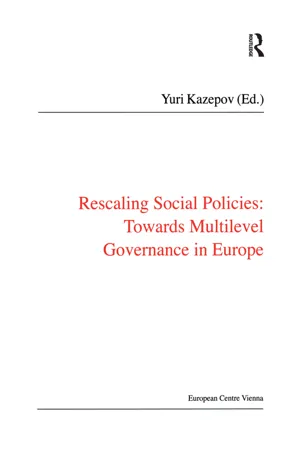
Rescaling Social Policies towards Multilevel Governance in Europe
Social Assistance, Activation and Care for Older People
- 506 pages
- English
- ePUB (mobile friendly)
- Available on iOS & Android
eBook - ePub
Rescaling Social Policies towards Multilevel Governance in Europe
Social Assistance, Activation and Care for Older People
About this book
The workings of multi-level governance -- institutional choices concerning centralisation, decentralisation and subsidiarity -- are widely debated within European public policy, but few systematic studies assessing the effects of changing divisions of power for policy-making have been carried out. This volume offers an assessment of the workings of multi-level governance in terms of social welfare policy across different clusters of European states -- Nordic, Southern European, Central and East European. This book reports on a major comparative study at the European Centre for Social Welfare policy and Research, which included partners from univerisities in Finland, France, Italy, Norway, Sweden, Poland, Spain and Switzerland. It reports on three particular policy areas: social assistance and local policies against poverty; activation and labour market policies; and care for the elderly. The authors describe different starting points, strategies and solutions in European countries which are facing similar challenges and could thus learn from each other. They explore the differences between European welfare regimes in terms of territorial responsibilities, the changes that have taken place over the past few years and their effects. The book is distinctive in highlighting comparative transversal and transnational issues of multi-level governance in social welfare policies, rather than presenting country reports.
Information
PART I:
Towards Multilevel Governance in Selected Policy Areas
The Changing Area of Labour Market Activation Policy
Chapter 2
Activation and Rescaling: Interrelated Questions in Social Policy?
Stefania Sabatinelli1
Introduction
Activation has over the years become a keyword in economic and social policies in all Western countries. According to some authors, this entails a real paradigm shift, not only in political rhetoric, but a new way of thinking: everybody should be active, should activate or be activated (Serrano Pascual, 2007; Jenson, 2006). In particular, those population groups whose activation rates are lower than the average, should be pushed, accompanied and / or forced to increase their participation in the labour market. These groups are most of all women and senior workers (adults in the last years before pension age), on which the Employment Strategy of the European Union focuses in particular (see the Lisbon targets; European Commission, 2000). Yet, the same rhetoric also regards the (eligible or actual) recipients of public support: the disabled, recipients of unemployment and social assistance, and especially the long-term unemployed, young people in search of a first or stable job, and single mothers, even with young children.
In this chapter we focus in particular on the implications of the activation paradigm in social assistance and labour market policies. The aim is to highlight some of the main driving forces that, with different timing and to different extents, triggered two parallel processes: the emerging of activation and the rescaling process. Such driving forces partly stemmed from ongoing macro-changes that concerned all Western countries, but were filtered by national and local specific features of each institutional and socio-economic context. This requires simultaneously investigating similarities and differences, convergence and diversification trends. The chapter by Barberis and Baumann compares labour market policies, providing contextual data and considering their implications for users, while the chapter by Vappu Karjalainen focuses on governance patterns and practices, and on the role of different actors taking part in the activation programmes, both on the vertical and horizontal dimensions. Conversely, this chapter tackles the processes at the basis of activation development, the different meanings of the concept, and the narratives developed to accompany its diffusion. However, it also addresses the links with the parallel ongoing rescaling process, and the implications for social policy contents.
1 Driving forces for the development of activation in labour market and social policies
If activation indicates the introduction of systematic links between social protection and labour market participation (Barbier, 2006), some degree of activation could be found since the first examples of social policies, e.g. workhouses (Polanyi, 1944); however its forms and meanings have deeply changed over time and space.
Economic crisis and recession periods have historically been pathbreaking moments bringing social and labour market policies into public debate, followed by varying degrees of reform implementation in practice. In this sense, the introduction and the strengthening of activation polices can be linked to particular crisis periods, when the rise of social expenditure led to a tightening of resources. As a matter of fact, Western countries' welfare systems were consolidated during the decades after World War II, in a context of full employment, considerable rates of economic growth, a strongly legitimated state with clear hierarchical power, implementing Keynesian demand-side political economy measures, and stable social reproduction mechanisms. Also included was a steady division of labour according to gender. As the literature has largely highlighted, since the economic crises of the 1970s, starting with the oil shocks, and throughout the deindustrialisation process, this picture has deeply changed (O'Connor, 1973; Offe, 1984; Pierson, 1990; Esping-Andersen, 2002; Brenner, 2004). In particular, the sharp and structural increase in unemployment rates and length led to serious concerns about the increase in public expenditure, and to debates about the ways to maintain it under control. In a parallel fashion, a shift was observed towards increased social assistance recipients, as long as more and more unemployed expired entitlement requirements to contributory employment benefits before getting another job. This was partly as a consequence of restrictive reforms of these nationally-managed contributory measures. The reforms in social policies approved in this period generally entailed rhetoric about financial retrenchment, even if the result of lower generosity is controversial (Pierson, 1994 and 1996). For some authors, this implied a major paradigm shift, from the socialisation of risks and collective coverage to individual responsibility and protection, leading to a "reshaping" of the welfare state (Serrano Pascual and Magnusson, 2007). Ongoing macro-economic transformations were mainly taken as given and not questioned, and policies were consequently reformed.
The huge parallel growth in female labour market participation has been the key element of a number of major transformations, especially in terms of new social needs, i.e. particularly those related to the requirements of work-life balance (Esping-Andersen, 2007). Such transformations also called for changes in the gender division of labour; still, contextual changes in labour market patterns, welfare system arrangements and men's behaviour in general have not been observed to point to real systematic change, but rather to minor adjustments.2 As a consequence, increasing tensions are observed within family relationships (between individuals, the sexes and generations) as well as at the societal level (Hochschild, 2003). The link between work, reproduction and welfare reforms is, in fact, a question that concerns society as a whole, and not only some particular social groups. Reforms over the last decades have unfortunately seemed to assume the latter.
In the context of labour market and social assistance policies the activation paradigm shift implied a rather new emphasis on individualisation. On a general level, the accentuated tendency towards individualisation contributed to bringing about - and at the same time was triggered by - the shift from mass production towards differentiated and flexible production. As a consequence, a growing need emerged for an individualised matching between labour demand and supply. This also involved a conceptual shift from the idea of the worker as part of the labour force as embedded in the Keynesian political-economic system, to the idea of the worker as an individual actor (Touraine, 2000). A tendency towards an underestimation of macro-social reasons for unemployment (economic crisis, the incapacity of the economic systems to create a sufficient number of good jobs) began to grow. Failures on the market, and particularly unemployment, started again to be blamed more on single individuals, their personal characteristics (inadequate attitude and/or unsuitable skills), their past experiences (inconstant working life), their availability for work (assumed to be weak and/or too selective) and their being inclined to live on social assistance. As a consequence, public discourse developed an emphasis on the need for an individualised approach to the (re)insertion of such people into the labour market.3
The emphasis on activation, then, entails a dual nature. On one hand, it descends from this understanding of failures on the labour market, and from a growing stigmatisation of dependency on welfare and fear of the related costs for society (Serrano Pascual and Magnusson, 2007), which gained more attention and legitimacy than the concern about dependency on the market. The latter used to be the principal worry of the welfare state during the fordist era - although to different degrees in the different welfare models (Esping-Andersen, 1999). On the other hand, it was the growing awareness that passive measures (alone) contribute to the consolidation of disadvantage and neglect the importance of participation that enhanced the attention of scholars and policy-makers about active policies. As we shall see later in more detail, these two elements are co-present, but generally unevenly distributed among the countries and models. This dual nature of the emphasis on activation means that just one ideology cannot explain the changes we are tackling, which are instead part of a much more complex social process (see Kazepov, infra).
The introduction of activation in social assistance and labour market policies, then, responds to newly identified needs, both at the macro- and at the micro-level. On the macro-level, the aim of the introduction of active policies is to have more people at work, which means having fewer people living on social assistance (which represent a cost for the public accounts), and more people paying taxes and social contributions. In turn, the aforesaid leads to more public resources to help those in need. On the individual level, activation is meant to fight supposed passive attitudes,4 to increase independence and self-esteem and to enrich and update one's skills, and therefore one's chances to autonomously earn the resources for one's personal and family well-being through participation in the labour market. In this sense, activation policies are one of the most pertinent examples of social policies as social investment, and not merely as social costs (Esping-Andersen, 2002).
In order to legitimise activation policies, specific ideological discourses have been developed (Lind and Møller, 2006) and two different kinds of narratives can be identified in the public debate (Vranken, 2004).
On the one side, activation policies are presented as a necessity to contain the financial and social costs of inefficient and passive unemployment measures, in a moment when cuts to public expenditure are required both by the fiscal crisis and by the budgetary constraints linked to the EU Monetary Union. In this discourse, the accent is on the duties of the beneficiaries (especially the duty to work and maintain oneself), and on the conditionality of entitlement to benefits: citizens who receive income maintenance have to give something back. This kind of discourse is particularly addressed by policy-makers and politicians to taxpayers, who sustain through their fiscal payments the resources devoted to benefits, and who should be reassured that beneficiaries do not receive support unconditionally (Lind and Møller, 2006). A changing idea of social justice is to be observed here, as support is not anymore understood as fair when simple conditions of need are verified, but these must be accompanied by demonstration of goodwill to "pay the community back" (Serrano Pascual and Magnusson, 2007).
On the other side, what is also highlighted is the fundamental function that work has in shaping the personality and in fostering the social inclusion and integration of people. In this sense, access to activation programmes is a right that unemployed persons should be able to claim from the public administration, as a key to entering the labour market (again), and thus to avoid falling into poverty. In this discourse the accent is on the rights of unemployed citizens (to work, but also to the maintenance of a living standard and of one's own professional skills and competencies), and therefore on the empowerment of the individual beneficiary (Kazepov and Sabatinelli, 2006).
In some contexts, the current reforming trends in labour market regulation and policies started long ago. This is true for Sweden, where a "Third Road" was already discussed in the 1940s, and gradually implemented in the following decades (Pontusson, 1992; Tepe, 2005), in the Scandinavian work ethic tradition (Barbier, 2006). The same trend spread later throughout all Western countries, triggered also by international organisations - the World Bank, IMF, ILO, and most of all the OECD and the EU - that largely supported and favoured the development of activation policies. In particular, the OECD already adopted a recommendation in favour of active labour policies in 1964, when economic policies were still characterised by a strong Keynesian approach. Since the second half of the 1990s, then, especially on the wave of the studies on the Aktivering strategy that Denmark developed from 1994, the OECD truly started to boost activation issues, in a period when social consensus towards tightening reforms in labour market regulation and support policies was getting stronger (OECD, 1996).
Two major different examples of the move towards activation came from North America: the Self-Sufficiency Project in Canada in 1992 and the Personal Responsibility and Work Opportunity Reconciliation Act in the USA in 1996.5 The fact that such reforms were initially conceived within the Anglo-Saxon liberist welfare model, and thus pervaded with a shame-for-dependency approach typical of that model, partly explains the suspicion with which they were received in European contexts, framing the fear of an " Americanisation" of European welfare states. By that was meant a retrenchment of expenditure, stricter access criteria and less generosity.
In the European context, the introduction of the Revenu Minimum d'Insertion ...
Table of contents
- Cover
- Half Title
- Title
- Copyright
- Dedication
- Contents
- List of Figures and Tables
- The Rescaling Project and This Book
- Setting the Scene: Rescaling and Governance
- Part I: Towards Multilevel Governance in Selected Policy Areas
- Part II: The Challenges of Multilevel Governance Arrangements within Social Policies
- Appendix
- References
- The Authors
Trusted by 375,005 students
Access to over 1.5 million titles for a fair monthly price.
Study more efficiently using our study tools.
Frequently asked questions
Yes, you can cancel anytime from the Subscription tab in your account settings on the Perlego website. Your subscription will stay active until the end of your current billing period. Learn how to cancel your subscription
No, books cannot be downloaded as external files, such as PDFs, for use outside of Perlego. However, you can download books within the Perlego app for offline reading on mobile or tablet. Learn how to download books offline
Perlego offers two plans: Essential and Complete
- Essential is ideal for learners and professionals who enjoy exploring a wide range of subjects. Access the Essential Library with 800,000+ trusted titles and best-sellers across business, personal growth, and the humanities. Includes unlimited reading time and Standard Read Aloud voice.
- Complete: Perfect for advanced learners and researchers needing full, unrestricted access. Unlock 1.5M+ books across hundreds of subjects, including academic and specialized titles. The Complete Plan also includes advanced features like Premium Read Aloud and Research Assistant.
We are an online textbook subscription service, where you can get access to an entire online library for less than the price of a single book per month. With over 1.5 million books across 990+ topics, we’ve got you covered! Learn about our mission
Look out for the read-aloud symbol on your next book to see if you can listen to it. The read-aloud tool reads text aloud for you, highlighting the text as it is being read. You can pause it, speed it up and slow it down. Learn more about Read Aloud
Yes! You can use the Perlego app on both iOS and Android devices to read anytime, anywhere — even offline. Perfect for commutes or when you’re on the go.
Please note we cannot support devices running on iOS 13 and Android 7 or earlier. Learn more about using the app
Please note we cannot support devices running on iOS 13 and Android 7 or earlier. Learn more about using the app
Yes, you can access Rescaling Social Policies towards Multilevel Governance in Europe by Yuri Kazepov in PDF and/or ePUB format, as well as other popular books in Politics & International Relations & Social Policy. We have over 1.5 million books available in our catalogue for you to explore.