Digital Design and Fabrication
eBook - ePub

Digital Design and Fabrication

  1. 656 pages
  2. English
  3. ePUB (mobile friendly)
  4. Available on iOS & Android
eBook - ePub

Digital Design and Fabrication

About this book

In response to tremendous growth and new technologies in the semiconductor industry, this volume is organized into five, information-rich sections. Digital Design and Fabrication surveys the latest advances in computer architecture and design as well as the technologies used to manufacture and test them. Featuring contributions from leading experts, the book also includes a new section on memory and storage in addition to a new chapter on nonvolatile memory technologies.

Developing advanced concepts, this sharply focused book—

  • Describes new technologies that have become driving factors for the electronic industry
  • Includes new information on semiconductor memory circuits, whose development best illustrates the phenomenal progress encountered by the fabrication and technology sector
  • Contains a section dedicated to issues related to system power consumption
  • Describes reliability and testability of computer systems
  • Pinpoints trends and state-of-the-art advances in fabrication and CMOS technologies
  • Describes performance evaluation measures, which are the bottom line from the user's point of view
  • Discusses design techniques used to create modern computer systems, including high-speed computer arithmetic and high-frequency design, timing and clocking, and PLL and DLL design
Frequently asked questions

Yes, you can cancel anytime from the Subscription tab in your account settings on the Perlego website. Your subscription will stay active until the end of your current billing period. Learn how to cancel your subscription.
No, books cannot be downloaded as external files, such as PDFs, for use outside of Perlego. However, you can download books within the Perlego app for offline reading on mobile or tablet. Learn more here.
Perlego offers two plans: Essential and Complete
  • Essential is ideal for learners and professionals who enjoy exploring a wide range of subjects. Access the Essential Library with 800,000+ trusted titles and best-sellers across business, personal growth, and the humanities. Includes unlimited reading time and Standard Read Aloud voice.
  • Complete: Perfect for advanced learners and researchers needing full, unrestricted access. Unlock 1.4M+ books across hundreds of subjects, including academic and specialized titles. The Complete Plan also includes advanced features like Premium Read Aloud and Research Assistant.
Both plans are available with monthly, semester, or annual billing cycles.
We are an online textbook subscription service, where you can get access to an entire online library for less than the price of a single book per month. With over 1 million books across 1000+ topics, we’ve got you covered! Learn more here.
Look out for the read-aloud symbol on your next book to see if you can listen to it. The read-aloud tool reads text aloud for you, highlighting the text as it is being read. You can pause it, speed it up and slow it down. Learn more here.
Yes! You can use the Perlego app on both iOS or Android devices to read anytime, anywhere — even offline. Perfect for commutes or when you’re on the go.
Please note we cannot support devices running on iOS 13 and Android 7 or earlier. Learn more about using the app.
Yes, you can access Digital Design and Fabrication by Vojin G. Oklobdzija in PDF and/or ePUB format, as well as other popular books in Computer Science & Computer Engineering. We have over one million books available in our catalogue for you to explore.

Information

IV

Design for Low Power

  1. 12 Design for Low Power Hai Li, Rakesh Patet Kinyip Sit, Zhenyu Tang, and Shahram Jamshidi
    1. IntroductionRTL and Gate Level Dynamic Power OptimizationPower Optimizations in Transistor Level for Static and Dynamic CircuitsPower Reduction at Physical Implementation LevelCAD Tools for Auto Power OptimizationConclusion
  2. 13 Low-Power Circuit Technologies Masayuki Miyazllki
    1. IntroductionBasic Theories of CMOS CircuitsSupply Voltage ManagementThreshold Voltage ManagementClock Distribution Management
  3. 14 Techniques for Leakage Power Reduction Vivek De, Ali Keshavarzi, Siva Narendra, Dinesh Somasekhar, Shekhar Borkar, James Kao, Raj Nair, and Yibin Ye
    1. IntroductionTransistor Leakage Current ComponentsCircuit Subthreshold Leakage CurrentLeakage Control Techniques
  4. 15 Dynamic Voltage Scaling Thomas D. Burd
    1. IntroductionProcessor OperationDynamically Varying VoltageA Custom DVS Processor SystemDesign IssuesConclusions
  5. 16 Lightweight Embedded Systems Foad Dabiri, Tammara Massey, Ani Nahapetian, Majid Sarrafzadeh, and Roozbeh Jafari
    1. IntroductionOnline Dynamic Voltage Scaling for Discrete VoltagesReliable and Fault Tolerant Networked Embedded SystemsSecurity in Lightweight Embedded SystemsConclusion
  6. 17 Low-Power Design of Systems on Chip Christian Piguet
    1. IntroductionPower Reduction from High to Low LevelLarge Power Reduction at High LevelLow-Power Microcontroller CoresLow-Power DSP Embedded in SoCsLow-Power SRAM MemoriesLow-Power Standard Cell LibrariesLeakage Reduction at Architectural Level
  7. 18 Implementation-Level Impact on Low-Power Design Katsunori Seno
    1. IntroductionSystem Level ImpactAlgorithm Level ImpactArchitecture Level ImpactCircuit Level ImpactProcess/Device Level ImpactSummary
  8. 19 Accurate Power Estimation of Combinational CMOS Digital Circuits Hendrawan Soeleman and Kaushik Roy
    1. IntroductionPower ConsumptionProbabilistic Technique to Estimate Switching ActivityStatistical TechniqueExperimental ResultsSummary and Conclusion
  9. 20 Clock-Powered CMOS for Energy-Efficient Computing Nestoras Tzartzanis and William Athas
    1. IntroductionOverview of Clock-Powered LogicClock DriverEnergy-Recovery LatchInterfacing Clock-Powered Signals with CMOS LogicDriver ComparisonClock-Powered Microprocessor DesignConclusions

12
Design for Low Power

Hai Li
Rakesh Patel
Kinyip Sit
Zhenyu Tang
Shahram Jamshidi
Intel Corporation
  1. 12.1 Introduction
  2. 12.2 RTL and Gate Level Dynamic Power Optimization
    1. Clock GatingSwitching Activity Reduction through Data GatingLow-Power Logic Synthesis and FSM OptimizationBus Encoding
  3. 12.3 Power Optimizations in Transistor Level for Static and Dynamic Circuits
    1. Static Circuit Design ConsiderationsDynamic Circuit Design ConsiderationsPower Consumption due to ContentionPower-Delay Product Comparison
  4. 12.4 Power Reduction at Physical Implementation Level
    1. Power Reduction Techniques in Floor PlanInterconnect Power Reduction Techniques
  5. 12.5 CAD Tools for Auto Power Optimization
    1. Power Analysis at Different Levels of AbstractionCAD Tools for Clock Gating, Cell Sizing, and Transistor SizingCAD Tools for Low-Power Clock Tree Synthesis and Voltage IslandCAD Tools for Multiple Threshold Voltage and Multiple Channel Length Devices
  6. 12.6 Conclusion

12.1 Introduction

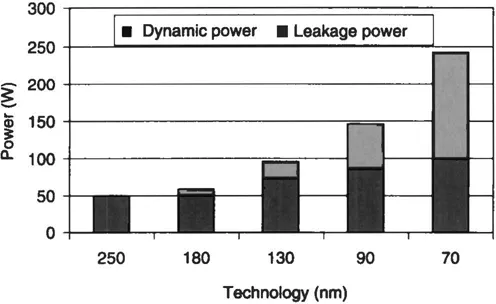
In every process generation, as transistor size decreases it enables to pack more features on silicon. Moore's law predicts doubling of transistors every 18 months. From switching power perspective, it means doubling power consumption every 18 months if device geometry is not reduced. As we migrate to smaller device geometry, transistor capacitance and threshold voltage are reduced thus allowing for a lower supply voltage operation. The benefits of lower capacitance as well as lowering of supply voltage will not offset the increase in power due to added features on the silicon and higher frequency of operation. From one process generation to the next, variety of design techniques are implemented to ensure power consumption stays relatively constant. As shown in Figure 12.1, since the advent of 130 nm technology, switching power consumption from one process generation to the next has remained relatively constant [1].
One of the key design parameters for consideration in any very large scale integration (VLSI) design is average power consumption. The average power is defined as [2,3]
Pavg=Pdynamic+Pstatic
(12.1)
images
FIGURE 12.1 Power trend with technology scaling. (From Hillman, D., Virtual Silicon, and J. Wei, Tensilica, SNUG Implementing Power Management IP for Dynamic and Static Power Reduction in Configurable Microprocessors using the Galaxy Design Platform at 130 nm” SNUG, Boston, MA, 2004. With permission.)
The Pdynamic component comprises power consumption due to transistor switching and Pstatic component comprises power consumption due to transistor leakage when it is idle. In this chapter, we examine sources of dynamic power consumption and different methods of its reduction in submicron design practices. The Pdynamic has two components, Pswitching and Pshort-circuit. The Pswitching is power consumed when transistor is switching and Pshort-circuit is power consumed due to direct current path between the supply and ground when gate output is switching.
Pshort-circuit is defined as
Pshort-circuit=λf(VDD2Vth)3
(12.2)
where
  1. λ is a constant
  2. Vth is the threshold voltage
Short-circuit power is a small portion of the total Pavg described in Equation 12.2 [2]. For a high-performance ASIC designs, it comprises 10%–20% of total power consumpti...

Table of contents

  1. Cover Page
  2. Title Page
  3. Copyright Page
  4. Table of Contents
  5. Acknowledgments
  6. Preface
  7. Editor
  8. Editorial Board
  9. SECTION I Fabrication and Technology
  10. SECTION II Memory and Storage
  11. SECTION III Design Techniques
  12. SECTION IV Design for Low Power
  13. SECTION V Testing and Design for Testability
  14. Index