eBook - ePub
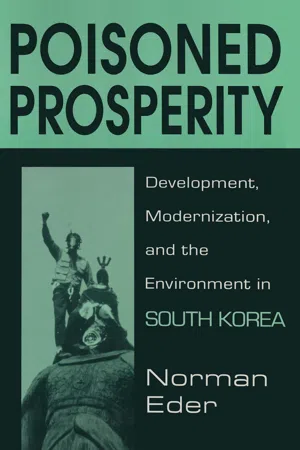
Poisoned Prosperity
Development, Modernization and the Environment in South Korea
- 224 pages
- English
- ePUB (mobile friendly)
- Available on iOS & Android
eBook - ePub
About this book
A study of environmental degradation, this work presents the environmental problems of South Korea. The effects of rapid industrialisation and modernisation are documented along with the choices and actions which are available to the country.
Information
1 The Human and Environmental Costs of Industrialization
DOI: 10.4324/9781315285658-2
Korea is one of the most homogeneous societies in the world; its culture and institutions all reflect a nearly complete lack of ethnic and racial diversity. Moreover, with the exception of a small Chinese minority and the international districts of Seoul, most Koreans have rarely come in contact with foreigners until very recently. To be sure, Koreans are increasingly bombarded by the international media and incessant twentieth-century consumerism, but the effect of this on the Korean way of thinking seems to have been far less than in other, more open societies. As a result, in Korea today, the modern and the traditional live uneasily, side by side, rarely reconciled and sometimes at odds with each other's demands.
The patterns of modern Korean daily life have been shaped by a mix of old and new. This frustrates and infuriates foreigners who live and work in Korean society and who try to study, influence, and interact with it from afar. Although traditional class consciousness has been reduced, it has been replaced by an equally strong class status system that still defies Western principles of pluralism and democracy. This uniquely Korean system is based on education, money, personal connections, and political position. Place and status at birth are no longer the exclusive determining factors of success and failure, yet they and the family connections they bring remain the critical elements in Korean life. Egalitarianism has grown in recent years, but personal relations remain hierarchical and paramount in all aspects of personal life, business, and government. Personal connection, whether based on friendship, family kinship, or business loyalty, will usually take precedence over principle and public policy. These precepts have been readily accepted by Koreans, who, with only a few exceptions, have for centuries conformed to them as the natural order of life. The result has been remarkable stability and order through hunger, conquest, and now industrialization. Today, though, the very elements that have long given stability and strength to Korean society make social and political change—indeed, any change—extremely difficult.1
Korean life has long been dominated by geographic position. Attached to the Asian continental land mass on one side and surrounded by ocean on three others, Korea and her history have been shaped by her larger and more powerful neighbors, China and Japan. The Chinese historically have been known as the "big brother" and cultural mentor. The Japanese have been a mortal enemy for a millennium. For both, though, Korea has been a battleground. Chinese Han and Tang emperors launched repeated invasions from the time of Christ, and in the thirteenth century the Mongols invaded and occupied the peninsula. Two brutal Japanese invasions swept over Korea in the late sixteenth century, followed by destructive Manchu invasions in the early seventeenth century. Each invasion destroyed native governments and robbed Korea of cultural and historic relics, leaving a sense of isolation and shameful defeat and a fierce national pride in those things that are uniquely Korean. The country's history also imbued Koreans with a clannishness, a deep sense of mistrust, and a suspicion of everything and anyone that might threaten the status quo and stability.2
The first glimmer of modernization in Korea came about as a result of conquest and tragedy. In 1910, imperial Japan brought an end to the native Yi dynasty and began its rule of Korea, which would last until the Japanese defeat in 1945. During the Japanese occupation, Koreans were classified as Japanese citizens (second-class, of course); the once-free nation was incorporated into Japan's domestic systems of government and treated as a province, as opposed to a conquered nation. Koreans were forced to give up their distinct language and culture and to adopt Japanese forms in all aspects of public and private life. The Japanese, in seeking to exploit the human and natural resources of their new conquest, reduced the native Korean ruling elite to subservience, eliminated feudalism, and recast everything from public education to civil administration to conform to the contemporary Japanese model. The Japanese rulers also began the transformation of Korea's preindustrial economic infrastructure. They constructed the first modern factories and brought modern communications and transportation systems to the peninsula. Japan also established the foundations of Korea's pattern of monopolistic capitalism, although this remained securely in the hands of Japanese bureaucrats, military officers, and expatriate business owners.
After the defeat of Japan, Korea was divided between the communist North and the capitalist South. The Second World War had left both north and south devastated, economically and socially, because although there were no major campaigns fought on the peninsula, the Japanese used Korean labor and resources to fuel their war machine. By 1945 the nation was destitute. The Korean War only added to the devastation. From 1950 to 1953, armies raced from one end of Korea to the other, leaving little except destruction and hungry refugees in their paths. At the signing of the armistice, the Korean people could rightfully claim that they lived in one of the most impoverished and brutalized nations on the face of the earth.
Throughout the second half of the 1950s, the Republic of Korea existed as a dependent state under the protection of the United States. Ruled by an authoritarian government and military, South Korea survived in nearly total poverty. In contrast, communist North Korea was the beneficiary of Soviet and Chinese political competition. This led to the creation of heavy industry and rising production rates that were viewed as a security threat by the rulers of South Korea and the United States government. In the face of this, Koreans and American supporters alike recognized that the South's security could not be maintained without economic growth and modernization at all levels of life. This realization formed the critical political foundation for the launching of economic development in the South, which in the early 1960s concentrated its national energies and talents on centrally managing the growth of heavy industry, from steel to chemicals to textiles, to create a modern industrial economy.3
This development was not accompanied by social or political modernization, however. Until very recently, Korean government was authoritarian, repressive of human rights, and abusive of individual liberties and political diversity. Unfettered industrial development has been the sole ambition of Korean national domestic policy over the past thirty years, and anything that stood in its way, from political dissent and labor organization to environmental concerns, was seen as demanding aggressive elimination by whatever means necessary.
The story of this "Korean economic miracle" is well known and often looked to as the standard for third world economic development. Following a policy of export-led growth and the creation of a heavy industrial manufacturing base, the Korean economy set world records for expansion.4 From 1986 to 1989 real GNP growth averaged 11.3 percent. Per capita GNP nearly doubled, from $2,194 in 1984 to $4,127 in 1988. By the close of 1993, per capita GNP had risen to $7,007.5 Although growth rates have slowed in recent years (3.8 percent in 1993, but above the 8 percent range for 1994), the Korean economy continues to expand. The government reported that per capita income rose to $8,300 in 1994, and forecasters expect it to reach at least $9,700 in 1995 and break the $10,000 barrier in 1996.6 In making these economic strides, Korea is moving from a foundation of heavy manufacturing industries toward more diversification. In 1993 Korea was the world's largest producer of semiconductors and a leader in chemicals, machinery, ships, and high-technology consumer goods.
Rapid industrialization in Korea has left its mark on the landscape, and the results of this environmental neglect are easily found.7 Although no nationwide epidemiologic research has been conducted (many local studies do exist), chronic respiratory ailments and the incidence of environmentally linked cancers are assumed to be rising steadily. Concerns about environmentally associated diseases are further aggravated by the heavy consumption of tobacco and alcohol products. Over 73 percent of Korean males smoke the relatively cheap and government-subsidized Korean tobacco. Only 7 percent of the female population use tobacco, but that percentage is rising rapidly. This use of tobacco in Korea compares to 61 percent of Japanese and Chinese males, 47 percent of Thais, and 28 percent of American men.8 Drink, too, is cheap and widely and heavily used in all social and business interactions, with the national liquor, soju, costing about 800 won ($1) per half-liter bottle.
The urban areas of Seoul and Pusan have become heavily congested by growing populations and millions of vehicles. Even cities with populations of less than one million are feeling the effects of uncontrolled urbanization due to centrally directed industrial development. In 1994 it was estimated that Korea had over seven million automobiles on its streets, and hundreds of thousands of new vehicles are being added annually. Moreover, the incessant construction of housing, office complexes,
Table 1.1 Average SO2 Level in Major Korean Cities (ppm)
| City | 1984 | 1986 | 1990 | 1992 |
| Seoul | 0.066 | 0.054 | 0.051 | 0.035 |
| Pusan | 0.050 | 0.042 | 0.039 | 0.033 |
| Taegu | 0.040 | 0.043 | 0.041 | 0.040 |
| Kwangju | 0.026 | 0.020 | 0.017 | 0.017 |
| Ulsan | 0.024 | 0.032 | 0.031 | 0.031 |
Source: Korean Ministry of Environment, Seoul, 1993 Report on Environmental Status of Korea.
roads, subways, and factories adds tons of large particulates to the nation's airsheds. Air pollution levels, therefore, are high by world standards in all major Korean cities. Although some progress has been made in recent years, the citizens of Seoul suffer air pollution levels slightly below those of Mexico City, which has long been known for having the most polluted air of the world's major urban centers. On most days in Seoul, the lovely mountains that serve as the city's backdrop are shrouded by smog created by auto emissions, the burning of carbon fuels, construction and municipal wastes, and suspended dust particles (see Table 1.1).
The high levels of air pollution have produced serious acid rain problems. A recent two-year survey of rainfall pH in Seoul, conducted by th...
Table of contents
- Cover Page
- Half Title Page
- Title Page
- Copyright Page
- Contents Page
- Acknowledgments Page
- Introduction Page
- Map of Korea Page
- 1. The Human and Environmental Costs of Industrialization
- 2. The History and Structure of Environmental Administration in Korea: A Brief Overview
- 3. Realities and Limits of Environmental Law and Management in Korea
- 4. The Forces for Change: Prosperity, Democratization, and Internationalization
- 5. Nongovernment Organizations: Environmentalism and Civic Democracy
- 6. Internationalization and the Environment
- 7. Environmental Stability and the Prospects for Progress
- Bibliography
- Index
Trusted by 375,005 students
Access to over 1.5 million titles for a fair monthly price.
Study more efficiently using our study tools.
Frequently asked questions
Yes, you can cancel anytime from the Subscription tab in your account settings on the Perlego website. Your subscription will stay active until the end of your current billing period. Learn how to cancel your subscription
No, books cannot be downloaded as external files, such as PDFs, for use outside of Perlego. However, you can download books within the Perlego app for offline reading on mobile or tablet. Learn how to download books offline
Perlego offers two plans: Essential and Complete
- Essential is ideal for learners and professionals who enjoy exploring a wide range of subjects. Access the Essential Library with 800,000+ trusted titles and best-sellers across business, personal growth, and the humanities. Includes unlimited reading time and Standard Read Aloud voice.
- Complete: Perfect for advanced learners and researchers needing full, unrestricted access. Unlock 1.5M+ books across hundreds of subjects, including academic and specialized titles. The Complete Plan also includes advanced features like Premium Read Aloud and Research Assistant.
We are an online textbook subscription service, where you can get access to an entire online library for less than the price of a single book per month. With over 1.5 million books across 990+ topics, we’ve got you covered! Learn about our mission
Look out for the read-aloud symbol on your next book to see if you can listen to it. The read-aloud tool reads text aloud for you, highlighting the text as it is being read. You can pause it, speed it up and slow it down. Learn more about Read Aloud
Yes! You can use the Perlego app on both iOS and Android devices to read anytime, anywhere — even offline. Perfect for commutes or when you’re on the go.
Please note we cannot support devices running on iOS 13 and Android 7 or earlier. Learn more about using the app
Please note we cannot support devices running on iOS 13 and Android 7 or earlier. Learn more about using the app
Yes, you can access Poisoned Prosperity by Norman R. Eder in PDF and/or ePUB format, as well as other popular books in Politics & International Relations & Asian Politics. We have over 1.5 million books available in our catalogue for you to explore.