- 304 pages
- English
- ePUB (mobile friendly)
- Available on iOS & Android
eBook - ePub
Electrical Machine Analysis Using Finite Elements
About this book
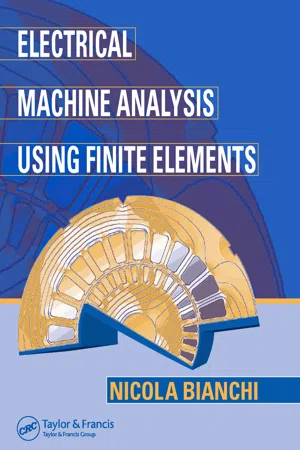
From the fan motor in your PC to precision control of aircraft, electrical machines of all sizes, varieties, and levels of complexity permeate our world. Some are very simple, while others require exacting and application-specific design. Electrical Machine Analysis Using Finite Elements provides the tools necessary for the analysis and design of any type of electrical machine by integrating mathematical/numerical techniques with analytical and design methodologies.
Building successively from simple to complex analyses, this book leads you step-by-step through the procedures and illustrates their implementation with examples of both traditional and innovative machines. Although the examples are of specific devices, they demonstrate how the procedures apply to any type of electrical machine, introducing a preliminary theory followed by various considerations for the unique circumstance. The author presents the mathematical background underlying the analysis, but emphasizes application of the techniques, common strategies, and obtained results. He also supplies codes for simple algorithms and reveals analytical methodologies that universally apply to any software program.
With step-by-step coverage of the fundamentals and common procedures, Electrical Machine Analysis Using Finite Elements offers a superior analytical framework that allows you to adapt to any electrical machine, to any software platform, and to any specific requirements that you may encounter.
Information
1
Outline of Electromagnetic Fields
In this chapter, some basic concepts of vector analysis and electromagnetic fields are outlined. These concepts will be used in the remainder of the book. The aim is to furnish a concise treatment and a practical formulary, but keep in mind that it is not an exhaustive one. Any reader interested in mastering this subject should look it up in the books listed in the References.
1.1 VECTOR ANALYSIS
In a three-dimensional space, let V = V(P) be a scalar quantity that defines a scalar field, and A = A(P) be a vector quantity that defines a vector field. The dependence on the point P is expressed by using a reference system with curvilinear orthogonal coordinates: they are Cartesian (x,y,z), cylindrical (r,ϑ,z), or spherical (r,ϑ,φ) coordinates.
In general, each of these quantities can be a function of the time, that is, V = V(P,t) and A = A(P,t). This dependence is considered in Section 1.1.8. However, in order to simplify the text, the explicit notation pointing out the dependence of the various quantities on the point P and the time t is omitted.
1.1.1 Operations Among Vectors
Let A and B be two vectors, with |A| and |B| their magnitude respectively and γ the angle between their oriented direct...
Table of contents
- Cover Page
- Title Page
- Copy Page
- Contents
- 1 Outline of Electromagnetic Fields
- 2 Basic Principles of Finite Element Methods
- 3 Applications of the Finite Element Method to Two-Dimensional Fields
- 4 The Analysis Procedure Using the Finite Element Method
- 5 Cylindrical Magnetic Devices
- 6 The Single-Phase Transformer
- 7 Single-Phase Variable Reactance
- 8 Synchronous Generators
- 9 Surface-Mounted Permanent Magnet Motors
- 10 Interior Permanent Magnet and Reluctance Synchronous Motors
- 11 Self-Starting Single-Phase Synchronous Motors
- 12 Switched Reluctance Motors
- 13 Three-Phase Induction Motors
- Appendix
- Index
Trusted by 375,005 students
Access to over 1.5 million titles for a fair monthly price.
Study more efficiently using our study tools.
Frequently asked questions
Yes, you can cancel anytime from the Subscription tab in your account settings on the Perlego website. Your subscription will stay active until the end of your current billing period. Learn how to cancel your subscription
No, books cannot be downloaded as external files, such as PDFs, for use outside of Perlego. However, you can download books within the Perlego app for offline reading on mobile or tablet. Learn how to download books offline
Perlego offers two plans: Essential and Complete
- Essential is ideal for learners and professionals who enjoy exploring a wide range of subjects. Access the Essential Library with 800,000+ trusted titles and best-sellers across business, personal growth, and the humanities. Includes unlimited reading time and Standard Read Aloud voice.
- Complete: Perfect for advanced learners and researchers needing full, unrestricted access. Unlock 1.5M+ books across hundreds of subjects, including academic and specialized titles. The Complete Plan also includes advanced features like Premium Read Aloud and Research Assistant.
We are an online textbook subscription service, where you can get access to an entire online library for less than the price of a single book per month. With over 1.5 million books across 990+ topics, we’ve got you covered! Learn about our mission
Look out for the read-aloud symbol on your next book to see if you can listen to it. The read-aloud tool reads text aloud for you, highlighting the text as it is being read. You can pause it, speed it up and slow it down. Learn more about Read Aloud
Yes! You can use the Perlego app on both iOS and Android devices to read anytime, anywhere — even offline. Perfect for commutes or when you’re on the go.
Please note we cannot support devices running on iOS 13 and Android 7 or earlier. Learn more about using the app
Please note we cannot support devices running on iOS 13 and Android 7 or earlier. Learn more about using the app
Yes, you can access Electrical Machine Analysis Using Finite Elements by Nicola Bianchi in PDF and/or ePUB format, as well as other popular books in Technology & Engineering & Electrical Engineering & Telecommunications. We have over 1.5 million books available in our catalogue for you to explore.