- 336 pages
- English
- ePUB (mobile friendly)
- Available on iOS & Android
eBook - ePub
About this book
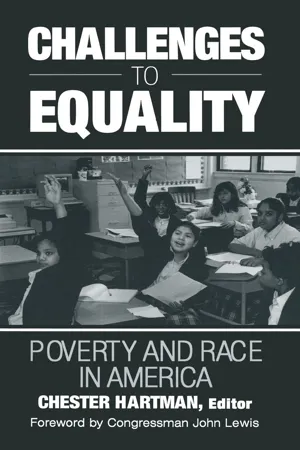
Artioles and symposia on major controversial social issues: integration and civil rights; President Clinton's recent race initiative; poverty; education; the environment; democratic participation; disability rights; corporate welfare; and others. The range of contributors is wide, and includes Julian Bond, Herbert Gans, James Loewen, Jonathan Kozol, Manning Marable, Howard Zinn, Benjamin DeMott, Frances Fox Piven, and Marian Wright Edelman.
Information
Integration
Civil Rights, Now and Then
Julian Bond
At the turn of the century, the great scholar and activist W.E.B. DuBois predicted that "the problem of the twentieth century will be the problem of the color line." Not only was he right, but one regrettably may conclude that it will be also the problem of the century just begun.
This is a time when the leadership of the House and Senate is more hostile to civil rights than in recent memory. On a civil rights report card prepared by the National Association for the Advancement of Colored People (NAACP)—with 100 percent as a perfect score—they fail, averaging 21 percent in the House and 36 percent in the Senate.
It is also the aftermath of Supreme Court decisions sharply attacking affirmative action, limiting the scope of the court's historic 1954 decision in Brown v. Board of Education, and restricting the Voting Rights Act, and in a climate in which trashing affirmative action substitutes for dialogue on race.
In the current formulation, it is black people who hold the key to racial progress, but the door to justice is double-locked. White people keep their keys in their Dockets, and many deny that they have a key at all.
Everywhere, we see clear racial fault lines, which divide American society as much now as at any time in our past.
Some Bright Spots
The picture we see is not without its brighter side. Taken over several decades rather than in snapshot moments, our portrait shows clear progress throughout the twentieth century. No more do signs read "white" and "colored." The voters' booths and schoolhouse doors now swing open for everyone, no longer closed to those whose skins are dark. Despite popular thinking to the contrary, the battle to preserve affirmative action is being won, not lost. Nearly twenty states have tried to place anti-fairness referenda on their ballots and all, but two, have failed. The two which succeeded did so by deceiving the public: in California 27 percent of voters said they thought a vote for Proposition 209 was a vote for civil rights; Washington State's Initiative 200 was a California copycat.
Three times in 1998, Congress voted on affirmative action measures, and three times bipartisan majorities voted to keep vital protections for minorities and women.
But....
But for many, despite the successes, today's civil rights scene must seem like an echo of the past.
Many stand now in reflection of that earlier movement's successes, confused about what the next steps should be. The task ahead is enormous— equal to if not greater than the job already done.
Today we are three-and-a-half decades past the second Reconstruction, the modern movement for civil rights that eliminated legal segregation in the United States, and thirteen decades past the first Reconstruction, the single period in American history in which the national government used armed might to enforce the civil rights of black Americans.
Then, as now, scientific racism and social Darwinism were in vogue. Then, as now, a race-weary nation decided these problems could be best solved if left to the individual states. Then, as now, racist demagogues walked the land. Then, as now, minorities and immigrants became scapegoats for real and imagined economic distress.
Then a reign of state-sanctioned and private terror, including ritual human sacrifice, swept across the South to reinforce white supremacy. That is when the heavy hand of racial segregation descended across the South, a cotton curtain that separated blacks from education and from opportunity, but not from hope.
As we recall the struggles of the recent past, many of us are confused about what the movement's aims and goals were, what it accomplished and where it failed, and what our responsibilities are to complete its unfinished business today.
The movement's origins were in a bitter struggle for elementary civil rights, but it largely became, in the post-segregation era, a movement for political and economic power, and today black women and men hold office and wield power in numbers we only dreamed of before.
But despite impressive increases in the numbers of black people holding public office, despite our ability to sit and eat and ride and vote and attend school in places that used to bar black faces, in some important ways nonwhite Americans face problems more difficult to attack today than in years before.
The 1960s–1980s
Much of the origins of today's distresses are found in the recent past and came to climax in the 1980s.
Over time, opposition to government, especially Washington government, succeeded opposition to Communism as a secular religion. The United Nations, Washington bureaucrats, gays and lesbians, and supporters of minority and women's rights replaced the Soviet Union as the "evil empire," and together, these became the energies driving the callous coalition that captured Congress in 1994.
As long ago as 1964, Republicans had begun to remake their party as the white people's party, and they found a winning formula at the intersection of race and opposition to activist government. For much of the 1980s, America was presided over by an amiable ideologue whose sole intent was removing government from every aspect of our lives. He brought to power a band of financial and ideological profiteers who descended on the nation's capital like a crazed swarm of right-wing locusts, bent on destroying the rules and laws that protected our people from poisoned air and water and from greed. But nowhere was their assault on the rule of law so great as in their attempt to subvert, ignore, defy, and destroy the laws that required an America that is bias-free.
Today, thanks to judicial appointments by Presidents Reagan and Bush, the greatest threat to affirmative action comes from the courts—not, as the media would have us believe, from the anti-affirmative action preferences of the people.
Then, as now, they unleashed a gang of financial sociopaths to raid and ravage the national treasury.
Then, as now, they forced a form of triage economics upon us. Then it produced the first increase in infant mortality rates in twenty years and pushed thousands of poor and working poor Americans deeper into poverty.
By the mid 1980s, the Census Bureau reported that the number of Americans living in poverty had increased over the previous four years by 9 million, the biggest increase since these statistics were first collected over two decades ago. In the late 1960s, three-quarters of all black men were working; by the end of the 1980s, only 57 percent had a job.
Today's Conditions
Today, a significant portion of our population faces permanent privation, with the percentage of people living in poverty growing from 12.8 to 13.7 percent between 1989 and 1996.
Although we hear a lot these days about how well our economy is doing, we do not hear much about how poorly the average person does. Between 1990 and 1995, median family income actually declined while the number of people with a net worth over $1 million more than doubled.
The United States today is the most economically stratified of all industrial nations, the gap between rich and poor larger than in Britain, Italy, Canada, Germany, France, Finland—greater and rising faster than anywhere else.
Those years then were what these years now promise to be—a kind of festive party, thrown for America's rich.
Since 1979, the wages of the bottom 20 percent of workers have dropped nearly 12 percent. Workers at the bottom half of the wage scale make 75 cents less per hour than they did twenty years ago.
This at a time when the average executive earns 220 times what the average production worker is paid.
And for those workers whose skins are black or brown, the gap is greater and their prospects bleaker. Today, the net financial assets of black families in which one member has a postgraduate degree are lower than the assets of white families in which the highest level of education achieved is elementary school.
In 1968, the Kerner Commission, appointed by President Johnson to investigate the causes and prescribe the cures for the 1967 riots, concluded that "white racism" was the single most important cause of continued racial inequality in income, housing, employment, education, and life chances between blacks and whites.
Within a few short years, the growing numbers of blacks and other minorities and women, pushing for entry into and power in the academy, the media, business, government, and other traditionally white male institutions, created a backlash in the discourse over race. The previously privileged majority exploded in angry resentment at having to share space with the formerly excluded.
Opinion leaders began to reformulate and redefine the terms of the discussion. No longer was the Kerner Commission's description of the problem acceptable.
Any indictment of white America could be abandoned, and a Susan Smith defense was adopted—black people did it, did it to the country, and did it to themselves. Black behavior, not white racism, became the reason why whites and blacks lived in separate worlds. Racism retreated and pathology advanced. The burden of racial problem-solving shifted from racism's creators to its victims. The failure of the lesser breeds to enjoy society's fruits became their fault alone. In a kind of nonsensical tautology we heard again and again; these people are poor because they are pathological, they are pathological because they are poor.
Pressure for additional civil rights laws became special pleading. America's most privileged population, white men, suddenly became a victim class. Aggressive blacks and pushy women became responsible for America's demise.
All this occurred despite almost daily incidents of racial attack, and a series of public opinion polls that demonstrate most white Americans believe racial minorities are less than equal human beings, lacking in thrift, morality, industriousness, and patriotism.
Most Americans do not just believe minorities are suspect; they believe there are more of them than there actually are.
According to a Gallup Poll, the average American thinks that 18 percent of all Americans are Jewish; the real figure is 3 percent. The average American thinks that 21 percent of all Americans are Hispanic; the exact number is 8 percent; most Americans think that 32 percent of all Americans are black; the real figure, of course, is 12 percent.
For the average American, then, minorities are the majority: 71 percent of the national population.
The New Racism
This exaggeration of the other, this blame-shifting and role-reversal, where victim becomes perpetrator and minorities become majorities, this perversion of reality occurred as a result of an organized campaign that continues to this day.
It is led by a curious mix of whites and a few blacks, academics, journalists, and policymakers. Its aim is the demobilization of effective insurgent politics, the depoliticizing of discussions of our gross misdistribution of income, and the adoption of reactionary and punitive social policy.
Its adherents profess strong support for equal rights while opposing every tool designed to achieve this goal. They attack and discredit affirmative action, not simply because it threatens ancient white-skin privilege, but because it serves as a handy symbol of despised government intervention, and feeds the myths of black-caused white disadvantage.
For these new racists, equal opportunity is a burden that society cannot afford to bear. Their less than subtle message is that including blacks and women excludes quality.
The continuing disparity between black and white life chances is not a result of black life choices; it stems from epidemic racism and an economic system dependent on class division.
Abundant scholarship notwithstanding, there is no other possible explanation—not family breakdown, not lack of middle-class values, not lack of education and skills, not absence of role models. These are symptoms. Racism is the cause; its elimination is the cure.
But racism was no rationale for bad behavior even when it legitimized slavery and made people property; it ought be no excuse for anyone's failure to strive to live with decency now.
We must be careful not to define the ideology and practice of white supremacy too narrowly. It is greater than scrawled graffiti and individual indignity, the policeman's nightstick, the job or home or education denied. It is rooted deeply in the logic of our market system, in the culturally defined and politically enforced prices paid for different units of labor, and it is deeply entrenched in our national psyche.
Black Political Gains
The strategies of the 1960s movement were litigation, organization, mobilization, and civil disobedience, aimed at creating a national political constituency for civil rights advances.
In the 1970s, electoral strategies began to dominate, prompted by the increase in black votes engendered by the 1965 Voting Rights Act. The numbers of locally elected black officials multiplied, coinciding with a decline in political party organization, and, for many, the number of black voters sufficient to elect them became voters enough.
Forgotten in the wave of inaugurations of new black mayors was the plight of blue-collar blacks. Just as black workers began to win access to industrial jobs and organized labor, the jobs went offshore and labor declined in power and influence. President Nixon's plan to promote black capitalism as a cure for underdeveloped ghettoes was embraced by a growing generation of politically connected black entrepreneurs, and their cause gained ascendancy.
Some black elites joined white elites at the feeding trough.
Since the heady days of the 1960s, too many have concentrated too much on enriching too few, while the large numbers of working-class black Americans, like their counterparts in the larger society, have seen their plight ignored, their incomes shrink, and their jobs disappear.
Martin Luther King lost his life supporting a garbage workers' strike in Memphis; the right to decent work at decent pay remains as basic to human freedom as the right to vote.
"Negroes," King said in 1961, "are almost entirely a working people. There are pitifully few Negro millionaires and few Negro employers."
That there are more black millionaires today is a tribute to the movement King led; that there are proportionately fewer blacks working today is an indictment of our times and our economic system, a reflection of our failure to keep the movement coming on.
Everywhere black Americans face conditions different from but just as daunting as the bus back seats, fire hoses, and billy clubs of three decades ago.
On streets and sidewalks where many black Americans live, crime and violence are a frequent rule. As angry white men blow up buildings, angry black men blow each other away. These are not drive-by shootings or stranger shooting stranger; in most of these deaths, the killer and the victim knew each other. These are friend shooting friend.
Black Children
In America today, compared with a white child, a black child is one and a half times more likely to grow up in a family whose head did not finish high school.
- That child is two times as likely to be born to a teenage mother.
- That child is two and a half times more likely to be born with low birth weight.
- That child is three times more likely to live in a single-parent home.
- That child is four times more likely to have a mother who had no prenatal care.
- That child is four and a half times more likely to live with neither parent.
- That child is five times as likely to depend solely on a mother's earnings.
- That child is nine times as likely to be a victim of homicide as a teenager or young adult, the end of a long, winding, uphill struggle to beat the racial odds against success.
In life chances, life expectancy, and median income—by all the standards by which life is measured—black Americans see a deep gulf between the American dream and the reality of their lives.
Affirmative Action
For the last thirty-five years—the period of the second Reconstruction—the most effective tool for advancing entry into mainstream American life has been affirmative action.
Opponents now try to tell us that it does not work, or it used to work but it does not now and is not needed now; when it does work, it only helps people who do not need it. Their real problem is that it does work, and despite limits, where it works it works well.
These opponents argue that the beneficiaries of race-centered affirmative action are "profiting" from it, as if its goals were comparable to an investment shared by a greedy few, a sub-tribe of dusky Donald Trumps and ebony Ivan Boeskys trading up life's ladder.
There is never "profit" in receiving right treatment. Receiving rights that others already enjoy is no benefit or badge of privilege; it is the natural order of things in a democratic society.
Affirmative action really is not about preferential treatment for blacks; it is about removing preferential tr...
Table of contents
- Cover Page
- Half Title page
- Title Page
- Copyright Page
- Contents
- Foreword
- Introduction
- Part 1. Integration
- Part 2. Poverty
- Part 3. Education
- Part 4. Democratic Participation
- Part 5. Environmental Justice
- Part 6. Race, Poverty, and ...
- Part 7. President Clinton's Initiative on Race
- Contributors
- PRRAC Board of Directors and Social Science Advisory Board
- Index
Trusted by 375,005 students
Access to over 1.5 million titles for a fair monthly price.
Study more efficiently using our study tools.
Frequently asked questions
Yes, you can cancel anytime from the Subscription tab in your account settings on the Perlego website. Your subscription will stay active until the end of your current billing period. Learn how to cancel your subscription
No, books cannot be downloaded as external files, such as PDFs, for use outside of Perlego. However, you can download books within the Perlego app for offline reading on mobile or tablet. Learn how to download books offline
Perlego offers two plans: Essential and Complete
- Essential is ideal for learners and professionals who enjoy exploring a wide range of subjects. Access the Essential Library with 800,000+ trusted titles and best-sellers across business, personal growth, and the humanities. Includes unlimited reading time and Standard Read Aloud voice.
- Complete: Perfect for advanced learners and researchers needing full, unrestricted access. Unlock 1.5M+ books across hundreds of subjects, including academic and specialized titles. The Complete Plan also includes advanced features like Premium Read Aloud and Research Assistant.
We are an online textbook subscription service, where you can get access to an entire online library for less than the price of a single book per month. With over 1.5 million books across 990+ topics, we’ve got you covered! Learn about our mission
Look out for the read-aloud symbol on your next book to see if you can listen to it. The read-aloud tool reads text aloud for you, highlighting the text as it is being read. You can pause it, speed it up and slow it down. Learn more about Read Aloud
Yes! You can use the Perlego app on both iOS and Android devices to read anytime, anywhere — even offline. Perfect for commutes or when you’re on the go.
Please note we cannot support devices running on iOS 13 and Android 7 or earlier. Learn more about using the app
Please note we cannot support devices running on iOS 13 and Android 7 or earlier. Learn more about using the app
Yes, you can access Challenges to Equality by Jean M Hartman,John Lewis in PDF and/or ePUB format, as well as other popular books in Social Sciences & Asian History. We have over 1.5 million books available in our catalogue for you to explore.