![]()
1 MODERN STATE FORMATION
Introduction
This chapter will focus on the rise of the modern state in Iran, reflecting on the Qajar legacy but focusing in particular on the key structural developments taking place during the reign of the two Pahlavi monarchs. The analysis will flow into a survey of the institutional structures of the modern state and the changes that the 1979 Islamic Revolution brought about. It will aim to explain how the revolution affected the Iranian ‘state form’ and how historically significant these changes have proved to be. The institutional makeup and constitutional underpinnings of the Islamic republic will also be discussed.
As noted, Iran’s experience with republicanism is recent, having been ruled by a range of monarchical dynasties over three millennia. But the end of the monarchy was a relatively sudden act and, for the nature of the revolutionary upheavals, therefore stands out as one of the most significant political developments of our time in terms of an apparently powerful leader of a fast-emerging regional power being challenged, exiled and finally deposed in just two short years between summer of 1977 and winter of 1979.
The development of a constitutional political regime in 1905, on the back of the constitutional movement, which quickly overwhelmed the corroding Qajar dynasty and finally gave birth to a new political order in the 1920s, can be seen as the point of departure for the making of modern Iran. Iran, as an ‘empire-country’ is a heterogeneous state and in its modern form is an amalgam of nationalities and ethnicities, crisscrossed by tribal communities of different sizes and significance today. Iran’s socio-national makeup has over the decades played a significant part in determining the central government’s regional policies, resource allocation, and even the country’s foreign policy. Three times since the early twentieth century, for example, ‘national uprisings’ in the Azeri and Kurdish regions of the country have directly challenged the authority of Tehran and forced the mobilization of its military forces to put down such rebellions. So, the nationalities question, rooted in the country’s demographic makeup, provides a useful entry point for taking account of the emergence of the modern Iranian state.
Iran’s geography forms one of its key characteristics. Geography has had a strong hand in the rise of its civilization and has continued to play its part in determining Iran’s history. Rooted in and based on the foundations of a vast multinational empire, Iran’s geopolitical presence, its ethnicity, its languages and outlook on life and the surrounding areas have all been shaped by geography. Empire and geography have ensured that Iran be a heterogeneous country and home to many ethnicities.
Iran is not a demographically homogeneous country and is, indeed, by any international comparison one of the most ethnically diverse countries of the world. Being a multi-ethnic and multinational state brings its own unique pressures on the central authorities. National policies tend to underline the centre’s keenness to control the provinces as tightly as possible, particularly as the majority of the country’s minorities occupy the territorial edges of Iran. Thus, Kurdish, Lur and Azeri regions stretch from the foothills of the Zagros Mountains to the Aras River in the north (bordering Iraq, Turkey, Armenia and Azerbaijan); the Arabs live in the oil-rich province of Khuzestan in the southwest (bordering Iraq and Kuwait); the Baluch region is in the southeast and shares its lineage with the Baluchis of Pakistan; Turkmens live in the northeast and close to the border with Turkmenistan. Geography has dictated that all eight countries with which it has a land border have a linguistic/cultural presence in Iran.
A variety of Indo-European, Semitic and Turkic languages are spoken in Iran, and these are enriched by variations amongst the country’s several nomadic tribal communities who in the past have been a source of insecurity for the central government but today travel across the country in smaller numbers in accordance with weather conditions and their established ‘ghouch’ (travel) customs. Foreign-supported uprisings in demand of autonomy in the Azeri and Kurdish regions since the early twentieth century have made a considerable impression on the Persian masters of the state, adding to the central authorities’ nervousness of politicized minorities and the socialization of ethnic (national or tribal) communities – Kurds, Azeris, Bakhtiaris – into activists. In these senses, Iran’s ethnic makeup has had a very considerable impact on its modern state structures and has played an important part in the emergence of strong and pervasive central administrative machinery at the heart of the state.
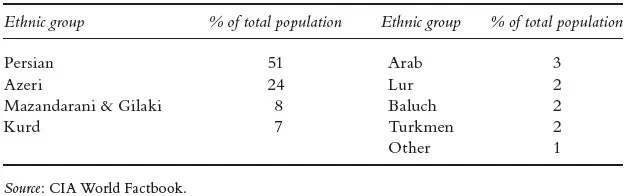
In addition to its varied ethnic communities, Iran also benefits from being a multi-religious and multi-confessional state. Shia Islam accounts for 89 per cent of the country’s population, Sunni Islam for a further 10 per cent, and the remainder are Christians, Jews, Zoroastrians, and the unrecognized community of Bahais.1 As Table 1.1 shows, ‘ethnic minorities’ as a single category make up nearly 50 per cent of Iran’s population, so as a force, ethnic groups have a considerable presence, if not influence, in the country.
TABLE 1.1 Ethnic makeup of Iran
Historical legacy
Persia, as the country was known until the early twentieth century, has been a major power since its emergence as a transcontinental empire in the sixth century bc. Nine centuries before the arrival of Islam on their shores, the Persians of Achaemenid dynasty had created a multinational world empire with a formidable military force and cultural and economic links to match. At its height, the empire stretched from Egypt to the Indus and from the Aral Sea to the Aegean. Following Alexander the Great’s destruction of the Achaemenid Empire, the Sassanians under Ardeshir I emerged in the third century to restore Persian greatness with conquest and with security and economic prosperity. This dynasty established a new regional order whose boundaries were constantly tested by the Romans and later Byzantine. The Sassanians also had to defend the empire against Muslim Arab armies coming from the south and west and eventually incorporate Islam into the empire’s life in the seventh century. This fundamental change in the empire’s belief system did not come at the expense of its well-established customs and cultural mores and Persian identity, which not only remained intact but actually contributed to the development of Islamic empires for centuries to come.
Despite expensive wars, the onslaught of the Mongols and spectacular defeats, the Persian civilization not only survived but also thrived. The Persians played a significant role in the fostering of the ancient Silk Road stretching across the vast Eurasian landmass and later played their part in enriching Islam’s empires. Persia, for all its bloody encounters with European powers, including the Ottomans and Imperial Russia, remained a major power until the eighteenth century. In this sense, Iran of today is the product of a deep-rooted transnational empire, with a sophisticated character. Its history and sense of self-worth is embedded in the characters of the world, the Eurasian world, which its civilization helped shape. As a result, it is, as a nation-state, steeped in many layers of identity and histories. The idea of Persia/Iran then is an old one, and the powerful contextual narrative, which has come from its sons – through such literal giants as Ferdowsi, Hafez, Saadi, Roumi – has stamped in the nation’s collective memory a strong sense of self-worth and also awareness of the place of age/history at the centre of its self-identity. Pedde argues that Iran is
The only real nation in the wide area extending from the Eastern Mediterranean to the Indian Ocean that has over 3,000 years of history and identity.… Persia and then Iran have experienced periods of both splendor and decline, economic and military might and crises and defeat, without ever losing an awareness of national identity and a sense of mission. This has brought about an extraordinary fusion of cultural values and political capabilities that has over the centuries made it possible to forge a state administration, an ever-evolving body of legislation and an ability to manage its own role and interaction with the outside world that are virtually unique in the [Middle East] region.2
But, history has also given it baggage, which is both positive and negative. The negative baggage follows the Qajar monarchs’ inability to secure the empire and its territories and to find a path for Persia to modernize European style. Indeed, Iran’s early modern period began with the rise of the Qajar dynasty in 1794. The Qajar shahs faced four distinct sets of pressures as they set about consolidating the Persian Empire. Their first challenge was to secure the empire’s territorial integrity, which was being openly contested by European powers. Qajar kings spent much of their reign either trying to stave off encroachments by Russia, the Ottomans, Great Britain, and France or cutting deals with them for the sake of their crown. The second challenge was ensuring internal cohesion. With central authority being as weak as it was in this period, tribal and ethnic rebellions constantly threatened the monarchy’s grip on the state. Third, the empire suffered from a stale and corrupt political system. Finally, the Qajars had difficulty developing the Persian economy to keep up with the rapid advances taking place in Europe. Under the Qajars, Iran was in stagnation, experiencing steady decline. External vulnerability and internal disorder provided the backdrop for modernizers, nationalists and progressive clerics to rally in support of constitutionalism in the early twentieth century.
Emergence of a modern state
Iranians, like their Russian counterparts, rebelled against arbitrary rule in 1905 and, in the course of Iran’s unique constitutional revolution, managed to create a semblance of a modern and democratic state. But the 1905–21 period in Iran was anything but peaceful and stable and during which central authority weakened considerably. Iran’s domestic problems were compounded by the Great War and the eventual demise of two of Iran’s neighbours, the czarist order in Russia to the north and the Ottoman Empire to the west and south of the country.3 But Iran’s ties with Germany also exposed it to European geopolitical intrigue in which Berlin threatened to intervene in India (Britain’s greatest colony) from Iranian territory.
The price of a constitutional order and the promise of rule of law appeared to be anarchy and social mayhem. And in this context, the Cossack Brigade colonel, Reza Khan, appeared on the scene as the saviour of the nation, following a coup attempt in 1921 against the crown. Patriot and intensely nationalist, Reza Khan’s first mission was to restore order to the country, for which the military budget under his control as the commander-in-chief was tripled, outstripping expenditure on other departments “by a margin of four to one”.4 The country was bankrupt at this juncture, and there was little money to be found in the national treasury to finance the newly emerging national army under Reza Khan’s command, so Reza Khan appropriated funds from other government departments and collected income accruing from such foreign oil companies as the Standard Oil Company of America active in the country.5 After Ahmad Shah Qajar, under considerable pressure from the military, had left the country in 1923, Reza Khan had become the country’s de facto leader. The Qajar dynasty was voted out by the Majlis on 31 October 1925, and Reza Khan was best positioned to bury this dynasty. But interestingly the constitutionally created Majlis, the source of national authority at the time, reconstituted itself as a constituent assembly, in order to vote for Reza Khan to become king of a new dynasty on 12 December 1925.6 With this act the Pahlavi dynasty was born, but one of the deputies that objected to Reza Khan transforming himself from prime minister to king was none other than Mohammad Mossadeq – the nationalist aristocrat who became prime minister in the 1950s and also the chief opponent of Reza Shah’s successor.
Reza Shah, the founder of the relatively short-lived Pahlavi dynasty (1925–79), is credited with establishing the modern state of Iran. Basing his own strategy on the secular modernist practices of the republic of Turkey under Kamal Ataturk next door, Reza Shah used his sixteen years on the throne to revolutionize the country’s administration, class structure, infrastructure, and economic development strategy. Pushing through sweeping changes, which removed the old order and Iran’s traditional-style politics for a Western-style governance system, he swiftly marginalized the hard fought for independent parliament, introduced a modern bureaucracy, enhanced educational opportunities and pushed women into public space while curtailing the power of the clerical establishment on society. He was a man with a mission whose reign, often brutal and heavy-handed, dragged Iran into the twentieth century. His rule accelerated the country’s modernization, industrialization, urbanization, secularization and bureaucratization. He pushed modernization at a fast pace and did not suffer fools gladly, but his impatience for national development left in its wake many casualties, which included accumulation of land and other assets by the court for patronage, centralization of power relations, repression and suspension of many freedoms, a controlled press, the banning of minority languages, and bureaucratization of politics. Forcing European-style of dress and the broader secularization of the country, as embodied in forced unveiling of women, also left a bad taste in what was still a highly traditional and God-fearing society. His disempowerment of the clerics, beginning before he was ‘elected’ king, accelerated in the 1930s by the end of which the mullahs had lost much of their cultural, political and economic privileges to the secular state organs, and even Sharia (Islamic legal codes) were being abolished in favour of new civil and criminal codes.
Externally, Reza Shah operated with a deep awareness of Iran’s geopolitical vulnerabilities and thus adopted a cautious foreign policy that aimed to reduce Britain’s and Russia’s hold on the country through building relations with other European countries, notably France, Germany and Italy. This strategy was largely successful in the 1930s and brought in much needed know-how from Germany and Italy in particular. The 1930s had witnessed Germany emerge as Reza Shah’s key economic partner: Germany was busily building Iran’s roads and highways, railroads, communications networks, power stations, factories and other major buildings and was also supplying it with machinery, tools and all manner of industrial goods. Not surprisingly, on the eve of the Second World War, 26 per cent of Iran’s exports had been destined for Germany, compared with 8 per cent to Britain, and Germany accounted for 49 per cent of the country’s imports, with just 9 per cent coming from Britain.7
Reza Shah’s drive for modernization of the country was swiftly derai...