Automotive Embedded Systems Handbook
eBook - ePub

Automotive Embedded Systems Handbook

  1. 470 pages
  2. English
  3. ePUB (mobile friendly)
  4. Available on iOS & Android
eBook - ePub

About this book

A Clear Outline of Current Methods for Designing and Implementing Automotive Systems

Highlighting requirements, technologies, and business models, the Automotive Embedded Systems Handbook provides a comprehensive overview of existing and future automotive electronic systems. It presents state-of-the-art methodological and technical solutions in the areas of in-vehicle architectures, multipartner development processes, software engineering methods, embedded communications, and safety and dependability assessment.

Divided into four parts, the book begins with an introduction to the design constraints of automotive-embedded systems. It also examines AUTOSAR as the emerging de facto standard and looks at how key technologies, such as sensors and wireless networks, will facilitate the conception of partially and fully autonomous vehicles. The next section focuses on networks and protocols, including CAN, LIN, FlexRay, and TTCAN. The third part explores the design processes of electronic embedded systems, along with new design methodologies, such as the virtual platform. The final section presents validation and verification techniques relating to safety issues.

Providing domain-specific solutions to various technical challenges, this handbook serves as a reliable, complete, and well-documented source of information on automotive embedded systems.

Frequently asked questions

Yes, you can cancel anytime from the Subscription tab in your account settings on the Perlego website. Your subscription will stay active until the end of your current billing period. Learn how to cancel your subscription.
No, books cannot be downloaded as external files, such as PDFs, for use outside of Perlego. However, you can download books within the Perlego app for offline reading on mobile or tablet. Learn more here.
Perlego offers two plans: Essential and Complete
  • Essential is ideal for learners and professionals who enjoy exploring a wide range of subjects. Access the Essential Library with 800,000+ trusted titles and best-sellers across business, personal growth, and the humanities. Includes unlimited reading time and Standard Read Aloud voice.
  • Complete: Perfect for advanced learners and researchers needing full, unrestricted access. Unlock 1.4M+ books across hundreds of subjects, including academic and specialized titles. The Complete Plan also includes advanced features like Premium Read Aloud and Research Assistant.
Both plans are available with monthly, semester, or annual billing cycles.
We are an online textbook subscription service, where you can get access to an entire online library for less than the price of a single book per month. With over 1 million books across 1000+ topics, we’ve got you covered! Learn more here.
Look out for the read-aloud symbol on your next book to see if you can listen to it. The read-aloud tool reads text aloud for you, highlighting the text as it is being read. You can pause it, speed it up and slow it down. Learn more here.
Yes! You can use the Perlego app on both iOS or Android devices to read anytime, anywhere — even offline. Perfect for commutes or when you’re on the go.
Please note we cannot support devices running on iOS 13 and Android 7 or earlier. Learn more about using the app.
Yes, you can access Automotive Embedded Systems Handbook by Nicolas Navet, Francoise Simonot-Lion, Nicolas Navet,Francoise Simonot-Lion in PDF and/or ePUB format, as well as other popular books in Technology & Engineering & Computer Engineering. We have over one million books available in our catalogue for you to explore.

I

Automotive Architectures

1 Vehicle Functional Domains and Their Requirements
Françoise Simonot-Lion and Yvon Trinquet
  • General Context
  • Functional Domains
  • Standardized Components, Models, and Processes
  • Certification Issue of Safety-Critical In -Vehicle Embedded Systems
  • Conclusion
2 Application of the AUTOSAR Standard
Stefan Voget, Michael Golm, Bernard Sanchez, and Friedhelm Stappert
  • Motivation
  • Mainstay of AUTOSAR: AUTOSAR Architecture
  • Main Areas of AUTOSAR Standardization: BSW and RTE
  • Main Areas of AUTOSAR Standardization: Methodology and Templates
  • AUTOSAR in Practice: Conformance Testing
  • AUTOSAR in Practice: Migration to AUTOSAR ECU
  • AUTOSAR in Practice: Application of OEM–Supplier Collaboration
  • AUTOSAR in Practice: Demonstration of AUTOSAR-Compliant ECUs
  • Business Aspects
  • Outlook
3 Intelligent Vehicle Technologies
Michel Parent and Patrice Bodu
  • Introduction: Road Transport and Its Evolution
  • New Technologies
  • Dependability Issues
  • Fully Autonomous Car: Dream or Reality?
  • Conclusion

1

Vehicle Functional Domains and Their Requirements

Françoise Simonot-Lion
Lorraine Laboratory of Computer Science Research and Applications
Yvon Trinquet
Institute of Communications Research and Cybernetics of Nantes
1.1 General Context
1.2 Functional Domains
  • Power Train Domain
  • Chassis Domain
  • Body Domain
  • Multimedia, Telematic, and HMI
  • Active/Passive Safety
  • Diagnostic
1.3 Standardized Components, Models, and Processes
  • In-Vehicle Networks and Protocols
  • Operating Systems
  • Middleware
  • Architecture Description Languages for Automotive Applications
1.4 Certification Issue of Safety-Critical In-Vehicle Embedded Systems
1.5 Conclusion
References

1.1 General Context

The automotive industry is today the sixth largest economy in the world, producing around 70 million cars every year and making an important contribution to government revenues all around the world [1]. As for other industries, significant improvements in functionalities, performance, comfort, safety, etc. are provided by electronic and software technologies. Indeed, since 1990, the sector of embedded electronics, and more precisely embedded software, has been increasing at an annual rate of 10%. In 2006, the cost of an electronic-embedded system represented at least 25% of the total cost of a car and more than 35% for a high-end model [2]. This cost is equally shared between electronic and software components. These general trends have led to currently embedding up to 500 MB on more than 70 microprocessors [3] connected on communication networks. The following are some of the various examples. Figure 1.1 shows an electronic architecture embedded in a Laguna (source: Renault French carmaker) illustrating several computers interconnected and controlling the engine, the wipers, the lights, the doors, and the suspension or providing a support for interaction with the driver or the passengers. In 2004, the embedded electronic system of a Volkswagen Phaeton was composed of more than 10,000 electrical devices, 61 microprocessors, three controller area networks (CAN) that support the exchanges of 2500 pieces of data, several subnetworks, and one multimedia bus [4]. In the Volvo S70, two networks support the communication between the microprocessors controlling the mirrors, those controlling the doors and those controlling the transmission system and, for example, the position of the mirrors is automatically controlled according to the sense the vehicle is going and the volume of the radio is adjusted to the vehicle speed, information provided, among others, by the antilock braking system (ABS) controller. In a recent Cadillac, when an accident causes an airbag to inflate, its microcontroller emits a signal to the embedded global positioning system (GPS) receiver that then communicates with the cell phone, making it possible to give the vehicle’s position to therescueservice. Thesoftware code size of thePeugeot CX model(source: PSA Peugeot Citroen French carmarker) was 1.1 KB in 1980, and 2 MB for the 607 model in 2000. These are just a few examples, but there are many more that could illustrate this very large growth of embedded electronic systems in modern vehicles.
Images
Figure 1.1 A part of the embedded electronic architecture of a Renault Laguna. (Courtesy of Renault Automobile. With permission.)
The automotive industry has evolved rapidly and will evolve even more rapidly under the influence of several factors such as pressure from state legislation, pressure from customers, and technological progress (hardware and software aspects). Indeed, a great surge for the development of electronic control systems came through the regulation concerning air pollution. But we must also consider the pressure from consumers for more performance (at lower fuel consumption), comfort, and safety. Add to all this the fact that satisfying these needs and obligations is only possible because of technological progress.
Electronic technology has made great strides and nowadays the quality of electronic components—performance, robustness, and reliability—enables using them even for critical systems. At the same time, the decreasing cost of electronic technology allows them to be used to support any function in a car. Furthermore, in the last decade, several automotive-embedded networks such as local interconnect networks (LIN), CAN, TTP/C, FlexRay, MOST, and IDB-1394 were developed. This has led to the concept of multiplexing, whose principal advantage is a significant reduction in the wiring cost as well as the flexibility it gives to designers; data (e.g., vehicle speed) sampled by one microcontroller becomes available to distant functions that need them with no additional sensors or links.
Another technological reason for the increase of automotive embedded systems is the fact that these new hardware and software technologies facilitate the introduction of functions whose development would be costly or not even feasible if using only mechanical or hydraulic technology. Consequently, they allow to satisfy the end user requirements in terms of safety, comfort, and even costs. Well-known examples are electronic engine control, ABS, electronic stability program (ESP), active suspension, etc. In short, thanks to these technologies, customers can buy a safe, efficient, and personalized vehicle, while carmakers are able to master the differentiation between product variations and innovation (analysts have stated that more than 80% of innovation, and therefore of added value, will be obtained thanks to electronic systems [5]). Furthermore, it also has to be noted that some functions can only be achieved through digital systems. The following are some examples: (1) the mastering of air pollution can only be achieved by controlling the engine with complex control laws; (2) new engine concepts could not be implemented without an electronic control; (3) modern stability control systems (e.g., ESP), which are based on close interaction between the engine, steering, and braking controllers, can be efficiently implemented using an embedded network.
Last, multimedia and telematic applications in cars are increasing rapidly due to consumer pressure; a vehicle currently includes electronic equipment like hand-free phones, audio/radio devices, and navigation systems. For the passengers, a lot of entertainment devices, such as video equipment and communication with the outside world are also available. These kinds of applications have little to do with the vehicle’s operation itself; nevertheless they increase significantly as part of the software included in a car.
In short, i...
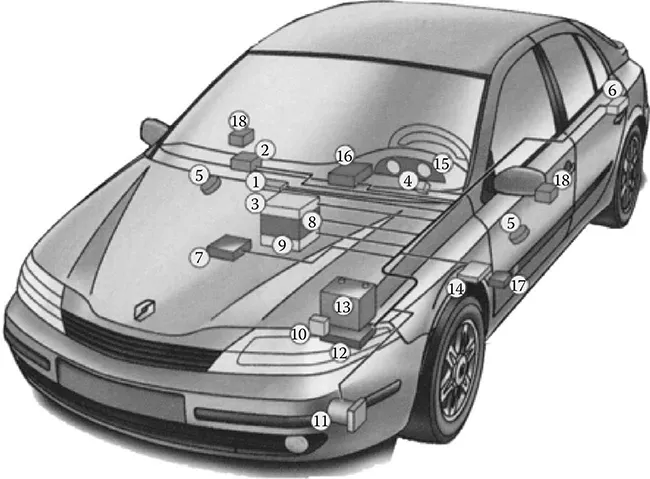
Table of contents

  1. Cover Page
  2. Half title
  3. Title
  4. Copy
  5. Preface
  6. Editors
  7. Contributors
  8. Part I Automotive Architectures
  9. 1 Vehicle Functional Domains and Their Requirements Françoise Simonot-Lion and Yvon Trinquet
  10. 2 Application of the AUTOSAR Standard Stefan Voget, Michael Golm, Bernard Sanchez, and Friedhelm Stappert
  11. 3 Intelligent Vehicle Technologies Michel Parent and Patrice Bodu
  12. Part II Embedded Communications
  13. 4 A Review of Embedded Automotive Protocols Nicolas Navet and Françoise Simonot-Lion
  14. 5 FlexRay Protocol SchĂ€tz, Christian KĂŒhnel, and Michael Gonschorek
  15. 6 Dependable Automotive CAN Networks Juan Pimentel, Julian Proenza, Luis Almeida, Guillermo Rodriguez-Navas, Manuel Barranco, and Joaquim Ferreira
  16. Part III Embedded Software and Development Processes
  17. 7 Product Lines in Automotive Electronics MatthiasWeber and Mark-Oliver Reiser
  18. 8 Reuse of Software in Automotive Electronics Andreas KrĂŒger, Bernd Hardung, andThorsten Kölzow
  19. 9 Automotive Architecture Description Languages Henrik Lönn and Ulrich Freund
  20. 10 Model-Based Development of Automotive Embedded Systems Martin Törngren, DeJiu Chen, Diana Malvius and Jakob Axelsson
  21. Part V Verification, Testing, and Timing Analysis Mirko Conrad and Ines Fey
  22. 11 Testing Automotive Control Software Roman Pallierer and Thomas M. Galla
  23. 12 Testing and Monitoring of FlexRay-Based Applications Roman Pallierer and Thomas M. Galla
  24. 13 Timing Analysis of CAN-Based Automotive Communication Systems Systems Thomas Nolte, Hans A. Hansson,Mikael Nolin, and Sasikumar Punnekkat
  25. 14 Scheduling Messages with Offsets on Controller Area Network Mathieu Grenier, Lionel Havet, and Nicolas Navet
  26. 15 Formal Methods in the Automotive Domain: The Case of TTA Holger Pfeifer
  27. Index