eBook - ePub
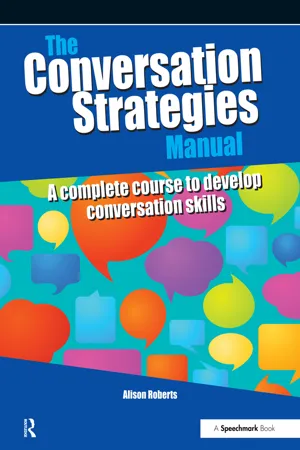
The Conversation Strategies Manual
A Complete Course to Develop Conversation Skills
- 192 pages
- English
- ePUB (mobile friendly)
- Available on iOS & Android
eBook - ePub
About this book
Some people worry about participating in social settings because they lack confidence in their conversation skills. They may dread an evening at the pub or even just a chat with one friend, for fear of saying the wrong thing, not being able to think of anything to talk about, or whether they will find themselves feeling generally embarrassed about their conversational technique. This book offers a structure to help with the skills needed for initiating, maintaining, and ending conversations. It looks at casual chat and formal talk with one person face-to-face and on the phone, as well as how to converse in a group. There are over 30 chapters, each dealing with an aspect of conversation such as Greetings How to remember names Being topical, Using humour Reminiscing Repairing conversational gaffs, Escaping! The Conversational Menu Each topic is considered and discussed; exercises are suggested; "homework" is given on credit-card-sized cards, and then the Checklist is filled in, so that learning is secure. This is a complete course on conversation skills. designed for people over 16, either to work with the Speech and Language Therapist, or for some, to work on their own. Alison Roberts is a Speech and Language Therapist whose work has chiefly focused for the last 20 years on the communication needs of 11-25 year-olds with a wide variety of intriguing differences in ability. She works with several brilliant therapists who together form a team called Good Communication. Alison lectures to SLT students and to Careers Advisers and has written several sets of cards and books which have been published by Speechmark Publishing. She is also an enthusiastic craftswoman with an endless need and desire to devise her own SLT games, which gave rise to the original series of articles in the Speech and Language Therapy in Practice magazine.
Information
1
Introduction
Social settings that require us to talk can feel unnerving to anyone. How will we greet people? What will we talk about? Will we be able to understand what they are talking about? In short, are we up to the task? Have we 'mastered the art of conversation' sufficiently to allow it to flow in a natural way?
Such doubts feed into almost everyone’s shyness at some time in their lives, but there are people who fear social settings so much that they will avoid socialising wherever possible. At the same time they can feel lonely or in need of a friend. For some people their preference for being alone far outweighs their desire to be sociable, but practice in the skills needed to talk can help to make conversations easier. There are, after all, some situations where conversation is expected and keeping quiet is not an option.
This book sets out ideas for analysing and recording conversational abilities in a transparent way, alongside the client; suggests strategies and exercises to help improve confidence in conversations; offers photocopiable homework reminders the size of credit cards for each aspect of conversation being addressed, and provides a photocopiable template for a progress journal to be filled in by both the client and the therapist.
Some activities suggested in the book aim to help with getting conversations started, others include looking at the value of conversational questions and the skills of keeping a conversation going or drawing it to a close. One chapter aims to be a morale and confidence booster, another looks at the conversational codes used in different social settings and one looks at the general structure of conversations.
The book is written with Speech and Language Therapists in mind, to use as an assessment and therapy tool with clients who struggle to use, or understand, conversation techniques. However, each chapter is addressed to the client so that they may use the book themselves and so that therapy can become a collaborative venture. For many clients the best way of working with this book will be to discuss each chapter with the therapist, work with the activities suggested, complete the homework for each chapter, fill in the journal and then revise with the therapist. Please read the next section, ‘Procedure’, for more details.
2
Procedure
Before you start
Please be aware of a key document in the Appendices: the Conversation Strategies Checklist (CSC), which is used both as a self-assessment tool and as a log for the client’s experiences and reflections. It is there to help maximise the effectiveness of therapy and self-help.
The log part of the form asks the client to observe others using the strategy in question, date the observation, include a comment and then make a note of the date when they used the strategy, adding another comment where possible. This log forms a rolling self-assessment that makes progress clear. It is kept by the client and reviewed by the therapist from time to time. It is designed to be used in addition to the homework ‘credit cards’, but it is, of course, for the therapist and client to decide jointly how therapy is to proceed; these are just tools to help you.
The aim will be to reassess towards the end of the period of therapy.
Identifying the problem areas
Many clients feel uneasy about holding conversations, but are not sure where in the process things go wrong or how they could improve their skills and confidence. It is helpful to gather information from the client, as well as further details perhaps from a family member, partner or friend, and add information from observation of the client within the clinical setting and, where possible, in other social situations.
Begin by working with the individual client. Have ready a photocopy of the CSC and together consider and fill in the self-assessment scale for each item. If the client is unsure, look at the relevant chapter for more detail and further discuss whether that is something they need to tackle.
Often the client’s own perspective gives sufficient information to pinpoint problem areas but sometimes they ask for the thoughts of others to be involved. Some clients prefer to fill in all or part of the CSC at home. The client and therapist should both keep a dated copy of the initial CSC results as a record of the baseline.
As work progresses the client may decide that they would, in fact, benefit from tackling some other aspects of conversation too. This information can be factored in later.
Where to start therapy
The CSC results may indicate that there are only a few areas requiring a lot of work, with other aspects of conversation just needing a little confidence-building. However, many clients like to work through all of the chapters from start to finish, and the first few chapters are often of interest to all clients; it has been found that working on them tends to raise confidence, and this helps the therapist to deepen their knowledge of the client's strengths and difficulties.
The order of the first chapters follows approximately the way a conversation proceeds – they are not necessarily progressive in levels of difficulty. Later chapters tackle specific areas of skill, and therapists and clients may want to pass a few sections by, to reach a particular aspect of conversation that is found to be difficult.
Please don’t feel constrained by the written order; it’s often a good idea just to ‘dip in’ here and there or to use the chapters in the way that meets the needs of your client.
Group therapy versus one-to-one
It is a good idea to encourage the client to participate in some group therapy sessions after the initial interview so that they can practise conversation in a more realistic setting, and may benefit fully from the suggested group therapy activities and games.
It would be a counsel of perfection to advise matching ages and types of client, but this is sometimes possible in a college setting. It is often found that working on aspects of conversation that were not on one client’s list but on that of another group member can still be a helpful exercise for all, for the following reasons: as affirmation of their own ability; to benefit from the feeling of being able to help another client; or to discover that they could in fact do with a little more practice in an area they thought they had fully understood.
Therapists and clients may feel that after a few group therapy sessions some individual appointments are needed again to review, reassess and agree upon the next steps.
It is not always possible to form a group, but therapy can still be very effective in the one-to-one setting. Motivation is often particularly high in older clients who attend on an individual basis but with some sessions enhanced by the occasional presence of a partner, family member or friend. Individual clients will need to make even more use of the CSC log to show how they are tackling the skills outside the sessions. As therapy progresses they will also make use of the homework cards and feed back on those.
Session activities and homework
Therapeutic activities aim to balance interactive and reflective work, so that therapy does not become boring. They are mostly designed for small groups, but many are for one client plus the therapist. In addition to the discussions, role play scenarios and other activities suggested in each chapter, there are the homework 'credit cards', designed to help generalise into daily life the work started in the clinical sessions. Clients should be encouraged to report back information on their homework experiences.
Final chapters
The last two chapters are general discussion points and can be used at any point in the therapy course, as a break from more intense work or as the last session before a holiday.
3
Greetings
Self-assessment questionnaire
On a scale of 1–10, where 1 is difficult and 10 is easy, how do you feel about greeting:
- just one friend of the same sex as you?
- just one friend of the opposite sex?
- a group of friends of the same sex as you?
- a group of friends of the opposite sex or a mix of males and females?
- new people in a familiar place, for example, at college/work?
- new people not 'on your territory' - perhaps in a pub or a waiting room?
“Hi!”, “Good morning!”, “Hello!”, “Good afternoon!”
Greeting a friend or family member whom you see every day can be comparatively easy – you may only need to give a small acknowledgement of their presence. But how will you greet several friends, work colleagues or fellow students at a break, or later at the pub? How do you tackle the greeting at the start of an interview? How do you manage the greetings that usually take place on the phone? What is the most appropriate way to greet a new girlfriend or boyfriend at an evening meal? Or his/her parents? How do you greet people at a sombre occasion or at a particularly happy one? How formal should you be or how casual?
A man I have met, who has Asperger’s Syndrome, and is an excellent speaker on the subject of living with the condition, mentioned at one of his talks that he has a particular difficulty in approaching doors. He worries that there will be someone else approaching the door from the other side at the same time. The following questions are among those that bother him about this situation:
- Should he make eye contact with the person?
- Should he greet them and if so what would be the appropriate greeting?
- How long should he talk with the person?
- Should he hold the door open for them if it's a woman? If it's a man?
His concerns reflect the worries experienced by many shy people and by those on the autism spectrum when they meet people, not just in the 'door situation', but generally, for example, just how do you arrange your face and say the words of greeting?
In this chapter we look at styles of greeting, planning your approach and some practical therapy activities.
Styles of greeting
Any greeting is primarily an acknowledgment of the other person and how we feel about their presence at that moment. It is usually considered to be rude not to make any acknowledgement of another person.
Greetings graded in order of warmth are discussed below, from the barest minimum where we merely recognise that the other person, a stranger, is there, to the level where we are so overjoyed to see a friend/loved one that we will give them a hug or even a kiss. Consider the following grades of greeting:
1 A complete stranger
Make brief eye contact with the other person or people, putting on a pleasant face, although not quite smiling. This means that you are showing that you know they are there, but are not intending to become involved in a conversation. (For more information on eye contact please see the chapter ‘Body language’.)
2 Someone you see from time to time, but haven't ever spoken to
Make eye contact and smile. This is a ‘warm but brisk’ greeting.
3 An acquaintance or someone you know slightly
Make brief eye contact, smile and say “Good morning” or just “Morning”, “Hello”, “Hi” and so on, and walk on swiftly. This indicates that you are quite pleased to see them, although you haven’t time to chat at the moment.
4 Someone you know a bit better
Make f...
Table of contents
- Cover
- Title
- Copyright
- Acknowledgements
- Contents
- 1 Introduction
- 2 Procedure
- 3 Greetings
- 4 Opening gambits
- 5 Introducing yourself
- 6 Remembering names
- 7 Mechanical rules
- 8 Formulaic interchanges
- 9 Formal and casual conversations
- 10 Body language
- 11 What are other people's interests?
- 12 Open and closed questions and invitations to speak
- 13 The www. technique
- 14 Choosing and introducing a conversation topic
- 15 Noticing, commenting and making polite observations
- 16 The Social CV.
- 17 Using humour
- 18 Compliments
- 19 Criticism and complaints
- 20 Reminiscing and reflecting
- 21 Being optimistic
- 22 Being positive about other people
- 23 Argument, making a point and detachment from your opinions
- 24 Apologies and repairing conversational 'gaffes'
- 25 Escaping!
- 26 Electronic conversations
- 27 Eavesdropping
- 28 Conversation at parties and special occasions
- 29 The conversation 'menu'
- 30 Sayings and points to consider about conversations
- Appendices
Trusted by 375,005 students
Access to over 1.5 million titles for a fair monthly price.
Study more efficiently using our study tools.
Frequently asked questions
Yes, you can cancel anytime from the Subscription tab in your account settings on the Perlego website. Your subscription will stay active until the end of your current billing period. Learn how to cancel your subscription
No, books cannot be downloaded as external files, such as PDFs, for use outside of Perlego. However, you can download books within the Perlego app for offline reading on mobile or tablet. Learn how to download books offline
Perlego offers two plans: Essential and Complete
- Essential is ideal for learners and professionals who enjoy exploring a wide range of subjects. Access the Essential Library with 800,000+ trusted titles and best-sellers across business, personal growth, and the humanities. Includes unlimited reading time and Standard Read Aloud voice.
- Complete: Perfect for advanced learners and researchers needing full, unrestricted access. Unlock 1.5M+ books across hundreds of subjects, including academic and specialized titles. The Complete Plan also includes advanced features like Premium Read Aloud and Research Assistant.
We are an online textbook subscription service, where you can get access to an entire online library for less than the price of a single book per month. With over 1.5 million books across 990+ topics, we’ve got you covered! Learn about our mission
Look out for the read-aloud symbol on your next book to see if you can listen to it. The read-aloud tool reads text aloud for you, highlighting the text as it is being read. You can pause it, speed it up and slow it down. Learn more about Read Aloud
Yes! You can use the Perlego app on both iOS and Android devices to read anytime, anywhere — even offline. Perfect for commutes or when you’re on the go.
Please note we cannot support devices running on iOS 13 and Android 7 or earlier. Learn more about using the app
Please note we cannot support devices running on iOS 13 and Android 7 or earlier. Learn more about using the app
Yes, you can access The Conversation Strategies Manual by Alison Roberts in PDF and/or ePUB format, as well as other popular books in Education & Education General. We have over 1.5 million books available in our catalogue for you to explore.