- 208 pages
- English
- ePUB (mobile friendly)
- Available on iOS & Android
eBook - ePub
Functions of Two Variables
About this book
Multivariate calculus, as traditionally presented, can overwhelm students who approach it directly from a one-variable calculus background. There is another way-a highly engaging way that does not neglect readers' own intuition, experience, and excitement. One that presents the fundamentals of the subject in a two-variable context and was set forth in the popular first edition of Functions of Two Variables.
The second edition goes even further toward a treatment that is at once gentle but rigorous, atypical yet logical, and ultimately an ideal introduction to a subject important to careers both within and outside of mathematics. The author's style remains informal and his approach problem-oriented. He takes care to motivate concepts prior to their introduction and to justify them afterwards, to explain the use and abuse of notation and the scope of the techniques developed.
Functions of Two Variables, Second Edition includes a new section on tangent lines, more emphasis on the chain rule, a rearrangement of several chapters, refined examples, and more exercises. It maintains a balance between intuition, explanation, methodology, and justification, enhanced by diagrams, heuristic comments, examples, exercises, and proofs.
Information
Publisher
Chapman and Hall/CRCYear
2017Print ISBN
9781584881902
9781138417762
Edition
2eBook ISBN
9781351990226
1
Functions from R2 to R
Summary. We introduce the problem of finding the maximum and minimum of a real-valued function of two variables. The one-dimensional theory suggests that we discuss the problem for functions defined on open sets and their boundaries. We define open sets, consider a possible definition of the derivative and define the graph of a function of two variables.
In this course we will discuss all possible functions which involve two variables and so look at functions from R2 into R, from R into R2 and from R2 into R2. We begin by considering functions from R2 into R and our objective is to obtain methods for finding maxima and minima. If the functions are arbitrarily behaved we get nowhere, so we have to make some assumptions—we will use the general term regularity conditions—on the functions considered. These regularity conditions usually relate to continuity and differentiability. First, however, we try and see, based on our one-dimensional experience, how we might proceed and then return to look more closely at what we need in order to proceed. The main one-dimensional motivation is the following fundamental result.
Theorem 1.
If f:[a, b] → R is continuous on the closed interval [a, b], then f has a maximum and a minimum on [a, b].
In other words there are two points in [a, b], x1 and x2, such that
for all x in [a, b].
The function f has a minimum value f(x1) which is achieved at x1 and a maximum value f(x2) which is achieved at x2 (Figure 1.1). Both the maximum and minimum are finite. The maximum (or minimum) may appear in two ways:
- (i) it may occur at a point inside [a, b], i.e., in (a, b) or
- (ii) it may occur at a boundary point, i.e., at either a or b.
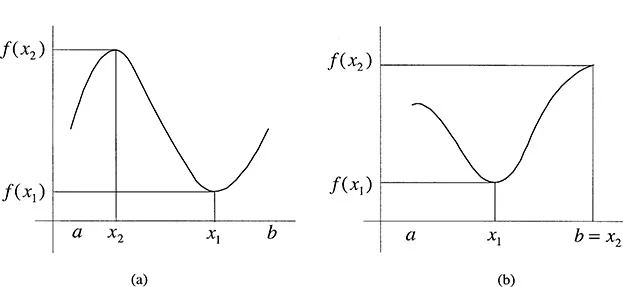
Figure 1.1
In Figure 1.1(a) we see that possibility (i) occurs for both maximum and minimum, while in (b) possibility (ii) occurs for the maximum and possibility (i) occurs for the minimum.
If f is differentiable on (a, b) and the maximum occurs inside, then we have f′(x2) = 0 so our method of proceeding in this case is to look at all x in (a, b) where f′(x) = 0. We call these the critical points of f. There is usually only a small number of critical points so we can evaluate f at these points. This takes care of all possibilities inside and since there are only two other points—the end points a and b—we can find f(a) and f(b) and locate the maximum by choosing which one of this small set of possibilities gives the largest value of the function.
If we are now considering a functio...
Table of contents
- Cover Page
- Title Page
- Copyright Page
- Dedication
- Preface
- 1 Functions from R2 to R
- 2 Partial Derivatives
- 3 Critical Points
- 4 Maxima and Minima
- 5 Saddle Points
- 6 Sufficiently Regular Functions
- 7 Linear Approximation
- 8 Tangent Lines
- 9 Method and Examples of Lagrange Multipliers
- 10 Theory and Examples of Lagrange Multipliers
- 11 Tangent Planes
- 12 The Chain Rule
- 13 Directed Curves
- 14 Curvature
- 15 Quadratic Approximation
- 16 Vector Valued Differentiation
- 17 Complex Analysis
- 18 Line Integrals
- 19 The Fundamental Theorem of Calculus
- 20 Double Integrals
- 21 Coordinate Systems
- 22 Green’s Theorem
- Solutions
- Index
Trusted by 375,005 students
Access to over 1.5 million titles for a fair monthly price.
Study more efficiently using our study tools.
Frequently asked questions
Yes, you can cancel anytime from the Subscription tab in your account settings on the Perlego website. Your subscription will stay active until the end of your current billing period. Learn how to cancel your subscription
No, books cannot be downloaded as external files, such as PDFs, for use outside of Perlego. However, you can download books within the Perlego app for offline reading on mobile or tablet. Learn how to download books offline
Perlego offers two plans: Essential and Complete
- Essential is ideal for learners and professionals who enjoy exploring a wide range of subjects. Access the Essential Library with 800,000+ trusted titles and best-sellers across business, personal growth, and the humanities. Includes unlimited reading time and Standard Read Aloud voice.
- Complete: Perfect for advanced learners and researchers needing full, unrestricted access. Unlock 1.5M+ books across hundreds of subjects, including academic and specialized titles. The Complete Plan also includes advanced features like Premium Read Aloud and Research Assistant.
We are an online textbook subscription service, where you can get access to an entire online library for less than the price of a single book per month. With over 1.5 million books across 990+ topics, we’ve got you covered! Learn about our mission
Look out for the read-aloud symbol on your next book to see if you can listen to it. The read-aloud tool reads text aloud for you, highlighting the text as it is being read. You can pause it, speed it up and slow it down. Learn more about Read Aloud
Yes! You can use the Perlego app on both iOS and Android devices to read anytime, anywhere — even offline. Perfect for commutes or when you’re on the go.
Please note we cannot support devices running on iOS 13 and Android 7 or earlier. Learn more about using the app
Please note we cannot support devices running on iOS 13 and Android 7 or earlier. Learn more about using the app
Yes, you can access Functions of Two Variables by Sean Dineen in PDF and/or ePUB format, as well as other popular books in Mathematics & Calculus. We have over 1.5 million books available in our catalogue for you to explore.